


Eric Slick has never boxed himself into just one corner of the live-music world. As a young musician growing up in Philadelphia, he played drums for the Zappa offshoot Project/Object and prog-rock hero Adrian Belew. Then, after a chance encounter at Bonnaroo, he officially joined local heroes Dr. Dog and remains a key part of that beloved post-jam indie-Americana group to this day. He’s also a respected songwriter and established solo artist, where he is able to showcase his Leonard Cohen-indebted vocals and guitar work, and plays drums for trending, roots-leaning indie-rockers like Kevin Morby and Waxahatchee. Plus, he has ties to the jamband world too,describing Joe Russo as a mentor.
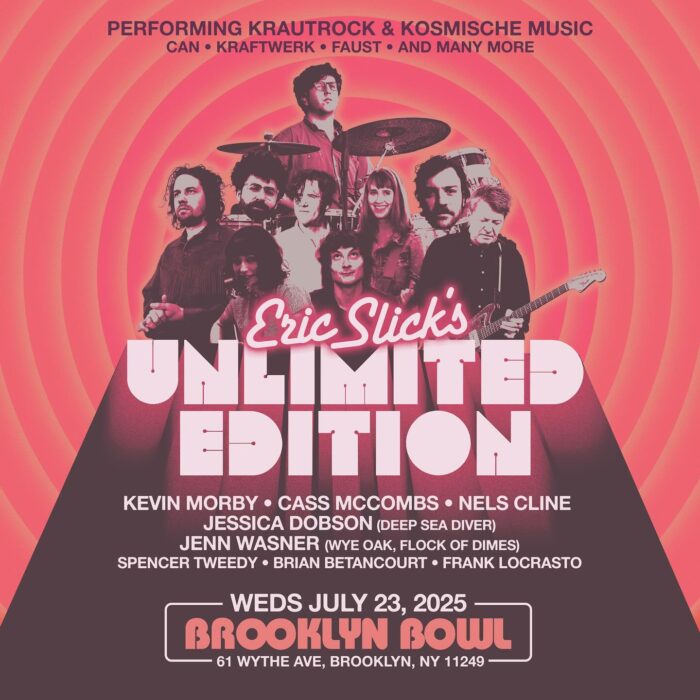
And, on Wednesday, July 23 at New York’s Brooklyn Bowl, Slick will turn his attention to yet another form of experimental music, Krautrock and Kosmische Music. Billed as Unlimited Edition, the two-set show will celebrate the music of CAN, Kraftwerk, Faust and many others, featuring Slick on drums and a core band consisting of Spencer Tweedy (Waxhatachee, Tweedy), Brian Betancourt (Benjamin Booker, Kevin Morby) and Frank Locrasto (Fruit Bats). Staying true to the club’s ethos and jamband spirit, a cross-genre mix of big-name players are slated to join in during the night as well, including Kevin Morby, Cass McCombs, Nels Cline, Jenn Wasner (Wye Oak, Flock Of Dimes), Jessica Dobson (Deep Sea Diver), Sinkane, Skyler Skjelset (Fleet Floxes) and Andy Molholt (Speedy Ortiz). (For those already committed to seeing another improvisational band at Forest Hills in Queens, N.Y. that night, Slick mentions their show will go later.)
Here, the Nashville-based drummer discusses his gateway into Krautrock, connection to Unlimited Edition’s marquee names and how an offer to play Blues Traveler’s “Hook” led him to his current endeavor.
Let’s start with the original idea for Unlimited Edition. What inspired you to put together this all-star lineup, paying tribute to CAN, Kraftwerk, Faust and some of the oft-overlooked Krautrock bands?
Basically, when I did the Relix 50th anniversary celebration in January, [then-Brooklyn Bowl talent buyer] Lucas [Sacks] came up to me after the show and, in passing, said, “Hey, if you ever wanna do something here, just let me know.” And I was really taken aback by that in a good way. I was like, “You want me to do something here?” And then I started thinking about it and I was like, “Well, I could do a Zappa night because that was a huge part of my musical upbringing.”
But then the more I thought about it, the more I was like, “That’s gonna be a ton of work because Zappa’s music is extremely complicated and requires a lot of charts. So maybe there’s something else I can do that’s a little bit more open-ended.” Joe Russo, who is basically my mentor, has got the Dead thing covered, so I knew I didn’t need to do any Dead music. But I thought, “Well, what else is kind of open-ended and jammy but maybe a little bit more out there?” And then I thought about Krautrock, and I thought about all this music that I love. I’m such a massive fan of all that music, like CAN, Kraftwerk, Faust and Amon Düül II—all these bands that I grew up listening to in my late teens/ early 20s. And I’ve never really gotten an opportunity to play any of it live. I was like, “Wait a second, all those songs are kind of jams—they are all 10-to-20 minutes long. We could really ride that out and make it super unique and different and fun. And that got me really excited. So then, when I came back to Brooklyn Bowl, they were just like, “Yes, let’s do that.”
Before we dive deeper into Krautrock, I wanted to touch on the Relix 50 party for a second. You are known for your fun ‘90s rock covers and you sang Blues Traveler’s “Hook” at that event, which was a highlight for many. How did you land on that song, which represented a particular moment in the ‘90s jam-rock scene?
Well, the Blues Traveler thing came up so last minute because we really didn’t know what kind of tune I was gonna do and then [Real Estate and Taper’s Choice bassist Alex] Bleeker, who was one of the people putting the setlist together, was just like, “Hey man, do you wanna sing ‘Hook?’” And I was just like, “Wait, what? Yes, sure!” It’s very funny that “Hook” led me to do an avant-garde Krautrock jam show, but here we are, and that’s the world we live in now.
You have quite an impressive list of guest musicians for the show. Who were some of the first people you reached out to for the gig?
At first, I started to think about who in my immediate musical circle would be a good fit for this and, initially, I had reached out to Glenn Kotche from Wilco, but those guys are so busy this summer that he politely declined—the same with John Stirratt, Wilco’s bass player. So I thought, “If I can’t get Glenn, then maybe I can get Spencer Tweedy? He’s next in line, right?” And Spencer’s also a near-and-dear friend of mine. So once Spencer was involved, I started thinking that we could do double drums—that would be really captivating for a locked-group thing. Then I started thinking about bass players who have a really hypnotic groove and Brian Betancourt came to mind. [Betancourt plays with Kevin Morby and Benjamin Booker, among others]. And then [Fruit Bats’] Frank Locrasto is probably one of my favorite keyboard/synthesizer players in the universe. So the fact that those three guys were available itself was so exciting. That’s the core of the band for the night.
To take a step back, you mentioned that Krautrock was a big part of your musical upbringing in your late teens and early twenties. For readers who mostly know you from your work with Dr. Dog and your solo records, that might initially be a bit surprising. What was your getaway into that world?
Early on, I was playing in a Frank Zappa tribute act called Project/Object—that was with Zappa alumni, like Napoleon Murphy Brock, who was in Zappa band from 1972 until 1976. Don Preston, one of the original members of Mothers of Invention, was also in the band. So I had a real deep prog-rock foundation. And then, of course, I started playing with Adrian Belew, a phenomenal guitar player who played on a ton of different stuff, including Talking Heads’ Remain in Light and with King Crimson. He spans across pop generations—he’s played on so many different records. But then in my early twenties, I started getting into all different kinds of stuff. I joined Dr. Dog, and I remember exactly where I was the first time I heard CAN. I was at this venue called Time in Philly, and I was playing with my friend Michael Johnson, who is an amazing musician. He has a band called Ape School, and “Vitamin C” by CAN was playing over the speakers. I was like, “What is this?” And he looked at me and was like, “Are you serious? You don’t know CAN?” He gave me this incredulous look and I was like, “I guess I should dive into the discography.” I just went down a rabbit hole with all that stuff and started listening to everything I could get my hands on. It was such a cool thing to discover, even a bit later on. You’d think I would have discovered it earlier playing all the prog rock festivals and psychedelic festivals that I did but, for whatever reason, it never came across my plate—or maybe I wasn’t even ready for it.
Earlier you mentioned Joe Russo, and you also have roots in the extended jamband world. Of course, groups like Phish, Disco Biscuits and Umphrey’s McGee often cite Zappa and the prog scene as an influence. For someone who is not quite familiar with Krautrock music, how would you describe that style in relation to the Grateful Dead-rooted jamband world? It’s very much the opposite side of the same coin—the long, improvisational passages that the Bay Area jam scene was known for back in the day.
And I think that a lot of the influences are actually the same. When you read about like how Phil Lesh was really into Stockhausen, so were CAN. There was a common thread between people at that time, who were getting into things like tape manipulation. The American version of that was the Dead and the German version was Krautrock. It’s still
hippie music, but it’s presented in a slightly different way. But they’re both expansive and both require improvisation and both require virtuosic playing. Krautrock’s a little bit more reserved or monotonous. It’s also interesting that both of those styles were such an influence on some of the songwriters I’m into, like Wilco. “Spiders (Kidsmoke),” from A Ghost is Born, is a clear homage to Krautrock with its locked-groove thing. So it’s all part of the same thread.
I’d say that A Ghost is Born was both a gateway to Krautrock for many indie-rock and Americana music fans and a gateway to Wilco for many fans of guitar-rock and jam music, given the shift in style from their earlier alt-country sound and Yankee Hotel Foxtrot. And, of course, that set the stage for the current, longstanding Wilco lineup. Moving on to your show, you have a number of big-name artists joining you, one of which is Wilco’s Nels Cline. Another is Kevin Morby, who you play drums with regularly. When did you approach them about being part of the night?
With Kevin, there’s some obvious reasons. We’re both going up to Newport the next day, so it was like, “Well, Kevin’s already gonna be there, so I might as well rope him into this.” I met Kevin at The Last Waltz tribute at The Capitol Theater in 2014, and we’ve just remained friends ever since. And then, around 2022, when his record This is a Photograph came out, we sort of rekindled our friendship and realized how much we had in common and how close we actually were. It was kind of like that moment in Step Brothers when they were like, “Holy shit, did we just become best friends?” Kevin and I have so much so much in common in terms of what we like musically, and I started touring with him in 2023. Even when we were working on his music, we would talk about Krautrock a lot, especially in regards to the extended jam sections of his shows, where it’s Krautrock-meets-Pharoah Sanders. [Longtime Dap-Kings member and Robert Walter’s 20th Congress alum] Cochemea, who plays sax with Kevin, is very much schooled in that world, and we’re trying to like meld those two worlds together. So Kevin was an obvious choice. He was also in the band Woods, and they’ve got songs that are complete like Krautrock jams, where they’re riding out one chord for 10 minutes. So Kevin’s very familiar with the language via playing in that band.
Cass McCombs was another person that I met at The Last Waltz tribute that we did. Joe and Marco [Benevento] were part of it as well, and I remember seeing Cass for the first time live and realizing that he’s a total Grateful Dead fan—I actually, met Kevin, Cass and Nels doing that Last Waltz show. I had been listening to Cass’ records and I did not even put it together, until I saw him live, that he was into the Dead. I also noticed that he has a real motoric-Krautinfluence in his songs, where he’s playing one chord for a long time and singing one lyric over and over and over again, and I was like, “He’s into this sort of transcendent, locked-group thing, too.”
And then with Nels, if you put him on anything, you know it is going to be transcendent.
Kevin and Cass represented the songwriter side of things, and Nels is on the wild improvisation side. I just know from playing with him a couple times that he’s really capable of anything. And his playing is always really surprising—he’s one of my favorite guitar players because he doesn’t make the guitar sound like a guitar. So I feel like he’s the perfect fit to be there and just like take it to that next.
I also wanted to represent women, too, so I was like, “OK, Jessica Dobson from Deep Sea Diver is one of my other favorite guitar players, and so is Jenn Wasner from Wye Oak,” who also played guitar for Bon Iver. Jen’s playing is so textural and beautiful. It’s a nice counterpoint to Nel’s style. Jessica is somewhere in between. We can do the big, crazy guitar thing but then we can also do these really beautiful, textural pads and then, of course, have more options for vocals—they’re both incredible vocalists, too, and great songwriters in their own right. It’s an embarrassment of riches.
You and Spencer will be playing drums together at the Bowl, which is fitting since you have both held down the drum seat for some of the same artists in the Expanded Kevin Morby/ Waxahatchee Universe.
Spencer is an amazing drummer and part of the whole Waxahatchee scene, so it’s all connected. And Spencer is a student of this music as well. I just know that everybody who is there is going to get it and know how to approach it with extreme confidence but also patience. This music is very open-ended and patient and I really want the show to kind of build to a crescendo. I feel like all the musicians that are on board are just amazing at that.
Given both the breath of the material you are honoring and the mix of players involved, how do you envision the flow of the night as you build to that crescendo?
Definitely two sets—the way that I’m thinking about it is that it’ll just start sort of build, chronologically speaking, because I wanna tell the story of the beginnings of Krautrock and then I also wanna include some songs that people don’t expect, some things that are maybe newer, or that aren’t considered classics, to show the evolution of the music and how it has influenced people. That’s the goal of the show—Kevin and I have talked about what modern songs we are going to do that can help tie this whole thing together. The idea is to tell a story and then, also, I really don’t want it to necessarily just be guest artists coming up and doing a song and then leaving. I want it to be loose and shambolic. When you watch CAN performances, they’re weaving in and out of songs and things are just constantly moving. To me, that is a jam format—every Dead bootleg you listen to has surprising transitions and then these [moments] that are expected but that people still like—“China Cat Sunflower” into “I Know You Rider.” But I do think it’ll be cool to keep people on their toes and let them just vibe out. That’s the whole point. It’s going to be going late, so if we get some people coming over after [Phish play at Forrest Hills in Queens, N.Y., nearby], then I’d be pumped.
Last year, you released a solo album, New Age Rage. You have quite a busy year ahead of you, between tours with Kevin Morby and some Dr. Dog dates, plus session work. Are you working on another solo record as well?
It’s 95% done, so it just needs to be mixed and I have to do a couple more overdubs, but it’s pretty much ready to go, and it’ll probably be out at the top of next year. I’m just kind of gearing up for my crazy rest of the year. The beginning of the year was really slow, and then once May hit, it was just insanity. I’m mostly just prepping for those Dr. Dog dates and then, after that Dr. Dog run is done, I’ll move into the Unlimited Edition stuff but then also play with Kevin Morby at Newport Folk. Then I’m doing a doing a fall run with Kevin, a benefit with Billy Martin and there’s Dr. Dog stuff the rest of the year, too. It’s now hitting me how much I need to prepare. With Dr. Dog, we don’t play that often anymore, but it’s riding a bike. I’m really looking forward to seeing everybody. My favorite part of getting back together is talking and hanging out with everyone. Forest Hills is gonna be a blast and then we’re gonna do Red Rocks and a couple more shows this year. We are keeping it pretty chill and then we’ll probably go into the studio next year—that’s my guess anyway.
Though you have been a member of Dr. Dog for 15 years, you had your first lead vocal with the band on a song you wrote, “Tell Your Friends,” on 2024’s self-titled album. You also sang that song with Dr. Dog at The Mann in Philadelphia last year and, judging by your social media posts, it seemed like a big moment.
It was incredible. It was the best moment of my life because that was where I saw my first show. So it was a really eerie, full-circle moment of just being like, “Holy crap, I went here when I was two years old to see a Ringo Starr and now I’m a drummer who is taking center stage to sing this song I wrote.” It was truly surreal.
Ringo was my first full show, though technically the first show that my parents ever took me to was Todd Rundgren, which also means a lot. But Ringo was my first full in-concert show. That first Todd Rundgren show I saw was him with a bunch of backing tracks playing synthesizers, and I was like two months old, so I have no recollection of it. But the Ringo show also had Levon Helm and Jim Keltner on drums, which had a subconscious effect on me.

2 Comments comments associated with this post
Eric Slick Adds Sinkane, Fleet Foxes' Skyler Skjelset and More to Unlimited Edition Lineup
July 20, 2025 at 9:32 am[…] of the concert, Slick spoke with Jambands.com, striking a comparison between jam stalwarts the Grateful Dead and CAN’s Krautrock canon, as well […]
Eric Slick Adds Sinkane, Fleet Foxes' Skyler Skjelset and More to Unlimited Edition Lineup
July 20, 2025 at 9:31 am[…] of the concert, Slick spoke with Jambands.com, offering a comparison between jam stalwarts the Grateful Dead and CAN’s Krautrock canon, as well […]