



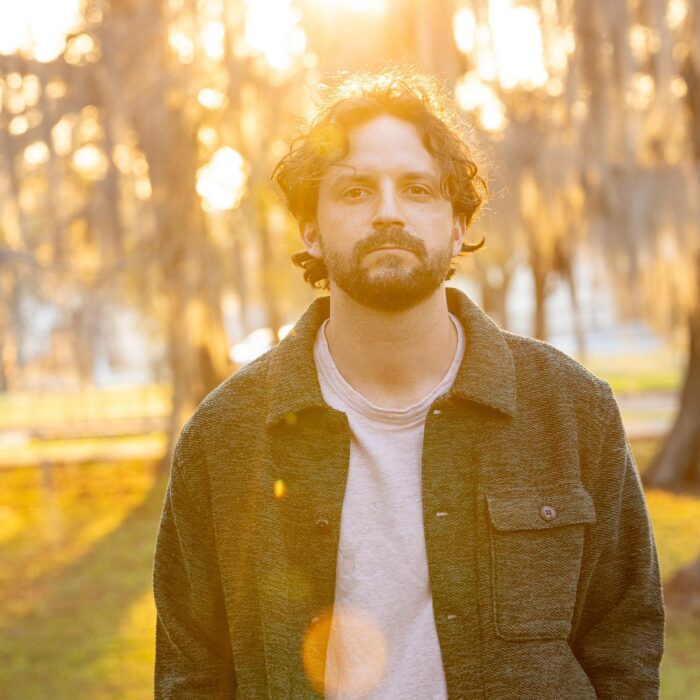
Photo by Hunter Holder
***
“Part of what held me up from doing this sooner was a lack of confidence as far as my singing—it took me continually putting myself out of my comfort zone and doing these shows to get more comfortable and that’s helped me became a little less blocked up and self-conscious with my songwriting,” The Revivalists co-founder and guitarist Zack Feinberg says, as he traces the origins of his nascent solo project and its accompanying debut album, Call It a Miracle, which collects original material he has been chipping away at for, in some cases, close to two decades. “There was the pandemic and, in 2021, I had twins, so that’s occupied a large space in my life. With the band going, I never carved out the time to do this, but a friend of mine in New Orleans kept encouraging me. I said, ‘I’m nervous,’ and he said, ‘That’s where the good shit is—that’s where the growth is.’”
After The Revivalists wound down from the release of 2023’s Pour It Out into the Night, Feinberg started honing in on the long-gestating project in a “fairly DIY way,” working off old demos at home, linking up with collaborators like Louque and Kristin Diable. The guitarist also continued to workshop his material live over the past few years, sometimes with the help of his Revs bandmates, allowing him to explore his original material in a mix of settings.
During a brief pause during Jazz Fest, as The Revivalists prepare to release their next studio set, Get It Honest, in July, Feinberg looked back on the lessons he’s learned from saying yes to the many opportunities that have recently come his way.
Let’s start by talking about your solo music. You released your debut, Call It a Miracle, in 2025. After years of writing songs for The Revivalists, what finally made you decide to take the next step and put out a record under your own name?
I’ve been writing music for a long time and part of what held me up from doing it sooner was a lack of confidence as far as my singing. It just took a while of continually putting myself out there with some shows and stepping out of my comfort zone to where I was doing that, but it helped me get more comfortable and confident with my singing. I also think that helped get my songwriting to become less blocked up and self-conscious. Singing is not my strong suit—I consider myself a guitarist-songwriter because I’m reluctant to say singer-songwriter—and it took me a while to get over that. I had all this material that’s been accumulating over what’s now almost 20 years and these songs that have stuck with me. And I felt like, “These songs deserve to be heard.”
So I wanted to put them out, but then there was the pandemic and I had kids—I had twins in 2021—and that occupied a large space of my life. And before that, with the band going, I didn’t carve out the time. But, [in 2023], we put out a big Revivalists release, Pour It Out into the Night, and then there was a time when we were just touring behind it. So I felt like, “OK, now is the time to carve out some time and do this.” So I did it in a fairly DIY kind of way at my house over the last few years. A lot of it was based on demos from many years ago that I made in my former house.
I worked on it with Mack Major—he’s a good friend of mine from New Orleans and an awesome engineer. I went over to his house a lot and we did two days at a studio in New Orleans and put it all together.
After testing the waters with some solo shows, was there a certain song that you wrote or a performance where you finally made the decision to jump in with two feet, or was it a more gradual realization that now was the time?
At a certain point, I did say, “Let’s do this.” A friend of mine in New Orleans encouraged me by saying, “You’ve got these tunes, step out of your comfort zone.” I was like, “Oh, man, I’m nervous.” And he was like, “That’s where the good shit is, man. That’s where growth happens.” And that’s the truth.
So really, with this whole solo project, I’m just saying yes to everything and it’s humbling in a lot of ways, but it’s awesome. I’m afforded a lot of great opportunities and privileges because of my association with The Revivalists and that work, which I’m grateful for. But then I also welcome the experience of being humbled. I find that music is continually humbling at all levels. Even the Rolling Stones, when they play a new song, you see the mass exodus to the bathroom. Or, when you are in the studio and you’re not getting it, you have to accept that you need to re-approach how you’re doing something. It’s about listening to what’s going on around you. With this, I welcome going out there, trying my best, sometimes falling short and just continually improving because the only way to get better is through experience. So I’m saying yes to as many shows as I can that are coming my way and I’ve been open to all of these experiences.
Though this project has been fairly DIY, as you mentioned, you have had a few special opportunities from the beginning to present this music in a way that has been a little less lowkey. One of those moments was when you performed with The Louisiana Philharmonic Orchestra at The Jazz Market last year. How did that collaboration come to be and how did you feel your homegrown music translated when placed in an orchestral setting?
It was crazy. At my first solo show, two years ago now, my friend Amanda Bohren was there, and she came up to me after. She works for the Louisiana Philharmonic Orchestra, and we started talking. She said the show was great, and that they’d love to have me do something with the orchestra. I was like, “Oh, yeah, sure.” It was one of those things where I thought she was just being nice, and I’m like, “This isn’t real.” But then, sure enough, she sent an email about it and I was like, “Oh, shit, I’m definitely in.” So she paired me up with an arranger who’s an orchestra member who plays viola and we worked it out over four or five sessions. He’d come over, we’d pick the songs and he would have ideas based off of things in the song—guitar parts or something—and then he’d add these amazing arrangements.
It was a 30-piece orchestra, which is a very different experience, especially because, at that point, my solo shows didn’t even have super-solid arrangements as far as how long little sections would go. And if you have 30 people tied to a piece of music, you have to be locked in as far as, like, how long everything is. With The Revivalists, we don’t play with tracks, and here we have 30 real humans that can’t deviate from [the score], so it was an undertaking and super challenging and another thing that was way out of the comfort zone. But it was also beautiful, and it was really rewarding. I only had one huge major fuck up during it, where we totally fell off, but I chalked it up as a win.
The material on Call It a Miracle was written over an extended period of time, during which you experienced a ton of growth as an artist and individual. When it came time to put the album together, did you find that there were certain threads that held the songs together?
There’s definitely an acoustic, folky singer-songwriter strain throughout this—this acoustic finger-picking sort of strain. I write a lot like that and it’s one of my favorite things to do on the guitar—it’s a strain that lumps a lot of things together, stylistically and aesthetically.
There’s this one song that’s very different called “Elodie” that’s written on a cigar box guitar, where I do this finger picking with my right hand, so it sounds like there’s a lot going on. So I would say that “Elodie,” as well as “Rolling in the Moss” and “Common Thread,” all have this hypnotic, finger-picking thing going on. I’ve been writing songs like that for a long time.
“Moonlight Graham” is a song that I wrote when I was 21, and it has this Americana vibe. A little background on that one: Moonlight Graham is a real person who was a character in the movie Field of Dreams and the book, which is based on Shoeless Joe Jackson and his story, which is a true story. He was a minor league baseball player that got called up to the big leagues at long last, but he doesn’t get in an “at bat.” He played an inning and a half or something in the outfield.
At the time that I wrote it, I was a very young man getting started with The Revivalists. I was like, “Oh, wow, I’m pursuing this dream and it might not work out, but it’s going to be really cool to have this experience, even if it doesn’t work out.” There was this gratitude practice—an early attempt at a gratitude exercise—in that song. And, aesthetically, that feels like it’s in a similar place to a lot of these other songs. There are all these earthy songs. There’s a little bit of a rock edge on some of them, but I feel like the more rock ones generally fit better in The Revivalists. So the more chill ones that didn’t get picked up for The Revivalists stuff all fit together here. And even the more up-tempo songs on the album, or fairly rocking ones, still fit in here because they are all coming from me, and they all represent real, significant things in my life over the last 15 years.
It must be interesting to look back on a song you started writing early on, when you didn’t know what the future was going to hold for you as a musician, especially given all the experiences the band has had collectively and the numerous times you yourself have been at bat since then. How far along was that number when you pulled it out for this project?
So that song was fully written a long time ago. The guys in the band liked it. But we never cut it and no pun intended, I’m not gonna go to bat too hard for something. After a while, it either comes up or it doesn’t. But the songs and stories that stick with you stick with you because they’re significant, one way or another. There are a million ways for music to be good. It could be an emotion or a vibe.
I did this acoustic show at this hotel here in New Orleans called The Chloe, and I busted out a very old Revivalists song that I wrote with David [Shaw] called “Straw Man,” and I was like, “I still like this song.” I was in my early 20s when I wrote that, but I remember what I was sort of reckoning with and what I was going through. It’s not super obvious. It’s not necessarily an incredibly well executed concept of a song—there’s a concept, but it’s not super clear—but that’s also cool. There’s some depth and mystery in it. And that’s attractive, and I dig it—I wrote differently back then. So it’s cool to look back and revisit something if you are still into it. It’s liberating in a way, too, because when you look at something and how you wrote when you were younger, you [realize that you] weren’t even thinking as much along the lines of the ways that you thought something had to be done. So it’s a reminder that there’s no rules when it comes to making music.
Looking ahead, you have a solo show coming up at the end of a busy few weeks during Jazz Fest. How do you plan to present the music during that gig?
So Saturday, May 2, at NOLA Brewing, I’ll be doing a free show, and it’s going to be a trio with George Gekas, from my band, on bass and Isaac Eady [from Tedeschi Trucks Band] on drums. The drummer that I typically use, David Shirley, is not available, so I was like, “Well, I don’t know if I’m gonna do it,” but I was like, “You know, if Isaac’s available, I’ll do it with him.” And he was like, “Sure, I’m in.” [Tedeschi Trucks Band will perform at the New Orleans Jazz & Heritage Fairgrounds the next day.]
We all met Isaac in 2011 or something like that. He was playing in a band out of Pensacola called Hotel Oscar. I think he was living in Destin at the time, and his first role in the band wasn’t the drum set—it was auxiliary percussion and keyboard. But we were already like, “Oh, this kid’s awesome.” And then they eventually had him take over on drums. We did some shows with them in Key West, and we even did an after-party with them after one of those shows. So we’ve really just been friends since then, and I did a brief side-project gig with him and Michael Girardo from our band in 2014, and we just had a great connection. I’ve admired his playing forever and I actually remember when he was thinking about moving to New Orleans and I walked around with him and showed him Frenchman Street and some places.
He had like a regular gig on Bourbon Street for a long time. So, at this point, we are old friends and I’ve just admired him for a long time and his solo stuff is outstanding. I’ve never played in this context with him before, but we go way back and he’s an incredible, unreal musician.
You are George have been playing together since college and have truly grown up together as musicians in The Revivalists. How do you feel his style shines in the context of a trio?
George is a great bass player and he’s really good for that setting because he likes to play, he likes to take up space, which works really well in the trio setting. He’s supportive, but it doesn’t feel like it’s lacking to me. Also, from a personal standpoint, there’s really just been an outstanding growth in his personality and character in the past five or six years, and to see that has been really cool. He’s matured and been super healthy. He’s been sober and he’s just been a great vibe—not that he wasn’t before, but it’s just been really nice to see. All the friendships in the band, at this point, are really strong. We go back a long time. Everybody knows each other’s shit, good and bad. And there’s a level of acceptance and care that’s really cool.
I started doing a couple of these shows as a trio when we were traveling in the fall—I’d add them between dates with the band—and I’ve really enjoyed playing in that format. It leaves a lot of space to move the ship quickly in a different direction. It’s kind of like a hybrid between a power-rock thing and a singer-songwriter set. I like to ramble and do a little stand-up adjacent bantering, too.
It’s been about a year since you released Call It a Miracle. How have you felt the experience of playing in this smaller format is impacting your approach going forward and do you plan to continue to do solo sets while the band gears up for a new album cycle?
I’ve been peppering in little opportunities because The Revivalists were touring pretty heavily. We had the 10-year Men Amongst Mountains tour, and I did a few things during that with some of the guys between there.
As soon as I released this album, we were in the studio for three weeks for The Revivalists. It’s all part of this; it’s all serving the same sort of thing, which is working on music and trying to share that and spend my time doing that as much as possible. I’ll continue to look for opportunities to pepper shows in as this year goes on as well.
I haven’t done like a ton of them, maybe I’ve done 10 or so in the last year. But I’ve found that, since I’m kind of saying yes to everything, I’ll try all of these different settings. Maybe I’ll do a solo acoustic set or two, or I’ll do a set with just me or George or just me and a piano player. And I’ve found that, since I’m not being particularly selective about it, and since I just wanna go out there and present the material and just see what happens, it’s just about the experience of sharing music. I’m not really being precious about the presentation.
In the beginning, it was more like, “OK, this is a singer-songwriter thing. It’s gonna be quiet, it’s gonna be in a listening room.” Now, I’m conforming to the room a little more and just playing to what serves the space and it’s been awesome. I did a theater on the north shore in Mandeville, and it was a super-attentive crowd, but they wanted the rock moments too, which was cool, because we can go there. And singer-songwriter storyteller moments were great. With Saturday, it might be a party crowd and that’s great, too. I am fine with however it turns out.
As I mark the year since the album, I feel good about it. I would characterize this project as more of a personal triumph for me. I hadn’t shared my voice yet in this literal way—I hadn’t sung yet—and just to do it has been personally liberating for me and creatively liberating. I feel better about everything that I do musically, having done this, and being able to share this part of myself in these songs.
I recently got a car with a good sound system. And I was like, “I wonder how my album sounds after this time?” So I put it on, and I thought, “This sounds pretty good!” I felt good about it and that could have gone either way. So I’m happy to get out there and play the tunes.
Have you continued to write toward another album in the past year?
I find that writing has to be for the song. It can’t be like, “This song is gonna live on in this world or whatever.” The song is going to come out, and you want to make the best one possible and bring that to fruition. What does the song want? So I’m writing a lot and I’ll probably present this batch of songs to the next Revivalist project and, at a certain point, I’ll do another solo record because there’ll be some that make it and some that don’t. I’m cool with all of it.
Finally, we are between Jazz Fest weekends. What have been your highlights this year so far, as both a fan and performer?
I’ve been really thinking a lot this year about how awesome it is that we have this incredible festival in our hometown that we get to play every single year. That’s insane. It’s so awesome. We did Pres Hall on Thursday night, and one of my favorite bands of the last couple of years, Mt. Joy, was there hanging out, and Matt Quinn, their singer, got up there and played with the band, and it was so cool. And we did a little pop-up show at Le Bon Temps Roule on Sunday. We just posted a picture of the stage on Instagram and put the time on it. It’s a fun thing that we’re starting to do now. Last year, we did Snake and Jake’s, and we kept it up with another fun underplay. It turned into a huge block party—it was hot and sweaty and cramped on stage. It was awesome.
Saturday was beautiful at the Fairgrounds—we had a great set, great crowd. We’ve been playing some of the new songs. We have a song, “Heart Stop,” the first single that’s out, and we have been playing that one and we’ve been playing this other one, “Lost and Found,” live as well. That will be the next release, which is out on May 15.
Stevie Nicks still sounds great. Waddy Wachtel, a legend of a guitar player, still sounds amazing. [I didn’t Nicks her play her New Orleans tribute], I was juggling kids and whatnot. Our trailer is pretty fun these days. There are 11 kids in the family, plus friends, so it’s chaos in a good way.
So I didn’t get to see a ton of music recreationally, just given this chapter of life that I’m in with 4-year-old twins, and, truthfully, that’s one of the reasons I’m not really super getting after touring behind the solo project as much as I would want to. But that’s a good thing. I’m just really grateful. I have the best job, man. I play guitar for my job. It’s great.I love being a dad and love my job and I’m really grateful for all that.

No Comments comments associated with this post