


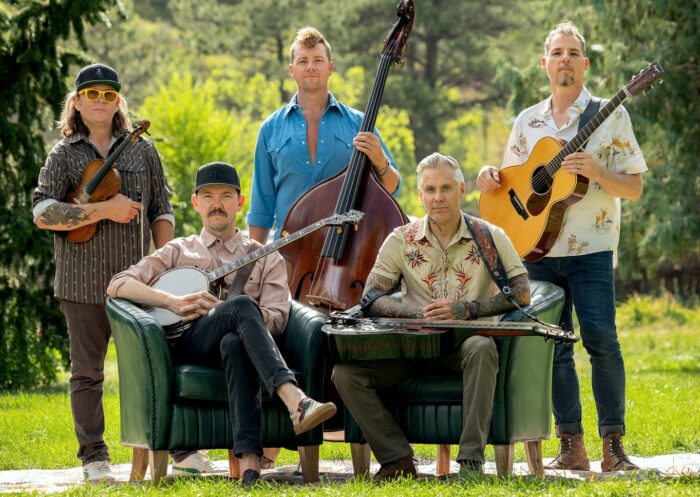
photo: Daniel Milchev
As The Infamous Stringdusters celebrate their 20th anniversary, the Grammy Award-winning quintet continues with what it’s always done—pushing forward as creative artists. As they recorded their latest album, bassist Travis Book came up with the concept of the release aligning with their two decades together. Inspiring each other during the process, nearly 50 songs were written by Book, Chris Pandolfi (banjo), Jeremy Garrett (fiddle), Andy Hall (dobro), Andy Falco (guitar) with 20 of these eventually recorded for 20/20, which features their boundary-pushing mix of bluegrass, Americana, country and folk.
“We were so excited to make the most epic record we’ve ever made,” said Dusters banjoist Chris Pandolfi. “It’s so much longer than any record we’ve ever previously put out. In some way that’s us saying, “Look. We’re not the new guys anymore. We’ve been around for 20 years. We built something that is very much our own and very unique and original, and we know our crowd and we know our thing. We don’t need to play the game anymore of trimming an album down to 11 or 12 tracks with one single.”
I catch Pandolfi at home during a brief break shortly before the band returns to the stage with dates in Colorado. “We’re so busy right now, and with good reason, because we have this new record that we put so much time and energy into.”
During our time we focus on the band’s 20th anniversary and history, discuss the new album as well as his TRAD PLUS presents Trance Banjo solo release, his ongoing podcast Inside the Musician’s Brain and much more.
Let’s start with the obvious, The Infamous Stringdusters are celebrating their 20th anniversary. What’s been the glue for the group to stay together?
God, it is a long time. One day, it feels like it’s been a long time and one day, it feels like it has flown by. I think that it feels like it’s flown by because there’s something very natural and synchronous about our connection.
So, in some way, it’s luck. It really is that. That’s not to say that we haven’t done a lot to align on our goals as individuals and musicians and human beings. We also really got lucky in our synergy because to have a band that’s really a collective of five people who are all very fiercely independent artists. We all sing. We all write. We all do lots of side projects, and it really does feel like a collective to me to get five people together in a band like that and have the music really satisfy everyone, to keep them engaged and keep them coming back. That’s a very unique thing.
There’s something about that that’s luck, and there’s part of it that speaks to how aligned we are to wanting our career to evolve around being in our own band, being our own boss, writing our own music because we all worked as sidemen to some amazing artists. Andy Hall was in Dolly Parton’s band and I was playing with Emmitt Nershi Band with Drew [Emmitt] and Billy [Nershi] from [Leftover] Salmon and [String] Cheese [Incident]. These were some great gigs. We realized in the course of doing those gigs that we wanted to do something that was our own and there are challenges and there are amazing upsides with it.
Being aligned on that has really been key. That’s a big driver because we all really share in crafting the vision for this thing. That extends beyond the music. It certainly focuses on the music, but it also extends to the experience of being in this band and how much we want to play and what the business plan looks like. We’ve been aligned on those things from very early on, all five of us. That’s another really crucial tie that binds us together.
It’s interesting that you bring that up because the next question I was going to ask had to do with the early days of the Dusters and what was your vision for what you wanted to do.
The vision was to play original music and to be our own boss. We’re all so creative and visionary in our own right. As I said, I really consider the band like a collective, and everybody brings so many different things to the table—musically, artistically and otherwise—and we have done a great job of synergizing all those things, bringing all those things together, making them work together and pursuing this dream of having our own thing.
Having your own thing is so cool. So many of the artists that we look up to are going to be remembered because of their original music, their songs. That’s your legacy as an artist. We really wanted to create that in bluegrass music with our original writing, with our catalog, as part of this genre, this community. It really extends to a few different things. Making our own mark and saying our own thing, that was the biggest part of the initial vision. The vision at the beginning isn’t really too focused on the business part of things. That comes with time. You’re just happy to live another day. You’re just trying to get to that next gig, and that’s a very natural, very cool thing, very important part of the process. You learn so much at that phase of the game.
Since you mentioned songwriting, I find that the musicianship of many bluegrass artists is really high, which appeals to me in its own right and can sustain careers. But beyond that, some groups like yours are able to connect on another level through your commitment to writing memorable songs.
I think bluegrass appeals to people for different reasons. There are aspects of the music, the tight kicking sound of the acoustic instruments, the vocal harmonies, the rhythm or aspects of the music that are really really catchy. When you can combine those aspects with catchy songs, with memorable songs then you really have something. And again, songwriting has always been a goal for us. We put out all these records of original music, and we’ve had other projects, too, where we do covers because we want to do that, too. We’re pretty prolific as a band and we’ve done a lot over the years.
Here we are, 20 years in and we’ve just released our longest album. We wrote almost 50 new songs that we trimmed down to 20 on this record for the very sort of thing that you’re talking about because the songs are the thing. Every great artist, their legacy is their songs, and while the playing and the harmonies, these other aspects of bluegrass that can be really cool and are such cool, important hooky part of the music I don’t think you’re remembered for that stuff the same way you are remembered for great songs. Great songs are the things that stick in someone’s head. Great songs are the things that give a voice to our shared experiences. That’s really the thing. That’s really the first focus.
People always ask, “Are you guys a bluegrass band?” and my answer is, “Yes, we are a bluegrass band. We take the roles of the bluegrass instruments, like the banjo, that bass playing on the downbeat, the guitar like a snare drum chopping like a mandolin on the upbeats. We take those things and we use those tools to bring these new songs to life.
But, it’s the song that dictates how you play it and what tools you use. You don’t just plug everything in. It’s the bluegrass way. So, you have these different pieces of the musical formula, and we’ve always prided ourselves on coming from traditional bluegrass music. It’s the best musical education you could ever get, but it’s all about using those tools and that education to bring our original songs to light. That’s the goal of the band.
On the subject of terminology, you say bluegrass. I’ve read stories where you’re referred to as jamgrass, others describe The Infamous Stringdusters as progressive bluegrass. Do you have a preference?
Yeah, it’s a great question and the answer has shifted over the years. Right off the bat, my answer would be bluegrass. I think we’re a bluegrass band. At this point in time bluegrass is so much cooler and more widely accepted just for what it is. It’s not owned by this smaller crowd of traditional music fans. And I don’t fault those fans. Those are great music fans but it gets a little confusing in that world because they all play the music and there are a lot of amateur bands, part-time bands and with that, you get a lot of ownership over the music. That was the world that we started out in 20 years ago.
Now, in 20 years so much has changed. We’re living in the Billy Strings era now where bluegrass is hitting so many more ears. Also, the fringes of bluegrass where we have always existed, the quality of the music has really come up, and the influences have really trickled down. The guys that we’ve always listened to—Bela Fleck, Jerry Douglas and Sam Bush. They’re the Old Guard now. Then, we’ve come along and we’ve been part of this evolution process. We’ve been part of bringing the bluegrass pedigree into the musical world that’s a little more exploratory. We, sort of, do it all.
Now, you could use any one of those terms for our band, but I call us a bluegrass band because that’s where we’re from. That’s the tie that binds us together. That’s our common thread as musicians. That’s what influenced us. Ultimately, whether you jam or whether your music is progressive or traditional, it doesn’t matter anymore. I feel like we are so clearly a bluegrass band. It’s a string band, no drums, banjo, fiddle. We play some very traditional songs every night during the set, and then we write a lot of original music. And again, we use the bluegrass tools we have to bring that music to life.
Back in the day, the word was more fraught. We’d say bluegrass back in the day, and it was like people didn’t know what to do with us. There wasn’t a clear track of standing room clubs to play in front of an audience that was more participating music and writing that energy way. That didn’t really exist when we started out. We were kind of breaking some new ground along with other bands. Some that came before us, like Cheese and Salmon, and our contemporaries. Yonder [Mountain String Band] did a lot to flesh out this path for a string band to play Red Rocks and such; Greensky, of course, Railroad Earth. We were a part of that. We were the end of that first wave of whatever you want to call it – bluegrass, jamgrass, progressive bluegrass – but I call the Stringdusters bluegrass.
In the Bluegrass Situation Artist of the Month piece on the Stringdusters, it talks about seeing your band as the next step of evolution, from traditional to the jamgrass of Leftover Salmon and Yonder to where we are now. as that a desire, a goal early on or later?
Yeah, I’m really proud of that because that’s what I love to do at the shows. I love to have music that stretches out and what I understand that moment as, it’s the most present it ever can be with music. When you’re playing a three-minute bluegrass song, it relies on totally different aesthetic and musical sensibility to land with the audience. It’s about being tight. It’s about being airtight and moving from one thing really quickly to another with this conviction, this power.
But, when you get to those moments during the show…and for us it’s a lot, which is why my answer to your question is yeah, we are definitely part of that evolution. I went to, growing up, going to Phish shows before I even knew what bluegrass was. I got my first banjo because I was a Bela Fleck and the Flecktones fan. I didn’t know anything about bluegrass. I really came from a much more experimental musical world.
The banjo led me into the bluegrass world, which is much more regimented, but, again, the best musical education to get. When we started coming full circle as a band, finding our legs as far as adding those more jammy sections into a show, to come back to my original point. What is that moment during the show?
That is the most present you can be. You’re paying attention to other musicians onstage. You’re listening as much as you possibly could. You’re waiting to hear what happens, and you’re gonna react to that. And then, you’re also totally in sync with the audience, seeing how they react to the music. They start to come up with music and you answer that musically. Then, you’re into this incredibly present, incredibly live and unique moment that will never be recreated at another show. That’s quintessential live music. That’s the power of live performance. That’s the synergy that we’ve learned to create after 20 years of playing together. That’s some of the most memorable and amazing, cool parts of the music that we have. So, I love it all. I love throwing down on a three-minute bluegrass song, fast and tight, and there’s no question that you know what’s happening to everyone, every step along the way. But, we have always incorporated more experimental sections in our music. We’re definitely walking in both worlds. We love both things. We try to do both things well because they’re native to who we are.
We’ve got…Andy Falco is our Grateful Dead guy, and we’ve got a couple Phish fans in the house and fans of jazz and experimental music. These things ultimately have all influenced us. I hope that that continues to evolve over the next 20 years of our band.
When you mentioned about Andy and the Grateful Dead it reminds me of earlier when you were talking about songs lasting years from now. The Dead has been pointed to for its catalog and its legacy that, as it’s been said, will be around for hundreds of years because of the songs.
In my time as a professional musician, the Grateful Dead catalog has become the songbook of the roots music world. Through different gigs that I’ve had, like Keller Williams’ Grateful Grass is a great example, playing with Oteil Burbridge, whose a friend of mine, and played on one of my solo albums and all of our exposure to Phil Lesh and Terrapin Crossroads and playing Graham [Lesh]. And now, especially with Bobby [Weir] recently passing away, we’re moving into a post-Grateful Dead world. Obviously, [Bill] Kreutzmann and Mickey [Hart] are still around, but the music is going to move to another phase because they were never the main purveyors of the catalog. Having Bobby around Dead & Co, you really felt there was still some vitality to that.
Now, reflecting on Bobby’s passing and the importance of the music, it’s so unbelievable, the width of their influence, not only in music, but, of course, it’s everything—the community, creative. business side of the equation. What they did is what we’re all trying to do, build a community around our music that exists onto themselves and keeps things going. They were the masters of that. We emulate that on a musical front with our songwriting, trying to create something that is meaningful and lasting and also in terms of the business that we’re building and the community that’s forming around the music.
You played with Phil at LOCKN’. We’re not going to focus too much on the Dead, but do you have a Phil story?
Oh my God. I have a bunch. We really got to spend some great time with Phil, but my favorite Phil story is, Phil invited us to do Phil & Friends at LOCKN’. It was such an absolute dream come true. In the band were the Dusters, Jon Fishman on drums, Page McConnell on keys, Anders Osborne on guitar, Joe Russo on drums, and then Derek Trucks and Susan Tedeschi would be sitting in—a pinch me lineup to say the least.
On the day of the show, Phil’s flight got canceled, and that’s kind of an issue when you’re doing a Phil & Friends because you have a whole big rehearsal that day. That’s the essence of the gig. We go to the rehearsal space off-site and Russo leads us through rehearsal, and we get the word that they chartered a plane and Phil’s coming, he’s going to arrive, maybe, just in time, maybe, a few minutes late.
At LOCKN’ they had that rotating stage, setting up on the back of the stage. It’s now showtime. It’s 10 minutes past showtime and Phil’s late. We hear he’s coming. We’re all set up at the back of the stage. I’m standing there with Fishman right behind me on the kit and Page McConnell over here and I’m just buzzing in anticipation.
Then, you see a police escort coming down the road, pulls in. Phil gets out, jumps up onstage, tests three notes on the bass and then Boom! the stage starts spinning to the front of house, and you come out and there’s 30, 000 people and the first notes that we play with Phil Lesh were in front of that crowd. It was a surreal moment. As a music fan, such a full circle thing to be playing with my heroes and all that anticipation. It was something I’ll never forget.
Years ago, I interviewed Tim Carbone from Railroad Earth and he played with Phil. As we were talking, he noticed the charts that he had from that experience. Did Phil have everything written out for you and the other Friends as well?
It was not written out. It was all by ear. We had a lot of exposure to Grateful Dead music. We play a lot of that music. So, we knew the stuff, but it was…it was really interesting during the rehearsal with Joe Russo, who is one of the great Grateful Dead experts out there. Now, as we, transition into this post-Grateful Dead world, Russo is an expert. He was part of Furthur. Obviously, JRAD, Joe Russo’s Almost Dead. He’s got his credentials, and he led us through the rehearsal. His knowledge is so deep that he was, like, “Alright, well Bobby does it this way but Phil usually does it this way. So, Phil watch for him to cue on this part and then we’re gonna go to the next chord.”
So, not only was it all by ear but as time has passed, those guys have each evolved their own arrangements and understanding of the music. So, everything is so unique. But, that’s the whole ethos of the Grateful Dead, right? You’ve got be on your toes and you never do the same thing twice. That was part of the experience, and, I guess, felt right, if you will.
For someone with a music school background, did the way that he explained things calm you down a bit because he was talking in technical terms?
It did. Of course you don’t have to know music theory. You don’t have to be literate in music and its different technical aspects to be a great musician but that’s a great example of a professional music situation where it certainly helps to have that kind of understanding because it allows you to speak a common language with someone like Joe, who’s really good at doing that, and gain a better understanding of the music.
Ultimately, the playing is all going to be by ear. Going to Berklee [College of Music] has helped me in a lot of ways, but it really helped me in my professional career to be flexible and play with different people and be able to adapt to different situations, and that’s a great example of that.
I want to get to the band’s Americana Vibes label, but since you brought up Berklee, what were you studying?
I was the first ever banjo principal at the Berklee College of Music. I got my undergrad degree… Because I only started playing banjo when I was 18, I was a freshman in college. I got my undergrad degree in four years. Then, I went to study in the diploma program at Berklee. When I was going to Berklee, I wanted banjo as my instrument. I played other things as well but, far and away, I’m focusing on banjo.
They had said, “Well, you can come to Berklee and study guitar and transpose everything for banjo.” I was, like, “That’s not what I want to do.” So, through my teacher, Tony Trischka and chair of the strings department Matt Glaser, they helped me chart my own course there, and I was the first ever banjo principal. Two years after my time at Berklee, they started the American Roots program where you can now study banjo, mandolin, etc. some roots-based kind of thing.
It speaks to the fact that, like I was saying earlier, bluegrass is a lot cooler and more widespread than it was when I was starting out. I could barely even find a banjo teacher, let alone a music school where they would allow banjo, but now they have a bunch of students, and they have great teachers and bluegrass is a lot more popular than when we started out 20 years ago.

No Comments comments associated with this post