


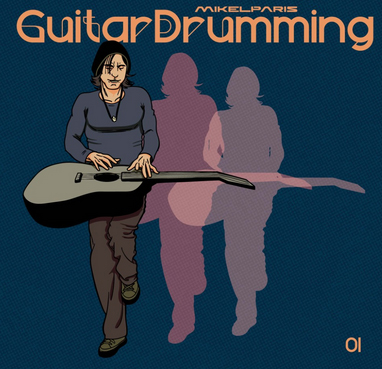
JPG: Moving to your solo albums, HIHOWAREYA VOL. 1 has a bit of an O.A.R. vibe to it and Snidbits is more song-oriented more than the rhythm-oriented GuitarDrumming 01. Your thoughts on the differences between the albums.
MP: So, Snidbits were songs that were written primarily during my A SONG A DAY (ASAD) livestream from 2020 to 2022.
One of the things that I created was a thing called the Snidbit Workshop…and I know it’s supposed to be “snippets,” right? That’s the real dictionary word, “snippet,” but I always said, “snidbits.” So, snidbits became these little ideas in my phone on a voice memo. I would sing a snidbit.
The Snidbit Workshop was where for three or four weeks I’d work on a song during the livestream in front of the audience. It was really about breaking down the wall of me feeling like a song needed to be perfect before anybody heard it. That’s never gonna happen. You can strive for perfection, maybe near perfection, as far as we think for our creative endeavors. So, that was about me writing and workshopping new songs during the pandemic and it really captured where my headspace was during that time period, too.
I did 29 Snidbit Workshop songs and decided last year… “I want to do the guitar drumming project, but I don’t think I’m quite ready yet with that concept. Let me put out “Snidbits.” Thematically, rhythmically and lyrically, those songs are all over the place, just where my brain was in…where all of our brains were during that time period. We all have unique memories and experiences of that. I was really trying to give a little time capsule on the “Snidbits” album, of this is some of the journey I went through during that time period. A lot of it was letting go, and it was less is more. It was like, don’t fill these songs and these tracks with every moment. Let there be space…and let it breathe.
“B Good 2 Me” on Snidbits is a real exercise in that every instrument has its space, and there’s not a lot of instruments. I get chills when I sing some of those songs, sometimes, which is an okay thing to say as a musician; if you created moments in music that affect you in that way when you’re performing it. I want to be able to listen to my music. I’m not an artist that can’t listen to themselves because for me that’s the ultimate payoff as a musician. We get to travel. We get to perform. But, we also get to write and then enjoy what we’ve created. I want to be able to enjoy my creations like I enjoy other people’s creations.
JPG: With Guitar Drumming 01, the music has a rhythmic feel to it as well as a lot of the vocal melodies. Was that purposeful or accidental?
MP: That’s one of those questions where you ask somebody where they got the inspiration for something. Sometimes, it’s just a subconscious thing. I’m not necessarily consciously aware of those decisions that I make. Often, I try to go back to the moment of inspiration as much as possible. “What was the melody that I sung? What were the notes? How did it fit in with the other rhythm that I came up with?”
For the most part, it’s just an innate decision but then you go back to the song, and you start fine-tuning it. I do think that that there are conscious moments, yes, where I was – vocally — let me try something more rhythmic and see how that connects with what I’m doing on the guitar and everything. So, I have embraced way more now than 15 years ago. Just because you sing something one way or play something one way doesn’t mean that that’s the way it should be. You can go back and look at those moments and edit and tweak things.
But, like any artist — a painter or anything — you need to know when to stop and, sometimes, the hardest thing is to know when to stop. “When do I stop editing? When do I stop trying to make this better?” Sometimes, you go back to that moment of inspiration of me just with my guitar and singing this idea into the microphone on the iPhone and you’re like, “That’s still better. Okay, I need to…” and being okay with that, being okay with spending time on a song and then realizing this is the wrong direction and not beating yourself up, “I just wasted all that time on it.”
I used to feel that way. Silly. Stupid. I gravitate towards singing more rhythmically and yet I realize that there are times where I need to push myself to get out of that comfort zone and sing things more legato (to sing smoothly with notes flowing from one to the next without any breaks) and longer phrases and I have to push myself to do that.
JPG: The rhythmic way of singing was more noticeable on Guitar Drumming 01. Prior to that, you were singing more legato on the other albums. This one, it was more noticeable because I heard the rhythmic aspect of the guitar drumming approach. Since you mentioned learning to stop yourself from editing that brings up the idea of adding. You have the addition of special guests on the new album. What brought you to that decision?
MP: There’s so many reasons behind that. All the guests on this album and Guitar Drumming 02 are meaningful relationships, some of which have been relationships for 20-plus years. We see more and more now from a business music standpoint, the value of collaborations, especially as independent artists look to try and get their music to new audiences, in front of new ears. Collaborating with a guest artist who’s more established than you, hopefully, is something that I saw the value from a marketing standpoint. From a heart standpoint pretty much all of the collabs on “Guitar Drumming 01” were full circle situations for me.
I met Vernon Reid (Living Colour) in Guitar Center in New York City over two decades ago. I just recorded a version of “MoveIT,” which is on “Flow,” just an instrumental version. That was the first time that my guitar drumming style really was just by itself with no vocals on an album.
So, it was on “Flow,” and I had a CD on me in Guitar Center. I went over to Vernon, and I was like, “Hey man, just a big fan,” and he was very gracious and very nice, and Guitar Center has those listening rooms in the back with the speakers, and you can go and choose what monitors you want to use in your studio. So, I was like, “Hey man, I got this guitar style I’ve been working on, and I really think you’re going to like it. Would you mind listening to it?” He said, “Yeah.” So, I took Vernon back and I’d already listened to it. So, I knew what speakers I liked the best. “This guitar drumming. It’s just me on guitar. I just want to get your feeling.” He listened to the whole thing. He was nodding his head and he’s like, “I get it,” and we just started having conversations about music. I would meet him, sometimes, like at Astor Place and start meeting some of his people. I was always a Living Colour fan, just incredible. I saw them at Irving Plaza. That was the first time I saw them.
So last year, I was thinking about “I should start bringing in some guests, collab or feature.” And, I thought about Vernon right away. He was the first person I thought of, hearing his guitar playing from Living Colour, his soloing, his melodies and his tones and effects and all that. I got this song “Good 2 Go.” So, I called him. “Would you be willing to do this?”
I sent him the track and gave him my brief notes — here’s a moment where I hear you ripping an amazing guitar solo, the rest, do whatever the heck you want. And he sent me tracks and the stuff that he put down in the verses and the outro were things I never heard of.
Part of what came out of having these incredible musicians be on my songs is that they added things that I never would have thought of that made the songs, in my opinion, better than it would have been if it was just me. That was a real coming full circle with Vernon, getting him on that and being so happy with what he did.
And G. Love! I saw G. Love & Special Sauce open up for Blues Traveler when I was in STOMP. A bunch of us went and saw them. That first G. Love & Special Sauce album. That was so good. So, I was a fan from way back when. Then, I got to meet G. Love with some O.A.R. stuff. He started becoming friendly with the band. The band’s done some touring with G. Love.
I approached him a year-and-a-half ago, maybe, if he would ever be interested in doing something. Then, last year, I sent him “HitMe.” He’s, like, “I’m gonna be in a studio next week, on this day,” I was like, “Alright, here’s the track.” And, again, I couldn’t be happier with the harmonica that he played. It was so great!
My friends Of Good Nature are doing another song. It’s for GuitarDrumming 02. We’re working on that right now.
The whole collab idea, the whole feature thing, has been nothing but a positive, uplifting experience. I don’t want to do a whole album where it’s all featured artists on every song but for this next record, there’s going to be four and there’ll be four or five songs that is just me; eight to 10 songs on “Guitar Drumming 02.”
Moving forward, why the heck not? Why wouldn’t you want to have some songs that you’re sharing, creatively, ideas with someone else who’s gonna create something different and new that you couldn’t do by yourself? I’m all about it. I’m super-excited about the new ones. I can’t wait for you to hear what’s coming up.
With the Stephen Kellogg one. That song’s been with me for a little while, too. I’m really excited about it.
JPG: How did you hook up with the O.A.R. guys?
MP: Dan Finnerty, a STOMP friend, started a project called the Dan Band. A good reference is in the movie “Old School” during the wedding scene when he started singing “Total Eclipse of the Heart,” and he starts swearing and making up his own lyrics. So, that’s Dan Finnerty. The Dan Band is this whole project where he sings women songs, but he’s very crass and very off the cuff and interjects his own lyrics and words. He’s got two straight men in suits doing choreography, a full band, and he does this whole show. It’s just incredible!
Going back to me feeling like my body was failing me in STOMP and I was like, “I can’t do it anymore.” He reached out to me in 2005, that summer. “I’m doing a House of Blues tour, do you want to play keyboards in The Dan Band? We’re gonna go to all these House of Blues around the country.” I was like, “Thank you!” I needed something. So, the tour manager of that run, Adam, who also did front of house for The Dan Band, had done some tech with O.A.R. in that same period 2003, 2004.
After The Dan Band run Adam was at Feeling Better Than Everfine Fest. O.A.R. used to do a festival every year with the label [Everfine]. So, Adam was hanging out at the festival, working with another artist and he’s sitting with some of the O.A.R. crew guys.
They were like, “You know any keyboard players? The band’s looking for a steady keyboardist?” Up until that point, the band, to my knowledge had friends sit in or a band is opening up that has a keyboardist. It’s a friend. “You want to sit in and play during our set also,” but they never really had a focused, dedicated [person] to learn all the keyboard parts.
“Stories of a Stranger” was coming out that year and Bernie Worrell played keyboards on all of that stuff because Jerry Harrison (Talking Heads) produced “Stories of a Stranger” for O.A.R. Adam texted me, “Can I give your info to the O.A.R. crew because they’re looking for a keyboardist? I didn’t really know who the band was, at that point, in the summer of 2005.
Then, Jerry [DePizzo] called me, and we talked a little bit. Then, he sent me like nine CDs. (laughs) I was like, “Who are these guys?” And I just started listening. And he’s, like, “I’m going to have you meet up with Mark [Roberge] and Benj [Gershman] in New York.” I think they were only seeing three people, and they were all people, from what I understand, who were referred to them by somebody.
I started familiarizing myself with all these songs, trying to understand what is this band’s vocabulary? A lot of the songs didn’t have keyboards. What do I do on those? There was one CD that was written on with a Sharpie. And I saved that for last. Of course, that was “Stories of a Stranger,” the new album, but I didn’t really pay much attention to that because I’m gonna focus on these.
Jerry calls me one day. He’s like, “Are you available on Friday to come in and meet up with Mark and Benj? which was three days from when he was on the phone with me. “Yeah. 100 per cent!” He’s like, “Can you prep “Program Director,” “Lay Down” and “The Stranger?” I was like, “What are those songs?!?? From what album?” He said, “Stories of a Stranger” Of course, the one freaking CD that, “I’ll save that one for the end,” was the one they wanted me to prepare songs. So, I was cramming those songs, trying to learn something.
I meet up with Mark and Benj in New York City at a rehearsal space. Someone else was coming out. I came in, sat down, and literally, Mark and I talked for 20 minutes. He loved my background with STOMP with percussion, obviously, being able to play keyboards, having played with Pink. My resume was okay. When you think about a resume builder for a piano player, STOMP doesn’t do anything for you. No one plays piano in that show. As a performer, as a professional, it helped.
Finally, I was like, “You want to play something?” and he’s like, “Yeah, let’s do it.” So, we played through those three songs, and as I was leaving, some guy had flown in from LA and he brought all this gear with him. “Well, I guess my chances are probably pretty slim here.”
I went to my friend’s studio opening, a gallery in New York City in Tribeca, and I was really focused on all the artwork and reading everything because Mark’s like, “Someone will call you.”
I was just waiting, waiting, waiting, and then, Mark called. “You want to do this?” I was like, “Yeah. I do want to do it.” It’s one of those, again, not putting so much pressure on myself going into these audition situations, was definitely something that I learned throughout the years because, as an actor, you go on an audition for shit in New York City all the time, and it’s just denied denied…you have to learn how to deal with rejection. As a musician, that was always scary because “This is my music. This is my song that I wrote. How can you reject it?” I was always so afraid of it because it was way more personal than acting because I’m doing a character. It didn’t run as deep as getting rejected as a musician.
I’m not trying to prove myself, but I still feel like every day I wanna show this band that I’m gonna give my best and my all and try and bring something new and different to every show. That’s the only reason I could still be part of this group for 20 years. It’s the same reason I could be part of STOMP for 10 years because every show is different. Every setlist is different with this band. There is never the same setlist from one show to the next. For me, being on this planet and living every day, that’s how I want my days to be.
When I go to my job, when I go to work, it’s gonna be different. It’s not gonna be me doing the same things, playing the same songs the same way every time. Some people need that. There were some STOMPers that did the same solo every time because that’s in their makeup. They need that, and they spent time to make that perfect hands and feet solo or perfect double broom solo. That gave them some power. For me, the power comes from it not being the same and always being different.

No Comments comments associated with this post