


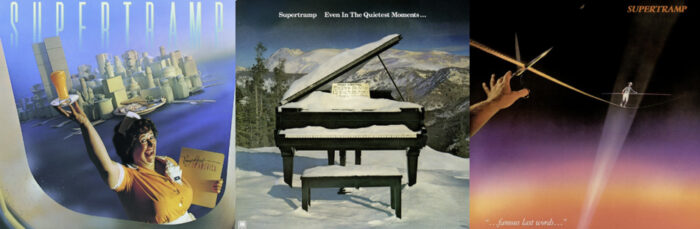
Supertramp continues its splendid vinyl reissue campaign, rolling out a polished-up trio of classic releases. Each are, once again, half-speed mastered at Abbey Road, and follow in-sequence in the catalog from the previous two—Crime of the Century and Crisis? What Crisis?. This trifecta, surveyed individually, are three LPS as divergent from each other as any in Supertramp’s discography. Taken, and listened to, in order they appear more as reactionary efforts to one another rather than as revolutionary or consciously evolutionary in the ensemble’s career arc.
First off, sonically, these new vinyl platters sound as well-crafted and restored as their predecessors- with Miles Showell and his keen lacquer cutting back in action. Secondly, as for reproducing the cover art and liners as they once were, yet another success. So, simply as present-day reissues, alone, these are quite lovely returns for a spate of Supertramp records from over four decades past; on quiet, shiny, deep black wax.
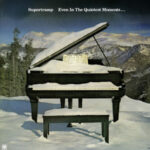
Even In The Quietest Moments… stood, in its time, as a commercial recovery after Crisis. And while Crisis was a very solid album that has aged rather well, it lent to a drop-off in popularity when first issued. To the rescue came the chart success of the Quietest single, “Give A Little Bit.” In fact, its millions of plays gave a lot; reigniting the art-pop esteem of the Tramp, and lining up the band for a forthcoming peak of all peaks.
The follow-up, 1979’s Breakfast In America, was a certified FM-radio beast, with single after single leading to some 22 million in sales worldwide. It was nearly impossible to avoid its hits, “The Logical Song,” “Goodbye Stranger,” and “The Long Way Home.” Yet, it was not just singles and filler. The deeper cuts, too, made for a complete, end to end triumph that stands as one of the more beloved albums of all-time.
From there, Supertramp stumbled a bit, then splintered. Granted, following-up such a high as Breakfast In America was the tallest of orders. One can’t be faulted for not climbing back easily to the top.
Still, it was the internal struggles of the band, rather than its external results following …Famous Last Words… release, that led to the departure of Roger Hodgson—one of the group’s two integral songwriters and vocalists. The effort, itself, was still a winner, rising to the top five of the album charts. In hindsight, though, as the last LP from the classic lineup, it resonates more for its eerily prescient title than for the tightening tracks within.

No Comments comments associated with this post