


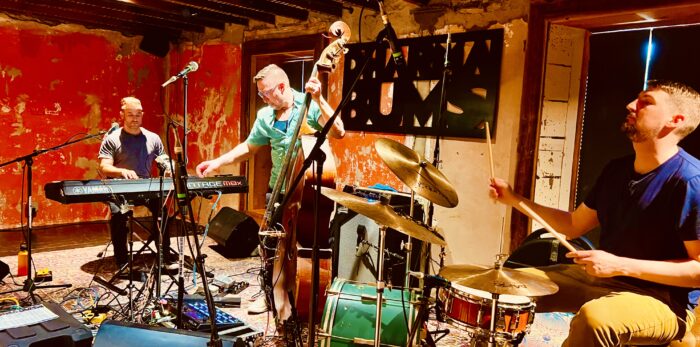
On this evening at New Hope’s canal-side Dharma Bums, Aron Magner’s SPAGA trio, the (mostly) acoustic jazz combo led by the Disco Biscuits’ keyboardist, delivered a set of originals and covers, many of them by Grateful Dead. New Hope has been a prominent arts town for over a century, with a local appetite for both jazz and the Dead. Dharma Bums, then, was the perfect room for Magner, upright bassist Jason Fraticelli, and drummer Matt Scarano – Philadelphia jazz veterans, all, and together as SPAGA since 2018 – to perform tunes from 2025’s SPAGA Plays Dead and beyond.
The trio opened with a Scarano original, “Wild Bill,” with Fraticelli bowing his upright bass through a wah pedal before abandoning the bow to pluck the full gamut of the neck. (The 2021 single, SPAGA’s first studio output after their 2019 self-titled debut, is named for Scarano’s old East Falls neighbor, whose photo graces the single’s art.) Scarano played a skeletal kit, a necessity after his recent move to Amsterdam: he pulled a minimum number of pieces – snare, kick, cymbals – from a set of drums stored at a friend’s studio in Philadelphia. (This included his conspicuously awesome kick drum, part of a 1965 Ludwig Club Date he repainted Eagles kelly green during the 2020 lockdown.) He locked into the groove sans toms, leading the trio through another original, “It’s Party Time,” before their first Dead tune of the night: “Cumberland Blues.” During the ensuing improvisation, Scarano dropped out entirely, leaving Fraticelli on lead with Magner shadowing him in real time, two-thirds of the band in open conversation, then returned so naturally that half the room likely never registered the seam. You know these are talented players going in, and hearing them actually perform as a straight ahead jazz trio – listening, ceding, rejoining – makes the show.
They moved into “Estimated Prophet,” implicitly raising the question: how do you cover a guitar vehicle without a six-string in sight? (The answer is: “admirably.”) Magner stayed mostly on piano, dropping in synth textures where Garcia’s leads once lived, while Fraticelli handled the tune’s undercarriage with presence and subtlety. Then came the most subversive tune of the night: an original arrangement of Peter Gabriel’s “In Your Eyes,” with Scarano on brushes and mallets and Fraticelli back on the bow. Mid-jam, Magner called a half-step key change and steered the band in and out of “Franklin’s Tower,” so smoothly that he appeared to sneak it past his own bandmates. One minute they were a jazz trio; the next, a rock band; then back. Another original, “For the Table” closed the set.
Magner opened the second set solo, easing into a reggae-tinted figure that sounded teasingly familiar. The ensuing jam found Fraticelli running his upright through a delay as he took the lead, the band finding their way to “Benny and the Jets” territory, then flirting with the Sugar Hill Gang. Triplets dominated until the trio resolved the whole thing into 4/4 and landed, improbably, in “They Love Each Other.” Magner shared that the trio had been shedding “Unbroken Chain,” the Mars Hotel deep cut that Phil Lesh himself rarely played live, and performed it publicly for the first time. Scarano’s New Orleans-inflected pocket carried the tune somewhere the Dead never took it, followed by an almost unrecognizable – at first – arrangement of “Friend of the Devil.”
Next, a fan shouted for Zeppelin, and the band answered with a slow and airy interpretation of “Black Dog.” They interwove “Terrapin Station,” with Magner peppering in “China Doll” teases, and erupted into the hardest jamming of the night, bringing all-out Bad Plus energy. They closed with “I Remember Ray,” which melted into “These Are the Good Old Days,” the title reading more like a statement of fact than mere nostalgia.
SPAGA’s set closed a circuit roughly seventy years in the making: by 1958, when Jack Kerouac published The Dharma Bums, the venue’s namesake novel, he and his contemporaries had spent the better part of a decade treating jazz as scripture, quoting Charlie Parker and Lester Young the way others quoted the Great Bard; and within a few years, Neal Cassady, the real-life model for the novel’s Cody Pomeray, had steered Ken Kesey’s Furthur bus straight into Haight-Ashbury and Grateful Dead lore. Magner has proven himself a master of interpreting Grateful Dead music across genres – jazz (SPAGA), rock (Billy & the Kids), and electronic (Deadtronica). The next 300 years of Grateful Dead music are off to a great start.

No Comments comments associated with this post