



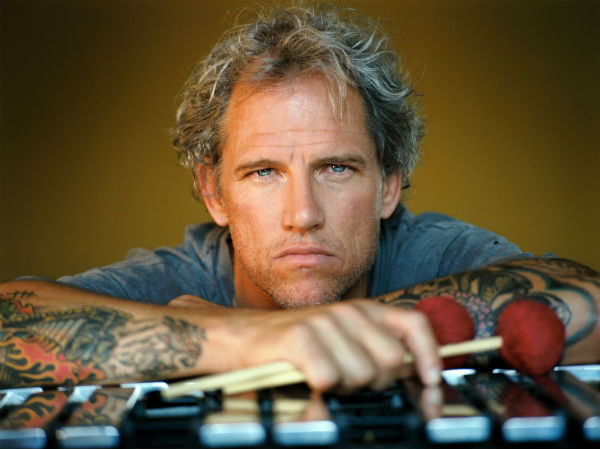
You’ve been sober now for a while. Living in a city like New Orleans, especially during a time like Jazz Fest and Mardi Gras, does that come into play? Do you still think about it?
I think about it when it’s over. It’s like, “Oh, sure would be nice to get loaded.” I haven’t gotten loaded in years, you know. And my version of getting loaded is different than most people’s versions of getting loaded. Anyway, I’m just glad haven’t had a heroin habit 19 years; I’m really thankful for that. But, you know, it’s always there. With the opioid epidemic that’s going on right now, it calls your name. But I’m scared shitless of opioids. All the stuff they’re putting in it, and all the people we’ve lost, young kids… I just feel lucky that I got out alive. I used to think I was some sort of magician that outsmarted heroin but, as I’ve gotten older, I’m like, “No, you just got lucky that you didn’t overdose and it’s that simple.”
As you’ve said, you play a lot of different types of shows and music. What sorts of different things do you personally get out of playing a show with your own band versus sitting in with an experimental group versus backing up someone like Rickie Lee Jones?
It’s cool you bring that question up. I try to be a really well-rounded, diverse musician. If one person comes to see me with the Mike Dillon Band, where I’m fucking freaking out, screaming and playing really aggressive and hard, and they like that side of me, then they come and see me play with Rickie Lee Jones, or play a beautiful ballad with James Singleton, they might be confused and go, “I don’t know; I don’t like that music.” When I was touring with Ani DiFranco, someone told us, “Oh, Mike looked bored.” But of course I wasn’t. If I played with Ani the way I played Les, she would’ve fired me after the first gig.
You’ve gotta play for the music, you know? And that’s what I love. When I play with my band, I get to do my songs, and do my stupid sense of humor and amuse myself. And that’s why I do it. I don’t make any money doing my band it’s a break-even [situation]. I pay my guys and we pay the hotels, but I get that spiritual satisfaction of making my records and becoming a better musician at my music. And trying make a better record as a composer. Whether Mike Dillon Band or Nolatet, I write for those bands, so I get the thrill of hearing a band play something I came up with in my bedroom. It’s fucking awesome. There’s no feeling like that; money can’t buy that feeling.
And then, when I go out and play with someone amazing like Rickie Lee Jones and look out to see someone from her generation that likes her music, I know I’m part of something bigger. I’ve sat in the studio [with her]—I got a co-production credit on her new record—just hearing take after take after take of amazing vocals, something that I could never ever do because I’m not a good singer. Like, there are good singers and then there are great singers—and then there are shitty punk-rock singers like me who just scream then go, “Yeah, alright, sounds good!” But to be a part of an amazing human voice is incredible. So I look forward to the challenge of adjusting to that.
At the same time, it’s all sort of the same. When I started to play with Rickie Lee, right away we had a connection on the time. That’s what I tell my students: Everyone wants to play with this drummer or that drummer because they like their time filled. You can play all the great licks and all the fills and fancy stuff you want, but at the core of it, people want to play with people they like sharing a sense of time with. The sonic space, that’s what you’re sharing. So, with Rickie, I love sharing a sonic space. With Claypool, the second we start playing together, we liked sharing each other’s sonic time-space, and we communicate on that level. So in some ways, it’s all the same. You’re still speaking the language of music; it’s just little subtle nuances. I play a lot of shakers and hand percussion with Rickie, which I don’t do in any other gig. She’s playing guitar and singing, and I just get to improvise and color it every night—like it’s a beautiful flower. And with Les, you know, he’s fucking playing beautiful, intense, badass, improvised, in-your-face funk bass. And I get to go, “OK, how can I make this stupid instrument I’m playing sound cool with that cool instrument.” And then somehow you find a voice. That’s what I like. I like the challenge. Another long answer. [Laughs.]
With your upcoming plans with Rickie Lee, do you have any time the rest of this year to work on your own stuff?
Well you know I had my last record, Bonobo Bonobo,come out. In addition to that band, I have my amazing percussion ensemble, and I have a new record in the can that’s all percussion music. The last one I did, Functioning Broke, had a bunch of Elliott Smith songs and a Neil Young song on it, marimba versions of songs I love. So I got another one of those coming out that I’m going to release probably at the top of next year. In August and September, in between tours with Rickie Lee, I’m picking up a few more weekends to get out and maybe try to hit a festival or two. I had to turn down a couple this summer, because we’ll be playing festivals in Europe with Rickie. This is the first summer I haven’t at least done one of either Summer Camp or moe.down or something. The guys in moe. called me and asked me to do moe.down this year, but I’m doing Glastonbury with Rickie so I had to pass on it. But it’s like, “Ughh!”
That’s a pretty good excuse though.
I’ve got a good excuse! I’m going to be in Europe, and I’ve done a lot of jam band festivals—which are fucking awesome, man. I mean, the jamband fans are the most supportive, and they’re pretty open-minded. Some of these kids love everything from Phish to Eric Dolphy to punk rock. I’ve said it before: Sometimes I think the fans are more open-minded than us musicians. Especially the older you get, you start turning into an old crab like, “Ehhhh, I don’t like that. I don’t like what the kids are doing.”
Well it seems like you’re not doing too much of that yourself.
No no. I got a cousin who’s a producer, this guy named John Hill. He produced [and co-wrote] that last big Portugal. The Man song, [“Feel It Still,”] and right now he’s in the studio with Tank and the Bangas in New Orleans. And he always sends me music to check out. Like, before Tame Impala broke big, he’s like, “Here, check this out!” So I’m glad I have people sending music my way to check out. My other buddy, Matt Chamberlain, the Critters Buggin drummer… That’s a band I miss. I’ve gotta say I miss Critters Buggin. It was an amazing collection of oddballs that made weird music, and now everyone’s too busy to play music together. It’s totally stupid. But at the end of the day, Matt and I still talk about new music. He sent me some crazy shit to check out at three in the morning last night. My favorite musicians are always out there looking for new music.
Speaking of jamband festivals, the Jam Cruise lineup recently dropped, and both Garage A Trois and Les Claypool’s Bastard Jazz are included for 2020.
That version of Garage A Trois is without me. That’s like the OG. They did Stanton’s [1998] record, All Kooked Out!, which was basically Garage A Trois, then they had some outtakes that they called the Mysteryfunk record, and that was Garage A Trois’ first EP. And it wasn’t until the first full-length Garage A Trois record that they got me on board. But they did a couple of tours without me. I think it just worked best for them as a trio not to have that loud, obnoxious percussionist around, you know? Stanton called me up and was like, “Is it cool?” I was like, “Hell yeah it’s cool.” I was on tour with Primus when they started doing that again, and from what I hear they’re having a great time. I’m going to be on the boat with Bastard Jazz, so I’m glad I’m going to be able to check out OG Garage A Trois. And I really can’t believe that Charlie Hunter—talk about crusty, crabby musicians—agreed to get on a boat. He used to say, “I’ll never get on Jam Cruise unless they promise me world peace.” So I guess he knows something that’s coming. Maybe world peace is on its way [laughs]. And I say that with a wink, Charlie!
You mentioned the Elliott Smith covers that you’ve done. I’m curious about your interest in him as a songwriter.
Yeah, and on my next one coming out, I did “Can’t Make a Sound” and “Talking to Mary,” plus Johnny Cash’s version of “Hurt” by Trent Reznor. I just read the Miles Davis autobiography, and he was such an expressive player. And I love learning standards, but to become a better, more lyrical player, I wanted to play modern songs that mean something to me. And I don’t know, maybe it’s because I’ve battled depression or whatever, but I relate to a lot of what Elliott Smith said in his lyrics. And one day I just learned one of his songs, and I was like, “Wow, this sounds really cool.” Then I played it and people thought it was nice. So the whole Elliott Smith on the vibraphone thing was kind of a happy accident. And that first record, Functioning Broke, I was just going to the studio to record for me. Carly and Adam had just left the band to go do their own thing, and I was pretty depressed about everything—the implosion of that version of the band. So I just started recording, and the engineer, Rick Nelson, was like, “Dude, this is really good. Let’s do a record.” So I kept working on it and people liked it. There was some review that said, “Check this record out. It’s vibraphone covers of Elliott Smith songs.” On the surface, it might sound cheesy and corny, but what I like and what some of the reviewers seemed to get right was, “Oh if you play an Elliott Smith song instrumentally, you don’t hear [the lyrics].” And maybe you don’t want to hear all the existential angst and anxiety of those lyrics. And those songs became kind of like little nursery rhymes. They had that quality to them. And then playing all the different instruments—bass marimba, xylophone, timpani—and just layering it and keeping it in the percussion family. That was a big part of the concept for that record.
I’ve got this new song that I did with Eddie Roberts on Color Red, “Tiki Birdwhistle.” It’s taking that concept of Martin Denny and Les Baxter, what those guys were doing, playing happy music with vibraphone and marimba, trying to do something new with it. There’s so much stuff to be inspired by. And of course, because I’m not any good at actually doing something 100%, I can’t ever sound like a song when I cover it. To quote Claypool, it sounds like a bastard. But I think that’s the way covers should be. They should always sound different. What’s the point of trying to sound like Led Zeppelin? That’s another reason I love playing with Rickie Lee. Her version of “Rebel Rebel,” it got back to her that it was David Bowie’s favorite of any cover. I learned that right away, playing with her. We were doing “Sympathy for the Devil,” and I was like, “Ooh, I got bongos. I can play the bongo part.” And she just looked at me in front of a packed house was was like, “No. Do something different.” I was like, “Awesome!” So I started playing fucked-up shakers.

No Comments comments associated with this post