



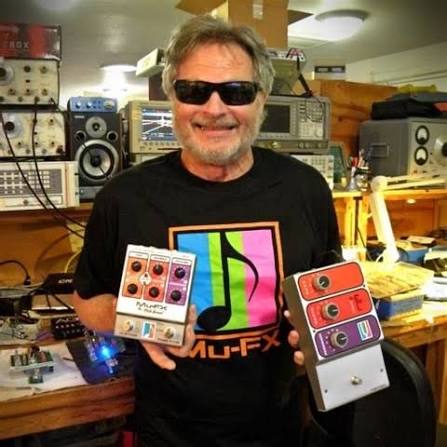
Mu-Tron III inventor and Musitronics co-founder Mike Beigel passed peacefully at home earlier this month. He was 79.
As his official obituary recounts:
Michael Lee Beigel was born in January 1947, in New York, New York to Jerome and Freda Beigel. At age 14, he purchased an oscilloscope and began studying wave theory. At age 17, he was accepted to Massachusetts Institute of Technology. Mike graduated as the first MIT double major in Electronic Music, with degrees in Electrical Engineering and in Humanities and Engineering.
While still at MIT, Mike became President of a research and development think tank company, Identic Data Inc., aiming to create new inventions and product designs. Soon, Mike and co-founder, Aaron Newman, launched Musitronics Corp with the Mu-Tron III. This product gave acoustic musical instruments a synthesizer sound. After Stevie Wonder used the Mu‑tron III envelope filter on his 1974 hit “Higher Ground,” Mike’s musical inventions quickly became popular among other guitarists of the era including Jerry Garcia, Bootsy Collins, Frank Zappa and more! Later in life, Mike continued to create musical inventions through Beigel Sound Lab and Mu-FX. Mike’s creations included the Mu-Tron III, Bi-Phase, Octave Divider, Phasor, Phasor II, Flanger, and Vol-Wah Pedal and he collaborated on products such as the Q-Tron, the Resynator and the Orange Squeezer. In 2025, Mike received a Certificate of Recognition from the Recording Academy for his achievements in music engineering and innovation.
While Mike is mostly known for his music technology contributions, Mike was also a pioneer of RFID, Radio Frequency Identification, bio-identification technology. As a consultant for AVID, American Veterinary Identification Devices, Mike developed and directed initial manufacturing of RFID products that allow pet owners to identify and locate their lost pets. Next, Mike applied RFID bio-identification technology to animal conservation efforts in remote severe temperature environments. First, he worked with the New Zealand Antarctic Program, NZAP, and then the National Science Foundation US Antarctic Project to design and build an RFID “Penguin Weighbridge” system to provide high accuracy ID and biometric information on traveling Adélie penguins. A highlight of his life, he traveled to Antarctica numerous times to test the equipment onsite in collaboration with scientists and wildlife. Then, he adapted the penguin RFID weighbridge technology to track endangered tortoises in the Mojave Desert.
In his personal life, Mike enjoyed photography, traveling, gardening, backyard bird watching and watersports, like windsurfing, surfing, and boogie boarding. Mike loved animals, owning many cats, birds, fish, tortoises, turtles, lizards, and one beloved dog during his lifetime. Mike had one child, Romy, who is now a Boeing Industrial Engineer. For most of her life, Mike lived with Dercum’s disease, a rare chronic condition characterized by painful fatty lipomas under the skin.
Beigel is survived by his inventions, their impacts and the family and friends who loved him. His family asks that fans of his work and community members share their reflections @mikebeigelmusic on Instagram, where his daughter will continue sharing his stories. Donations can also be made to forgottenfuturesmusic.org, who has been working with Beigel’s family since 2025 to preserve his musical prototypes.

No Comments comments associated with this post