



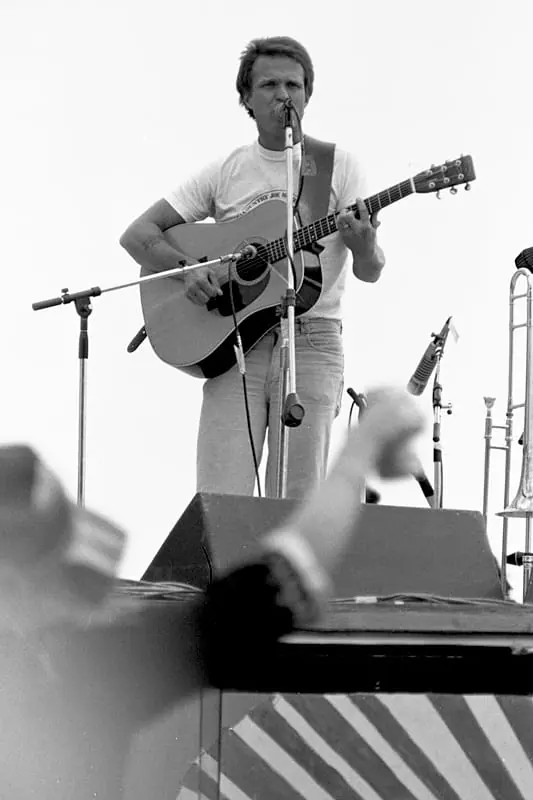
“File:Countryjoe 79.jpg” by Rtsanderson is licensed under CC BY-SA 3.0.
“Country Joe” McDonald, the band leader who fronted Country Joe and the Fish, and the voice that captured the frustration of the Vietnam combat and transformed this into an anti-war song that became one of the signature moments at the Woodstock Music & Art Fair in 1969, passed away on Saturday, March 7, 2026. He was 84 years old.
The singer and songwriter, born Joseph Allen McDonald, succumbed to complications caused by Parkinson’s disease in Berkeley, Calif. The cause of death was reported by McDonald’s wife, Kathy, and issued by the musician’s publicist.
McDonald’s ascent dates back to the Age of Aquarius. His historic turn leading the massive Woodstock audience in disapproval of the Vietnam War through the passionate formation of the crowd-repeated F-U-C-K via the “Fish Chant,” an expression of frustration and display of might in numbers that led into protest anthem, “I Feel Like I’m Fixin’ to Die Rag.”
The historic display became synonymous with anti-war efforts, a cornerstone of McDonald’s lineage as an artist unafraid to assert his political views.
Joseph Allen McDonald was born on January 1, 1942, in Washington, D.C., and grew up in El Monte, Calif. As a young man, McDonald played trombone with local dance bands, initiating his musical inclination before enlisting in the Navy. He served from 1959 to 1962, before attending California State University, Los Angeles for one year.
After dropping out of college, he returned to the Bay Area and co-founded Country Joe and the Fish with Barry Melton in 1965. In an interview with Classic Bands, McDonald spoke about the meaning behind the band’s name: “It was suggested that the group be called Country Mao And The Fish because Mao Tse-tung said that the revolutionaries move like fish through the sea and I said that was stupid. It was suggested that we call it Country Joe And The Fish after Joseph Stalin.”
With a moniker worth talking about, the ensemble released their debut record, Electric Music for the Mind and Body, in May 1967, which spent a staggering 38 weeks on the Billboard charts and remains one of the best examples of psychedelic rock.
The band’s popularity spiked with the release of their follow-up album, I Feel Like I’m Fixin’ to Die, in November 1967, continuing their blooming tendency to assert political commentary as expressions of their music.
Speaking about the origins of “I Feel Like I’m Fixin’ to Die Rag,” McDonald once told the Street Spirit:
I had been in the Navy for three years, and being a veteran always influenced my point of view. So I wrote this song called “Who Am I?” a song that’s very loved now. [“Who Am I” was released on the second Country Joe & the Fish album.]
It took two or three days to write the lyrics; it was kind of difficult. But I finally got it, and I sat back in my chair and I was just happy that I finished it and I started strumming on my guitar, and I strummed what turned into the music for the chorus of “I Feel Like I’m Fixin’ to Die Rag.” And then I started writing and I wrote the whole song in about 30 minutes. I thought it was a pretty productive day.
When asked about soldiers’ response to the track, he said: “They really do like it because it speaks the truth. The important thing about the “Fixin’ to Die Rag” was that it had a new point of view that did not blame soldiers for war. It just blamed the politicians, and it blamed the manufacturers of weapons. It didn’t blame the soldiers. Someone who was in the military could sing the song, and the attitude is, ‘Whoopee, we’re all going to die.’”
Before performing at Woodstock, Country Joe and the Fish were popular on the Bay Area live music circuit, sharing bills with other regional luminaries like the Grateful Dead, Big Brother & The Holding Company, and Quicksilver Messenger Service. During 1967’s Summer of Love, Joe and his band participated in the first Human Be-In gathering at San Francisco’s Polo Field in Golden Gate Park.
They continued to use their position to speak out against global conflicts by taking part in the Mobilization to End the War in Vietnam, supporting grape strikers, and performing two concerts at San Quentin Prison [their 1967 concert featured the Grateful Dead].
Eventually, their frustrations with the war in Vietnam fueled the aforementioned call-and-response chant at Woodstock, where the band replaced the spelling of F-I-S-H with F-U-C-K. McDonald encouraged the audience, asking, “What’s that spell?” and received the desired outcome.
McDonald captured the disapproval of a dying generation, entrenched in war, and trapped by the government’s encouragement to die for your country.
Country Joe and the Fish continued to assert their beliefs in song, often honoring fellow free thinkers, like Woody Guthrie, the inspiration behind his 1969 solo debut, Thinking of Woody Guthrie. McDonald maintained this approach with his solo career following the 1971 dissolution of Country Joe and the Fish. He continued to use his platform to speak up for what he believed was right. For instance, McDonald performed “I Feel Like I’m Fixin’ to Die Rag,” during an anti-nuclear protest at the Livermore Laboratory, in observation of the 70th anniversary of the Hiroshima bombing.
The outspoken freedom fighter is survived by his five children and wife, Kathy. McDonald’s legacy will continue through each generation’s ensuing echo of the Woodstock-famed anti-war anthem, and the belief in total freedom of speech.

No Comments comments associated with this post