


You’ve noted that while you were on tour, between stops you would go to local synagogues and communities and do research. Could you talk about that experience and some of the places you visited?
I did that right when I had the revelation that there was this connection between the musics. I was on tour with John Brown’s Body at the time in Davis, Calif., and had a day off and rented a bike and rode to the nearest synagogue and photocopied the prayer book. I was just really excited to start writing the bass lines and horn lines for these songs. I couldn’t believe it had never been done before—at least I didn’t think it had; there are other artists that have taken this approach, but there aren’t a lot of them [laughs]. It’s definitely fringe.
Can you walk us through the process of curating this set of Hanukah songs?
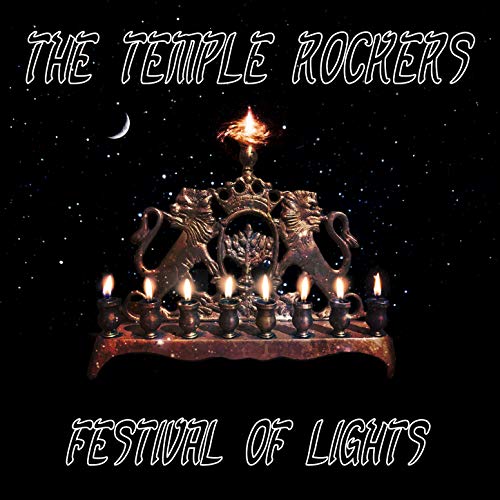
I knew I wanted to do “Days Long Ago” and “Spin Dem” and perform them in our style, and I knew I wanted Linval Thompson to sing those songs. So when I decided to go ahead with making the record, 12 has been the magic number for me of songs I want on a record—all my records have had 12 songs on them—so I knew I wanted 12, and only came up with eight songs I knew in total from Hanukah that would fit the reggae style and would pass the test. I didn’t want to do “Dreidel, Dreidel, Dreidel,” for instance—I find it to be kind of cheesy—so that didn’t make it on there. I needed to find more music to flesh it out, so I did a lot of research online and sought out different recordings to find music that resonated with me that I felt like would be a good match with the Jamaican style to make the 12, basically. And that was really exciting and fun because one of my favorite parts about this project is creating—as a bass player I love writing grooves and drum beats, too, so to be able to have these songs that didn’t have bass lines and drum beats and horns and such, that’s just really inspiring to me as a musician from where I come from and what I like to do. One of the songs that Ansel Meditations sings, “Do You Know Why?,” is one of my favorite songs on the album and is one that I didn’t know before doing some research, for instance.
You mentioned writing the music, so were there songs where you created new music in addition to classic lyrics versus other ones where you maybe stayed more true to the original arrangements in a reggae style? Which songs fell into each of those categories?
Yeah. I stayed true to the melodies in all of them, so that really laid the foundations for the songs. After that, it’s about groove. Once again, “Do You Know Why?” I really enjoyed writing the bass line for that. If you listen to that song as I heard it, which was just vocals and piano or something like that, there’s no reggae in it at all. Arrangement-wise, I couldn’t name a specific song; they all stay true to the melody, then at that point, depending on the way it went, how I arranged it—I don’t know how to exactly differentiate.
There are some guest singers from the reggae world, some legends. Could you talk a little about who you brought in to this and how you explained to them, for people who aren’t from a Jewish background, the spiritual aspect of it? Obviously they knew the reggae side, but how did that whole conversation go, and what was your takeaway from it?
I feel very fortunate because I got three of my top five artists that I was seeking out to do the project, so that’s really exciting to me. Besides the creation of the music, probably my favorite part of this project was being able to connect with these guys, and I was at each of the sessions in person, we weren’t emailing anything. In fact, the project was almost entirely done on two-inch tape analog, reel to reel, so when I went to Miami to work with Wayne Jarrett, I had to bring my reels with me, like the old days. It was really fun to share the concept with them—it was foreign to them—then to give them the music and lyrics and have them work on it. They all really loved working on it and expressed how deeply moved they were by the music, and I made some friends. It was a great adventure to go to these folks. Ansel actually came to my studio and stayed with me for a couple days. So even having Ansel stay with me a couple days and getting to know him as a person and work on the music together, see how these guys work, was really rewarding and enriching for me because these are some of my musical idols. To be able to work with them, be in the studio, see how they approach music, like the phrasing and such, was really interesting. I gave versions of the songs to Wayne Jarrett with me singing them, the very straight way I know how to sing them, then he took the phrasing and made it his own, and that was really beautiful to watch. Same with Ansel, just making it his own, adding some of his own stylistic vocal signatures to it. Then Linval was on the spot what he did, and he didn’t get any of this in advance, we did it right in the studio. I played it for him, gave him the words, and we just did it right there, so he didn’t have time to prepare the way the other two guys did. So it was an adventure, that’s for sure. It was fun. It’s also challenging because they speak patois, which is a dialect of English, and it’s hard to pronounce some of the Hebrew. Especially the ch sound. It’s really, really hard for these guys, and it was frustrating and fun. Now looking back, it’s a laugh. But it was hard to get some of those pronunciations down.
Zorn is a master of using Jewish melodies and themes as the springboard for a catalog of deep improvisational jazz music. What was your experience working with him?
There was a little dialogue about how—because the sub-label of Tzadik that these came out on was Radical Jewish Culture—there was some dialogue between us, “Is this radical enough?” Just to be doing Jewish reggae stuff. Or does it need to be more radical than that? And Adonai Dub was a lot more radical. The remixes of each of the records was more radical, per se, than the vocal versions. But in the end, he let it go through just as my blend, rather than making anything too crazy about it. Then Bill Laswell, when he did his mix, he definitely added a bit of a sonic radicalism to it. Craig “Dubfader” Welsch is doing the remix of this album. He has a real sound. He’s a master of mixing.

No Comments comments associated with this post