

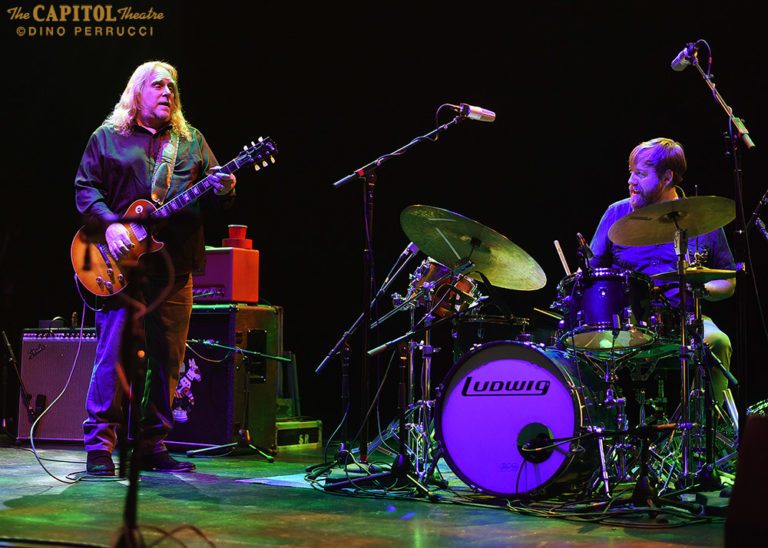
This Saturday, Oct. 19, at The Capitol Theatre in Port Chester, NY, guitarist Warren Haynes, bassist George Porter Jr., drummer Joe Russo and keyboardist John Medeski will revive their One Night Only collaboration (with help from saxophonist Karl Denson) for another evening of music benefitting Debra of America, an organization that helps fight and raise awareness of Epidermolysis Bullosa, a rare genetic condition that causes children to be born with extremely fragile skin.
On the "One Night Only... Again!" show, Debra Executive Director Brett Kopelan say, "I am very grateful and excited to have Warren, Joe, John, George and now Karl come together for a night of great music and to spread the word about EB. Of course the concert is going to be great and a tremendous amount of fun with this incredibly talented group—that’s a given. But what’s more important, Warren’s involvement affords me the opportunity to raise awareness of what we call 'the worst disease you’ve never heard of.' People who might not ever hear about this terrible disease, if it wasn’t for Warren involvement, now can be a part in making these kids’ lives just a little better. We are on the forefront of gene therapy and wound healing in general, and we are incredibly close to a real treatment that is going to take away the pain the suffering this disease causes. EB is just the proving ground to therapies for all types of illnesses and skin disorders as well as diabetes and burns. Concerts like this raise awareness, which leads to raising money, which leads to a treatment becoming a reality. It really is that simple. And for that, I thank Warren, one of my guitar heroes, for putting together such an incredible band for our cause."
Haynes was also recently honored by the Little Kids Rock organization during a ceremony in which the Gov’t Mule frontman was introduced by and shared the stage with Steve Miller for a performance of “Statesboro Blues.” Here, Haynes discusses his involvement with the two organizations and his ongoing appreciation for each of his One Night Only collaborators, plus what’s next in terms of writing music for both Mule and his own solo work, and why The Cap and the Beacon Theatre—where Mule will once again celebrate New Year’s Eve this winter—are two of his favorite venues to play.
Let’sstart out with the Little Kids Rock benefit last night. It looks like it was alot of fun for a good cause, and you and Steve Miller got to team up onstage.
Yeah,it was cool all around. Little Kids Rock started out very grassroots and grewinto this great organization. They’re approaching their goal of a million students,as far as providing music education, which is amazing. I was really honored tobe connected to the whole thing. It was a really fun night—the house band wasgreat, and playing with Steve was fun. I was honored to have him present me theaward. It was a beautiful night.
What’syour history with Steve?
We’ve known each other a long time. We did some touring together in the ‘90s and we’ve played together quite a few times. He brought the Steve Miller Band to Christmas Jam [Haynes’ annual musical gathering in Asheville, NC] a few years back. We played together for this Les Paul event with a bunch of guitar players [an NYC celebration for Paul’s100th birthday in 2015]; it was really fun. So yeah, we’ve done quite a few things together.
Inrelation to Little Kids Rock, can you talk about the importance of youth musiceducation and your own experience? It seems that arts programs like music arethe first things to be let go when cutting budgets.
Obviously,I’m someone who believes that offering music education programs to kids isextremely important. For the last several decades, seeing funding for creativearts in general, but music specifically, be taken away is very frustrating,because it’s so important for kids to have a pathway at an early age. It’s hardfor me to believe that we can’t as a country, as a government, provide that—thatwe leave it up to individuals and broader organizations to make sure it getstaken care of. But, that’s where we are. It’s very unfortunate. I was luckygrowing up—my dad bought me an electric guitar and an electric amp when I was12 years old. And every year, he would trade it in for something a little bitbetter. A lot of kids don’t have that as an option. If there aren’t programsavailable to provide instruments, then a lot of kids just don’t have thatoption of pursuing something that might end up changing their lives.
Movingto a different cause you’re involved with, you have the second One Night Onlybenefit concert for Debra of America coming up at The Capitol Theatre, with areally cool group of musicians. I’m curious about your connection with theDebra organization and fighting EB [Epidermolysis Bullosa], which I wasn’taware of before doing some research. It obviously needs some light shined on itfor research.
Absolutely.I was unaware of it until a little over a year ago [before the first One NightOnly benefit]. As you mentioned, it’s a very important cause. Whenever there’sa opportunity to get musicians together and play to raise money and shine alight on things, it just makes total sense. It’s a way of utilizing music tomake things better. And for us, it’s an opportunity to play some music withwonderful musicians that don’t get to play together often enough. If we can dothat, and also help the cause, it’s kind of a win-win.
Howwere you approached to be a part of this before last year’s show?
Ididn’t know much about it prior to them reaching out to us about doing a show.But the more I learned about it, the more I thought, “This has to happen.”
Absolutely.You mentioned that this group of musicians doesn’t really get to play together,but you obviously have experience with them, at least individually, so let’sget into each of them, starting with George Porter Jr.
Well,Porter and I go way, way back. He was one of the people that helped Gov’t Mulestay alive after Allen Woody passed away [in 2000]. We’veplayed together tons of times. He’s one of my favorite musicians on the planet.I think he just has such unique voice and spirit on his instrument. He’s one ofthe people that took bass guitar in a new direction. If you say, “Play likeGeorge Porter,” they know what that means. That in itself is the ultimatecompliment.
Movingon to Joe Russo.
Russois someone I’ve known a long time as well. Not quite as long as Porter, Iguess, but I love Joe’s sense of experimentation and improv. He’s one of thosedrummers who’s not afraid to steer the music in a direction other than where itwas headed in that moment. I love that. That’s one of the things that we havein common, that appreciation for the unexpected and shaking things up. Joe’selasticity as a drummer is really beautiful, and it starts with the intent:what you want music to be, what it means to you and what it can be. When youlook at those sorts of things through a different lens, music can be playedwith no pressure. It’s a language, a way of communicating. With all these guys,the communication level is really high.
Thatbrings us to John Medeski, who also is certainly not afraid to go differentdirections with music.
Medeskiis another one of my favorites. We’ve done quite a few things together in thelast few years—for decades now, but in the last few years we’ve started to domore projects together. I just love his free spirit, his take on music and alsohis versatility. He’s known for painting outside the lines, which is great, buthe’s one of those people who’s educated in so many different types of music andcan play anything. Fortunately, we get to experience what he chooses and how heinterprets music, which is fantastic.
Karl Densonis also a great addition to the group this year.
Karlis a fantastic musician and bandleader. He’s really got an interesting way ofapproaching ensemble music. As a soloist, he’s fantastic as well, obviously. Wedid a couple of weeks together a few years ago, where Karl just got on the buswith Gov’t Mule, and we would play part of the night with him. He really openedour minds up, even in a lot of our original material, to new directions wecould take some of the songs. Specifically, there were certain sections ofsongs where he’d say, “What if we did this and turned this into an improv soloacross these changes, then we’ll move it over to here.” Just all these thingsthat we had never thought about. A lot of them stuck—a lot of them we still dothat way, even in a four-piece setting.
Last year’s One Night Only concert featured a similar lineup, with Skerik instead of Karl—how did that concert come together, musically, considering the group hadn’t had much experience together?
Well,I think that everyone, including both the musicians and the audience, goes intothis knowing that it’s not going to be a situation that’s rehearsed over andover; there’s going to be a ton of improv. It’s more about the spirit of theevent and the spirit of the five of us playing together. So, even we don’t know where it’s gonna go musically until it goes there.And that’s the beauty—the whole point of the journey is to see what happens. Ilove the fact that we’re gonna be able to do it again—even though we said itwas only gonna happen for that one night. [Laughs.]. It was so much fun.Every chemistry is different. Every situation where you get a bunch ofmusicians together to play, you try to cater to the strengths of theindividuals and to the strengths of the collective. A lot of it just happens onthe fly. A certain amount of it can be based on rehearsal and that sort ofthing, but once we go out there, everything changes and the script goes out thewindow.
Gov’tMule released your Live at The Capitol Theatre album earlier this year—whatkind of significance does this venue hold for you, especially now after havingthat landmark event for the band?
I’vealways had a lot of reverence for that venue. It’s one of my favorite places toplay. And for numerous reasons: It looks great and sounds great, and there’s agreat history. The vibe of the whole staff and venue is what music venues aresupposed to be.
Inthe new issue of Relix, you mention that you’ve been writing new songs,some that could be part of a solo release and some that would be more suited toGov’t Mule.
It’sfunny—I’ve been writing a lot of stuff that’s in between the Man In Motion [2011]and the Ashes & Dust[2015] material. In my mind, I’ve beendescribing it kind of as Muscle Shoals sound. I’ve written a lot of songs inthat direction in the past few years, so I can see something along those linesbeing an upcoming project. Also, as I mentioned, I did write a few instrumentalpieces, which I had not done in a while. That’s probably gonna be a part of thenext Gov’t Mule record, which we haven’t dived into it yet. But, we’ve talkedabout that and how we’re all excited about exploring some instrumental songsand some big instrumental sections. We’re just talking a lot about what kind ofrecord we want the next one to be, because it will be the first Mule recordafter surviving 25 years. [Laughs.].
Right,exactly. Opening a new chapter.
Yeahabsolutely. One that we never thought we’d have the opportunity to open. Wenever planned on being around nearly this long.
Whichdo you see coming first, a solo album or a Mule record?
Idon’t know—I haven’t really crossed that bridge. I’m really looking forward toboth, in the way that I get to be back in the studio and get back to work, youknow? I feel like there’s a lot of projects on the horizon.
Speakingof Gov’t Mule, you guys have a New Year’s Eve run in the Northeast coming up this winter, which ends witha return to the Beacon Theatre in New York. That venue obviously also has a lotof history to it, especially with you, Mule, the Allman Brothers, etc.
Well,I love the Beacon. It’s the place that I’ve probably played more than any othervenue—gotta be close to 300 times that I’ve played there. [Laughs.]. Ilove it—just a classic New York theater. It was great before it was remodeled,then after the remodel, even greater. I’ve always loved playing there since thevery beginning. I never saw the Fillmore East, but some of the original membersof the Allman Brothers talk about how the Beacon reminded them of the Fillmore.And not just the audience, but something about the vibe in the venue itself.Obviously, the Beacon is more of a traditional theater. I’ve just had so manywonderful experiences there—walking on stage there feels very comfortable.
Andyou’ll be starting out that run in Philadelphia with support from The AllmanBetts Band, who are kind of carrying on the mantle of the Allman Brothers Bandwith the next generation of musicians in that family.
I’mreally happy that they’re doing what they’re doing, keeping the tradition ofthat music alive. Their music is obviously different than the Allman Brothers’ music, but it follows in that sort of tradition. Obviously I’veknown all of those guys for most of their lives—and a big part of my life—and I’mreally happy for them. When we get to do some shows together, it’s always fun.We did a show recently with Mule in Jackson Hole, and Duane Betts came out andplayed with us, and he sounded wonderful as always. We will play togetherwhenever we can.
Anyfinal thoughts on the upcoming One Night Only benefit show at The Cap?
I’mjust super psyched to get back together with that group of musicians. What agreat opportunity for all of us to play together. That’s a lot of my favoritemusicians on the planet. I’m being redundant now, but we just don’t get to playtogether often enough.





