

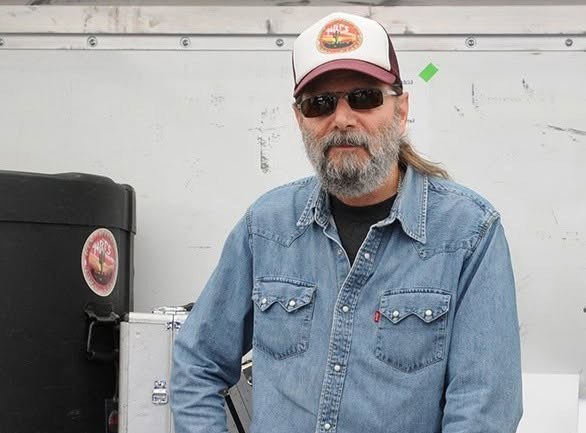
Through nearly six decades, from Long Island to San Francisco to New York and Dallas, Michael Falzarano has seemingly been in the right place at the right time. At those locations, he impressed the right people with his musicianship and knowledge of the catalog by some of the biggest acts from the San Francisco scene—Grateful Dead, New Riders of the Purple Sage, Hot Tuna, Jefferson Airplane. Just as importantly, he placed the artistic project first rather than stubbornly push his individual ideas.
His lengthy career has found him recording and touring the world with Hot Tuna as well as contributing to Jorma Kaukonen’s solo endeavors and joining David Nelson and Buddy Cage in a revitalized New Riders of the Purple Sage for 12 years. It also includes dozens of live collaborations and studio work with members of the Grateful Dead, Merl Saunders, Melvin Seals, Trey Anastasio, Johnnie Johnson, Vassar Clements, Warren Haynes, Dr. John and Paul Simon among others.

“It's the kind of thing where I found myself multiple times in situations where I looked around the room and thought, ‘I don't know how this happened. I'm just a kid from Long Island who used to play these songs in shitty little bars and now I'm here in the room with Paul Simon.’”
He’s currently keeping himself busy with Falz and Friends as well as The Englishtown Project, which plays songs from the legendary concert that featured the Marshall Tucker Band, New Riders of the Purple Sage and headliner, the Grateful Dead, in front of more than 125,000 people on Sept. 3, 1977 at Raceway Park in Englishtown, NJ.
He's also focused on his sixth solo album, Sunrise Over the Unknown. The release touches upon the themes of recovery and the journey back. It includes a collaboration with Robert Hunter that seemed to be touched by the cosmos.
There's a quote of yours that I wanted to bring up. You said, “Just leave the door open to whatever comes down the pike next because you never know where it's going to lead.” And you’ve lived that life.
There's no question about it. One door closes, the other opens. My favorite quote, along the same lines, is from the movie Temple Grandin. She said, “The door opened and I walked through it.” The door opens, you gotta walk through it. You gotta take a chance. There are calls that I would get in the early years, where I would think, “Wow! I can't believe I'm gonna go do this.” I almost talked myself out of it, and then, I thought, “Just go do it, and it works out, great. If it doesn't, then that just didn't work out,” but it almost always worked out.
I get this feeling that you’ve been invited to participate in all these different projects by keeping it together musically without letting your ego get in the way.
That's key. I'm level-headed. I understand the music business probably better than some, maybe not as much as others, but when I got into the New Riders, I was very helpful with them because Buddy [Cage] and David [Nelson] hadn't played together in a long time. The two younger guys—Ronnie Penque and Johnny Markowski—they've been playing in their local bands. Once you get into a full-on tour in the United States thing, things get a little crazy. I'd already been around the world with Hot Tuna. I'd already been as far as way as Japan and as close as my backyard.
I think it helps if you can have some talent and also be amicable and be open to whatever comes down the pike. I know a lot of guys who are really great, but they're very hard to deal with, and people don't want to deal with them. I talked to one of my friends about this because he's one of those people, and I'm going, “You have to learn to maybe, not be as vocal. If somebody's hiring you to do something, don't tell them how you're going to do it. If they want you to do something some way, and you want the gig, you’ve got to do it. Don't get in an argument about what's right or what's wrong or else don't take the gig.”
That has always been my philosophy, Get into something. Try not to make too many waves and just make it all come together.
In between all that playing live stuff I’ve recorded six albums of my own. That is what I really love to do is write songs because it's this magical thing that happens. I don't know how it happens. I don't know the process. It just sort of happens. I sit down, pick up a guitar and the next thing you know, I’ve got a riff, melody, and then a lyric comes or vice versa, any kind of configuration. Some of them come as complete thoughts and some of them take 20 years to write, but, eventually, it gets done.
As soon as I'm done with a project like this last one I put out, Sunrise Over the Unknown, I'm already recording again because songs come and I like to record them. For me, it's this thing that comes out of thin air. There's nothing there, the song doesn't exist, and then all of a sudden, before you know it, you're in the studio and you're playing something that might not have existed three days ago. I was able to capture it from the cosmos.
Keith Richards said he just puts his middle finger up in the air and tries to catch a tune. There are different ways of looking at this. Chris Robinson. I heard him say one time that it's just all one big giant song, and you're just taking a little piece of it, and it's got to come to you naturally. Other guys can sit down and just write songs. I don't know how to do that.
Years ago, I interviewed Brad Whitford of Aerosmith and he said that it wasn’t worth it to put out albums with new material anymore because it was challenging to recoup costs. What inspires you to record and release music?
What inspires me to do that is once you've written a bunch of songs like I did for Sunrise Over the Unknown. I wrote those songs and now I want to record them just to hear them, really. I'm recording them for myself.
Then, once I have enough songs, I realize, “Okay, this is an album's worth of material. These songs happen to hang together very well. Sometimes, you write a song and then you write another song and you couldn't put them on the same album because they’re two completely kind of vibes but all these songs came together.
I can understand a band like Aerosmith or any of those classic acts. They go in the studio and they gotta spend $100,000, $200,000 dollars to make a record. At my level, it's a small fraction of that and I think it sounds great. People don't realize the overhead that a band like Aerosmith would have, where they need a giant budget to go in the studio and they need time to write songs and get paid to do it.
With me and my immediate crew, both here in Texas on Long Island and Woodstock—three different groups of people that I record with—I just call them up, “ You guys want to record some songs?” “Yeah, sure. Let's go.”
The studio is where I get the most enjoyment, not that I don't like playing live. When I'm in the studio, I'm writing songs that are more concise whereas when I go out and play live, now we can stretch out on these things. Then, it can turn into whatever it turns into. The Grateful Dead did the same thing. They had some song songs and then they would go out and play them live and then they turn into these giant opuses, these big events.
It definitely makes me happy to go in and do it, and that's why I continue to do it. If it became a drag or I don't really want to be in the studio because it's a studio, and it's dark and sterile, then I would just stop.
The other thing that I do on all my solo records is, I always have all the musicians playing the song at the same time, just like we're playing live. I'll only do a song three times as I feel like after the third time, we're just going to start recycling parts. Then it’s going to become redundant. So, we'll come back to this song but we're not getting it today. Let's move on. I have other songs I want to record. That's been my theory for all these albums.
Some of them, you get lucky and you get a big review, like the last album, A Kaleidoscope Christmas. Rolling Stone magazine reviewed it. That was a fluke because Rolling Stone doesn't review small town guys like me. But there it was and it was a really great review. It definitely helped. It's the first time I've ever seen in real time a review actually help sell something because I was selling it myself at the time. It hadn't gone live to streaming and I was selling off my Facebook page. I was selling a lot of copies because it was 2020, and everybody was home. They had money, and everybody was buying it. Then, the Rolling Stone thing came out, and it doubled. Then, of course, it went live to streaming. On that day it all stopped. I didn't get a single order after that.
That album came out in 2020, and it’s six years later. Was it a matter of getting the songs with the same vibes together?
There were a couple things that happened. I started recording [A Keleidescope Christmas] in 2019, and I would have banged it out in three or four months but then COVID happened. So, now, a couple of months go by. Now, we're in the middle of 2020 and it's bad, as you remember.
So, then I started calling around seeing who has a home studio they could work with me on, and Jorma and Jack jumped in right away. Pete Sears jumped in right away. Jeff Mattson from Dark Star Orchestra, he came down to the studio. Jason Crosby from Jackson Browne's band, he came down to the studio I was working at on Long Island. Although COVID was still happening, we got it all together, and it came out at Christmastime for 2020.
Then in 2021, there's still COVID. Now another year goes by, the whole year-and-a-half went by. In 2021, it started to bubble up again. Throughout that whole period of time, I was writing songs. It wasn't like I just didn't do anything. That's what I did. I sat down, picked up a guitar. So, it comes to me, a chord change or a melody, and I write it down.
Then, around 2023, I decided I had enough songs for Sunrise Over the Unknown and I wanted to start recording them. So, I got together with all the guys from Long Island. They used to be in a band called the Zen Tricksters, which is like the premier Grateful Dead cover band in New York.
I knew Klyph Black through the Zen Tricksters. Klyph and I have been friends for at least 30 years. I don't remember exactly where we met, but I'm pretty sure it was at a show. It might have been Vassar Clements show where the Zen Tricksters were on the show and the guests were me, Levon Helm, Tom Hanway, I can't remember who else, but they were essentially the backup band.
All those guys, we've been friends for many years. So, when I started to think about doing this record, I immediately went to the guys I play with right now in the band that I have called The Englishtown Project, which is Kevin Griffin on lead guitar and pedal steel, Tom Circosta from Zen Tricksters, Klyph Black from the Zen Tricksters and Russell Stedman from the Zen Tricksters. Russell also played with the Jeff Matson Band for years.
That's my core band on Long Island. So, I sent them a couple of rough demos and they listened, then we got together in the studio, and we started working out the songs. Most of the songs came together there. I think I was in the studio for that session, maybe two days, and we recorded the bulk of the songs. I've been working with those guys so long that they know how I work, I know how they work, and we get the job done. It's comfortable. They know what to expect.
I'm also not one of those guys that goes in the studio and says, “This is how the song goes, what I'm looking for.” I'm more of a guy that’s like, “Let's play the song. Let's capture the moment. Take a snapshot in time and if it's cool vibe, if it's got an energy then, I'm good with it.” I've worked with some of my friends who will tell everyone, “The song has got to go exactly this way,” Even though it sounds great, I don't like that.
When I'm in the studio, I always tell the guys, “Look. I don't know what I'm looking for. I know what I'm not looking for, and if I hear that, then I'll say that's not the vibe. That's not a lick I want. We'll try something different.” Whether it's the guys from Long Island or the guys from Texas I work with, we've always been able to come up with something that works for that particular song.
So we started in 2023. Then in the middle of 2023, and I get diagnosed with some health issues. I had cancer, so, that's slowed me down. Then, there are other things that happened with people passing away and people get clean and sober. That's why all these songs have that kind of thought in mind. So, it took a little bit more time. By the end of 2024, I was able to finish it up. It's not just the album. Now, you’ve got to get the artwork together. I’m trying to do all of this at the same time. I'm a one-man show. I own the publishing company. I write the songs. I sing the songs, and do the whole package. There's a lot going on. So, by 2025, everything was up and ready to go. Early in 2026, it was going to come out and then something happened and it got pushed back a little bit and it got pushed back again. Eventually, it came out in July.
You mentioned about the album touching upon the themes of recovery and the journey back. You started recording the songs in 2023 before all these things happened to you and other people. So, was that originally a part of it?
I started writing songs in 2023. There were one or two songs touched on that. For instance, I was talking with the drummer Russell Stedman. You couldn't meet a more clean, sober, nice guy in Russell Stedman. That said, we were driving to a gig one time, and he started to tell me his story, and his story was that years before he was a drug addict, drunk, lost everything, his wife divorced him, lost the house, lost the car. Kids wouldn't speak to him. I was shocked because if there's ever a person that I thought wasn't that person, it's this guy.
But, that's what happened. Later that night, I started to put that altogether in my mind and the song, “Mighty Mississippi,” came together. It's loosely about him because, basically, he said that he realized at one point, “If I stay doing this one more day, I'm gonna die,” and he just decided that was it. He hit rock bottom. He couldn't swim any deeper into this mud, and he decided to clean up. So, that was one of the first songs in that theme.
The other songs are all in that theme as well. They don't sound like that because they kind of sound upbeat and happy but that's pretty much what the vibe was in for some of the other songs. For instance, “I Had a Dream Last Night,” that was the song I wrote with my friend, Terri [Billinghurst Wilkinson]. Now, she's not a songwriter. She's a schoolteacher but she's written a paragraph on a Facebook page, and she said, “I had a dream last night about my mama. It was summertime, and I was about 11 and I was jumping Double Dutch with my sister.” I thought, “There's something there that feels like a song.” So I picked up a guitar and the next thing, you know, it's a whole song. I sent her an email, the demo and I said, “I bet you didn't think you're gonna wake up this morning a songwriter but this is what happened.” Her mind was blown. That was about coming back from grief. “One Brick at a Time” and “Take Back What's Mine” are both songs about having to come back, trying to get back to where you once were. Getting over the trauma of it all.
How did dealing with cancer change you as a person and a creator?
As a person, you have to deal with things a little differently. You have to deal with things as they come at you, all this stuff. Your mind could start to play games with you because you can go down a million different rabbit holes. I try not to do that, but there were times when I did.
As an artist or as a songwriter, I don't think it's changed anything because I basically still do everything the way I used to do it. There are times during this last three-year period where I had to take the time off to deal with treatment, which I did, but then I got right back on the pony and started to ride again. Like I said, we just spent several months touring. So, it didn't really affect that aspect of things. Maybe it will someday. I can't say about that.
I know a lot of people that were in the same boat. That it has affected them. They can't handle the drugs. They can't fight through the fatigue. That's the only thing I felt more than anything is fatigue because your body's working overtime. I like to say it hasn't been pleasant but it hasn’t been horrible.
Did it give you a different view on life?
In a sense, yes. You don't think about it too much when you're just living your life day-to-day but when something happens, you realize how fragile your life is. Now, this could kill me someday or I could walk out on the street tomorrow and a piano could fall on my head. We don't know what's going to happen. So, I try and keep everything in perspective.
Now, there are days when it gets a little overwhelming and I just power through it and get through the next day and then I’m fine.
I've written some songs that, maybe, are inspired by that, but I think this group of songs that's on Sunrise Over the Unknown is more about the other side of it, getting through it. How I feel about it? The other thing on this particular album is I was very fortunate to have written a song with Robert Hunter.
Robert and I met in the late ‘70s, early ‘80s. Jorma and I were friends, and he called me up one day. “Listen, I'm going over to my friend Bob's studio. He's recording a new album. You want to tag along?” I said, “Sure.” I'm doing nothing. I'm in my late 20s now. I'm like a kid in the candy store. You kidding me?
He picks me up. We drive up to Marin or wherever it was in Northern California, north of San Francisco. We walked into the studio. Right away, I realized this is some kind of Grateful Dead studio or something because it's Robert Hunter. He's over there. Bob Weir's coming and going. John Cipollina is stopped in. Jorma’s here. I thought, “Wow! This is unbelievable.” Throughout that session—I think it was like two days—I got to know Robert a little bit.
Later on, we ran into each other, after Jerry passed on, for the Furthur Festival. I reintroduced myself to him, and he said, “I remember who you are.” A little bit later, he came to the New Riders of the Purple Sage in California. We go on stage for the first set, and I get onstage and I looked down, and in the middle of the crowd, up close to the front of the stage, but not too close, Robert Hunter’s standing there. I'm like, “This is unbelievable. What is he doing in the middle of that crowd?” But he stood for the whole set, was loving it, and he wrote a really great review.
At set break, he came backstage. I re-introduced myself to him again, and, again, he said, “I remember who you are.” That was kind of it.
Then, I was going online to do some research on a song called “Listen to the Rhythm of the Falling Rain” (aka “Rhythm of the Rain”) by the Cascades because somewhere along the way when I was younger, I read somewhere that Link Wray had written that song under a pseudonym and gave it to the band. I thought, “Now, we have Google. I could check it out.”
There was nothing about that Cascades song that came up but just below it, the second Google search result was something called “Cupful of Rain.” “That's an interesting title. Let me click on that.” It's the rabbit hole of Google. So, I click on it and it's a two-page illustration, kind of like a cartoon, and I'm reading it and I'm thinking it's kind of lyrical. So, I picked up a guitar and started playing something and made little changes. Then, it became a thing. I said, “Let me look. Maybe, it shows who wrote this and at the top it said, “Illustration by…” I forget the guy's name right now. I'll look it up and “…words by Robert Hunter.” I thought, “Could it be the same Robert Hunter?” I didn't know him to do illustrations
So, I figured, “You know what? I'm just gonna send him an email and see what he has to say about it.” I said, “Hey, Bob. I stumbled on this thing, “Cupful of Rain,” and I came up with a melody and chord changes. I was wondering if you haven't done anything with it, would you mind if I put some music to it?” I explained to him I was looking up the Cascades…He got back to me pretty quickly and said, “I did have something for that but I can’t remember what it was. So, why don’t you go ahead.” So, I did.
I was with Zen Tricksters that night or the next night and we played it on a radio show. I’ve been playing it ever since. I played it with the New Riders. I played it with many bands. Then, when I was doing this particular group of songs, I felt like it really fit with these. I wanted to record it for other albums, but it never really fit with the other songs. So, I didn't put it on any of those. With this one, I knew it would fit. When I recorded this bunch of songs, it was one of the first ones we recorded because I played it many times with the Zen Trickster who I was in the studio with at the time.
Hunter was not the kind of guy that tells you what the song is about or anything like that. In my mind, I felt when I sing the song, I feel like, maybe, he wrote it about the passing of Jerry [Garcia] because the lyrics are what they are.
I probably wrote the actual song maybe 20 years ago and I played it on and off. It was one of my favorite songs to play whenever I'm playing solo stuff by myself. I always include that song in the set.
I just remembered that the illustration. I did go online and find the illustration. It's by Timothy Truman. I think he did a couple album covers for Robert Hunter, and various other people.
You mentioned The Englishtown Project. How did that come about? Will you play any of these songs in that setting?
The Englishtown Project, as you probably already know, is very specific to the Grateful Dead, New Riders of the Purple Sage and Marshall Tucker Band, three bands that played the original show on Sept. 3rd, 1977. The reason I started that band eight or nine years ago because everywhere I went with New Riders of the Purple Sage, somebody would come up to me and say, “I saw the New Riders in Englishtown!” “Englishtown was my first Dead show.” Somewhere along the way, I was talking with one of my friends, Rob Wolfson and I told him the story. Then we said, “We should just put a band together with the guys and play some of the songs.” So, that's what we did.
I called Pete Shapiro and he gave us Brooklyn Bowl on Sept. 3rd, Memorial Day weekend. I thought, “Memorial Day weekend in New York. Most people are going to leave Brooklyn and New York.” Fortunately for us, it was a rainy Labor Day weekend and 500 people showed up. So, right away, I thought, “There might be something here.”
We had a great time. We were only going to do that one show. I think we might have done a warm-up show at Garcia's just to do because we hadn't done it yet. I had no preconceived notion about it. I thought the one show would be fun, playing with all my friends. All the Zen Tricksters guys were very schooled in all that material. Playing with me for so many years, they know the New Riders stuff. They know Marshall Tucker, and they know the Grateful Dead inside out, upside down.
I called up my agent at the time and asked what he thought about it. He said, “If there’s an audience then great, let's do it.” So, we did. The one show has now turned into close to 200 shows. It's a lot of fun to do. Some of the shows coming up in the fall and the winter will be Englishtown shows and then the other shows I usually do under the name Falz & Friends because many people shorten my name down to Falz, or Michael Falzarano & Friends. In that, I encompass everything—the New Riders, Hot Tuna, some original songs. I would play some of these original songs in that setup. It seems to work out. People seem to dig it.
But before we finish I’d like to relate one more thing about the song “Cupful of Rain?” Remember, this whole thing came about because I was doing research on the song “Rhythm of the Rain” by The Cascades. In his email to me, he did say, “I really love that song. It's really great,” and we had a little discussion about that.
After he passed, I was asked to come up and play up in Woodstock at The Colony Woodstock. They were doing a memorial show (“Hunter Gathering: A Celebration of the Life and Art of Robert Hunter” on Dec. 15, 2019). They asked me to come up and do a couple songs. I agreed. He said, “What do you want to do?” I said, “I'd like to do “Friend of the Devil” because “Friend of the Devil” was originally meant as a song for the New Riders of the Purple Sage, but history would change that. Once Jerry heard it, he did what he did and put the bridge in, and the rest is history. I said, “And I'd like to do the song I wrote with Robert Hunter, “Cupful of Rain.” They said, “That'd be great.”
So, I come up. There's a bunch of people playing. I wait my turn. I go up and I play in a little trio that includes Professor Louie on accordion and piano. I do “Friend of the Devil,” and I explain a little story about the whole thing, how it came about, how David Nelson came up with the intro, how John Dawson supposedly came up with the line “friend of the devil” according to an interview I read with Robert Hunter. Then, we did a “Cupful of Rain.” I said a little story about that.
Because I was at the time living in New York City, which is two-and-a-half hours away, I didn't stay for the whole night. I decided I was gonna take off. So, I got in the car, and I don't like to listen to music too much after I play music or go see a show. So, I'm driving in silence down the [New York] thruway. Then, I turned the radio on, and I push the button for the radio and the song began, “Listen to the rhythm of the falling rain,” came on the radio.
I thought, “This is some kind of sign because I was thinking about the song, the whole ride down there. I wish Robert was here. I wish I could have played it for him. Literally, it was like pressing play on a CD player. I couldn't believe it. I immediately called up David Nelson, and he said, “Oh my God! I don’t know what's going on? That's gotta be a sign of some sort.” I go, “Yeah, Dave. I don't know, some kind of sign. Don't know what it means, but sometimes…” Anyway, I find that interesting,
Maybe it was Robert saying, “Hello.”
Think of all the millions of songs, the many radio stations. Any of those radio stations could be playing…and I hear that song. Come on, that’s from another plane somewhere.





