

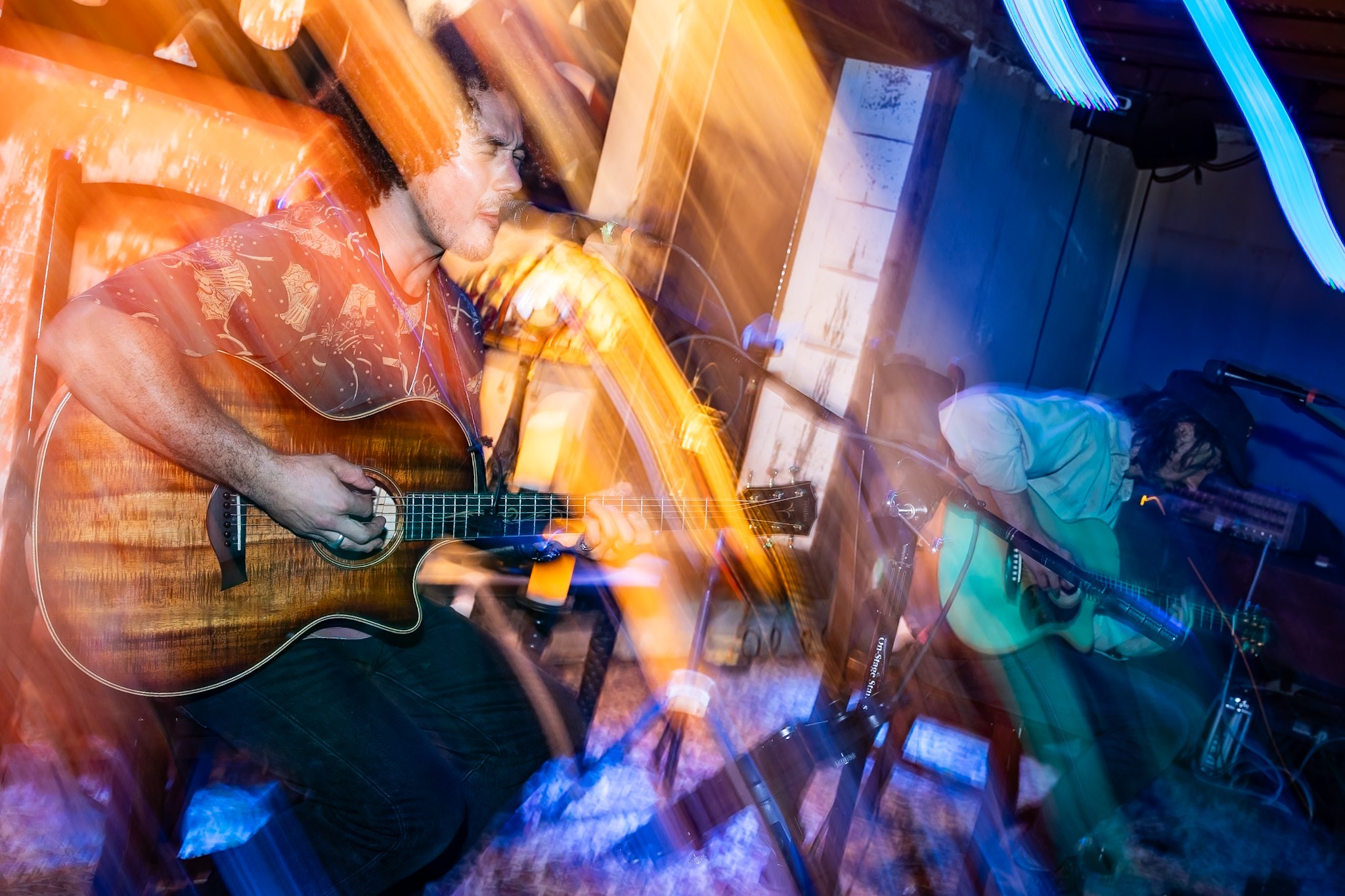
Brian Murray and Jimmy Law, who share six-string duties with Dogs in a Pile, recently brought their acoustic duo to Dharma Bums on Friday night. The New Hope room, which sits atop an amazing vegetarian restaurant, just celebrated its third birthday, and Murray's Law was one of many household names to play the venue that month, (Others included Stanley Jordan and Tom Hamilton.) The pre-show PA played Doc Watson, which wasn't an accident: Murray cites Watson, as well as Tony Rice and Norman Blake, as influences. He introduced Law as his better half, then went right into "Stump Water," a nod to another pair of influences, Chet Atkins and Jerry Reed. They established the structure of the evening right away, trading leads empathically and supporting one another with playing you'd be hard pressed to call "rhythm." They eased into a slinky cover of John Hartford's "Joseph's Dream." Their voices split the labor as cleanly as their hands. Murray's is a gravelly instrument, strong and a bit worn at the edges, somewhere near the 1970s Don Henley register. Law's is somehow sweeter, soulful but not overwrought. His right hand showed how a two-piece gets a crowd moving without a rhythm section, though it also didn't hurt that each player had a pedalboard before him. (They also were both plugged into the house system directly and also had acoustic mics, contributing to a rich sonic presentation.) Murray used his octave pedal tastefully throughout the night and used some combination of chorus and compression to add a 12-string-like shimmer to the sonic texture. Delay and echo sat on everything, helping fill out the sound in the absence of a full band. A few tunes in, Murray's guitar found a high, clipped, tightly-voiced attack that read almost like a mandolin: bluegrass in the mechanics, without the costume. Weir and Barlow's "Black-Throated Wind" turned up, appearing on Weir’s Ace before it was ever a Dead tune. Its instrumental tail wound down and opened out into "Lazy Susan," a Murray original written in Nashville and not another one from the songbook, though it’s understandable why you might think so. The men in the room donned ponytails and hats: some trucker, some baseball, and exactly one backwards, which in a New Hope Dead room counts as a demographic finding. The second set is where the duo stopped sounding like a reduction and started sounding like a format. They offered big dynamic swings and a stretch that veered close to ragtime and old-time – a shorter walk from bluegrass than many playing Dead songs are willing to take – along with a passage of carnival music that had no business working. Murray offered a “Bathtub Gin” tease that grabbed the room instantly, along with an instrumental that circled long enough that it sounded like it was headed into "Ghost." "Unfocused" ran into "Little Things," which came out with more bounce than the electric version and a steadier drive underneath. Law built one section from nothing but a percussive octave figure on the acoustic, and somewhere in there a pick swished flat across the strings, a scratch left in on purpose. One tune landed hard enough to get a comment back from the stage – they used to open with that one, apparently, which is what a duo says about a song that has outgrown its old job.By that point the argument for the format had stopped being a critical one and become a floor-level one. People were dancing, and it was obvious why.Lead, rhythm, and percussion, were all accounted for and not overcrowded. The songs are built for two, and left the crowd with a fairly clear picture of what five people would do with them. The joke in the name is Murphy's Law, and it holds up better than a pun has to: a duo is the format where whatever goes wrong arrives unaccompanied. But in this case, nothing did. The set closed on a tune that opened out into a big, airy jam. They came back for one more, “All The Same,” and left the crowd wanting more.

Subscribe to skip adsAdvertisement