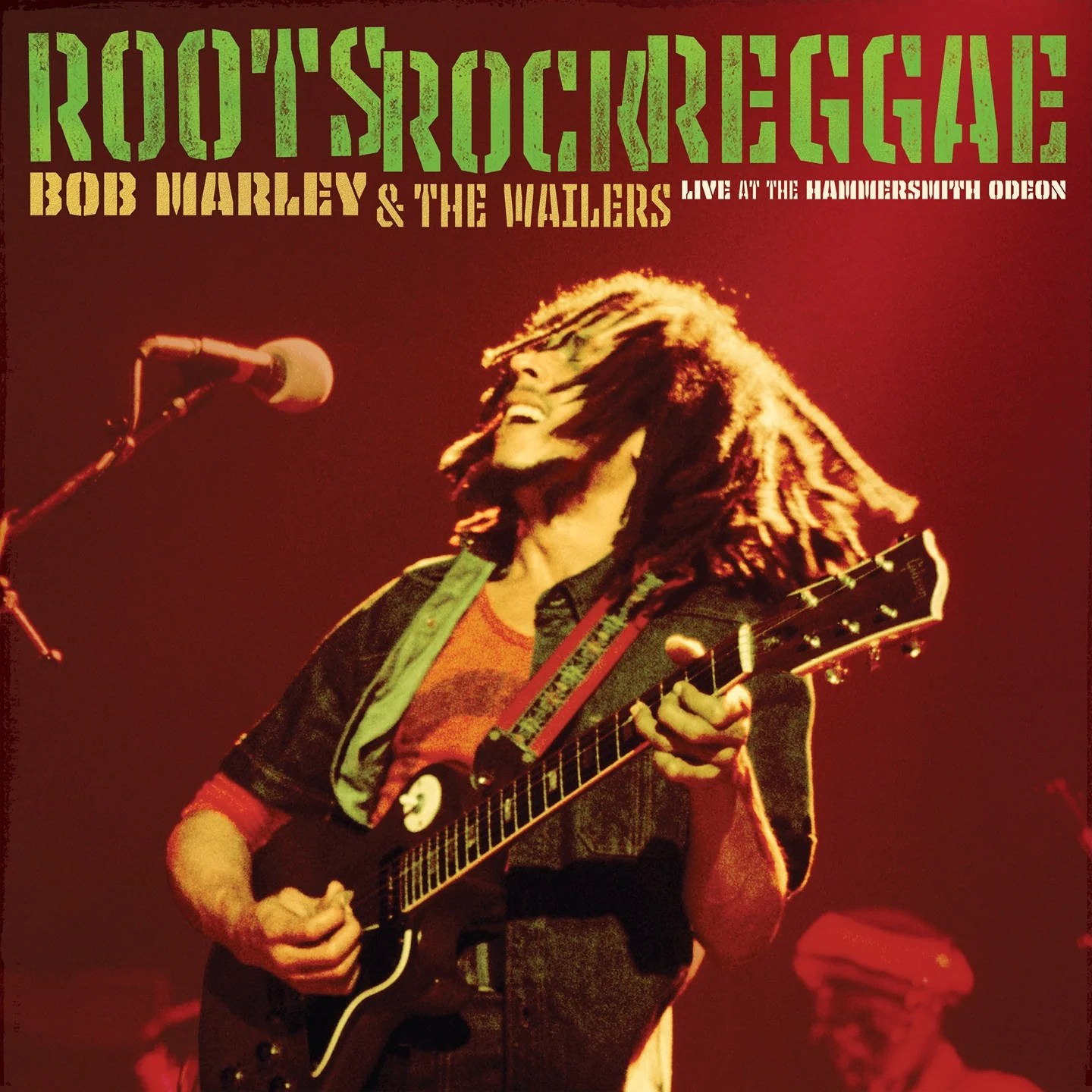
Though inextricably linked to the island birthplace that informed nearly everything we’ve come to understand about the myth and majesty of Bob Marley, his live performances far away from the shores of Jamaica continue to be plentiful source material for greatness. Simple logistics- pro recording gear available, not to mention Island record label headquarters, in proximity to the venues- certainly account for the most plausible explanation. Still, as the two-disc Roots Rock Reggae amplifies, Marley and his Wailers abroad are, once again, mystical magic.
Extracted from a series of shows in the summer of 1976 at London’s Hammersmith Odeon, this archival set chronologically follows the ’75 summer tour that resulted in the marvelous Live! LP- itself, tracked at London’s Rainbow. It also follows the release, earlier in ’76, of the studio album, Rastaman Vibration, that saw the reggae superstar asserting himself more as a Third World spokesperson.
Whereas Live! is a whip-dangerous, spark-spitting wire transmitting tales of Trenchtown, seducing its audience into a frenetic collaborator, this 18-song collection is more refined, more subdued- at least, through its first dozen selections. Attribute that, partly, to a splendid mix and mastering- from John Morales and Kevin Reeves, respectively- that favors the sweeter, dual keyboard efforts of Earl Lindo and Tyrone Downie over the hypnotic pulse of the non-pareil royalty of the Barrett brothers- Aston and Carly- on bass and drums.
Marley, too, is front and center, vocally, playing with words and phrasing, and off of the shimmering I-Three, for max effect. No more so than on the encore, housed on the second disc, that elevates this double to repeat listens. Across the finale, Marley swarms, tying together the social and political indictments of “Rat Race,” “War,” “No More Trouble,” and the closing “Get Up, Stand Up” into a breathless cascade of verse and variation. It’s as impressive and evocative physically and emotionally as it is artistically, with Marley discovering new and unrelenting corners to blitz.
Any Marley live recording is bound to have surprises. He was an artist and performer seeking, always, and driven by spirit. No two shows are ever the same. Roots Rock Reggae is another critical, historic document of a recording, as any Marley performance should be considered. (Just months after this tour, would-be assassins shot and wounded Marley at his home in Kingston, leading to his self-exile in England.) Most importantly, this is exemplary Bob Marley and the Wailers in London in ’76. Motivated, spellbinding, and singular.