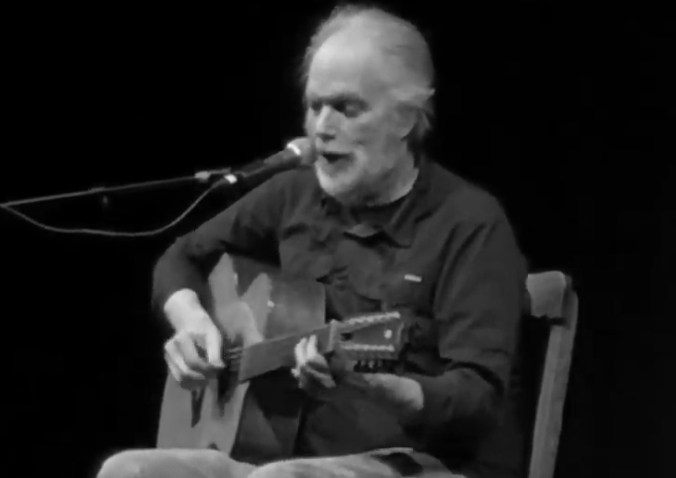
“This is a weird job,” Leo Kottke said about halfwaythrough his Easter Sunday concert in Newark, Ohio, as he contemplated the“black knob” - also known as a mic - staring him in the face.
Being a solo act, flying without a setlist andhaving no one to play with, makes for antisocial performances, Kottke saidlater in the show as he joked about the Donner Party survivors who opened arestaurant in San Francisco.
“They have a new menu,” he said.
Between his musings and for the third time in asmany years, Kottke held the audience at 31 West in rapt silence as hedemonstrated what an acoustic guitar - two, actually; a 12-string and asix-string - can sound like in the right hands. And in Kotte’s hands, theguitar can sound like a bass, a dulcimer and multiple guitars all at the sametime.
For 95 minutes, the peerless axman ran through a mixof covers like the Allman Brothers Band’s “Little Martha” and originals such as“Julie’s House” on a stage adorned with nothing but a chair, a mic stand, aPersian rug and Kottke’s two guitars. And although there was nothing to see interms of staging or lights; Kottke’s hands were a show unto themselves.
When Kottke played slide, his guitars rattled androlled like a raging river. When his fingers danced along their necks, Kottke’sguitars rang out with harmonics and other consonant sounds. The capo heemployed on “Corrina, Corrina” provided yet another tuning to the many he usedthroughout the evening.
He was funny, but less talkative than usual, hittingan occasional bum note - which almost never happens - and taking his time totune up. This is a fine thing where Kottke is concerned because his tunings areoften as intriguing as other artists’ songs.
“All you get with a tuner is an opinion,” he saidduring one such exercise.
Most of the songs were instrumentals, numbers like“Wet Floor” and “Cripple Creek” and he occasionally sung tunes like “Last Trainto Chico” in his affective baritone.
No matter what he was doing - playing, playing andsinging or tossing off the goofball asides that mark his performances - theaudience was pin-drop quiet, laughing at his between-song banter and breakinginto applause only after the last sound of each song faded into the ether andrewarding the guitarist with a raucous standing ovation after the final tune -an encore that wasn’t an encore.
“That’s the end of he set,” he said as he remainedseated and swapped his six-string for the 12 he’d put aside after a handful ofopening numbers.
“I’d like to play the encore now and we can allleave the building at the same time.”
He did.
And we did.
And it was nearly perfect.