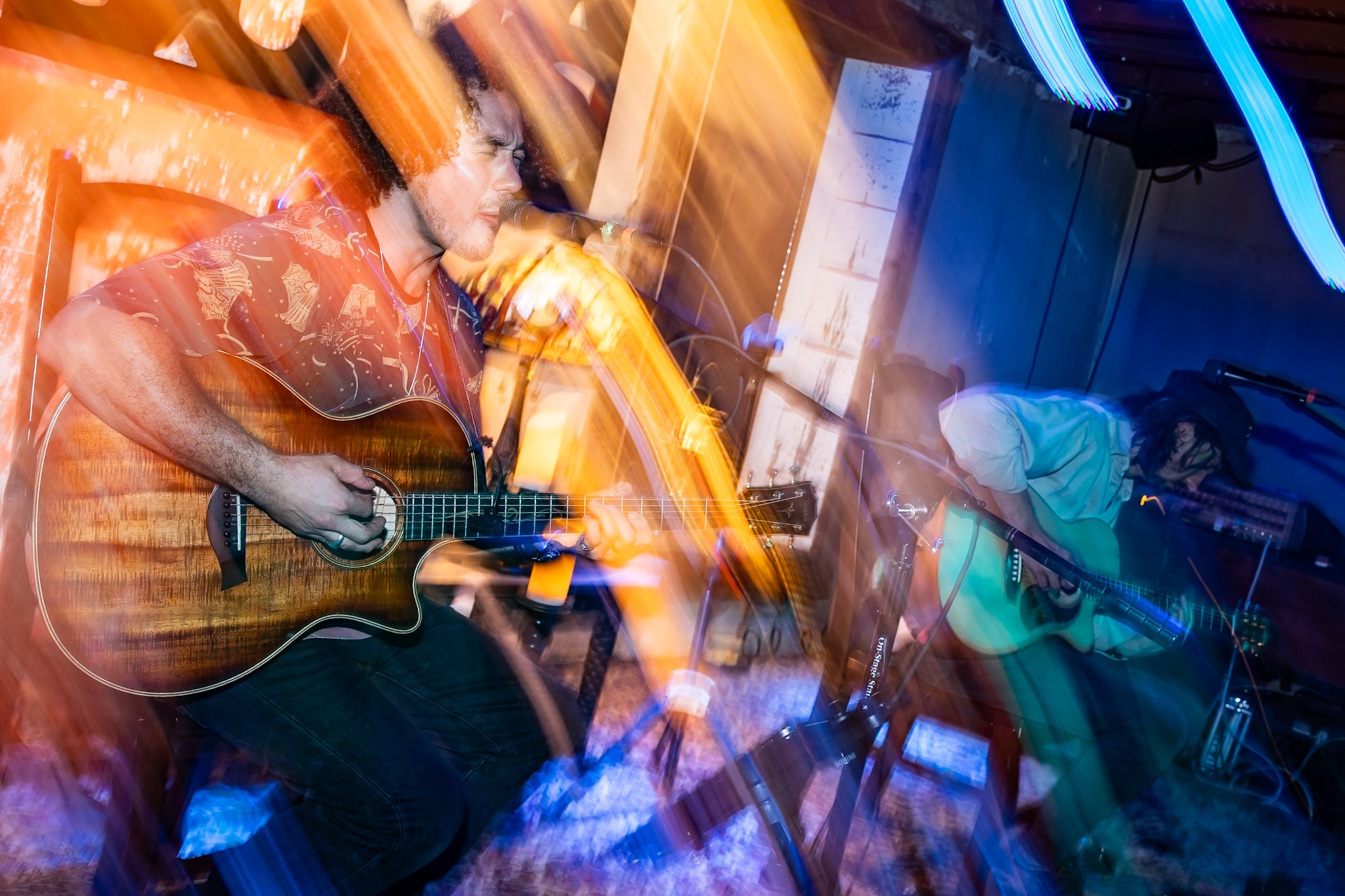
Photo by Vernon Webb
This was certainly not your standard Hot Tuna show. The accompanying line-up served to take Tuna into uncharted waters. This was an evening of music for fans with eclectic tastes and unerring reverence for music of timeless depth, strength and beauty.
The line-up, assembled by Columbia Artists Management, rolled into Durham’s nearly 90-year old Carolina Theater for the 19th show of its two-or-so-month “Hot Tuna Blues Tour.” Although by the end of the night I felt “Hot Tuna Revue” may have been a more appropriate name with the rotating cast of musical characters and the music extending far beyond simply The Blues.
The current core Hot Tuna trio commenced the opening acoustic set with “Hesitation Blues,” considered by many to be Jorma Kaukonen’s signature song despite having been written decades before he was born. Those who had not seen Tuna in recent were immediately shown why Barry Mitterhoff fits in so well, as his he judiciously wove his mandolin into the music. Here, as he would much of the night, he played with subtlety behind the vocals here, introduced thoughts from which Jorma would expound on his solos there, and at points just flat-out “tore it up” on his own solos. As to be expected these days, Kaukonen was in classic form almost immediately. It is astonishing how he has continued to improve as a player at his advanced age. He artfully merged drawn-out low notes with brief higher flurries while keeping it all decidedly musical. He later played ideal counterpoint to Casady’s articulated rolling thunder of a solo, and even deftly threw into some snazzy dissonance during the final chorus. I was struck by the clarity of sound, as Tuna has at times over the years made liberal use of distortion even in acoustic sets. Here the clear and rich sound was most appropriate inside the sonic idealism of the Carolina Theater. The guest parade had not even begun and I knew we were in for a doozie of a show.
GE Smith then made his debut, donning a dobro and joining on Jimmie Rodgers’ “I’m Free from the Chain Gang now.” Smith’s subtlety helped to layer what was a mesmerizing blend of instrumentation during this old time country blues number the execution of which deviated from the predominant Tuna ethos of yesteryear by featuring short lead sections. Kaukonen’s singing here (and on “Second Chances” later in the set) was indicative of just how much better of a vocalist he is now than he was twenty or so years ago. These two pieces would not have been nearly as effective without his clear vocals which were artfully phrased with palpable expressiveness. He had the room in the palm of his hand when he sang “chances are like crystal, they shatter when they fall” on the movingly reflective “Second Chances, ” (a Kaukonen original which appears on the forthcoming Hot Tuna release Steady As She Goes, the band’s first full length studio release in over two decades).
However it was during the (sadly) still appropriate “Uncle Sam Blues” that Charlie Musselwhite first graced the stage. The Mississippi native who spent several years cutting his teeth in Chicago and has played with a veritable “Who’s Who” of blues musicians (including Muddy Waters himself) in his four decade-plus career since has somewhere along the way become inarguably one of the greatest harmonica players who ever lived. His every note seemed laced with enthusiasm and informed by his healthy experience and genial spirit. Musselwhite’s keen listening abilities helped him settle into the world of Hot Tuna with seeming ease and the brevity of his approach allowed for not a note to be wasted. He quickly read Mitterhoff’s cue for interplay at the beginning of Barry’s solo, and in turn acutely aware of when to back off. His own solo soared and then he joined in on Kaukonen’s peppery repeated notes to help the band leader bring his own solo to a rousing climax.
“Nine Pound Hammer” found Jorma singing in his more traditional fashion – with an appropriately spirited growl and some “fall-behind-and-hurry-to-catch-up” phrasing. Jorma has arranged a central riff for this song so blatantly infectious that it has become the theme music for Fur Peach Ranch Radio, an Ohio Public Radio program featuring performances from Kaukonen’s own Fur Peach Ranch guitar teaching school. Mitterhoff and Smith (on a riser behind Casady) each took sterling solos and engaged each other in interplay along the way.
Jim Lauderdale then entered and brought his, what I call “Nashadaelica,” with him. Jorma offered nice melodic inputs which blended sweetly with Lauderdale’s high lonesome vocals on “Halfway Down” (a widely-covered Lauderdale original). The song rollicked along with a Hank Williams-esque honky tonk swagger, with Kaukonen and Casady offering brief adornments without departing drastically from the core feel of the piece. Lauderdale then gave a “shout-out” to the nearby Carolina Friends School which he attended many years ago. He then led group through two songs from last year’s Patchwork River, a collection of songs he co-penned with Grateful Dead lyricist Robert Hunter. The optimistic, “Good Together” had a distinct Bay Area feel, and Lauderdale sang the lead with earnest, although the choruses screamed for more vocal harmony. “Alligator Alley,” something of an activist ballad, was extremely well-received by the North Carolina audience. Jorma even dropped a quick bit of fuzz guitar behind Lauderdale’s singing of one of the “girl named Alice” lines, harkening back to Jefferson Airplane’s, “White Rabbit.” Charlie Musselwhite then returned to bring some funky harmonica to the loping country rhythms of “Headed for the Hills,” with Lauderdale’s voice again soaring triumphantly over the music. Mitterhoff even offered some vocal harmonies, Smith played a very brief but strong solo and Casady’s low-key, yet-still-bubbling-with-exuberance bass lines (not to mention occasional mouthing of the lyrics) indicated that this might be a Lauderdale favorite of his.
Musselwhite then assumed lead vocals for “Sad and Beautiful World,” a song he reportedly wrote with his mother in mind, and recorded with Mavis Staples on his 2010 release, The Well. Musselwhite’s conversational vocal style possesses elegance and an underlying smile which on this night for some reason also managed to at once place me in the mind of John Hartford and still convey the emotion of the song. His harmonica colorings were brought forth with the paucity for which Musselwhite has become revered over the years. Jorma then took center stage again to enrapture the crowd with some incredible left hand work as the band powered through a high energy acoustic-rockabilly take on “Just Because.”
Photo by Vernon Webb
The second set was all electric, kicking off with a couple of Tuna chestnuts delivered with fire and Smith again augmenting. “Ode to Billy Dean” from the band’s 1972 Burgers release featured Mitterhoff playing leads on an electric tenor guitar (typically a rhythm instrument) and GE and Jorma each offering counterpoint solos – Smith a fiery scorcher and Kaukonen a more finessed approach. The band even engaged in some ensemble play after the final vocals. Then we were taken to Tuna’s 1973 studio effort Phosphorescent Rat by, “Corners without Exits,” a somewhat breezily-cored tune by Tuna standards. Kaukonen offered some of his best rhythm guitar of the night on this number, and Casady again shook the heavens with spine-tingling bass. Kaukonen waited until the end of the song to really dig into his Sunburst and when he did, the sparks flew.
Musselwhite returned and Smith stepped up for lead vocal on “Long Gone Bowling Green,” a roaring version of what sounded like a song from the early part of last century, but seemed to contain different lyrics from a song which WC Handy penned as a tribute to a legendary bank robber which shares the same name and was made famous by Louis Armstrong. This was Smith’s time to shine with his lead vocals and searing guitar work on his Gold Les Paul. He also provided smart rhythm guitar behind Kaukonen and Musselwhite solos and interplay. It was interesting to see Smith assume the band-leader role here as he seemed to also do on the Musselwhite material all night.
Jorma then resumed the mantle to sing two covers which also appear on the forthcoming Hot Tuna release, Steady as She Goes. Marshall Wilborn’s “Goodbye to the Blues,” and Mark Markham’s cheeky “If This Is Love.” The former came off as Hot Tuna’s answer to Genesis’ “That’s All” and featured Lauderdale’s backing vocals. The latter was a hard-driving rocker with playful lyrics and incisive solos from Mitterhoff, Smith and Kaukonen (who prudently used distortion with classic modern times Jorma effectiveness). Smith culminated his solo with a full-on rock and roll flourish that delighted those who had found dancing room behind the seated audience.
Then Musselwhite was in the spotlight once again… His harmonica had a classic feel throughout this set; presumably it was run through an old guitar amp to lend “that Little Walter sound,” which fit snugly in this musical context. When Musselwhite performs “If I Should Have Bad Luck” solo, it often comes off as a bit mournful. But with Hot Tuna and GE Smith propelling him the song took on a defiant “bring on the bad luck” feel. Casady took particular delight in this one, stalking the stage as he thumped a muscular bass line. GE Smith scorched the beginning of his solo, but as happened in many ways on this night of jaw-dropping musicianship – he turned to Musselwhite mid-solo and engaged him in tantalizing interplay. During “Where Highway 61 Runs” Jorma seemed joyful, adding guitar color as the piece chugged along. When Musselwhite started using his left hand as trumpeters use mutes – each musician on the stage altered their inputs appropriately. Smith and Kaukonen brought the song to a rousing close. They exchanged licks (Smith with a more measured approach, Kaukonen more earnest, the two essentially role-flipping) and then they finally came together on a single, triumphantly repeated riff.
“Christo Redentor,” introduced by Musselwhite as “a song I first recorded 45 years ago, and it is STILL a great tune” followed and served as a bit of a show-stopper. This elegant piece hushed the crowd and brought forth some of the most lyrical playing of the night from Musselwhite and Mitterhoff. Delightfully sparse, this piece (which has also been recorded by Donald Byrd) had a middle section reminiscent of the central melody of Doc Pomus’ legendary piece, “Lonely Avenue.” Hot Tuna fans clearly had to take note that on “Christo Redentor” we were treated to about as close to a jazz solo from Jorma as we are typically gonna get. Lauderdale boldly and confidently stepped up to follow this strong number by leading the band through “Jawbone” (also co-written with Robert Hunter). The Tuna four provided most of the accompaniment, as a low-key Smith and Musselwhite huddled at stage right. Mitterhoff’s electrified mandolin soared on this number, the most Tuna-esque of the five on which Lauderdale sang lead on this night. Kaukonen delighted in playing with the infectious rhythm, while still finding space for occasional adornments. “Come Back Baby” concluded the set with the full ensemble on stage and everyone getting to solo. Musselwhite seemed to summon the Gods with his solo, Lauderdale sang a verse and GE Smith got wizardly with a slide which served as a prelude to an explosive Kaukonen solo before the final return to vocals. It served as a fitting and energetic end to a fantastic set of electric music.
Clearly Hot Tuna feels as though GE Smith is a de facto member at this point. Not only did he mingle impressively with all the musicians all night, but when Tuna returned for a “bringing it all back home” type encore surely specifically designed with the wild side of the Tuna fan base in mind, GE was there once again. He was part of a full-throttle Tuna-mayhem take on “Funky #7.” The band sunk its teeth into this with the unbridled ferocity which characterized the lion’s share of its legendary performances of the 70s. Casady unleashed a bass solo that literally shook the old theater to its foundations, and Jorma and Smith once again demonstrated that their times sharing the stage at Jorma’s Fur Peace Ranch have bolstered their musical kismet. Their solos spiraled to incredible heights, so much so that some of this chair-trenched (yet respectful and attentive) audience even (gasp) got up and DANCED. After a night of successfully sharing the stage with top notch musicians, Hot Tuna returned to its own uniquely and wildly psychedelic-laced blues sound – one which will outlive us all.