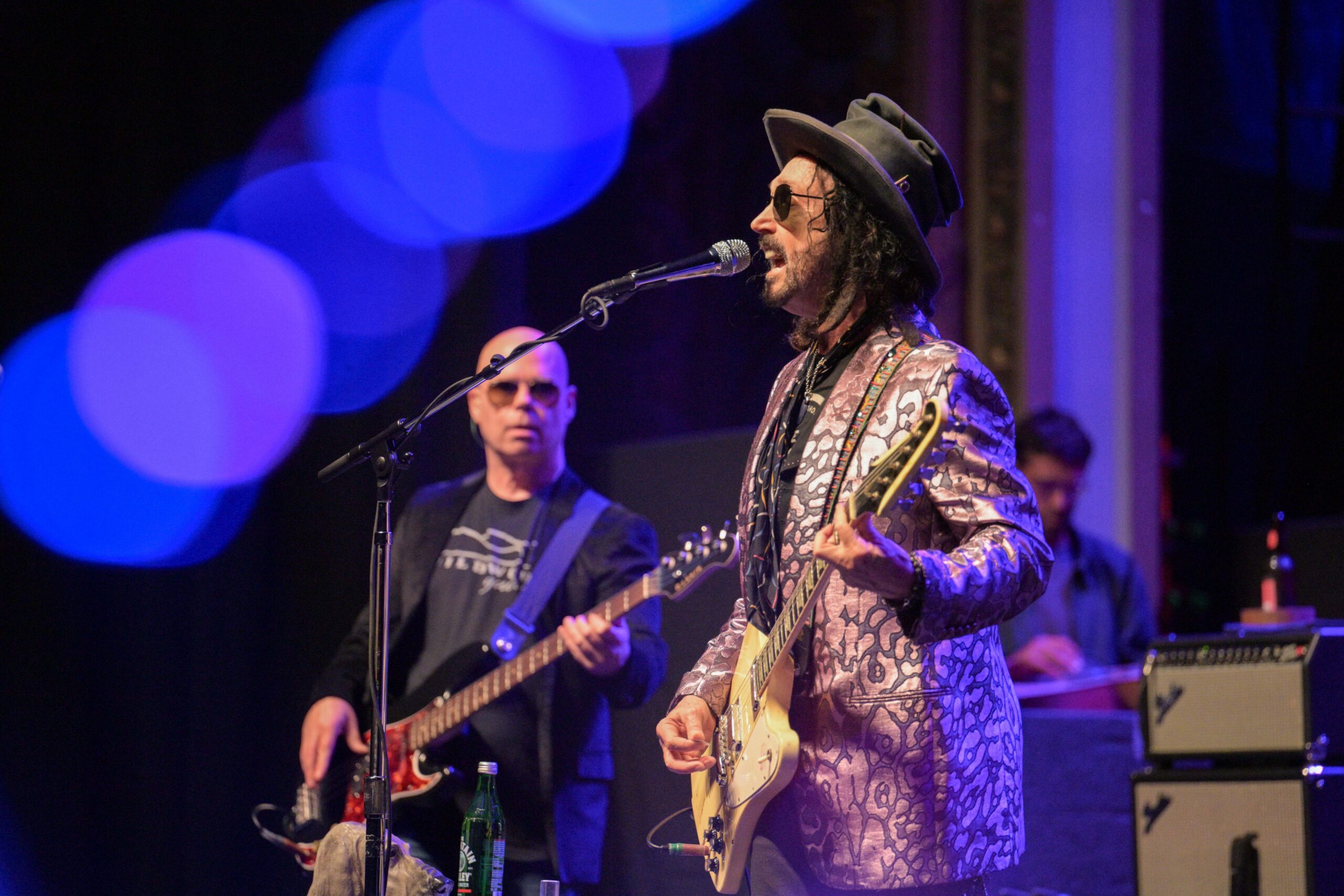
Photo by Vernon Webb
Jorma Kaukonen, one of the most highly esteemed living American roots-guitarists, is turning 70 later this month. To mark the momentous occasion, Jorma and his longtime band Hot Tuna (in their electric incarnation) played two celebratory birthday shows at the Beacon Theater on December 3rd and 4th. Jorma, a founding member of both the aforementioned Hot Tuna as well as Jefferson Airplane, has been a mainstay on the scene for over forty years. Consequently, he has garnered a whole host of musical friends and cohorts, many of whom came to pay tribute to the legendary guitarist over the course of
the two-night run.
Friday night’s show began at 8:05 with two back-to-back classics from Tuna’s 1973 Phosphorescent Rat album: “I See the Light” and “Corners without Exits.” Jorma’s bluesy guitar playing was in top-form as soon as he hit the stage and the early solos he traded with mandolin-player Barry Mitterhoff were electrifying. Although the only two members of the band who have consistently been part of its lineup since its formation in 1970 are Jorma and bassist Jack Casady (also an Airplane alumnus), the role of Jorma’s melodic instrumental foil (whether fiddle-player Papa John Creach in Tuna’s early days or keyboardist Pete Sears in the 90s) has always been integral to their sound and Mitterhoff is as formidable a foil as Jorma has ever had.
While these early songs were well executed, in retrospect, they merely foreshadowed the epic musical heights the band would eventually reach. The show really began to take off about five songs into the first set, as the guests started trickling in to pay tribute to the man-of-the-hour. The first guest was Woodstock guitarist Happy Traum, probably best known to the Beacon audience for his collaboration with Bob Dylan on the Greatest Hits Vol. 2 tracks “I Shall Be Released” and “When I Paint My Masterpiece” (more on that song later). Traum played acoustic guitar on “Sportin’ Life Blues.” One of the interesting things about these shows was that although the band was billed as Hot Tuna electric, in reality, they alternated between their acoustic and electric formats every two or three songs (although Casady never put down his electric bass, even during the acoustic numbers). As Traum walked off stage, Jorma wryly remarked that Happy is one of the few people he still plays with who is older than himself. “When I grow up,” he said with a smirk, “I want to be just like him.”
After a couple of more guest-less Tuna numbers, the band was joined by acoustic blues guitarist John Hammond, who Jorma met at Antioch college in 1960; the two have been friends ever since. “John was the first person I ever knew who became a star,” Jorma said of his old friend. Their on-stage embrace was one of the more poignant moments of the evening. It was moments such as this which lent the two nights an extra level of meaning; as incredible as the music was, the love displayed by everyone who graced the stage was equally as entertaining.
The last two songs of the first set established the tone for how the rest of the evening would proceed. First, the band brought out Bill Kirchen and Larry Campbell (on fiddle) for Kirchen’s “Talkin’ Bout Chicken.” Jorma has known Kirchen since the late 60s, when he was a member of Jefferson Airplane and Kirchen played guitar for Commander Cody. “That seems like another life,” Jorma quipped about the time the two shared in the Bay Area forty years ago. The set closed with a crowd-pleasing version of the Hot Tuna cover of Lightnin’ Hopkins’ “Come Back Baby” which featured one more guest: Warren Haynes, a man who has probably played the Beacon more times than any other musician alive. This version may be the definitive version of the classic cover, as Jorma, Barry Mitterhofff, Bill Kirchen, Larry Campbell (still on fiddle) and Warren all traded incredible solos. Jorma acted as the conductor, pointing at each soloist to indicate when it was his turn. It was truly a sight to behold and it left the crowd salivating for more as the lights came up for set-break.
The second set began with the band picking up their acoustic instruments for great versions of their hit “The Water Song” as well as “99 Year Blues,” both of which featured Byron House (who played on Jorma’s 2002 Grammy nominated album Blue Country Heart) on upright bass. The bass interplay between House and Casady added an interesting new dimension to these two Hot Tuna staples and it was nice to see Jack get some attention on such a guitar-heavy night. House then exited the stage and Larry Campbell re-entered to play guitar on “Genesis, ” a song that originally appeared on Quah, Jorma’s 1974 album with Tom Hobson, but has long since been an integral part of Hot Tuna’s repertoire (similar to the way the Grateful Dead adopted early Jerry Garcia solo numbers “Sugaree,” “Loser” and “The Wheel”). Larry has been spending a lot of time with Hot Tuna lately, as he is currently producing their first electric album in over twenty years, which they recorded at Levon Helm’s studio in Woodstock (Larry is the lead guitarist and musical director for the Levon Helm Band). Larry added beautiful lead guitar to what is already a beautiful song, and his solo was one of the highlights of the evening. It was reminiscent of the way Mikey Houser used to play lead on the song when it was covered by Widespread Panic.
For the next number, “Bowlegged Woman,” Warren came back out and the crowd was treated to another onstage shred-fest, as Jorma, Barry, Larry and Warren each wowed the audience with their virtuosity. The band then reverted to its acoustic format and brought out Bruce Hornsby, who played dulcimer and sang on “Children of Zion.” Bruce then moved to the grand piano (answering the question of who would be playing the piano that had been on stage all night) and Larry came back —this time on fiddle again—for an epic version of “I Know You Rider” (a song which Bruce played many times with the Grateful Dead in the early 90s and Larry was familiar with from the time he spent as a core member of Phil Lesh and Friends). As great as this version was, it did feature a somewhat awkward moment when both Casady and Hornsby attempted to solo at the same time, neither one knowing if he should
back down. Eventually, Casady deferred to the guest. After a couple of more straight Hot Tuna numbers—including a song from the forthcoming album, “If This Is Love, I Want My Money Back”—the band brought Bill Kirchen, Larry and Warren back out for a cover of Muddy Waters’ “Rock Me Baby” (which featured some particularly powerful soloing from Warren) and a nearly 13 minute version of “Funky #7.” The latter featured the evening’s best jam; it started as a guitar duel between Larry and Warren that rivaled most of the duels he has with his Allman Brothers Band foil Derek Trucks, and culminated with them jamming in unison and reaching Olympian musical heights. The four core Hot Tuna members (Jorma, Jack, Barry Mitterhoff and drummer Skoota Warner) then re-emerged for a brief, single-song encore of “Hit Single #1.” All and all, it was a near-perfect musical evening which left the crowd abuzz with anticipation about what Saturday night had in store.
Photo by Vernon Webb
There was palpable excitement in the air before the lights went down for the Saturday night show. The question of who would be sitting in was on everyone’s lips: would Levon Helm be joining in on the festivities? What about members of the Grateful Dead? And would there really be an Airplane reunion?
Although only one of the above options actually panned out, Saturday night’s show was equally as entertaining as Friday night’s, although in a very different way. If Friday night was more about bluesy
soloing, jamming and displays of musical virtuosity, Saturday night was more about Hot Tuna’s history (although it certainly had a healthy level of jamming, as well). After four strong opening numbers without any guests, Jorma announced that the band would be joined by one of their most illustrious alumni: Pete Sears, who played piano with the band in 90s and made the Live in Japan and the two Live at Sweetwater albums so memorable. After playing an incendiary solo on “San Francisco Bay Blues,” (a song which appeared on Live at Sweetwater Two), it was clear that Sears’ addition to the band’s sound that evening would add a whole different dimension to the music. Much like when Chuck Leavell sits in with the Allman Brothers Band, also usually at the Beacon, it was a treat to watch a true musical virtuoso who also is extremely familiar with Hot Tuna’s catalog sit in with the band for the duration of the evening and push the music to another level.
However, the real treat of the evening came right before the next song, when Jorma announced that they would be bringing up another Tuna alum, Michael Falzarano (who currently plays with the New Riders of the Purple Sage); however, as he walking out, a somewhat hunched over bearded man with a guitar emerged right behind him. A few seconds later, it became apparent to everyone that the second guest was Bob Weir, and the Beacon exploded with uproarious applause. “Oh yeah,” Jorma said, “I forgot to mention that Bob Weir is going to help us out with this one.” Bobby jammed with the band on “Big Railroad Blues” (which Bobby’s old group was known to cover from time to time), and later in the set, came back out for “Bowlegged Woman” and “Walkin’ Blues,” singing lead on the latter tune (Allman Brothers bassist Oteil Burbridge and Bob Steeler also joined in for these two songs).
After a long set break, the band returned with their acoustic instruments for “I See the Light” and the Airplane classic “Third Week at the Chelsea.” Although the rumors of an Airplane reunion on Saturday night turned out to be unfounded, it was fitting to see Jorma pay tribute to his former group for his 70th birthday in his own way. The band then brought out the first major guest of the set: Steve Earle, who sang “Nothing Brings you Down like You’re Hometown” and a cover of Townes Van Zandt’s “Brand New Companion” After the songs, he giddily said from the stage “Man, do I love this job!” After a few more acoustic numbers (all of which featured top-notch playing from Pete Sears), Bobby came back out with an acoustic guitar and led the Beacon through a sing-along version of “When I Paint My Masterpiece.” He received a standing ovation, and the moment was arguably the highlight of the two-night run. After Bobby walked offstage, Jorma, echoing Steve’s Earle earlier line, as he said with a
massive grin on his face: “Man, do I love this job!”
Following a crowd-pleasing version of the beloved acoustic Hot Tuna number “Hesitation Blues” the band brought the evening to a close with guest-laden versions of “Ak-47” “Funky #7” (which featured an epic Oteil-Casady bass duel) and “Come Back Baby” (with Weir, adding his funky, idiosyncratic rhythm guitar throughout). The crew also rolled out a Les Paul shaped birthday cake for Jorma, and all of the guests and the crowd sang the near-70 year guitar hero a rousing rendition of happy birthday. The evening closed with an encore of “Baby What You Want Me to Do?” that featured all of the evening’s guests and sent everyone home happy.
As incredible as the two nights were, they can also be characterized as two nights of missed opportunities. For example, Larry Campbell has been singing lead vocals on a cover of “Keep Your Lamps Trimmed and Burning”—a major Hot Tuna staple— with the Levon Helm Band for the past year or so. In fact, he did it at Levon’s second show at the Beacon a mere week before the Jorma birthday shows. One would think that Larry and Jorma being on-stage together presented a perfect opportunity for them to duet on this classic, but that theoretical version never came to fruition.
In a similar vein, when Warren Haynes toured with the Dead in 2009, on a number of occasions, he and Bob Weir dueted on an incredible cover of “Death Don’t Have No Mercy,” a Reverend Gary Davis song that is an extremely important part of Hot Tuna’s catalog (and of course, was also featured on Live Dead, albeit sung by Pigpen). Both Warren and Bobby were guests at the run, yet on neither night did Jorma cover this with either one of them. Furthermore, when Jorma was a member of one of the earliest incarnations of Phil Lesh and Friends (along with Steve Kimock), he would often lead the group through a cover of “Friend of the Devil” in his unique, finger-picking style—a Jorma-led version of the song was even featured on Phil’s 1999 live album, Love Will See You Through. On Saturday night, I found myself wondering why Jorma and Bobby did not take the opportunity to duet on this beloved Dead tune; rather, Bobby was used primarily to play rhythm on songs like “Big Railroad Blues” and “Come Back Bobby.” Also, if the band was going to cover “I Know You Rider,” why do it on Friday night with Bruce Hornsby as opposed to on Saturday night with Bob Weir? Of course, there was also the question of who could have been there. It would have been great to see John Bell sing on “Genesis” or “Bowlegged Woman.” And where was David Bromberg, one of Jorma’s closest friends and musical cohorts?
The two evenings also featured a few more repeats then one would have hoped for, and not just of Tuna Classics like “Come Back Baby” and “Funk #7,” but even of the new song, “If This is Love, I want My Money Back.”
However, in the grand scheme of things, these are minor critiques. All in all, the two shows constituted the best type of concert experience one can hope for. The guests were incredible, the crowd was animated and enthusiastic, and most importantly, Jorma was in top form. I can only hope that he is as impressive at his 80th birthday shows.