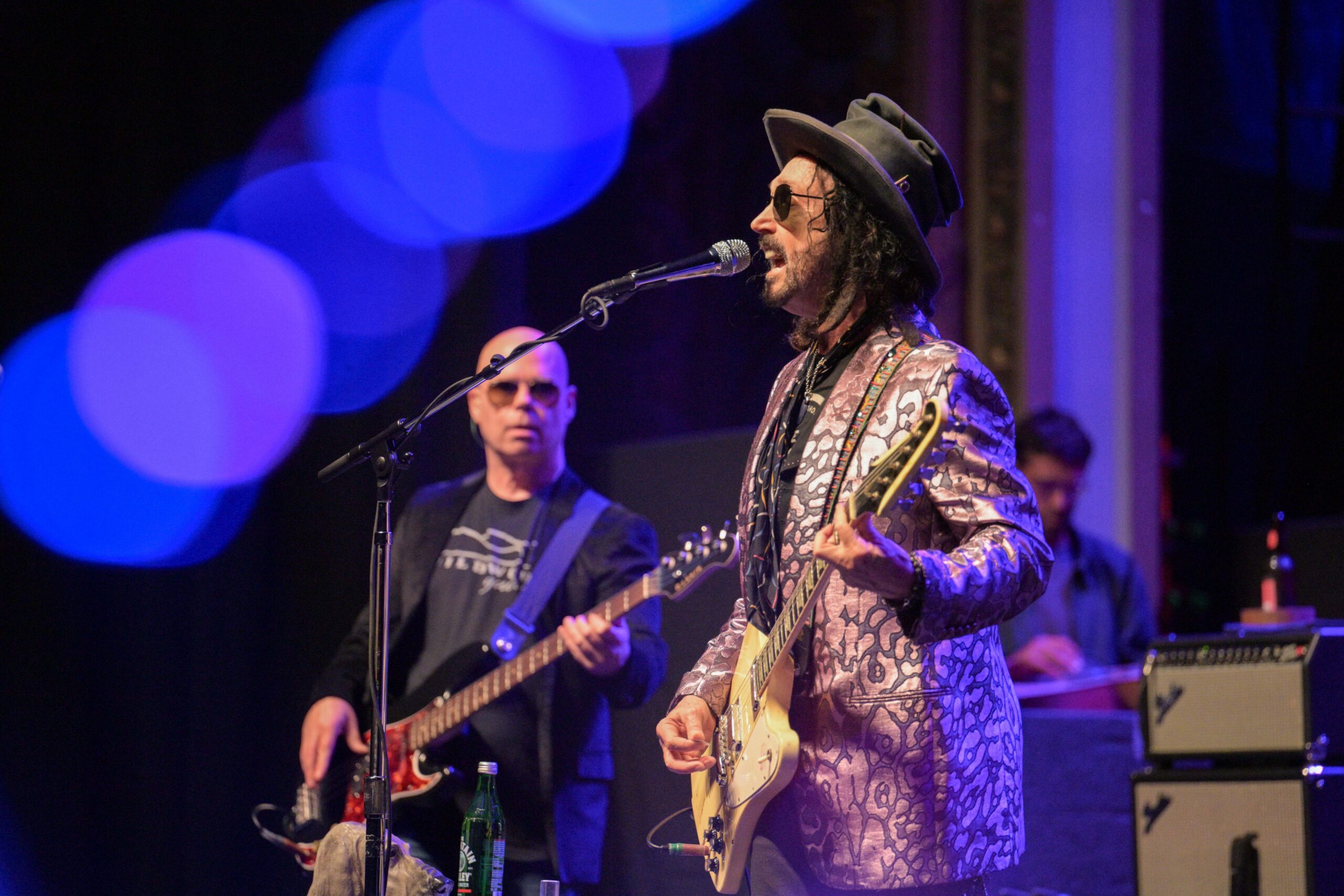
Photo by Norman Sands
Now in its fourth year, the Chicago Bluegrass and Blues Festival is an event that keeps expanding, like a gaseous nebulae in the vacuum of space. The event kicked off with a three night run of the String Cheese Incident at the Aragon Ballroom in Chicago’s Uptown neighbourhood last month. Six weeks later, the event picked up again with a bluegrass lineup so fine it would put most of Bean Blossom’s festivals to shame.
The first act on the main stage, Majors Junction, an up-tempo Americana outfit, had difficulty getting into their groove playing to a large room that was still filling in. There are some threads of Johnny Cash coming through in their style. There’s some close family ties in this band; guitarist Mike Mulcahy, his wife Heather O’brien and her sister Kiley O’Brien do the singing on songs that are mostly written by Mike.
Chicago’s finest traditional bluegrass players, The Henhouse Prowlers, brought the energy level in the room up quite a bit. Playing with two brand new members, Dan Andree (fiddle) and Star Moss (guitar), didn’t keep this band from cruising through a set full of originals and bluegrass staples. They even played a couple new songs written with their new members. The pre-existing three members, Jon Goldfine (bass), Ben Wright (banjo) and Grant Ziolkowski (mandolin) handled a majority of the singing, with Andree taking the lead for a composition of his own. The diversity in their vocal timbre gives them a broad versatility.
The Giving Tree Band’s equipment crowded every corner of the ample sized stage. On stage right was a Hammond B-3 organ, complete with a Leslie speaker cabinet, and stage left had a black upright piano. Eric Fink, the enigmatic leader of the band, spent most of the set center stage, next to his brother Todd Fink on banjo. At one point, the Fink brothers fetched a matching banjo and telecaster. The solid top banjo, complete with Fender-esque cutaway and tortoise shell pickguard, had a very unique, bright sound for the bluegrass instrument. There is a remarkable level of balance between the seven performers that comprise The Giving Tree Band, resulting in a layered texture in which you can listen to any member’s playing at any time.
Joe Purdy is a talented solo folk performer in his own right, but he must have felt lonely up on that big stage all by himself. He invited The Giving Tree Band to join him for most of his set. Patrick Burke traded in his electric bass for an upright while Eric Fink found his way to the B-3. Purdy seems to channel a younger Dylan when he’s singing full throttle. The harmonica held around his neck adds to a classic folk singer appearance.
Following Purdy with the Giving Tree reprise, the Auditorium Theater was treated to some Dawg music. The David Grisman Quintet’s purely instrumental approach results in a performance at the highest level of musicianship. Grisman himself is a great story teller; he leads into each song with a story that connects the audience to the music. He has a magical way of introducing his co-conspirators. Take for example Garcia Grisman Band member and 27 year DGQ veteran James Kerwin, who scurried off stage so that he could gingerly approach his bass from behind the curtains as the crowd cheered him on.
The DGQ has superb chemistry that has developed over the last few decades. Anytime one of the players is taking a solo, the supporting cast pulls back so break can rise above in the mix without sacrificing dynamic control. Grisman leads into “Slinky” stating “I think it’s time to get funky;” turn to Matt Eakle who wields a bass flute marvellously. Eakle and guitarist Grant Gordy play parallel leads on the outro from this tune. Grisman then introduces guest mandolinist Don Stiernberg to finish the last few songs of the set with DGQ. They really bring it home with a “Shady Grove” that the crowd ate up.
Del McCoury was one of the Blue Grass Boys when Bill Monroe’s band’s name was adopted by the genre it had spawned. Having played with the father of bluegrass, Del is now on tour with his two sons, Ronnie (mandolin) and Rob (banjo). With his shock white hair and wearing a light gray suit, Del plays stage left and leads the band of fine traditional bluegrass players. Rob McCoury has some of the fastest, most articulate chops I’ve ever heard on a banjo. It’s a treat to hear the McCourys harmonize on vocals with their genetically similar vocal chords. When they play the slower songs a hush settles over the audience. Del’s band closes out their set with “High on the Mountain,” a tune that really let’s Del show his vocal talents.
After a short reprieve, the Del McCoury Band returned to the stage, with David Grisman in tow, for the Big Mon Jam, a tribute to Bill Monroe. This set was history lesson on the genre of bluegrass. Del exclaiming “that’s rock ‘n roll right there” after Grisman and his son Robbie share the lead on the second song. Grisman introduces “Will You Be Loving Another Man” as a song from the first Blue Grass Boys 78 record, which featured Del McCoury. The group followed this up with a few songs they’d never rehearsed together. The first of these was Bill Monroe’s “A Good Woman’s Love,” which gave way to a song that Bill cowrote with Hank Williams, “I’m Lonesome Too.” Following that fine pair was a song penned by Vassar Clements, who not only played in Monroe’s band in the 1950s, but also was a collaborator with Grisman in Old and In the Way together.
Our final serving of bluegrass for the evening saw Rob and Ronnie McCoury, with their band mates, Jason Carter (fiddle) and Alan Bartram (bass), of both The Del McCoury Band and The Travelling McCourys, return to the stage with Jeff Austin and Bill Nershi. Nershi proclaims “I’m honored to share the stage with so many great performers tonight, welcome to the Rock ‘n Roll Rodeo!” Austin and Nershi take turns leading the band on vocals and the two sides of bluegrass, traditional and newgrass, find a perfect marriage in the sound of the band.
Jeff yells out “Let me hear you Chicago Illinois!” after the Arlington Heights, IL native acknowledges his Mom’s presence in the theater. Jeff and Ronnie dive into a fiery mandolin duel and the lights in the house intensify ever so slightly as the jam comes on strong. Watching Austin, you wonder how he can manage to sing while playing the mandolin with such fury. The bluegrass super group goes with one of Nershi’s classics, “Jellyfish,” complete with Billy’s hand gestures, to close out the night and resolve the concert with a musical technique known as a picardy third, leaving the Chicago audience quite satisfied with a night of amazing bluegrass and Americana.