

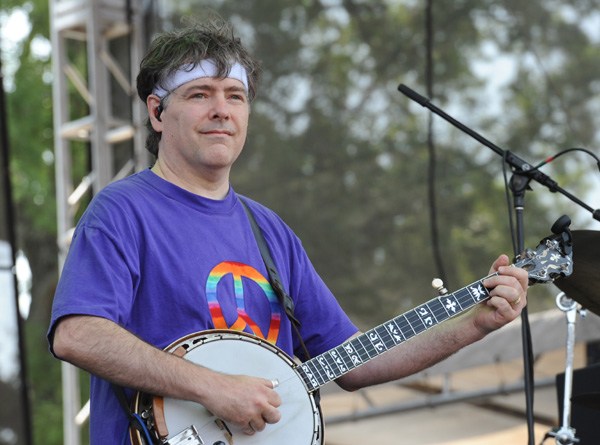
“You can feel your progress in a long relationship,” Béla Fleck says, thinking about his 30-year tenure with the Flecktones. “In a brand new relationship everything is new and fresh there’s a tendency to glorify that in musical groups. Of course, that can be great. But there is something else about that long haul, sticking with the same people for a long time and seeing how you can keep on moving together and observe your progress because you’re in the same situation.”
Onany given day, the banjo expert is working on a litany of projects. But, formany, his claim to fame continues to be the Flecktones’ far-reachingmusicality: part bluegrass, part jazz, all-encompassing.
Werecently caught up with Fleck, as he both explored the legacy of the Flecktonesand tended to his variety of creative irons in the fire.
What are you up to today?
Idropped my son off at school, I went to the gym, then I went and edited in theWhole Foods for about an hour, some music I am doing with Edgar Meyer and ZakirHussain. Then I got in the car to bring Juno back home.
Tell me more about this project withEdgar and Zakier...
Werecorded an album before this last tour, a whole album of new music. It’sreally fun, wonderful music: warm, trippy, wonderful, weird.
Wehave this great Indian Bansuri flute player named Rakesh Chaurasia playing withus now so it's a quartet. And we never really made an album of this groupespecially now that it’s four of us. The one album we did make, more than halfof it was a concerto we had written. So we had just thrown a few tunes aroundit to complete the album. We really hadn’t played much so now I think it is areally good strong material, interesting and beautiful music. I’m proud of it.It’s another thing.
You’re incredibly busy, you justextended the 30th Anniversary tour for the Flecktones. How does it feel to havesuch a warm reception and keep that party rolling in addition to all the otherthings you’re doing?
Oh,it’s great, it's kind of like Christmas, you know? Because we’ve done all thework. We just show up. I mean, we always have to tweak a few things but it'sfun remembering “Oh do you remember what we used to do on that tune?” It's fun.It's like revisiting old glories.
Honestly,creating new music has been intense and pressure-filled and we’ve always workedreally, really hard on it, but we’ve kind of taken it out of the wholeequation. We are just playing because we want to play.
We'renot promoting a record, we’re not reinventing the wheel. We’ve kind of beenexploring this idea—which goes against every bone in my body, by the way—thatyou don’t have to reinvent the wheel every time you put a group together. Youcould actually play the music you’ve created already that people want to hear.
Inthe past we wouldn’t get together just to tour. We would get together, make awhole new musical offering and play that intently for a couple of years. Thenmaybe disappear for a while.
Butnow it seems the best way is we’re just gonna get together for a few weeks andgo play some gigs. And there’s plenty of people that want to hear us who havenever heard us or have heard us before but want to hear it again.
Itjust feels good to get together and do something instead of do nothing.
Obviously, there is a magnetic pullthat makes all of you guys want to play together. Are there certain traitsmusically or personality-wise that Howard Levy, Roy "Future Man"Wooten and Victor Wooten and you all share that creates this magic?
Ohmy god, it’s so cool. It's almost like we complete each other. When we are alltogether it is this very complete package.
Howardis the egg-headed genius brain that looks at everything very analytically andalso the very spontaneous, which usually those things don’t go together.
Victor’sjust got this pure feel. The Future Man's also very very intellectual aboutmusic. He’s got all this math going on, an incredible mathematical abilitygoing on. He’s redividing the atom constantly—rhythmically dividing what wouldnormally be four beats into 11 or 17 or whatever and he just does it so beautifullyand naturally. And it's something the rest of us wouldn’t know how to do.
AllI am getting at is each of us brings something so different to each other andwe celebrate those differences. We're also similar in that we’re all the oddduck or the strange ranger in every band we’ve been in. Who are doing thingsthat haven’t been done on their instrument. Every one of us have always feltlike the underdog on some level.
The Flecktones are such a uniqueband, even by today’s standards. Looking back to the late-'80s when you guysstarted forming, what was the musical landscape like? I am sure you came acrosssome skeptics when you first came out.
Inthe jazz world, there was a celebration of young people who played in an olderway. There wasn’t a celebration of people doing brand new things with jazz.
Weactually were combining a lot of root elements to make something quitedifferent. It certainly wasn’t smooth jazz, it certainly wasn’t old jazz. Itwasn’t typical fusion.
Alot of the jazz festivals didn’t want to have anything to do with us, in thebeginning. They thought it was some trendy crap that would be gone hopefullyquite soon. This banjo band, or a harmonica band it was like "No, no, no,no. Not them."
Itwas kind of saying “This is where jazz stops.” We felt like that was the vibe.The fusion supergroups had run their course like Return to Forever, orMahavishnu Orchestra, or Weather Report. Those are like the three kingpins ofsuccessful fusion music and they were long gone, and we were more like themthan Wynton Marsalis. It was a different landscape.
Iwas trying to distance myself from bluegrass because I had been in it so long.I didn't want to be a jamband. I didn't think the jambands played as well asthe great Jazz groups and the great rock bands.
Iwould much rather be considered a jazz musician, but I was more of a closetjazz musician or a wannabe jazz musician. I wanted it real bad but I wasn’tnecessarily that either.
WhatI'm getting at is that in the beginning I did not want any bluegrass elementswhatsoever. We were trying so hard not to get the records in the bluegrassbins, and to be seen as jazz of some kind.
A lot of people don’t realize that theFlecktones initially formed for a one-night-only performance for PBS. Do youremember there immediately being sparks on stage?
Itwas ridiculous, in fact there is a YouTube of it.
It'sthe Lonesome Pines Special. You cansee us playing the first song together and we all sound skinny and young. Andthe audience is going crazy for it and we're all looking kind of surprised orstunned. It's not something you expect people to go crazy for and there theyare.
WhatI was going to say was even though we aren't doing new music, I think the bandreally is just as aggressively creative playing our old music right now aswe’ve ever been. In that everybody has just gotten so much better as musicians,or I hope that I have. I feel that I have.
Whether it's music or sports oranything, with a great team you can anticipate what the other person is goingto do before they do it. Obviously, the Flecktones have that in spades.
Thereis nothing like hitting some of the tunes that we’ve been playing since 1988.It’s crazy. “Sinister Minister” or “Sunset Road” or “Sex in a Pan”—It's like weown these tunes. They are so deep in our DNA at this point that we can abstractthem if we like or get right down in the middle of them. It's a celebration ofwhat we’ve achieved over the years.
I’vehad this experience a few times now with the record companies and the Jazzfestivals. When it started out nobody wanted us at a jazz festival. We did allwe could do to get booked on a jazz festival. But now it seems like we are oneof the last remaining groups of a certain era. And they all want us.
They’dsay “Well you can play once in a while here,” but they would never accept uswhole heartedly. But nowadays I run into some of those people and they’ll say“Oh man when we first had you on that festival it was so great, it was thebeginning of this great thing and I'm so proud of that time.” And I am thinkinglike, “Wait a second you're the gatekeeper who didn’t let us in.”
Butit is interesting how hindsight is for everybody and I am thankful for all ofthose people for the part that they did play.
Are there any younger players thatyou’re kind of reaching back and trying to give a little limelight?
Ohyeah I mean there are so many great players in bluegrass. That's anotherproject I’m finishing up right now that I am really excited about. I am playingwith a lot of great bluegrass musicians that are here today. Some of the olderguys: David Grisman, Sam Bush, Jerry Douglas, those cats. But also youngerguys, and of course Chris Thile isn’t one of the younger guys but he is animportant guy on the scene he turned it upside down. But there's also a wholebunch of other guys like Michael Cleveland on the fiddle and Billy Contreras onthe fiddle. Cody Kilby on the guitar and Sierra Hall on the mandolin, MollyTuttle.
Itused to be that I really did not want to play that kind of music unless I couldplay with Sam Bush and Jerry Douglas and these other guys. But times have movedon and there are some astonishing players that really get me fired up to playthat music again. Of course I want to do my own weird take on it, but it'sstill a bluegrass ensemble.
It's funny you're saying you want toplay with Sam Bush or Jerry Douglas, but those younger musicians are probablythinking, “Man, I want to play with Béla Fleck!”
That'swhat I am discovering. When you're the leader of a bunch of younger folks theykinda go, “Why don't you show us how you want us to be?” I get much moreconfident about asking for what I want to hear. But they also surprise me a lotwith their ideas and their playing. A lot of these people grew up listening tothe music I made with my peer group and so it’s in their DNA too. It’s a verycurious and interesting time.
It's been two years since Echo in the Valley. Do you and AbigailWashburn have plans for another record?
Wehave a couple of really interesting projects planned. Not just creating anotherrecord but something a bit more unusual than that. I'm not quite ready to saywhat it is because we are working towards it.
Eversince our son Juno was born we have been touring together quite a bit. Now thatwe have two kids, now we have a one and a half year old, named Theodor WilderWashburn Fleck it's harder for us to travel with the whole family. We’re stilldoing it but instead of doing it constantly we’re doing it with months inbetween. We’ve got a nice set of shows through the winter but we’re doing theright amount for the situation we’re in.
We’vebeen asked to write a song cycle for an orchestra and we are really excitedabout that idea because we have a couple of charts we’ve done where Abigailsings and I play that we were able to do with the great Colorado Orchestra. Andit’s really something interesting and special: the idea of telling a story thattakes a whole set to tell. And having all of the colors of the orchestra to doit.
Thenalso we’ve been collaborating with this amazing dance company called Pilobolus.They’ve always done really interesting unusual things with bodies and themovement and the music. So I think we are thinking more in creating a uniquelive experience that we could do. So, we’ll do another record but it’llprobably be built around some unique concept. Also, we'd love to do something withchildren as thats a big part of our life now. Doing a children's CD together,we’ve talked about that.
I know you have a concerto namedafter Juno does this mean there is a Theo one in the works?
Wellthere is another concerto I haven't named yet and I've been trying to think howthat could be for Theo, his other name is Wilder. Juno just sounds like aninteresting name for a concerto and that's why it works so well. Theo, I don’tknow. His other name is Wilder, it could be the Wilder Concerto. Or the WildConcerto. But it's not that wild of a concerto. It was written for the NewOrleans or Louisiana symphony. So it has a lot of New Orleans influences in it.That doesn't necessarily go with Wilder to me, but it could.
Well if you don’t name it after him, Theomight get jealous...
Bythe time he notices, I'll have something locked up for him.





