

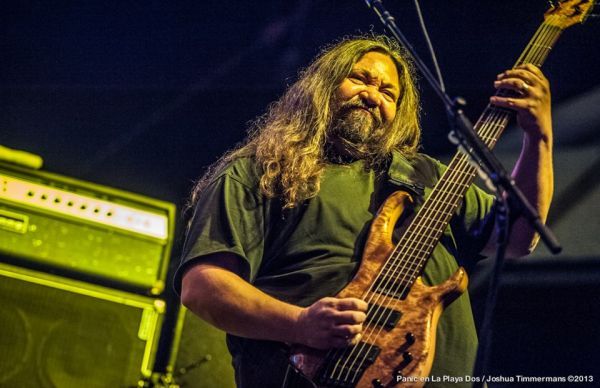
Friday, February 6, marked the 40th anniversary of Widespread Panic. On that date in 1986, drummer Todd Nance joined John Bell, Dave Schools and Mikey Houser for their initial gig as a quartet. In commemoration of this lofty achievement, we look back on our 2003 interview with Schools, which took place during a pivotal moment in the band's history.
***
On April 15, Widespread Panic released Ball, the group’s 8th studio effort and its first since the passing of co-founder and namesake, Mikey Houser. Not only is the roster slightly different on this disc, with George McConnell joining on guitar, but so is the band's approach, as Ball features material developed in the studio, rather than shaped in the live setting.
Beyond his efforts with Widespread, bass player Dave Schools continues to explore other creative outlets. In February he traveled to Europe for a string of shows with Jerry Joseph (Schools produced Joseph’s Conscious Contact disc). Meanwhile, he has been working on the second release from Slang, his collaboration with Layng Martine III. The following conversation touches on his recent projects outside of Panic as well as the past, present and future of the group.
I’d like to start off with your summer reading list. I can remember an interview with you a while back where you said you were reading Huck Finn for the eighth time.
Probably more like the 80th time. I just read Chuck Palahniuk, Lullaby. I’m reading two Noam Chomsky things—one is called Power and Terror: Post-9/11 Talks and Interviews and the other is called What Uncle Sam Really Wants. I’ve also just started David Sedaris Naked. I like to keep things on rotation because if you read these Noam Chomsky things solely you walk around being upset to your stomach.
It seems to me that bass players often do a fair amount of reading. Does it feel that way to you and if so what do you think accounts for that?
I think you’re right. I think it’s because bass players have no friends and when we were small children our best friends were books. [Laughs.] I read an article, I’m sure it was in Bass Player magazine, about bass players making better producers than other musicians because the bass is the bridge between the rhythm section and the melody lines. Bass players have to be aware of all things and how they balance. Maybe that has something to do with it. Maybe being balanced, bass players want to read, listen to music and also rock. But you do have a point, I think bass players tend to be more introspective. [Laughs.] Okay, let me just say it, I think we’re friendless. We all hang together. That’s what so great about Warren Haynes, he gave us a club where bass players could hang out together.
What originally drew you to the bass?
John Entwistle. John Entwistle was my hero. I loved The Who from a really young age. I got a bunch of 45 rpms of things like "Pinball Wizard" and other Who singles and I thought it was amazing. I even had a paper drum kit when I was four years old that said The Who on it. Guess what I did to it?
You destroyed it.
Of course I did. [Laughs.] After that it was cheap acoustic guitars for a while. We were living in apartments and I guess I was about twelve years old. I really wanted to play the drums but living in apartments there was absolutely no way I was going to practice, so it was "Hmm what’s the next best thing…bass!" A couple of years later it turned out to be a great call because no one wants to play the bass. There are a million lead guitarists, a million drummers but every band is always looking for a bass player. That’s when I said, "Well I guess this was the right decision."
I knew that music ran in my family and so did my mother, who had me taking piano lessons when I was in first and second grade. I hated it though, because it was so stiff and academic. I played the "Blue Danube Waltz" and the only reason I was playing it was because it was in my favorite movie, 2001. I walked out of my second year recital and my piano teacher told my mother that I had no talent.
Then, when I was taking bass lessons in fifth or sixth grade I didn’t want to do the scales, I just wanted to learn how to play "Dark Star." My bass guitar teacher would roll his eyes and say, "Good lord not only does he want to play rock-and-roll but he wants to play music by that awful Grateful Dead." So he suggested that I take up piano because he knew what kind of player Lesh was. I always thought it was an interesting thing that my piano teacher told me I had no talent and my bass teacher told me maybe I should play the piano.
At the time when I was picking it up and being really jealous of anyone who could play, I was listening not only to stuff like Blue Oyster Cult and classic 60’s rock- Zeppelin, Sabbath and all that. But albums also were coming out like Stanley Clarke’s School Days, some of this cooler fusion jazz before it turned into crap. To hear someone like Stanley Clarke back then when he was playing funk, jazz and rock and to hear what he could do with the bass was amazing. It was probably like someone who is just learning the instrument hearing Oteil or Vic Wooten. You’ll either put the guitar in the closet for the rest of your life or it will really kind of open your mind. So that’s what happened to me and I’ve been in bands ever since.
Have you ever been seriously tempted to pick up another instrument, like the drums?
Not really, I just love playing the bass. There’s nothing quite like feeling it all clicking together when you’re locked in with the drums and then you give the guitar player and the keyboard player a great piece of terrain to run across with their melodies. It’s a good feeling. There have been a few times when I wanted to sit down with the drums but I’m just not coordinated enough. I can’t do four things at one time.
In terms of that Bass Player article do you find that your role as a bassist has enhanced your abilities as a producer?
I’m proud of the things that I have produced that and hopefully the people I’ve produced will say they’re proud of them, mainly the Jerry Joseph & Jackmormons record Conscious Contact which was a great experience. Then there’s the Slang record and there’s another one that’s gonna come out really soon, which were produced by me and a fellow bass player, Layng Martine III. I don’t know what you call the music but it’s cool and we love it.
I’ve also done a lot of work with really young bands in Athens. That’s what I like to do—if I hear a young band that hasn’t made a record yet and they seem to put the goods across live, I’ll take them in to David Barbe’s studio and have him engineer while I’ll produce. We’ll work a couple of days on arrangements just to get them in there to learn the process, so that if they do get the big deal they don’t freak out and blow it.
That’s what I like to do. Maybe it’s a bit of a control freak issue but at the same time there are aspects of Widespread Panic records where there are things that everyone feels really strongly about. Everyone could be a producer for a little while. I don’t think anyone has the focus like John Keane does to deal with a six-piece band like us but we all have to hold some of our instincts in so we don’t get that too-many-cooks thing. So being able to work with these other bands and also the side projects makes it easier to keep your mouth shut when Panic’s in the studio. JoJo’s got his Smiling Assassins and Todd’s got his Barbara Cue records and it’s good for the whole thing. It’s really good for Widespread Panic to do these other things.
With Conscious Contact, did you come to Jerry Joseph or did he approach you?
We had talked about it for a while. He kept putting out these songwriterly, overproduced records filled with session guys that were designed to show what a great songwriter he was in any context. I felt that somebody needed to make a Jackmormons record or at least one that was like whatever Jerry sounds like live. We always agreed about that and then he got the deal with Terminus Records which was also the same label that put out Slang, loves Bruce Hampton and understands the feasibility of non-commercial music. They called and I said, "Well did you talk to Jerry about it?" and they said, "Oh, yeah," so it was great. In Jerry’s words when someone asked him why did he have me produce the record, he said, "So that he’d have someone to blame if it sucks." [Laughs.]
Did you know Jerry pretty well going back to the Little Women days?
Oh yeah, Jerry was responsible for taking Widespread Panic west of the Mississippi. We opened for Little Women back in the mid-to-late eighties. We got our foot in the door in Chicago, Boulder, San Francisco, Salt Lake, Portland…We wouldn’t have those territories if Jerry hadn’t given us that little bit of good feeling back then.
It would be interesting to see where that band would be today if they had remained together.
They did a reunion at the County Fair in Oregon about 2 years ago and I think once they got past all the stuff that broke up the band they had a really good time. But it’s hard to keep a band together especially when you have seriously-talented people. I think Little Women was way ahead of its time. They were one of the first bands to be play some Grateful Dead and do a reggae version of one of their original songs and have twenty minute guitar solos.
What led you to tour Europe with Jerry earlier this year?
That’s something we’d been talking about for a while. I wanted to learn how to sing harmony better and the best place for me to learn anything is on stage but maybe not necessarily in front of 10,000 people. We also wanted to write some songs and hang out. The idea originally was to do to Australia and have gigs that were a couple of days apart. Then, even if it took two days to drive to the next city which it generally will in Australia, we would be able to stop in some little bar and play or just stop at some hostel and sit in the room and write a couple of songs.
It just worked out that we could go to Europe in the timeframe to do it and it was easy. He already had a couple of gigs booked and we got in touch with the promoters and they were like, "Sure, you and Dave, whatever, bring it on."
We did manage to write a couple of songs and we had some great experiences. We played in smoky little dives to respectful German audiences, we did a gig in Paris, a gig in Amsterdam, a couple gigs in Switzerland and we had a great time.
Do you have any plans for the music you wrote together?
He’s been playing a couple of them. I’ve seen him play one by himself opening up for us and I know the Jackmormons have played both of them. Hopefully we’ll have a chance to do it again and write some more songs. I’d really like to put a supergroup together and maybe write a bunch of songs. Then go back to Berlin where he has some friends, some German musicians. He also has a label over there so we could hang out in Berlin and also write some songs together. It’s a whole different scene over there, it’s really cool.
Do you have any specific musicians in mind?
There is a German guy named Danny Dziuk who played on Jerry’s record called Oil which is just now available here in the states. He plays in a band whose name I can’t pronounce [Dziuks Küche]. They’re huge over there but he sat in with us one night and he’s an amazingly talented keyboard player. Since we had no drums that night it got very early Pink Floydish like "Saucerful of Secrets," "Interstellar Overdrive," kind of layering of textures and things. It was kind of a neat place to go when you’ve been doing this sort of folky thing so I would like to have him on keyboards.
Nothing against the Jackmormons whatsoever but I know Jerry needs to delve into other mediums and it’s really good for the creative process. Anything that he does on the side by himself or with other people comes back and serves the Jackmormons very well. So that’s really kind of a far out idea, and a chance to go back to Berlin and hand out. [Editor’s note: this band would record in 2004 with Schools, Joseph, Dziuk, Wally Ingram and Eric McFadden as Stockholm Syndrome.]
Speaking of textures, will your next Slang record have a layered approach similar to the first one?
I think it’s going to be a lot deeper. The original idea of this one was to start out with a quartet. So I put together myself and Matt Abts on drums, Ray Paczowski on keyboards and Knox Chandler on guitar—he’s played with Siouxsie & the Banshees and Cindy Lauper’s’ live band. He’s a really creative guy.
We just went into Good and Evil Studios in Brooklyn and cut loose with Layng at the control board. We put in fourteen hours of jamming. That’s when the hard work really begins of sorting through all that stuff, finding little pieces where the four of us really connected in an improv sense and cutting small building blocks out of those and then starting the Slang process by building arrangements, creating loops and rhythms.
Sometimes we’d use me and Matt, sometimes we’d use all four of us. It was difficult for Layng because usually you find a drum loop and build it from there pretty easily but this was different, with a kind of Bitches Brew feel for things. We sliced and diced but once we had these song forms built we’d bring in people like Eric McFadden who has been playing guitar with P-Funk—he’s great on acoustic flamenco guitar and he’s all over the first record. Jay Rodriguez from Groove Collective came in and basically became this whole horn section. Hopefully Vic Chesnutt can add vocals.
Lori Carson is doing a lot of vocals too. I had this torch song blues thing and I asked her to write something that would make a high school football coach cry, which is what she did..
Another cool things is I asked DJ logic if he wanted to participate. We were thinking maybe we’d get him scratching on four or five tracks but he did about eighteen them in four hours, it was amazing. We went out to Brooklyn and we were all just amazed standing around watching him work. He’d find that groove and dig in and do his thing. It was great.
So right now that is being translated and tracked. Layng is an extreme perfectionist and it takes a long time to get the stuff to where he feels like it’s focused and pointed in the right direction.
Let’s move to Ball. What led the band to record the disc as it did, with all new material rather than songs that had been developed in the live setting?
There are manifold reasons for that. First and foremost, that was the direction we had to go after dealing with loss of Mike Houser. We didn’t even have George in there for the first two weeks. We actually went in before our fall tour and we just threw down ideas. Anything was game to sort of get over the fact that Mike wasn’t there.
The second reason, following that logic, was to bring George in and let John Keane have some free reign. That way we could just go into the studio with no expectations, with all completely fresh ideas.
This also allowed us to do what we always wanted to do which was make a studio record from scratch in the studio. On every record there’s been a song or two done that way like "Surprise Valley" and "Bear’s Gone Fishin’" from Medicine. In a lot of cases we’ve found they’re our favorite tracks. So we thought why not try the whole record this way. There were a myriad of methods used in coming up with the songs and the arrangements. Then when we got down to building the songs, learning them and then going in and cutting them as a whole band it was like Mikey was there. Actually, I think we all assumed a piece of Mike’s personality. When you’ve lived that closely with someone for that long, part of making sure that there’re still around forever is everybody integrates some part of his personality. So it was kind of funny to watch.
But also sometimes you’d hear a phantom sound in your headphones while you were cutting a track and it would almost make you stop playing—"What was that?" I’m sure it was just a trick of the mind but it happened to everybody at some point or another.
I heard that happened but I wasn’t sure how literally to take it. I would imagine it must be difficult heading out on tour because even if you’ve worked through some of your own emotions, there are thousands of people out there on a given night dealing with Mikey’s loss in their intense way.
It’s been tough and it’s not over yet obviously. We needed to deal with that old cliché—Get back on the horse. That’s what he wanted us to do. I doubt he spent much very much time thinking about what that was going to mean but he made it perfectly clear that the train should keep rolling. There might have been things we would have done differently but it’s all hindsight. It’s almost been a year now, the magic is starting to come back and it’s working out great.
Sometimes an emotion hits though, when we’re playing some of his songs that we felt we could do without him and still be strong on stage. You’re in the middle of playing "Ain’t Life Grand" and you get choked up.
One that’s been tough on me is the song "Traveling Man" that he wrote for the record, which was the last song he wrote. He showed it to us when we were teaching George and Randall songs for the summer tour, sort of rehearsing as this big huge conglomerate. That was weird enough as it was but it was necessary and it was just a great song. We had a demo on tape that we used to work it up in the studio. When I’m playing that song, sometimes it’s almost like he’s sitting on my shoulder and it kind of freaks me out.
You didn’t perform "Traveling Man" until well into the spring tour. Was that a conscious or an unconscious decision?
It was unconscious. I think we just decided to play the easiest ones first. We’re still working on songs that we felt we needed to keep from the old repertoire. There’s a lot going on and we need take baby steps. We love taking chances but it’s a lot easier taking chances with a jam than with a song where you didn’t even write the words and I think that had a lot to do with it.
You employed a different approach on this album by creating the songs in studio. A number of bands have told me that they would love to do that but it can be cost prohibitive. To what extent did you impose a time limitation and how did that impact the music?.
First of all, we put the rule down that we were going to take as long as we needed to finish the record. We asked the record company to let us work without a deadline. Of course they had a suggestion. [Laughs.] But they understood the situation, they’re great folks—Sanctuary Records—and they gave us a lot of leeway. They didn’t have A&R guys down there pacing in circles listening to the emphasis track for radio. They left us alone until the record was done and then they came down to listen to the whole thing, which I think is great because that took the pressure off.
But at the same time, I think you need to impose pressure on yourself because if you don’t, you just keep stacking stuff up and reworking tracks. That’s what the producer is for, to say, "Stop, the song is complete. You don’t need to add ‘Tubular Bells’ to it. You don’t need to bring in the Baptist Choir for this one." But at the same time because of the nature of the material there was a lot of experimentation—everything from playing guitars with spoons to reworking songs. We did "Meeting of the Waters" five different times.
We understand fully that a lot of bands don’t have huge record deals and make their bread and butter by performing live. We can’t spend 18 months in the studio. We can’t afford it these days. No one can, except Radiohead. But since we record at home, we don’t have to pay for hotel rooms and catered food and all that stuff. We felt that after all we had been through, we were going to take as much time as we needed. I think it worked out well, the balance of not having a deadline and having the producer tell us to stop.
But still, everything was fair game. From Todd recording a song he had written on an acoustic guitar with a click track and the rest of the band learning it, then going back and cutting it with him on drums, to me building samples and then laying a bass line over them and having the rest of the guys come in cut their parts over that, to JB singing a song by himself, to working as a band on songs like "Meeting of the Waters" five or six times, to a song like "Nebulous" where a Zeppelin-style riff goes into a five minute space jam that is totally free form—and frankly we were glad that John allowed that space jam on there because I think it’s a cool part of the record.
I don’t even think JB was there when we did “Thin Air.” I just said, "Let’s do a fast Latin song that will showcase some of the percussion." We started with the Trower song "Too Rolling Stoned,” and I said, "Listen to this kind of beat”—it was a “Truckin’” kind of beat—"Let’s go from here and see what happens." So we recorded it and forgot about if for a couple weeks and then it came up again. There were a lot of things that didn’t make the record. Todd must have recorded seven or eight songs and JoJo had some songs. But like I said, anything was fair game and thank God for John Keane.
Given the nature of the process what was your reaction when you heard the final mixes?
I stopped listening pretty much right before I went to Europe. I don’t like to be there for any of the mixdown. So when I came back from Europe I had a couple of weeks and I still didn’t listen to the record. I didn’t listen until we were on our way to Madison, WI [for the first show of the spring tour, just prior to the release of Ball]. Then I listened to the mastered, sequenced version and it freaked me out because it was like taking a trip. I had been working on these songs—we all had—in pieces here and there jumping from one to the other so you don’t get sick of anything and keep your inspiration fresh, and it was a real journey of a record. It brought back a lot of emotion from the ones that were rough to overcome right at the beginning—the missing of Mikey and the fact that he wasn’t there to some of the hilarious drunken nights when ridiculous things would happen on tape, to just going over there to watch TV and listen to what John Keane was wringing out of George. I think it’s one of our best records. I’ve heard people call it somber and morose and country and I don’t really see any of that. I guess I see some of the somberness. I think it’s got a lot of journey. Once again, I think we’ve placed a lot of emphasis on the songwriting which I think is kind of our forte.
I think that’s an area where you are given short shrift. Whatever Panic does in the live setting all builds from those songs.
Well to talk about the Grateful Dead real briefly, it’s not about the scene, it’s not about the jamming, it’s about the fact that these guys wrote great songs in all kind of veins. They wrote songs from all different areas of American music but at the heart of everything that they did was a song with a melody. Without that there’s nothing to jam on, it’s bunch of whacking off.
When you have melody and a song then you have an open road for jamming. The example I always love to use is the Allman Brothers "Mountain Jam." They took that Donovan song, “There Is A Mountain," which is almost like a child’s song, it’s so simple. But it has a very obvious melody and they took that melody and they got a half hour long jam out of it with a simple melody that is the spark. That’s what allows you to be jamband and the Grateful Dead always had melody out the wazoo.
Since you brought up the term jamband, it seems like the band has been a bit frustrated over the past few years with that tag. Have you comes to terms with it or does it bother you any less?
It has been frustrating and it hasn’t always been the jamband thing. When we were first getting started in the mid-to-late ’80s, we had to escape the Athens band label which is as much of a misnomer as anything. People would see "From Athens, Georgia: Widespread Panic" and they were showing up in white linen shirts and black vests wanting to hear R.E.M.-type music. That’s when I started saying this pet phrase of mine I probably never let go of which is, “When you define something you limit its ability to be anything." Yeah we’re from Athens but we don’t sound like R.E.M and yes we’re a southern rock band but we don’t sound like Molly Hatchet. I guess we’re a jamband but we don’t sound like the Grateful Dead. All these labels lead someone to think that you’re going to sound like something else and that’s not fair.
It’s hard to describe music. I just got turned on to this band I never heard before. I saw them open for the Queens of the Stone Age and Chili Peppers in Kansas City, they’re called The Mars Volta. A representative of their label asked me what I thought about it and I said I don’t know, I’d never seen anything like it before. On one hand it frightened me, it freaked me out and on the other hand I wanted more of it. What kind of description is that? [Laughs.] I remember when we were touring with Blues Traveler a lot that Chan Kinchla and I came up with this term to describe the H.O.R.D.E. bands as they were in 1992, which was neo-retro. We thought was hilarious but that one never caught on. [Laughs.]
Moving back to the songs on Ball, how do you think they’ve fared now that you’ve been playing them out?
Some came quicker than others but we love for it to evolve and these songs are just now setting foot onstage and they’re being given their chance to take their first steps toward adolescence.
I think the open-ended ones are working well—"Thin Air" and "Nebulous." The one called "Monstrosity" has been difficult but it’s coming along nicely. Some of them were just great off the bat, like "Papa Johnny Road" and "Tortured Artist." "Counting Train Cars" and "Fishing" we’ve been doing acoustic which has been really nice.
We’ve been doing these acoustic sets during two-night runs in theaters and they’ve been real successful for two reasons. One, because they’re allowing us to hear things in a different way. Also, by virtue of the fact that it’s a little quieter, it creates a dynamic at the beginning of the show that gives us a lot of headroom to ramp up to later. If we haven’t knocked people senseless by the end of the first set, then they’re not numb by the second set, so we have an hour and a half to whip them into a frenzy. That’s been really successful, a cool by-product that we didn’t realize was going to happen.
"I’m Not Alone" was always one of my favorite songs, but when we were playing in nightclubs there was nowhere to put it because it would get quiet and you’d hear people talking about the hoochie mama they wanted to go home with and you’d hear the guy dumping all the empties into the trash can. It was this really cool song, and I thought, “Maybe one day we’ll get to play it.” Then when we got to theaters and arenas it was, "Okay, now people are here to listen to us and they can appreciate this song." It’s very satisfying to be able to play a very quiet, meaningful song and have everyone focused in on it.
Do you find that songs like that work just as well in an arena setting?
I love these songs in arena when you put them in just the right spot. It’s like the Grateful Dead thing when after they’ve ripped something like "Truckin’" or "The Other One" and then you get "Stella Blue," the quiet ballad that’s in the right spot.
For me, sometimes the whole night could turn on that deep ballad after “Space.” Your approach is not quite the same because the waves and flow are different.
They are and I think it’s just something a band has to come upon through repeated experimentation. The Grateful Dead happened upon it and it worked for them. They had three careers basically. They went from the "We’ll end when the acid stops working" to that supremely popular time to stopping and then rebuilding in 76/77. If you listen to those 76/77 tapes you can see them working on that thing that we’re talking about. It really wasn’t until Brent joined the band in the early 80’s where they cemented that as a complete foundation, a tried-and-true proven way.
I loved watching newbies go through their first experience especially back in the early 80’s when the Dead could get really scary. They would do the completely weird "Playing in the Band" jam into "Drums" which was plenty weird enough into "Space" and then rip your head off with "The Other One" and then make it all okay with a "Wharf Rat" or a "Morning Dew" and then do "Sugar Magnolia" or "U.S. Blues" and bring everyone back to the same happy place, because during that scary improv part of the show you’d see a myriad of reactions, including people pulling out their hair saying, "Make them stop, make them stop, they’re doing it on purpose" or "Why are they doing this to me?" It was amazing how people could be in a 10,000 seat arena and suddenly it was all about them—"Jerry’s doing this to me on purpose." But they’d do the "Good Loving" or "Sugar Magnolia" and those are great songs and everybody loves them. Maybe a tried-and-true dyed-in-the-wool Deadhead would sigh and say, "Oh well, here come another ‘Sugar Magnolia’" but it’s not about you, dude." [Laughs.] “It’s about wrangling energy and getting 10,000 people all on the same page and it’s like a kiss good night. And if you get something funky for an encore like "Satisfaction" then that’s even cooler. I tried never to fall into that cynical thing where I had seen too many shows and it was predictable and the mystique and the magic was gone, so I would demonstrate how much of a super fan I was by saying, "Oh great, here comes another ‘Sugar Magnolia,’ right on time just like the early morning train."
Plus when you’re talking about that period in the early to mid-80s, some of those shows look good on paper but they could be real sloppy.
One of the best shows I ever saw was absolutely the most common second set but that’s one of the best played shows I’d ever seen—Norfolk ’82 [4/3/82]. There's something that on paper looks they were punching the clock but they weren't. That was the Grateful Dead letting the spirits play them at its finest.
In that same period, just like you were saying, you'd go back and look at one of those Berkeley Community Theater shows where they do the weirdest shit ever and it's like, “Okay, they should have just punched the clock on that one.” But if you're going to take chances, then things like that are going to happen.
That's the beauty hopefully of what these jambands are doing. I think there's a lot of the younger ones that are missing the point. They don't have the songs and they're not letting things happen organically on stage. But it takes experience, it's all about the learning curve. There are dangerous areas of the learning curve where you can get seriously stuck in a rut. You need to take the magic that you have innately and use it. It's like life, there are watershed decisions you make that always influence the course of your life and I'm one of these people who thinks things work out as they do for a reason and you really shouldn't push them around too much. That's kind of always been the Panic philosophy, as it were.
Have there been periods where you felt that you were in those kinds of ruts?
Oh sure, definitely. One of those made us finally decide to start using setlists. It was about 1994 and we had never done it before. We'd been adamant about it. We wanted things to happen naturally but we would forget some of the cool songs. In the process of how songs would be generated live on stage there was a certain batch that Todd could start and certain batch that I could start. Everyone had some that they could start or try to key the other guys into,and the setlists got real repetitive because of that.
We needed to look at a master setlist and say, "Gosh we didn't play this song the whole tour." But we didn't start thinking about those things until we put a setlist together. By then we noticed a lot of people following us around from show to show and we thought not only will we keep this fresh for us but also fresh for these people.
So we came up with this system I don't know if you've seen the movie [2002’s The Earth Will Swallow You] but Garrie the setlist guy talks about how he presents the master setlist to us every night, color-coded. The ones in black we played last night there's not a chance we're going to play those again. Then the songs in red two nights ago and the ones in green were three nights ago—if we feel like it, we could play one of those. Then everything else on the list is fair game. We have that system and we developed it because we hit a bump as it were and we're fine with that.
Has that happened since then?
Not so much recently. There were a lot of ruts that were solved in the early days by sitting around a table and drinking a lot of tequila. We used to call those tequila confessions.
Was there a time where you were thinking that you might bring a saxophone permanently into the band?
No, never. Randall is a great friend and he's played on tracks of ours all the way back to the Ain't Life Grand record and he's sat in with us quite a few times. The whole thing was so difficult, trying to figure out a way to fulfill Mikey's wishes of wanting to play until he couldn't anymore and be able to have our summer tour at the same time. We hoped he would make it through the summer tour but we also knew there was a possibility that might not happen, so we had George and Randall out there to deal with that contingency.
It's still hard for me to talk about but both of those guys really stepped up to the plate. Randall was really great to have around because he's a very calm person, as well as a very gracious and wonderful person. He's also extremely talented. He's not just a horns guy. He's a keyboard player, he's a guitarist, he's a songwriter, he's an arranger and he can write charts. He was writing charts for himself and for George. I think together they took the pressure off each other of having to deal with what was most likely the inevitable thing which tuned out coming in the form of a phone call in Milwaukee that said we need to get down to the gig a couple hours early today because Mikey's going home. It's just a call no one wanted to get but we knew it might happen.
It's obviously been an intense two years. You've been at it for almost two decades now. Is there some possibility that in the near future you might take some time off?
You mean a sabbatical? [Laughs.] Let's call it a sabbatical. A sabbatical, a chance to be away from the harsh walls of academia and study somewhere else on your own. You know it's something we've been talking about for years. It was going to be this year but Mikey's illness precluded it.
We'll see where the momentum carries us. I think everybody would like to have some time with their families and their side projects. I would love to have a solid year to throw the tennis ball to my dog. So for now just say it's a possibility coming up.





