

***
Georgia’s Widespread Panic is in transit once again. This can be gleaned from a glance at the band’s tour docket, as the group will take to the road on June 23 for a summer of shows which includes three sold out nights at Red Rocks Amphitheater, four at the Warfield and a date with Bob Dylan & Phil Lesh. However, this statement also applies to Panic’s recording future. After parting ways with Capricorn, the band is a free agent once again, with a number of labels already courting the sextet. However, any record deal will have to make allowances for the group’s newest venture, Widespread Records. Last month the band released Another Joyous Occasion, the debut offing from its new label. This disc, which collects a number of performances from last year’s shows with the Dirty Dozen Brass Band, already has garnered critical commendation and fan plaudits.
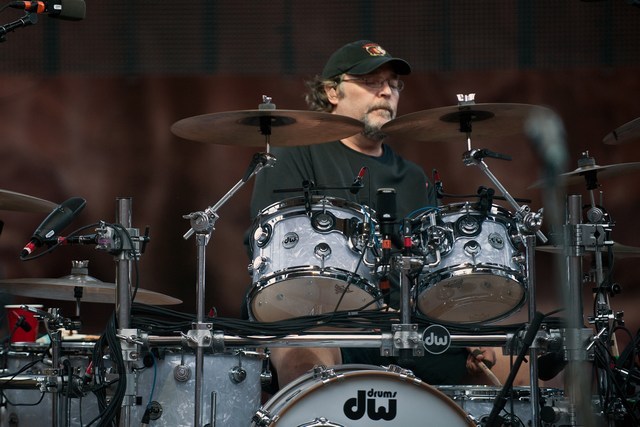
Drummer Todd Nance seems to be reacting to all of this news with a mellow, easy grace. It is this steady attitude that has allowed him to thrive for more than a decade as part of Widespread Panic’s staunch, nimble rhythm section. The textures and grooves he creates each evening with Sunny Ortiz help to define the band’s rich sound. Recently, Nance has further distinguished himself through his participation in his side project Barbara Cue. The following interview touches on all of these topics.
DB- Let’s jump in and talk about the new album. It features the Dirty Dozen Brass Band. How did that relationship come about?
TN- We were trying to so something different for our Halloween shows down in New Orleans the year before last. So we approached them. We had a great time with those guys and we thought it would be a great addition to have a horn section for a tour. So we got together with them for the summer. It turned out great, it was almost like a different band when the two of us got together. We thought some neat stuff was happening and some new sounds were coming out of it. So we decided to go back and get some of the best songs we did with them over the last summer and fall, put them on a little record and see what people thought. So far so good.
DB- In dealing with the DDBB, to what extent was the music worked out in advance?
TN- Well you know we never really work out improv. The less we talk about it the better it usually is. What we would do was set up a practice room in the bowels of whatever building we were playing in, and every day after dinner we’d go down there with those guys and rehearse a new song. I think in total we got about twenty-one, twenty-two songs together with them during the tour. As far as the improv, we’d say we’ve got this part and then we’ll meet back over here.
DB- Did anybody work out charts for them?
TN- No, they would sit there and they would figure out the parts. During the show, if we hit on a riff, say on an improv, one of the guys in the band would come up with a little horn stab and then tell the other guys what he was playing. Then they would come in with the harmonies on top of that and they’d do it right there on the spot, which is pretty slick. Most horn guys wouldn’t really go for something that like but these guys were ready for anything. They were great.
DB- To some degree I would imagine that the dynamic you described is analogous to your relationship with [percussionist] Sunny Ortiz. I’m curious, to what extent do you work out elements in advance with him?
TN- No, we never discuss parts. Unless somebody is going to play along with us, then we’ll kind of tell them how it goes. No, we’ve never discussed it, ever. We just kind of listen and play along. We can tell what happens next because we’ve been doing it for so long now.
DB- What role do you take in guiding or directing improv?
TN- Kind of the rule with improv is if you’re not done yet, keep playing and everybody else will go with you. I don’t necessarily lead them around, I just kind of listen and if it sounds like someone has said what they’re going to say then I’ll go ahead and give a lick that will let them know that we’re going to make a transition. Sometimes they’re not done yet and I’ll have to regroup. The same thing is if I’m playing along and everybody else is done but I’m not, then I’ll just keep on going and they’ll come back in and play along with me. So mainly you just have to listen and decide if you’re buddy’s done speaking his peace or not.
DB- How has your drumming style evolved during your years in the band?
TM- I would say I’m really able to concentrate on the groove without so much of the accents. I have Sunny there who can take care of the bells and whistles and all that stuff. It leaves me a little more open to concentrate on the groove. I guess overall playing with him has made me a more simplistic player than if I had been in Widespread Panic without him. When he first started playing with us he would play at gigs in Athens and Atlanta but he wasn’t traveling with us yet. It was really strange going back and forth. When he wasn’t there, I found myself trying to compensate for both us, which meant I was flying all over the drums, and flailing about. That’s the big thing. He really makes me concentrate on the groove a lot more.
DB- Do you have any particular drumming heroes or influences?
TM- For the most part we’ve become our own influence. We’ve been together for so long now that we influence each other more than any outside force influences us. When I was a kid I was heavily influenced by Richie Hayward (Little Feat). As time went on when I got into Zigaboo (Modeliste, Meters} was someone I listened to a lot and said, “Wow, I wish I could do that.” But I don’t really sit around and pick apart drum parts. If anything when I listen to the music I listen to the melody more than the rhythm. I don’t have a room in my house with pictures of Dave Weckl or Steve Gadd or all the heavies. I guess I like to look at myself more as a musician than as a drummer. So I’ll be more influenced by a group as a whole than one person in the band. Or maybe songwriters. Steve Earle is a songwriter I listen to a lot. I really admire his songwriting style. That’s somebody I do sit around nowadays and listen to and say, “Hmm, I wish I could do that.”
DB- Speaking of which, you’ve been taking a more active role in the band’s songwriting lately. What led to that?
TN- When we all lived together in the same house we would sit around and bounce ideas off each other to make songs. It could be a rhythm, it could be a chord change, or maybe one of us would just pick up a guitar and strum around with somebody else. After we all got married and moved away from each other we all began to write songs individually, which I didn’t really participate in for three or four years. Over the last few years, I’ve been trying to do my part. So when I’m sitting home doing nothing, I try to write some songs that I can run past the band.
DB- In addition to Steve Earle, who are some of your other influences?
TM- I’m surrounded by my influences: JB and Mike, Vic Chesnutt, Danny Hutchens, Jerry Joseph. All these people are around me all the time so it’s kind of scary, actually. Little drummer boy over here trying to write his little songs, when you’ve got all these heavyweights around. But it helps too, and it’s nice when they hear the songs and they’re encouraging about them.
DB- What do you write on?
TM- Guitar.
DB- How long have you been playing?
TM- I played guitar before I played drums
DB- When did you start playing drums?
TM- It’s like the classic Van Halen story. My brother played drums and I played guitar and we swapped one day. I stuck with it because I just enjoyed playing drums. Now it has become something I can hide behind, back in Fort Todd. At this point I would still rather play drums on stage than guitar because I’m not as confident in my guitar playing as I am in my drumming. So I keep my guitar playing behind closed doors for the most part.
DB- Let’s go back to the album, how hard was it selecting tunes?
TN- Unfortunately it wasn’t too hard because we lost a lot of the recording due to human error. So we should have had more to select from than we did. DB- Did you multi-track every night?
We had seven eight track machines but in order to tell what you have, you really need to bring everything into the studio. When we finally did that we got the bad news. There were a few important shows that we were lost- either the horns weren’t on there or there were tracks that weren’t on or whatever. It was pretty upsetting.
DB- Anything in particular that you regret losing?
TN- Mainly it was some shows we remember being quite good but human error jumped into the fray,. For instance, the last show of the summer tour in New York was lost.
DB- How democratic was the process of selecting tracks for the album?
TN- It came down to whoever would get up, go to John Keane’s, sit there and listen to all of it (laughs). Actually eventually we all sat down and listened and decided which ones we wanted to use. It was pretty much unanimous.
DB- There are a number of cover tunes on the album. I’m curious, who typically introduces those?
TN- Whoever really listen to a particular band. The NRBQ songs, I’m the NRBQ-head so those songs are because of me. Van Morrison songs you can probably bet would be through JB. Someone will be listening to what they like and turn everybody on to it who will say, “We should do one of these songs.”
DB- How vigorously do you rehearse those before you bring them out at a show?
TN- We don’t work stuff out too much before we try it live. I guess we figure that’s the proving ground right there. And people seem to enjoy watching a song progress too, kind of watch it grow before their eyes. There seem to be a lot of fans out there who appreciate that.
DB- Do you have any particular favorite moment on Another Joyous Occasion?
TN- The jam going into “Big Chief.” That was probably the band’s favorite part, where we were all like “Yeah, that’s pretty cool.” I think John Keane calls it the “Beehive Jam.” You can hear a swarming sound if you turn it up real loud and listen carefully because so much stuff is going on at once.
DB- What about the song “Arlene,” which typically can go out pretty far in the live setting. What led you to offer a “dance remix” on the new release?
TN- It seems like there’s a growing number of ravers coming to our shows. That’s cool and we wanted to do something for them, for the people who like to go to dance and stuff. We noticed this new group of kids coming to check us out and we said, “Let’s try this and see what happens.” Of course we’d done that before on Brute [the band’s collaboration with Vic Chesnutt] with a song called “Blight.” So it wasn’t actually the first time we’d done something like that.
DB- I’ve heard some people say that it really changes the entire mood of the album, which otherwise presents live tracks.
TN- The thing about it is, that is a live track with a couple of loops thrown on top of it. So its not as manufactured as I believe everybody thinks it is. If you can listen through a couple of those loops it’s basically Widespread Panic playing “Arleen.” It’s just got an edit with the horns on it, where the horns are struck in a couple of repetitive spots with that little lick they do. It’s pretty much a straight-up live performance with nothing taken away, it’s just got some stuff piled on top of it.
DB- Widespread Records, how active is the band in its direction?
TN- We pretty much make all the policies and the decisions. It’s our record company, we’re trying to run it. There are certain things we don’t need to know about but we’re all involved in the big issues.
DB- What was the impetus for creating it?
TN- We just wanted an outlet where we could put out stuff anytime we wanted to. Right now we don’t have a major record deal so it only made sense, really. We’ve also got the April shows from Athens in the can which we want to release. So we decided to become a record company and get these things out there, because I don’t know how long it’s going to before the next studio release comes out.
DB- Will you be releasing Athens as complete shows?
TN- I’m not sure yet. We have to go back and listen to them first of all. I’m not positive what format, whether we’re going to put it out altogether, one night at a time, or how we’re going to do it. We’ve haven’t discussed it yet.
DB- How many releases a year do you anticipate?
TN- We haven’t put a number on it. A couple a year seems reasonable. Possibly as the business grows we might be able to be a bit more ambitious but it’s a pretty small operation right now.
DB- Do you anticipate that you’ll put out the music of anyone else?
TN- Right now, probably not. Maybe in a year or so if things go well. Probably though we’ll be more into distributing stuff, I don’t know if we’ll sign bands and given them recording budgets. We’ll probably give them an outlet to sell their music like we do with the Widespread Panic merchandising site which carries Bloodkin CDs and the Barbara Cue CD.
DB- Well that provides a nice segue. Speaking of Barbara Cue, how did that come about?
TN- Basically, William Tonks, who’s a good friend of mine- he’s been in several bands, I’ve known him ever since I lived in Athens- we were always big NRBQ fans. For years we talked about getting together and doing a tribute show. We finally did it. He got a bunch of guys together who felt the same way about the band, we learned a bunch of their songs and did a show. Man, we had a good time with it so thought we’d get back together again, and then we started asking around, “Does anybody have a song to contribute?” So we all started throwing out songs and writing originals. It just kind of went from there.
DB- How has sound of Barbara Cue evolved?
TN- I don’t what the hell Barbara Cue is. One minute we’re playing stone cold country and the next minute its full balls-to-the-wall rock and roll. We kind of get dubbed as an alternative country band. I guess that’s what it’s evolved into from a wacky pop cover band to the point where nobody knows if we’re the country cousin or the city cousin .
DB- Well you did say you like Steve Earle.
TN- Exactly. He can’t make up his mind either. (laughs).





