

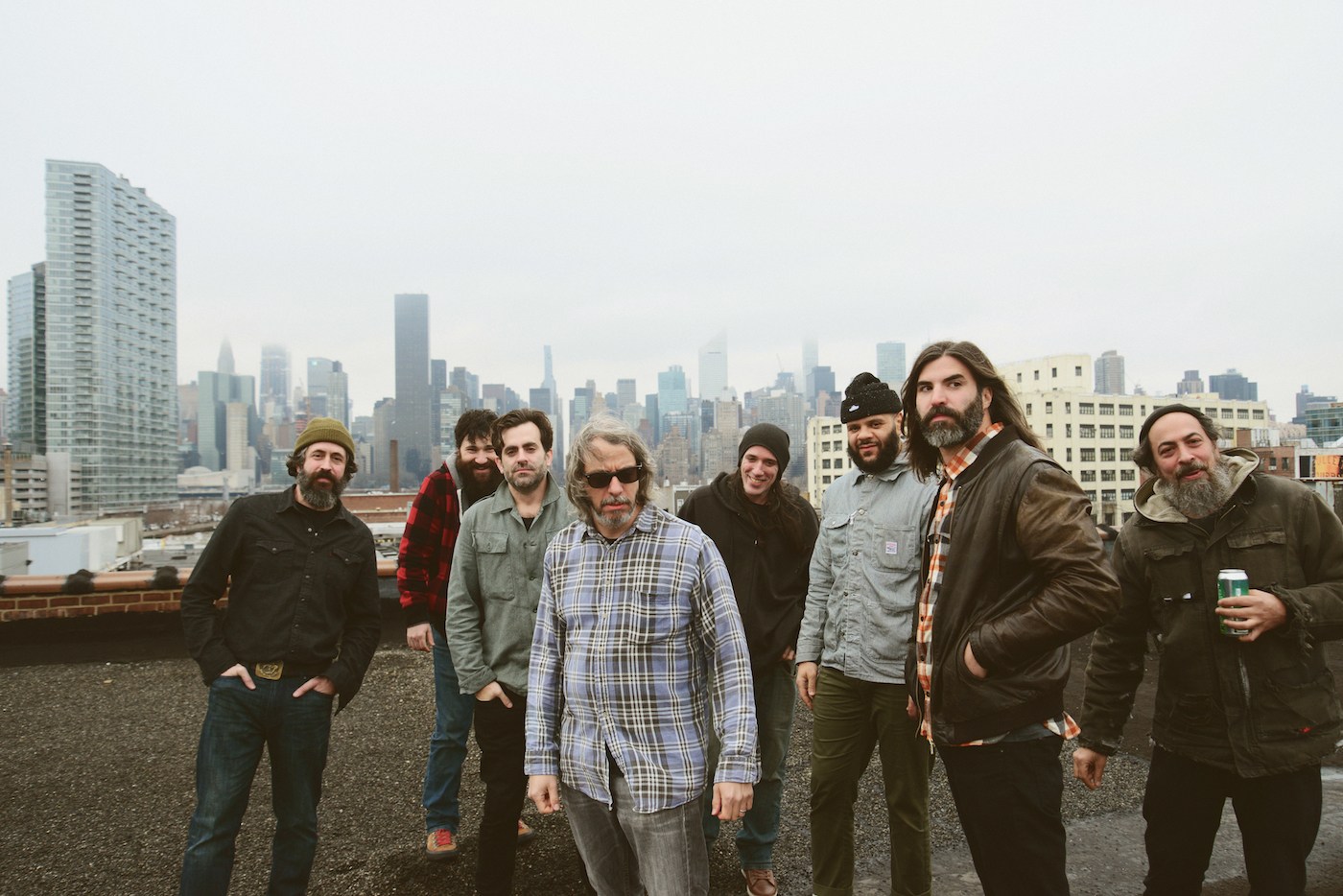
This Friday, April 12, The Budos Band will release their fifth studio album, aptly titled V, following up 2014’s Burnt Offering. On the new tracks, the formerly NYC-based outfit (since their last effort, a couple of key band members have moved out West) combine their early, Afrobeat- and funk-inspired ethos with the newer, rock- and metal-influenced sound that highlighted Burnt Offering, with thick horn and keyboard lines and driving guitar and bass riffs chugging along over dense percussion.
Below,saxophonist Jared Tankel, trumpeter Andrew Greene and organist Mike Dellerdiscuss how the band overcame geographic distance and changing personal livesto keep their chemistry flowing for the new album, why they chose to return totheir album numbering convention of BudosBand I-III, the metal influences that continueto pervade their music and how the passing of Daptone Records label mate andcollaborator Charles Bradley helped bring their family closer together—and evengrow.
Whendid these songs for V begin to come together?
JaredTankel: I think—and other guys, correct me ifI’m wrong—we started getting these tunes together in sessions in 2016, maybelate 2015. We did some touring around Burnt Offering and then, like, alot of babies were born and people moved and there were a lot of changes. Youknow, life happened for a minute. And it took a sec for us to figure out how wewere gonna make records going forward because, like I said, things changeddrastically in terms of people’s schedules and where everybody was living andall that.
AndrewGreene: Yeah, we started coming off ofquasi-touring for Burnt Offering. And then, besides babies being bornand people moving, there was a lot of touring around with Charles [Bradley],right? So some guys were around him for a while. And then the other thing was,wasn’t that around the time when Tommy’s older studio migrated over to DiamondMine, too?
MikeDeller: I was just trying to think about thetiming of all of that—it sounds about right to me.
Andrew:Yeah, so between Charles and movingand babies and studios relocating it was just a long time going.
Wheredid you all end up recording the tracks, since you were a bit more spread outthis time around?
Jared: This was all tracked at the new Dunham studios—which isnow known as Diamond Mine, in Long Island City in Queens. The way that we endedup writing this record was largely in the studio. In the past, our records werewritten over a course of time over rehearsals and things like that together atour practice studio out in Staten Island—which we still have. But, this one,again, given geography or whatever, we largely wrote in the studio as we wererecording and tracking. So it was mostly composed of and conceived of andrecorded all at Diamond Mine.
Sothat was definitely not your regular M.O. when writing for an album?
Mike: I was just going to say, that’s definitely true. We usedto basically compose entire albums before we went in to record them. I’d saywith Burnt Offering there might have been one or two that we started towrite in the studio, but with this one there was maybe one or two that we hadextremely rough outlines or demos of that we brought in, but everything waspretty much written on the spot.
Doyou think that approach altered the finished product in any way, compared toyour previous albums?
Mike: I think a big thing was that we had been doing a bunch oftouring right before it, so we were really in-sync—and, at this point, prettygood at our craft—so I don’t think it made as much of a difference as itnormally would’ve. I think we were able to just go in and do it because we werekind of hot and working already. It just happened as if it had been at ourpractice spot on Staten Island.
Whatwas the moving situation with members of the band? I’m curious about thegeographical hurdles with this record.
Jared: I moved to LA about three years ago now, so very early2016. Then, Tommy [Brenneck], our guitar player who is also one of theowners of Diamond Mine, he moved out here and has been here for like a year anda half or two years. So the two of us are out here in LA, and in terms of thecore band, everybody else is either in Staten Island or Brooklyn.
Whenyou moved out there, was there some fear about what the future was for theband?
Jared: Personally, I was worried. Leaving the centrality of theBudos was one of the biggest and hardest [decisions] for me. I’m from the EastCoast. I grew up there and I have family there, but all of that was a littlebit secondary to physically and geographically moving away from the band,because at that point we had been together for almost 15 years. For me it washard to move away from weekly or biweekly rehearsals and hangs that we werehaving and the whole concept of making records together and touring. I wasworried about how exactly it was gonna look and work out. And, obviously I don’tsee the guys as regularly as I used to and as regularly as I’d like to, but itactually turned out to be more or less fine. I feel like we really haven’tmissed a beat. We made this record and we’re already working on the next one.We’ve got some shows lined up and at this point, whether our shows are in NewYork or elsewhere, we’re all gonna have to travel on some level to get there,so we all meet up and pick up where we left off.
Andrew: I think we had a lot of momentum, too, going on aroundthe time these things started happening. With Burnt Offering, we wereplaying bigger shows to more and more people and then to have some of the bandto move across the country was kind of a bad turn at that point. Besides thefact that we’re all friends and we don’t want to see our friends move far away—everybody’sa big part of everybody else’s life—we had this momentum going and then it kindof gets put on hold. One of the positive things that has happened, I think, isthat when we do get together, if Tommy or Jared comes over to New York or [wego out there], there’s this pent-up creativity with the group, and we can bepretty prolific in 24 or 48 hours. These pent-up ideas come exploding out whenwe’re finally together again, which is kind of nice.
Howoften would you guys get together—how often would the people in LA fly to NYC—whileyou were working on V?
Jared: I would come east every few months for some reason oranother, and then we’d end up doing a session at some point. So it was asomewhat regular schedule. And to add on to what Andrew was saying about thatpent-up creativity, I think there was also a renewed sense of focus, you know?We knew that when we did get together, we needed to be productive. We’d haveour time to hang out and go drink beers together and fuck off or whatever, butwhen we were in the studio and we pressed record, we needed to make it count.So I think we all kind of rose to that challenge together.
Andrew: There’s an urgency with each of the recordings where it’s like, “You gotta get this down in the first or second take. That’s what’s on the record and that’s how you’re coming across.”
With past records, did you take more time in the studio?
Jared: All of our records have been recorded pretty quickly. Withthe first three, for sure, the tracking sessions all happened within a matterof days. We’d have the material and we’d get it done.
Andrew: Yeah, it was pretty much from 48 to 72 hours for the entirealbum to be recorded.
Jared: That changed on this one, because we broke it up intodifferent sessions, but I guess it was like a different sense of liverecording. With the other ones, we’d go into the studio with songs written forthe most part, and we’d record them all hot and live and relatively quickly.With these, we’d come in, we’d write and brainstorm and get the song together,and then we’d press record. So just a different sense of urgency.
Tomy ear, the new album sounds like a natural progression from Burnt Offering,with maybe more of a touch of what you guys were doing earlier on. It’sinteresting that you had I through III, then changed the patternwith Burnt Offering, which had some more prevalent rock and even metalinfluences. Did the return to the number-title format follow a conscious returnto your earlier sound, while still keeping those new influences?
Andrew: I don’t know—it was like an unconscious decision thateverybody just kind of agreed upon, you know? It wasn’t like, “We’ll do I,II, III, then we’ll do some cool record that has a cool-guy name,and then we’re gonna go to V.” It just kind of makes sense. I guess webetter digested a lot of the influences that were pulling us in differentdirections, like more reintegrated sort of Budos sound. I feel like we can onlygo so far away from what we were doing in I, II and III,and then [beyond that] it’s not the band anymore, right? Jared, was it aconscious decision to say this is V?
Jared: I think we kind of staked new territory with BurntOffering, and we made a conscious effort to make a different record on somelevel, but still a Budos record, and I think we accomplished that. Then it waslike, “Cool, we did that, and now we’re gonna take that and we’re gonna bringit back.” It’s all an evolution process. We staked our ground on that, and nowwe’re going dial it back a little bit and bring back certain elements ofearlier records. So when it came time to name it, we went back to the numberconvention. We didn’t really think about it—it was just like, “Yeah, we’re backto the V.” We did “Budos IV” and wecalled it something else because we were staking this new ground and trying outsome different things. BudosVis certainly different from II and III, but it’s a little bitmore in that cannon of Budos composition.
Andrew: I don’t know who said it, maybe it was [Henry] Rollins,and he was like lecturing or something—who knows what that guy does—anyway, hewas saying, “Bands progress, which means they suck.” Like, do I really want to hearthis band go in a different direction when I’ve come to know and love themdoing their sort of thing? Like, Budos is gonnaput out a rock opera or something like that…no. I don’t really want to hearthat. Just like I don’t really want to hear a funk band do a cover of a BlackSabbath record or something like that. I mean I guess some people do; not toknock the people that do want to hear it. But I don’t really want the bands Ilike to evolve. I mean to a certain extent, yeah, they’re not going to play thesame freakin’ riffs, but do I really want a band to put out a Celtic folkrecord that previously was doing trashy rock or something like that? I guess we’rejust playing what we like to play, honestly, and that has a lot to do with it,too. It’s kind of hard not to play what you like to play.
Whenyou guys are in the studio, is there ever any discussion about that kind ofthing—about influences or in what direction you want to take a record? Or is itmore that someone brings in an idea and you start playing off of that and therecord becomes what it becomes?
Mike: I would say it’s kind of a little of both. I think wemight have a slight sense of a direction we want to go in, or just somethingthat’s going to set this next record apart from the ones before it. But, whenit gets down to the more detailed aspects, like the actual songs, it is more oflike somebody comes with something, a riff or an idea, that we start with andthen see where it goes. If it’s good, we keep it, and if it’s not—forget it.
Andrew: Right. We’re not shy about telling each other when things are starting to suck, you know? Nobody’s got such an ego—and god bless this band. If the consensus is, “This is not a good sound,” we’re not like, “Oh let’s try to save it from the pyre.” No, that idea gets trashed, and we just move on. I’m thinking a lot of bands are gonna be like, “I’ve invested my soul in this idea and I don’t appreciate people casting it off so quickly.” But there’s definitely been moments, when we were recording V, where we literally had entire songs written and it’s just like, “This song is just not good and we’re not gonna work on it any further.” And then there were songs that actually ended up on the record that, at some point, somebody might’ve said weren’t going to cut it. But then, you know, on second thought, actually this song’s pretty good—let’s leave it on the record. But we all kind of have the same sensibilities when it comes to what the sound of a song should be. Like, on the earlier records it could be that the horns take such a front role that they kind of overshadow some of the other things going on in the rhythm section. So one of the main things I think that’s changed through the records is that the band has become much more democratized, where things are more complementary—without this guitar part, this bass part falls, or without this drum part this keyboard part falls. They all build each other up into a song.
LikeFrampton. A Peter Frampton song is a showcase for Peter Frampton, who plays thefucking guitar. It’s not like I’m listening to a Frampton song and I’m like, “Ohwow listen to that drum part there!” No, there’s a fucking 15-minute Framptonsolo at the end. So, to not have that happen is one of the goals. We’renot going to say “Oh the saxophone solo saved the song.” The whole song kind ofsupports itself. And in some ways, they kind of write themselves in that regard—everybodyfalls into place, and we know where everybody fits within the larger framework.I think we’ve said that in previous interviews, but it really is the case.
[Ed.Note: Greene at first started his Frampton note with a disclaimer to notinclude in the interview, but Tankel, laughing, convinced him otherwise. Greenethen offered further explanation:]
Andwhat I mean [about Frampton]: The guy’s a great musician and the music’s greatand he sold fucking billions of records but, again, honestly that’s a vehiclefor that person to play. It’s not like I’m saying, “Man, the vocals are so good—let’sget the vocal sound from that Frampton song.” That’s not the point of the tune.Hopefully I didn’t beat that to death…
I’mcurious how the harder-rock elements of Burnt Offering came into theband’s music, if it was something you guys were listening to together.
Jared: We’d always been listening to that music, especiallyduring the touring after Budos III.We were like, “We’re not listening to fucking funk and Afrobeat music in thevan anymore—that’s out. We’re listening to rock music.” We had all listened to thatmusic for all of our lives, in our own ways. And then it was finally like, “Youknow what? Let’s’ make a record that puts those influences out there moredeliberately. We were all on the same page with that, I think. By the end of III,we were like, “OK, cool, what’s next?” And Burnt Offering offered us theopportunity to change things up. I think we needed to do something [like that]so that we didn’t get bored with ourselves.
Andrew: Exactly. When we were on long tours, longer road trips,it just became the soundtrack in the van. I mean, I listen to that stuff anywayall the time, but then you just want to play like that, you know?
Also,before that, there were all these blogs popping up with a focus on obscurebands that kind of never made it, and people were really digging the psych-rockand heavy, hard-rock bands that came and went. And in that blogosphere, I becameobsessed myself with trying to find the rarest, trashiest—I’m going to lovinglycall it garbage. Listening to these bands that could barely record themselves. Theywere barely able to stand up when they recorded these records. That sound—Ialways found it amazing. There was a point in my life when I was listening tovery technical things for a long period of time. I was a music major in school,Then I moved so far away from that, where I just want to hear a band that canbarely stay alive. Then I just started making mixes for the van, passing upiPods to whoever was sitting in the front—“Put this on”—and then for hours we’relistening to trashy, obscure psych-rock. And there’s just somethingexciting about that—these bands are playing with such conviction. They’replaying the best they can play and they’re playing it with the most impetusthey can come up with—that part of it I really felt connected to. It’s-not-what-you-play-it’s-how-you-play-itmentality. Anybody could get up there and play like every freaking note andrhythm they know in the first 10 minutes of a show, but to get up there andplay two notes and make it sound amazing—that’s something. The kind ofgear that everybody was always interested in also lends itself well to that. We’renot using trigger pads or massive squawk boxes or digital manipulation ofthings, so we can get that sound pretty much right off the bat, because that’show we’re playing anyway.
Thenagain, what models are you looking for, anyway? When were there horns in a bandwith guitars and organs and stuff—where are we looking to in the first place?Our contemporaries, it’s not. Nowadays, it’s very technicallyoriented and things are produced and it’s more about a show set or a danceroutine or something like that—at least for the pop scene. The other part of itis that a few of us are just die-hard metal heads.
TheDaptone Records family is known for being a close-knit group. I know that someof the Budos members toured with the late Charles Bradley, and I wanted to askwhat it was like to be a part of his final tour, when he returned from cancertreatment but ultimately passed away from it in 2017.
Mike: Aw, man. Charles’ last outings were pretty heavy. Ipersonally was very conflicted, because he wanted to do it—he wanted to go outand play these shows and I wasn’t going to be able to stop him—but at the sametime, I wanted to make sure that he was home getting healthy, you know? I didn’t necessarily want him to go out. But hewanted to and I just decided, “Well OK, if you’re going to do this I’ll go withyou. I’m not gonna miss this.” But it was pretty heavy, and I would say all ofit definitely brought the family a lot closer together. I think it really gaveeverybody a sense of what we had, or have, going, and I think everybody gotthat. People caught on that this is a moment—not only a thing that we started,but a moment, and it could pass at any time. Charles and Sharon weren’tso young, but a lot of us are a lot younger and we don’t even think aboutmortality so much, I would say. Maybe the Budos guys a little bit more now aswe’re getting older. I remember having conversations with a lot of guys inDaptone and in other bands in Daptone that I hadn’t spoken with in a while. Andit’s not like we’re not that close or anything it’s just—you know, you’reworking, you’re doing your own thing, and this was a wake-up call, like, “Jesus, let’s all be happy that we’re together and cherish this.”
Wasit a surprise when he finally passed or did the guys around him kind of knowthat that was happening?
Mike: He was in the hospital for like a week or so. We werethere all day, every day, every night, sitting with him. And that was anotherthing—he had the Daptone family, but he also had a whole other family of peoplethat he played with, too, and so we got to connect with that, with this otherside of Charles—the Black Velvet side. [Bradley used Black Velvet as a stagename during this Jame Brown impersonator days.] We got to meet all theseother amazing old musicians and hear stories about what they had with Charles,which was incredible. I definitely feel like I made a lot of new friendsthroughout that experience.
Even before the hospital, we knew. He knew he was making a decision, you know? It was like, “Do you want to really hunker down and fight this, or do you want to do what you love?” I mean, I don’t want to speak for him because obviously I’m not him, but we all sort of knew. I’d say the last few tours with Charles were super emotional. That band, especially since we had been on the road so much in the years before that, we were all in this “too cool for school” mode, where nobody was really hanging out and everybody had their own agenda. We were just working on the road. Not that it was brutal and we hated each other or anything, we all just had our thing. But the last couple tours were not like that. It was all together, all day. Dinners, post-show—we were all taking in what we could.





