

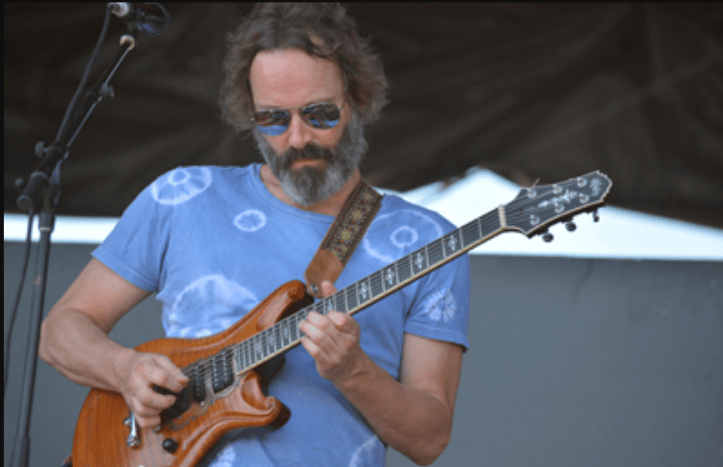
Neal Casal was the ultimate sideman to the stars, an incredibly tasteful guitarist who helped usher the likes of Chris Robinson, Ryan Adams and Phil Lesh into unchartered territory without ever overshadowing those marquee names. And, perhaps because, in his own words, he was “not rock-star-guitar-player material,” Casal’s August 26 suicide just days after playing with his own Circles Around the Sun and Bob Weir and Oteil Burbridge feels not only tragic and heartbreaking, but also incredibly real.
As the wave of social media posts and musical tributes that followedhis death clearly show, the New Jersey-bred guitarist—who spent most of hiscareer in New York and Los Angeles—also touched an incredibly range ofperformers during his thirty-year run. After cutting his teeth in theSouthern-rock act Blackfoot and focusing on singer/songwriter solo work formuch of the 1990s, Casal went on to tour with alt-country act Beachwood Sparksfor and serve key posts in The Chris Robinson Brotherhood, Adams’ Cardinals andvarious incarnations of Lesh’s Friends around Terrapin Crossroads. He alsohelped form the rock band Hazy Malaze, American trad-rock jamband supergroup HardWorking Americans, the California roots outfit The Skiffle Players, and his ownCircles Around the Sun, which grew out of his house music compositions for FareThee Well. An active studio player, he also helped blur the line between indie,jam, folk, country, psych, gospel, Americana and funk, serving as an unheraldedgodfather of the indie-jam movement and helping introduce a new generation tothe Grateful Dead’s cosmic sounds. (Robert Randolph, who worked with Casalearly on, credits the guitarist with introducing him to the Allman Brothers andThe Rolling Stones.)
In 2016, during an incredibly fertile period with CRB that produced AnywayYou Love, We Know How You Feel and If You Lived Here You Would Be Homeby Now, Casal spoke with Relix and Jambands.com about his creativepartnership with Robinson, his roots in the Dead’s world and his plans for athen nascent CATS. The complete interview, for the first time, is now availablehere.
You’ve grown into one of Chris Robinson’s closest creative partners inrecent years, and you have a long history playing music together, dating backto your time with Beachwood Sparks. When did you first meet?
I met Chris in the early ‘90s—he would never remember this, but therewas a bar in New York where we both used to hang out called 3 of Cups. We weremutual friends with the owner, Santo, though we were in different circles backthen. But I would see Chris quite a bit in 3 of Cups. We’re talking 1993-1994when The Black Crowes were scaling the heights and I met him and had a shortconversation about Gram Parsons once.
I had always been a Black Crowes fan. Their early records meant awhole lot to me. Chris’ prioritizing of good music started back then, and theguy always had his head pointed in the right direction. I was listening evenall the way back then, because he would always talk about the records that heloved and inspired him. Those who read his words, if they hadn’t heard thosealbums already, they would go out and buy them. That’s what musicians are supposedto do. That’s a good quarter of their job—to not only make their own music butalso tell the world about what they’re listening to, because musicians arealways into deeper stuff than you’re going to get at the purely commerciallevel. Chris was always great at pointing the way to music that you may nothave already heard.
But I met Chris officially in 2001, when Beachwood Sparks opened up apart of the Lionstour for the Crowes. We got friendly and made the connection about our mutualfriend in New York, then stayed in touch over the years. I would run into himin New York and LA—I ran into him at one of Jonathan Wilson’s jams in LowellCanyon around 2007. Then, a few more years went by and he called me with theidea to start the CRB, and I jumped right on board. The chance to work with himwas something that I didn’t have to think about. We got straight to work. Heand I started writing songs before we even played our first show. Chris wasaware that I had made many solo records and I was a songwriter as well, and oneof his main ideas was for me to help him and see if we could co-write and be asongwriting team of sorts. He invited me over to his house in Topanga, we hadour first meeting and it went well. He just gambled on me to see if it would work.You can think about something for forever but eventually you just have to rollyour dice, and he put his bet down on me and it worked out because we startedwriting songs right away. Adam [MacDougall] was the first member of the groupbecause they had talked about starting the band while they were part of theCrowes. I didn’t know Adam, but we became fast friends because we share so manyof the same musical values and are on the same page about almost everything, sothat worked out. We put the band together and got into a van and didresidencies around California for two months.
Again, that was an experiment to see if this thing had any legs andstaying power. There was one night in Santa Barbara—we were playing this littleclub called The Soho and the band caught fire and the audience felt that. Welooked at them, they looked at us and everybody in the room knew that there wasgoing to be a future in this. As a band, we blew ourselves up in front ofpeople. We didn’t make a record first—we played shows first—and we played showsfor almost a year before we made a record. Our early audiences, particularly inCalifornia, felt our growing pains for a few months, and those were the peoplethat gave us the idea that this was going to work. At least for me, there was adefining moment where our young band turned the corner and we all knew was thatthis was something we could take on the road, make records with and have afuture with. That’s how it went. We wasted no time in the beginning. We got toknow each other as we went. The work came first, really, but there have alwaysbeen a lot of laughs in this band. That’s the other pre-requisite for beinganywhere near the CRB: You better have a strong sense of humor or you’re notgoing to last long with us.
Did Chris make a decision early on that he wasn’t going to play hisBlack Crowes material with you guys or his solo material and instead focus onnew songs and classic covers.
The idea of playing Black Crowes hits was never on the table—not for asecond. The idea right from day one was to create a new band with new originalsongs and form an entirely different idea that would not be dependent on TheBlack Crowes’ history, songbook or fans. Any of Chris’ fans were invited alongfor the ride, but he wasn’t necessarily going after them. There was astipulation for the band that a club couldn’t advertise Chris Robinson of TheBlack Crowes. That name has never been on any part of advertising; it’s a partof the story that we talk about or he talks about in press or whatever, butit’s not an advertising tool and never was.
CRB has always had more of a Grateful Dead ethos than the Crowes,though some of their latter-day albums hinted at that direction.
Honestly, if the idea for the band was to be a satellite of The BlackCrowes, then I wouldn’t have been interested, personally. I love The BlackCrowes, don’t get me wrong. I’ve been a fan since day one, 1990, and I’ve seenmany of their shows, but I’m not interested in playing heavier rock music likethat. Their acoustic side or their country side, that I’m into, but I’m notrock-star-guitar-playermaterial; that’s just not my stance. To pursue a more Grateful Dead–inspiredthing was much more my taste, especially at this time in my life. It all workedout. Not just the Grateful Dead, but also psychedelic music in general and folkmusic and, we even explored jazz influences—not that we can really play jazz,but just as a mindset and an openness within the music where it’s not all thisheavy, guitar-drivenmusic. Guitars don’t necessarily fill up all the spaces in the music—there’sroom for all of Adam’s keyboard work, which opens up horizons of possibilities.It’s just a different music that’s coming from a different place. That idea hasbeen on the table since day one, and that’s what attracted me about the offerto join the group.
You all took a leap of faith, jumping in a van and playing small clubsfor months at a time. Did that experience make you reevaluate your career prioritiesin any way?
It personally wasn’t really a huge step back. I hadn’t been in verybig bands for long. The most successful group I had been in was Ryan Adams& The Cardinals, and that was an incredible ride where we were playingbigger venues and traveling in style. But as far as riding in vans, believe me,I’ve done a lot more of that in my career than I have the former, so it wasn’tthat shocking for me to do it.
On some level, for me,music is all the same no matter where you are. You can have your greatest orworst night in the shittiest bar or in the most successful venue in the planet,and I think sometimes the bigger shows can be a lot more isolating and sterileand not nearly as fun as the smaller ones. Don’t get me wrong—spending the restof my career riding around in a van is not my best idea, and I’m certainlyaiming higher than that. As far as how we started the group, it felt good to doit that way. We had to do it that way as well because of the economicsinvolved, which is a very real part of any group’s existence. It was abrand-new brand, we had no track record and we had to start small if this thingwas going to survive.
Another thing that Chris was adamant about and extremely smart aboutwas creating a band that can exist on its own finances and not have to takeloans from people and get investors and all that. We bit the bullet early so wecould build a business that could sustain itself. It was just a smart businessmove on Chris’ part that if we tightened our belts early and we built somethingreal and authentic that it could sustain itself on its own and not have to bowto any business pressure. Then we’re the free artists that we want to be and wecan live the free artistic life that everyone dreams about. We can play the exactkind of shows that we want. We can play a two-set, three-hour show and do it onour own terms. When we make records, we do have assistance from a label, butit’s not a huge thing that puts us in debt for the rest of our lives. We keepour record making on a reasonable turf. But when we make them we do exactlywhat we want, there’s no one barking at us to do anything. We make all thedecisions ourselves, and the people that we work with trust us to come up withsomething good. We put every penny and every ounce of sweat we have into thoserecords and shows because we do have the freedom that we built into the band.Starting the group in a van worked on many levels. As far as the stepping downform the bigger touring life, I think Chris is the one to really ask because heworked on such a higher level than the rest of us for so long. For myself, Itraveled the high and low roads equally for a long time so it wasn’t as much ofa shock for me.
In certain ways, your career arc foresaw the current indie-jam movement—you’veplayed in both improv-oriented bands as well as more song-driven, Downtown NewYork projects. What are your roots in the Grateful Dead world?
The indie crossover is rather hysterical now because, if you livedthrough the ‘90s, you know damn well that wasn’t the case 20 years ago. Butit’s fantastic that there’s this crossover now. I worry about the music itselfgetting a little too diluted and watered down and its original intentforgotten, but that’s another conversation. As for me, I’ve been a GratefulDead fan for many years. I saw shows in the ‘80s, in the ‘90s. I saw the JerryBand. So I’vebeen into it for a long time.
The music is very much a part of my DNA and that’s where it residesthe strongest. By that I mean that in the ‘90s and the early 2000s—and reallyuntil CRB started—I didn’t spend my time learning the Grateful Dead catalog indetail, because I was too busy writing my own songs and making my own recordswith my own name on them. I was doing my best to find my own voice as amusician and chart my own course as a musician so I was never involved in thefiner points of learning Grateful Dead songs, because I just had such a widefield of music that I was interested in and I was really trying to write myown. So their music did exist on the DNA level for me. I did listen to it a lotand I did learn some songs, but I learned more about chord changes and actualsongwriting from them than I did lead guitar playing, so to speak. I alwaysthought that their songwriting structures and how they put tunes together wereso interesting and there was so much to learn there. But I never spent timelearning stuff in detail until I started playing with Phil [Lesh] a few yearsago, and that came through the CRB. We get to spend time with [former Deadsound engineer] Betty Cantor, who’s out on tour with us now recording. I’veenjoyed getting to play with Bob the few times that I have, but playing withPhil is mostly what turned my focus to actually learning how to play that musicand looking closely at the DNA of that music—which is really a version oflooking closely at my own DNA and putting a magnifying glass on that music,what made it tick, what made it work and how I can learn to play and sing it.
I think about how I can possibly bring my own reverentyet—hopefully—soulful approach to it, because with any music that we evercover, the intent is not to imitate or copy but to find a way to bring itforward and communicate it in a fresh way that has some living quality to it inthis moment now. That’s the challenge with Grateful Dead music.
Whenever the CRB does Grateful Dead covers, we do our best to bringour own voices to it. That’s not hard when you have a singer like Chris whostamps his own identity on everything that he touches, because he has such astrong identity as a singer and musician. When I get to play with Phil, it’sjust the highest honor for me. I never take it for granted and I do my best toplay reverently, but also with my own charged energy to it. Anyway…GratefulDead music—it fucking rules!
I always felt in The Cardinals, especially those early years, werechanneling some of that Dead ethos, but maybe it was just a subconscious thing.
No, that’s definitely true, because Ryan was fairly obsessed with theGrateful Dead as well. The Cold Roses era, extending into Easy Tiger,was based on a lot of that stuff. Ryan wanted to explore those avenues, andthat’s really what got me going into it a little more deeply. Phil sat in withThe Cardinals at the Hollywood Bowl in 2006, so I met him then. I actually satin with Phil and Friends in 2008, and that was the first time I played with hisband. Then, I had a book of photography—my documentary book of my Cardinalsyears—and Phil wrote the afterword for that, so I had something of a friendshipgoing with him before the CRB.
The Cardinals were getting into some of those vibes, but really on avibe level though, not on any specific level. That seemed to put the idea intothe air, so I guess something was destined to happen because it didn’t go away.The Cardinals broke up and, a couple years later, up springs the CRB, and Philis sitting in with us and then Terrapin Crossroads opens and Phil needsmusicians to fill out his rosters for Rambles or for the shows at the bar andfor all of their activities they have going. I just happened to be standing inthe right place with my guitar on when he needed me for some of that stuff. Iwas more than willing to go where he called me, because he’s such an extremelyimportant figure in our musical lives that the chance to be around him andlearn from him as a musician is not one to be ignored. As you know, he is stillabsolutely playing his ass off, and he can run most 28 year olds into theground when it comes to stamina and focus and energy. Chris feels the same way.
CRB will have released two albums by the end of the year, Any WayYou Love, We Know How You Feel and the If You Lived Here, You Would Be Home by Now EP. It seems like a really fertile period forthe group. Can you pinpoint a moment things really started to gel on thatfront?
It’s really just a product of being together for five/six years andhaving built some confidence up. The beginning was simply the beginning. Youdon’t have your legs under you yet. On the other hand, there are some bandsthat come out of the gate fully formed, make a brilliant debut record and spendthe rest of their careers trying to chase that. That’s not us. We had to buildup to where we are now and earn our stars. So on this record, some of ourpersonal leanings come forward more and create a cohesive whole. For instance,on “Narcissus Soaking Wet,” you immediately you hear these P-Funk style vibescoming through, and that really is primarily Adam’s influence. Chris is a major[George] Clinton devotee, but it is really one of Adam's main influences, andyou hear that coming to the foreground—we had never done anything like thatbefore. Then,with a song like “Forever as the Moon,” you hear this Beggars Banquet [1968Rolling Stones album] thing coming through—which, OK, in relation to Chris’voice, no one’s surprised—but in this song you hear more of the subtle layerscoming through.
Moving to the EP, there’s a song like “Sweet Lullaby” with that country vibe. That comes a little bitmore from Chris and me; he and I share a deep love of the lostsinger-songwriters and country-rock artists of the golden ‘70s era, people likeGene Clark, Steve Young, Paul Siebel. There’s so many great, obscure recordsthat exist in this Light in the Attic reissue generation that we’re in now thatstill very few people know about, so a song like that comes from a shared lovethat Chris and I have of songs and artists like that. “Roan County Banjo” putsit all together; there’s a little bit of the psych-country, our San Francisco influenceslike Quicksilver [Messenger Service] or even more LA stuff like the Byrds andBuffalo Springfield. Adam manages to sneak his funk in there, Tony [Leone] getshis Band-esque Levon [Helm] pocket inthere and the rest takes care of itself. There are a lot of things comingtogether in a couple of records here.
Our new rhythm section has changed things dramatically, too, noquestion about it. We had an excellent rhythm section before. George [Sluppick]and Muddy [Mark Dutton] were founders of the band and they helped write theblueprint for what we’re doing now, but with Tony and Jeff Hill, we found twopeople who already knew each other and have played with each other for a longtime and have a friendship that stands outside of the CRB. They didn’t becomefriends or meet each other through this band; they already knew each other, andthere’s a strength to that that’s really apparent in what we’re doing now.They’re just a great rhythm section together and they’ve brought such a deeperpocket to our group. They’re two world-class musicians, simple as that. No bandis going anywhere fast without a great rhythm section—it’s just not going tohappen. At a certain point, if a band doesn’t have a great rhythm section,there’s going to be a reckoning. Lucky for us, we have a truly superb rhythmsection and we feel like we can go anywhere with these guys; they can playanything. Tony is not only a great drummer, but also a well-rounded musician—heplays mandolin, he’s a good singer and he’s even writing a little bit with usnow. He hears not just drum parts; he hears the song. He hears and feels thebigger picture of what a song or a band is supposed to be, and it’s the samething with Jeff. I’ve known Jeff for many years. He’s played on four of my solorecords, and we were in a band together 10-12 years ago that made threerecords. Jeff is not only a great bass player but also an engineer. He’s aproducer, he has tremendous studio skills, and he’s a great upright player andgreat singer.
All of these ancillary skills—not just the bass playing anddrumming—that’s what makes a musician great for a band. There are individualmusicians who are great as players on their own but they’re terrible in bands,because bands are all relational. Some of the greatest virtuoso musicians arenot meant to be band guys, and the CRB is very much a band in the real sense ofthe word. Anyone that plays in this band or comes around us has to be a trueband guy or girl. In our new rhythm section we have both: virtuoso players andstrong band personalities.
Who played bass on the album?
A guy named Ted Pecchio. He had played bass for Susan Tedeschi’s groupa long time. He comes from the Tedeschi Trucks world. He played with Col. Bruce[Hampton], too, for a long time.
Shifting to Circles Around the Sun, you have a few shows scheduled inthe next few months. The project started as simply the house music for FareThee Well, so what has the process of adapting that music to a live settingbeen like?
We record the music entirely live so, as a matter of fact, taking itout live and playing it is not hard at all. Re-creating it takes nothing.There’s no overdubs that we have to cover, no extra musicians that we have toget to cover all the parts that were on the record, because we recorded everybit of that music live in the studio in two days without one overdub.Reproducing the sound is very easy, but on the other hand I was reticent toplay shows with this group last year because I felt like in the afterglow ofFare Thee Well, there was this Grateful Dead fever that struck the nation andit seemed like people who would’ve never been into this before were suddenlyclaiming themselves lifelong fans. Something felt a little off about that tome, and I didn’t want to exploit it by jumping on the Grateful Dead fever 2015bandwagon just because people reacted so well to the music that we made forthem. It just felt better to wait and see if, once the fever died down, therewas still interest in the Circles Around the Sun music, then we would considerplaying it live. We were asked to play Lockn’ this year, and that said to methat the music had a life of its own beyond the Fare Thee Well fever.
There was another art of playing that music live that I was a littleconcerned about, which was whether it would translate live or not, because themusic was not meant to be played live as a band—it wasn’t made to be released,it wasn’t anything. It was only made to be played at the Fare Thee Well showson the screens on the sides of the stage, and that’s a totally differentapplication than taking it out live in front of people. Some of those pieces ofmusic are over 20-minutes long;they’re very, very patient, and several minutes will go by with not muchhappening in that music.
In many ways, it’s not the most exciting music in the world and itwasn’t made to be. What’s cool about that recorded music is that you can turnit on and it sounds pretty good and you can walk away from it for a while anddo some gardening or whatever and have it in the background and forget aboutit. But then if you feel like turning your attention back toward it, it’sinteresting enough that it will engage you, but you can go in and out of thatmusic if you want to. I think that’s great on a recorded level, but as far alive show goes, I wasn’t sure if that would fly or not. But doing that liveshow, we decided not to try to falter any of the music to please a crowd—wejust think it can be background music, a soundtrack to a party for people todance to or trip to or just hang out with their friends to. The focus isn’treally on any of the band members at all or on any kind of virtuosity orshredding—or even songs—but really on these wide-open palettes of improvisationfor people to either get into or not.
The first show went really well. We’re excited to do more and we’llsee how it goes, but the implication of the music was the Grateful Dead. Wemade it for them, and the way I approached it was to try to create music thatGrateful Dead fans can connect to and feel some familiarity with in terms ofthe sound, being a familiar sound but not laced with such mimicry that itbecomes a turn off. To pay true respect to Grateful Dead music is to do yourown thing with it, because the Grateful Dead were all about doing their ownthing. That’s why people love them. They very much did their own thing in theface of everything else that was going on in the world. These were trulyindividual thinkers, and that’s why we love them and that’s why they endure. Tojust copy them is antithetical to what they were all about.
There was a delicate line to walk when making the Circles Around the Sun music. You can feel that it was a nod and tribute of sorts but not so much so that there couldn’t exist a new identity. So I think it’s possible that we may have unwittingly achieved that goal. That’s what I was after, but I had no idea when we made it if we had done it or not. I’m still not totally sure, but people are telling me that we have, which very nice to hear. It’s an honor to have done it and be actually making jam music and that’s truly jam music. Like I said, some of those pieces of music were 15-, 20-, 25-minutes long. I never—and I know I’m speaking for Adam, too—we never would’ve done this five years ago, meaning that we learned this stuff by being in the CRB and through playing with Phil. It’s learning the art of the jam and how to really conduct a jam and how to have the patience that’s required to truly play beautiful music and not just show all your cards in your first hand. It takes a lot of work. If you put 10,000 hours into your instrument to get where you are now, you gotta put in another 20,000 hours to learn what I’m talking about. Within the last five/six years within the life of the CRB, there’s been multiple rounds of 10,000 hours all over again to try to further us and improve and learn to communicate better and deepen our artistic lives. Circles Around the Sun is an accident—well, maybe it’s not an accident… It’s another product of the work that we’ve put in.





