

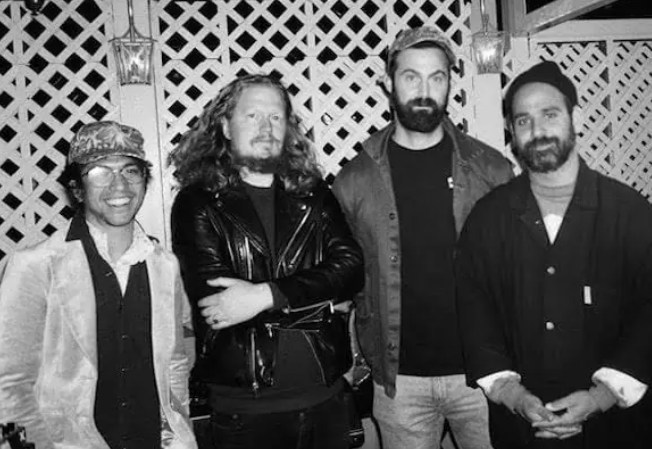
The members of Taper’s Choice have taken to calling their project a “subversive jamband,” which feels like an appropriate way to describe their approach. Though the four members of the five-year-old group all came of age in New York and New Jersey, in the shadow of the jamband scene, they each initially made a name for themselves on the indie-rock circuit. Guitarist and in-house producer Dave Harrington is best known for his work in the psychedelic-electronic project Darkside and as a journeyman musician on the Downtown New York experimental music scene; bassist and singer Alex Bleeker co-founded the jangly indie-pop group Real Estate with his high-school friends and leads a more freak-folk-inspired group under his own name. Drummer and singer Chris Tomson put together world-inspired “big indie” group Vampire Weekend with his friends at Columbia and worked with The Black Keys’ Patrick Carney on a solo release between VW LPs. And keyboardist Zach Tenorio blurs the times between indie and pop with his Providence, R.I.-bred group Arc Iris and has worked with a range of big-name acts, most recently helping shape Willow Smith’s 2024 set, Empathogen.
Now all based in California, the four musicians have used Taper’s Choice as an opportunity to both revisit their jamband roots and have some fun with the fan-friendly minutiae that have long helped their heroes build distinctive jamband universes of their own. At the end of last year, the quartet dropped their proper studio debut, Prog Hat, and this winter they’ll spend some time on the road touring the East Coast as they head to Jam Cruise. Along the way, they’ll return to New York’s Brooklyn Bowl on Jan. 31, just over a year after they served as the house band for Relix’s 50th anniversary celebration.
Shortly before embarking on their most extensive run in some time, Taper’s Choice looked back on the creation of their first record, their favorite collaborations with members of the Grateful Dead and Phish, and how to walk that fine line between being funny but not a joke.
Dave, you are listed as Prog Hat album's producer, along with the full band. Can you start by describing how and when Prog Hat was recorded and what type of atmosphere you aimed to capture in the studio?
Dave Harrington: We made the bulk of the record—all the “proggers”—at Lucy’s Meat Market here in LA with Pete Min engineering. Pete makes a lot of great modern jazz/improvised records and has an incredible synth and keyboard selection, so I was psyched to do it with him. In the studio, I always like to keep it as loose as possible, even and especially when dealing with challenging material like the knottier stuff on Prog Hat. I’m also notorious for not wanting to listen back to takes very much or at all. Once I feel like we have good sounds coming out of the mics and the board, I like to dive in and keep moving. I trust the other guys’ ears in the band implicitly, and especially in terms of picking strong performances, so I usually leave that to them and focus on the sonics and the arrangement and just trust that the take will come. I don’t think we did more than two or three takes of anything when we were there.
Alex Bleeker: We had been playing all of the songs on that record for some time, with the exception of “Song Hat.” “Song Hat” was a spontaneous “in-studio” composition, and it might just be my favorite tune on the record. We’ve yet to debut it live. I’m not sure what any of that means, but maybe we’ll work it up and bust it out on our upcoming East Coast dates. As far as the other tunes go, I feel like we possess a secret weapon in Dave’s production and post- production skills. So a lot of what you’re hearing was recorded live—playing together—and then it was all run through Dave’s metaphorical pedal board before it was finished.
Prog Hat features several extended, jam-forward originals but the Taper's catalog is actually already pretty big and this record feels carefully curated. What was the song-selection process like for this first album?
Chris Tomson: For me, the classic flow of some tense, heady composed madness releasing into open improv tends to be the highlight of many jam sets/shows/albums. And when Taper's started to accumulate such tunes, it seemed like a fun idea to just stack them all onto one record, hence Prog Hat. I also think of the more composed sections as statements of intent—there is a lot of fun to be had playing around with the idea of being a jamband and playing jamband music, but we also take this shit seriously. We wouldn't have crafted these kinds of tunes if we didn't.
And then, speaking for myself anyway, I think "Song Hat" is kind of a spiritual tribute to the drummer from ZZ Top, where despite being the only non-extremely hirsute member of the band his last name is, in fact, Beard.
DH: The band tracked all of the proggers on Prog Hat live together. It’s the only way for me that makes sense in capturing the core of the recording music like this—even when it’s through-composed, all the little micro-interactions that happen along the way add up to something very important for the feeling of the final record. When that is at the core, I am very un-precious and sometimes truly anarchic when it comes to postproduction and treatments and overdubs. I come from the production school of Teo Macero and King Tubby, where everything can be a dub, and so anything goes—I am always liberal with my own overdubs and general dub-concepts. Sometimes the live take needs to get dumped into a vat of codeine and emerge from the ooze in the next section by way of a mandocello Derek Bailey freakout. The guys are really trusting and supportive of my more chaotic production techniques, so I feel like it’s really a wide-open field for me to try anything with the recordings, no matter what the material.
CT, you and Bleeker are the primary singers in the band. Did each of you bring in kernels of song ideas to turn into full Taper's Choice tunes, or was the material, lyrics included, built by the full band during rehearsals?
CT: There is no set way. There is no wrong way. And, most importantly, there is no right way. There have been fully realized demos that have only needed slight alterations and then there have been the barest wisps of a chord progression that have somehow mutated into fully operational jam vehicles. Everyone writes, everyone writes well, and it's legitimately fun to do so in this band.
You have described Taper's Choice as a “subversive jamband” with some pretty tongue-in-cheek song titles and you are all naturally funny people, but the music itself is often serious and thoughtful. How conscious are you of finding the proper balance of humor and seriousness in the music?
AB: I’ve often said that Taper’s Choice is funny, but it’s not a joke. Perhaps our most “subversive” quality in this musical world that we’ve been courting so aggressively is that fact that we unapologetically embrace the term “jamband.” I’m not sure why it still seems to be carrying some kind of stigma, perhaps chiefly among those who embody and embrace the genre wholeheartedly. That said, I think all of the best jambands—and all of the best bands generally—are funny, and we’re doing our best to be a good band.
Prog Hat includes "The Dave Test," which contains some classic jamband-style theatrics when Dave gives a "yes" or "no" response to the song's improvisational section. What is the genesis of that song and how often would you say you give a "yes" versus a "no?"
DH: Like most of the proggers in our book, it comes from the mind of CT, and we usually flesh it out to varying degrees together. CT had this idea based on something unhinged I said that I can’t remember now and turned it into a structure for jamming. It’s both silly and quite genius. I’d say I’m maybe 50/50 but you’d have to ask Ghost Llama [who runs their fan site] for the stats.
In many ways Taper's is an amalgamation of your individual interests filtered through the lens of the jamband framework. From your perspective, where do you see prog music in the greater post-Dead, jamband Venn Diagram and did you make an effort to include Taper's Choice's more prog originals on this album in particular?
DH: Both CT and Zach bring a long and deep well of prog to the band, so it’s just kinda baked in there. To be honest, I don’t think I’ve ever had to learn so many notes, or at least remember so many notes, as I do in this band. I like to say yes and so I’m here to take the ride when presented with the music. I also love that whole lineage. I went to see Yes alone at MSG when I was 17.
Zach, of the four members of Taper's Choice, you come from a slightly different musical lineage. Growing up, what was your initial exposure to the extended jamband world?
Zach Tenorio: There was definitely a love for jambands when I was a kid, but it was pretty random and circumstantial. I remember seeing Steve Molitz from Particle at Moogfest 2004 and thinking that's the kind of music I wanted to make. I ended up starting a band in high school called Funkus, which absolutely was a jamband. I think we thought of ourselves as more of a funk band, but we played a melody of Nickelodeon theme songs—Hey Arnold!, Doug, Rugrats. I mean, could that get any more jam? As I got a little older, I got really into big indie—Animal Collective, Grizzly Bear, Dirty Projectors—and that basically quashed any chances of young Zach moving further into jamland.
You have also worked with Marco Benevento for years. How did you originally connect?
ZT: In 2006, Marco and Joe [Russo] did a clinic at a music program that I was a part of. I missed the clinic, so the teacher invited Marco and Joe to jam exclusively with me, which was terrifying and exhilarating. I remember having a hard time knowing where the downbeat was and I probably played like shit. I think we played ELP's “Hoedown.”
At that music program, we were basically taught that keyboards weren't cool, which was traumatic. Then, when I saw Marco play with the Duo and his Wurlitzer had so much distortion on it, it fed back. I thought, "Oh, Marco is cool! Keyboards can be cool." Obviously, I think keyboards are the coolest now, but for a 16-year-old kid, this was a watershed moment. Marco eventually became a mentor to me, and I've learned an enormous amount from him.
Though Prog Hat is the first official Taper's Choice album, the band has released a few live/studio hybrid recordings, including the Dead-referencing History of Taper's Choice Vol 1. For those unaware, can you talk a little about those projects and how you blend the live and studio recordings?
DH: It’s kinda the same stuff I was just saying, but with even more emphasis on the freedom and creative chaos of it all. Everything is a tape. Studio and live alike, you never know when a YouTube sample from an iconic interview from CBS Sunday Morning 10 years ago might become a new song. [Miles Davis’] Live/Evil is my north star in this—no wrong notes, be here now, nothing is true and everything is permitted.
Taper's Choice will play more shows in 2026 than the last two years combined. Like any good jamband, Taper's changes its setlist each night, but at the same time you will play in front of a lot of new people, in a number of new markets, this year. How do you put together the setlists for a run like this, where you likely want to balance showcasing all your new songs with changing things up for fans coming to multiple shows?
CT: As fully inculcated students of jam minutiae, it is our moral and ethical duty to perform different sets every night. I would say the process of choosing exactly what songs to play is a bit haphazard, and even though Bleeker leads this particular charge, it kind of has a Quaker-meeting vibe. And because we usually play places that serve food and beverages, the setlists themselves usually get written on paper from a "guest check" type pad, paper plates or cardboard ripped from random boxes backstage.
Zach, you have recently balanced big pop tours with more club-style shows with your groups. When left to your own devices, how do you come up with a setlist and change the running order of a show each night as a priority?
ZT: With WILLOW, the setlists are usually consistent night to night, but there's so much freedom within the improvisation that each show takes on a totally different energy. With Taper's, that's a Bleeker duty. It's always a conversation, but he's our guiding spirit and the setlists are always very different.
While some of Taper's Choice's titles are more straight ahead, others are full of winks to the extended jamband scene and speak to the common language that the four of you are well versed in. In certain ways, it reminds me of the fun titles jazz artists often give their tracks. Who usually names the band's songs and is there a conscious effort to be lovingly self-referential?
CT: Much like the songwriting, there is no set way with titles, although it's probably accurate to say the two biggest guiding lights are instinct and what gets a laugh going. On a deeper level, though, the jamband imperative to world build—to create our own cosmology—is also certainly a driving force.
The Doors have loomed large in Taper's Choice lore for a bit now. I feel like they are often forgotten in the discussion of seminal psychedelic bands these days for a variety of reasons. What led to Taper's actively rediscovering their music and using the band as a reference point?
AB: It led from a jam practice of ours that we like to call “micro-Doorsing.” When in doubt during a jam, you can always pull in a little bit of The Doors, but not too much.
Though Dave has released a number of records recently, I think Zach might win for most concurrent releases of anyone in the Taper's orbit, dropping Prog Hat, the first single off the new Arc Iris record, the BWAHAHA LP and a solo release in a matter of weeks. They all showcase different sides of your personality too. Can you talk a bit about the different studio sessions which produced those four records, highlighting both the similarities and differences?
ZT: Probably not the best business model to release so much music so close to each other, but what can you do. The full Arc Iris record, iTMRW will be dropping later this year. Both iTMRW and BWAHAHA were long-term projects—we're talking five years or more. The iTMRW sessions began in 2018, which is pretty unbelievable. The basic tracking was finished in 2020 and then the pandemic hit and took the wind out of our sails. I spent a great deal of time learning Ableton and then, in 2024, I opened up all the sessions again and turned them on their heads, adding a lot of in-the-box production. The final ingredient was WILLOW, who contributed vocals to half of the record.
BWAHAHA followed a similar arc. We tracked the majority of that record in mid-2020 in a boathouse on the Westport River in Massachusetts. I think once we got over the shock of the pandemic, it became a highly creative and productive time for us. Ryan Miller, who we all know and love from Guster, added his vocals in in a one-day marathon session in 2024
Field Trip was also an extension of my learning of Ableton, but the main difference was it was done completely on my own. Prog Hat was easily the simplest record to make. We spent a few days in a studio in Eagle Rock, Los Angeles recording "the prog tunes."
In LA, Zach, Dave and CT have played jazz and improv gigs together from time to time. How have you felt the local jazz and experimental scene has evolved since you moved to the West Coast and does it remind you of the Northeast scene you were a part of 10 years ago?
ZT: I'm no expert on the music scenes around the country, but what's happening in LA right now feels truly unique. There's a real hunger for improvised music and it's incredibly inspiring. People turn up for these shows. They become hangs for fellow musicians and likeminded individuals. For a city as big as LA, these shows really feel like being at the bar in Cheers. Shout out to my neighborhood spot, Solarc which is hosting some of the best improvised music out there. I never lived in NYC, but I've heard it's quite similar to how it used to be. When Arc Iris was based in Providence, we spent so much time on the road, and it felt like our community were fellow road warriors.
Looking ahead, Taper's Choice will tour with Eggy this spring. Real Estate recently did a run of shows with Eggy, including on the day that Bob Weir died. Bleeker, what were your takeaways from that run, and can you talk about putting together a last-minute Dead cover to honor Weir?
AB: I have so much love and respect for Eggy and their crew. They are consummate professionals, and they’re a great band. It was meaningful for me to be with them when we all got the news that Bobby had passed. It was their green room that I turned to for comfort in that moment—and I found it. It didn’t really take much to work up “One More Saturday Night.” Given that it was in fact a Saturday, I made the suggestion, and, of course, they already knew the tune. It was a pleasure to share the stage with them—they’re a machine! I’m hoping for more of that on the Taper’s run.
Last year, Taper headlined the Relix 50 party and one of the guests was Mike Gordon. A few months before that CT recreated one of my favorite ‘98 Phish segues, “Chalkdust Torture” into English Beat’s “Mirror in the Bathroom” and then back inro “Chaldust” on stage with Mike and the rest of Vampire Weekend in Seattle. Can you walk us through the decision to recreate that classic moment and your takeaways?
CT: Oh, man, playing “Chalkdust->Mirror in the Bathroom->Chalkdust” with Mike, are you fucking kidding me?! A total dream—when Mike and his awesome band were gracious enough to agree to open some shows for VW, immediately we thought about the most fun ways we could play together. He sat in on some of our tunes, but I asked if he'd do one Phish song and since VW had randomly rehearsed/jammed on “Chalkdust” before that was the natural one to try. Again, Mike was very accommodating and sweet to bless us with his presence! And incorporating the Worcester ‘98 reference was actually Ezra [Koenig]'s idea and I think it came to him as The Beat—formally known as The English Beat—had opened for us the week before and it all just fell into place.
The performance itself was a bit of a blur. I think it went fairly well, although I shudder to think what the folks over at Phantasy Tour had to say about it. But there are a few moments when I was able to semi-process it live, particularly that little descending riff at the end of the jam/solo. That's something I've been messing with on guitar for over 25 years, so to mentally snap during it and taking in the scene of Mike across the stage doing his damn thing in front of an arena full of Seattleites was utterly unreal and I was filled with appreciation and gratitude.
Looking back on the Relix 50 show in specific, in addition to some yearbook-quote-worthy song selections, there were a number of deep cuts on the setlist, including some Mike Gordon songs he hadn't played in over a decade. Can you talk a bit about how you put that show's setlist together and what it was like working with Mike and the other guests on which songs to bust out and how to nod to many of Relix's Mt. Rushmore acts?
AB: I feel like we took great care to work with the guest artists to make selections that everyone thought were cool. Everyone was keen to really dig in and make some cool choices. Of course, it was amazing to have that conversation with Mike. He had some really cool left field ideas that we were more than happy to indulge, as long as he agreed to play “Possum” with us to close out the night.
Two of the Relix 50 guests who have deep roots are Ryan Miller and Eric Slick, with whom Zach grew up. How did they both enter your orbit?
ZT: Both are incredible human beings. I first met Ryan at The Complete Last Waltz at the Capitol Theatre [in Port Chester, NY]. My partner, Jocie [Adams], was singing as Joni Mitchell, and Ryan was Van Morrison. Then, when Arc Iris toured through Burlington, V, Ryan showed up. We were playing at a crepe restaurant called the Skinny Pancake, and he was one of maybe 20 people there. After the show, he basically told us that he wanted to join our band, and he eventually did and that's how BWAHAHA was formed.
Slick and I were both in the aforementioned music program. The teacher was an incredibly problematic individual, which I won't get into. One of the great silver linings was the deep community of friends that we've maintained and I'm thankful to have Slick in my life. He's a monster player, endlessly hilarious and a lovely human being. I had a dream recently where he called "Norwegian Wood," "Kornweigan Wood." I told him about this, and within 10 minutes, he drafted a very good T-shirt design.
During Relix 50, Taper's choice played with Tom Constanten. Dave, I know you had a long, meaningful conversation with him. Can you share some of the wisdom he imparted on you and a few of your takeaways from that collaboration, which was pretty special.
DH: We were staying at the same hotel the night before the gig and Uncle Jesse told me TC needed a dinner buddy, so I sat with him and watched him eat a steak and we had a drink together and just talked about music and life in a pretty loose and casual way. It was lovely. More than anything, I just loved that he was there—that he was still staying, yes, still chasing the music, still excited about new music he was working on, still playing and happy to hang out with me and be so generous and thoughtful. May we all be so lucky to be that way when we get there.
We recently lost Bob Weir. Chris, you performed with him in 2012 at the Move Me Brightly show at TRI. Can you share a memory from that day–either a musical highlight or a fun interaction off the stage?
CT: Another unreal experience for me. When Bob passed away, I went to find some of that Move Me Brightly performance on YouTube, and as soon as it came on, I physically remembered just how terrified I was to play with him. Mike Gordon, while also a hero and intimidating, was someone who I'd seen live many times and felt somewhat contemporary to my life, whereas Bob and the Dead felt positively Homeric in their foundational and historical heft.
My main impression of Bob as a person was that he was very sweet but preferred to be playing music at almost all times—like as soon as a guitar hit his hands, he was able to lock into a whole different level of his being. That seemingly direct connection to the primordial urge to be a musician I found inspiring back then and I still do today.
My nonmusical highlight was randomly lucking into a one-hour car ride with just me, Bob and his manager at the time on the way to a Mets vs. Giants game. He charmingly shit-talked my NY/NJ sports fandom the entire ride and that remains one of my favorite conversations I've ever had. Bob Weir was a certified ball knower.
Bleeker and Dave played with Bill Kreutzmann at Outside Lands in 2015, though I don't think that either of you ever shared the stage with Bob Weir. However, Bleeker has lived in the Bay Area for years now. Do you have a favorite memory of seeing Bobby pop up for a surprise sit in or just around the neighborhood that you can share?
AB: Living in West Marin, I had the good fortune to catch Bobby around town a few times as he was going about his daily life. I met him twice. The first time, I was sitting in front of my local health food store eating a sandwich when he walked by and dropped something into our local freebox. I don’t usually behave this way, but this was Bob Weir in my little town. I chased him down and humbly thanked him for the music. He didn’t skip a beat and he said, “You’re welcome,” and then let me know that he had just dropped three drones in the freebox, and that if I wanted to, I could Frankenstein parts from all of them to create, “One working drone.” Thanks Bob.





