

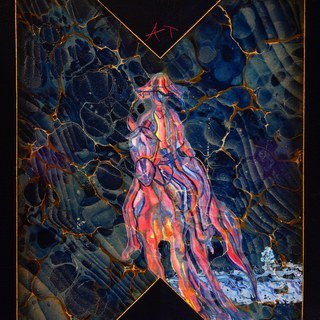
Baltimore’s experimental pop veterans Animal Collective originally formed as a duo of David Portner, a.k.a. Avey Tare, and Noah Lennox, a.k.a. Panda Bear. Over the years—and with their partners in weird, harmony-laden musical crime, Josh Dibb (Deakin) and Brian Weitz (Geologist)—the group has cemented themselves as indie icons, seeming to always push the envelope with the soundscapes they create while also peppering their output with undeniably catchy hooks stuck within and augmented by rich instrumentation.
The members of Animal Collectiveeach have their own identity, though, and both Portner and Lennox recently cameout with new solo albums (Cows OnHourglass Pond and Buoys, respectively). Here,the musician known as Avey Tare discusses the inspiration and process of hissolo record, the importance of improvisation in live music, why solo endeavorsstrengthen Animal Collective as a group and what the band has in store next forfans in 2019 and beyond.
I’ve read that your last solo album, Eucalyptus,started as a solo/bedroom type thing. Is that your regular solo writing M.O.?
Yeah, it’s pretty much my M.O. for allthe songs that I write, depending on when [I write it], where I am, what’sgoing on with my own life or what’s going on with Animal Collective at thetime. For example, I’m through the creative process, obviously, of this record,and now a bunch of solo stuff, so anything I’ve been writing in the past fivemonths or so, or even last summer, has been dedicated to Animal Collective. It’shard to write on tour, traveling around. A lot of the songs I write just sortof come into my head. It’s like that old saying, you know, feeling that themusic’s not mine, really. It’s coming from somewhere else and I’m justchanneling it or something like that. I tend to lean toward believing that,because it’s not very often that I sit down and work out a song. I do work outparts, but usually the bulk of the song just comes to me—like the melody willcome into my head and then, if I have my phone around or a personal recorder, I’llusually go right to my piano or my guitar and get that basic thing recorded.Most of the songs I write progress from there.
With these songs, it happened that Iwas asked to play a show in Copenhagen at CPH:DOX, which is a great documentaryfestival that Animal Collective and myself and my sister Abby have done a bunchof stuff for, whether it’s playing shows or visual stuff. Abby was asked to doa visual performance there, and she wanted me to help her out. The original setthat I intended to do was gonna be a set that I’d played before that was more DJ-style,more electronic, but it turns out that I lost a lot of that material when Iwent to go look for it. Because I had moved from my place in LA. So I decidedto just write a whole new set, and it really opened up the door for me for ayear of some pretty creative times and I ended up writing a bunch of songs of 2017.Last year, I just closed myself up in my home studio for the winter—January,February, March—and started recording the songs. I hadn’t really done my ownrecording in a long time. I mean, I do a lot of demo-ing and lighter stuff likethat at home, but it had been a while since I sat down and wanted to record aproper record and make it sound the way I wanted it to sound. I was like, “Well, I want to get better at this.” So it was me taking thetime to be able to do that, as well as record the record.
Did you have anyone else in the studio?
I mixed it with my friend AdamMcDaniel, who has a studio called Drop of Sun [in Asheville, NC]. I recorded iton tape machine, on half-inch tape, and I wanted to keep that vibe with theanalog thing going, so we mixed it on a really basic little mixer usingoutboard effects and stuff like that and trying not to use any computerplug-ins or anything.
Do you usually try to record to tape?
By myself, yeah, in all the personalrecording I’ve done. I still use a tape machine I got in high school. At thattime—back in my day [laughs]—there wasn’t a lot of computer recordinggoing on yet, so all of us in Animal Collective sort of got into recording andmaking music via DAP machines and tape machines still. It wasn’t until we movedto New York that we were opened up to the computer way of doing thing—and itwas really more Noah [Lennox] and Josh [Dibb] that went that route. I juststuck to demo-ing stuff like that because, whenever we would do AnimalCollective stuff, we’d always go into a studio where we’d have an engineer thatwould be using the computer, so I kind of put proper recording for myself asidefor a bit, ‘cause I was mostly focusing on Animal Collective stuff. But yeah, Iwanted to get back into it and I just love the way tape sounds. For the quality[I was going for] and what I was influenced by for this stuff, it seemed liketape would be the way to go.
And the songs were recorded inAsheville—is that where you’re living now?
Yeah—sometimes yeah. I kind of movearound. Actually, [I’m here with] Josh and Jeremy Hyman, who plays drums withAnimal Collective sometimes and went on the Painting With tour with us.They’re gonna help me out on tour with these songs, so we’re in the middle of apractice session.
If these songs are always kind ofcoming to you, how do you know when it’s time to make an album, especially withdifferent projects going on?
It starts with testing the waters ofwhat feels right to do and when. You know, as Animal Collective progressed overthe aughts or whatever, we started touring longer and longer for each record.So, by Merriweather Post Pavilion and Centipede Hz, we weretouring for a really long time—for us, not compared to other bands. Some bandstour forever, and that’s not our thing. It was during the Merriweathertouring—just because that was the first tour that felt like it was a verylengthy tour for us—I started thinking, “Oh, I think I’m pulling together asolo record in my head.” I finally wanted to sit down and record a solo record,which was [2010’s] Down There. Then it was just a matter of waiting forthat tour to be over so I could have time at home to really focus on it. [Sincethen,] it’s been sort of trial and error, trying to figure out the best timesto do this or that. In the last couple years, it’s been so separate in terms ofwhen Animal Collective is doing stuff and when I have time on my own. Solostuff—for me and the other guys—starts as an Animal Collective tour is dyingdown. That was definitely the case in 2017, when we had a couple AnimalCollective tours but most of the year I had to myself at home, so I was able towrite.
You mentioned that recording to tapewas a good method considering some of the influences that affected this record.Can you talk a bit about that?
A lot of it was early rock-and-rollstuff. From doing the first set that I did—the Copenhagen one I was talkingabout—and then some where I incorporated songs from Eucalyptus withthese newer songs, it became clear to me that it was going to be more of aguitar-centric record. And the guitars I’ve liked to listen to in the past fewyears are that old style of recording guitars, where they’re more textural,just sort of adding warmth to the melodies and that kind of thing, just gettingthe chords in there. I found that from a lot of Buddy Holly and early WaylonJennings and early country—‘50s and ‘60s country stuff that was maybe a littlebit more pop-centric. And I love Bo Diddley. It’s got a rawer vibe than mystuff, that early style of recording—like Sun Studios and Chess—it’s a few guysin a room with maybe one microphone. With the setup that I had, it was crucialfor me to go for that, because I was using the same mediums.
Do you differentiate, artistically,between the influences on the music of a record and the influences on thelyrics of a record? On the opening track, “What’s The Goodside?,” there’s alyric that says something like, “We’re gettingold now, better keep healthy.” Later in the record, there’s the song called “OurLittle Chapter,” which, to me, seemed like someone reflecting on the ending ofa relationship. And it seems like an overall reflective record. Was there acertain headspace you were in for any of these lyrics that made them come underthe same album title?
Yeah, for sure. It’s definitelyreflective. For me, it often just depends where I am in life, what’s happeningin life, and sometimes I’ll be in a place where I don’t want to write stuffthat’s reflective of my life, per se, or very personal. I think that’s wheresome of my more obscure or surreal-style of lyrics come in. Then other times, Ifeel the need to write stuff that’s very personal. To me, Eucalyptus wasvery personal stuff and more about the ending of relationships. I feel like Ifound myself in a new zone for this one, which was a lot brighter for me, justall-in-all more of a good mood, for my own personal life things—I’m alsorecognizing that the state of things in the world right now is in a veryinteresting place, and maybe not so good in a lot of ways. I think a lot of thelyrics are a balance, comparing my own personal state of being to the state ofthe world—kind of like a microcosm/macrocosm thing, which often I do. You know,when I say, “We’re getting old now,” I mean the human race, in a way, asmuch as I mean myself and the people around me. “Our Little Chapter,” to me, iskind of a collage. I write a lot of collage-type songs, where I’ll piece a lotof different images or feelings together. “Our Little Chapter” is more about friendships, which do end, and so it’s liketaking little pieces of different parts of friendships that have had meaning tome and just piecing them all together, just to get a greater scope of afriendship, in general.
Kind of in that vein—when you’rewriting, do you differentiate between creating a more structured song asopposed to something that’s more like a soundscape? I’m thinking of songs withlyrics, like “Saturdays (Again),” versus the track after that, “Chilly Blue,”which is more of an exploration sans lyrics.
Sometimes for sure. If I’m making arecord, a lot of times a thought will occur to me, like, “Well, this group ofsongs is lacking in this type of song, which is something I would really liketo hear.” You know what I mean? One of the main reasons for making music in thefirst place, or wanting to make music, is to make music that’s environmentaland spacious and sets a mood for the room people are hearing it in. More oftenthan not, that has more to do with the instrumentation and the melodies and thesounds rather than the lyrics.
What part would you say improvisationplays in your music, either in the studio or during a live show by yourself orwith Animal Collective?
I like to be able to get songs to aplace where there’s a sense of openness to it [in a live setting], especiallyin this example, where I’ve recorded songs myself but I’m choosing to take aband out to play them with me. I feel like it becomes important for there to be—forlack of a better word—a vibe between the players. You want to get into a zoneand a lot of that has to do with being very open to new things happening, and Ithink that’s my reason for playing live. I feel I strive—and we strive inAnimal Collective—to have the show feel like an experience and always feel likesomething new could possibly happen for us and for the audience. It’s hard toput yourself in that state of mind, especially as an audience member. I thinkimprovisation helps because it doesn’t keep you set on doing it one way oranother. You feel like you can put your own feelings into the song, which, atthe end of the day, makes the song good.
What is the plan for playing thesesongs with a live band?
It’s gonna be varied, but we’re tryingto keep it close to the instrumentation on the record, basically.
Can you speak to some of the benefitsof having your own artistic outlet outside of Animal Collective, and how thatmight have helped the group stay together for so long?
For me, it really comes down to beinga person that kind of has to—at this point—but also wants to just playmusic all the time. It’s what I do. Like I was saying before, I have music inmy head all the time. There have been times in my life when I’ve had topractice not playing music. So for me, it justkind of happened, but I do think it is nice to have the other outlets. It hasn’talways been conscious, but [it’s important for us] to be able to explore thingsor experiment with things that we might want to. I found more recently,especially with Noah and my stuff, that we’ll be working on stuff alone, thenwe’ll be like, “Oh, I’ve been doing this. I kind of want to try this withAnimal Collective.” [When we were younger], the reasons for them both existingwould be a little bit more disparate. Now, I feel like we’ve gotten into agroove where they’re blending and making more sense together.
Over the years, Animal Collective hasput out a pretty eclectic range of music. With that in mind, how do you andyour collaborators measure your own growth from album to album and project toproject, if that’s an important thing for you to be able to look over yourdiscography and see a certain kind growth in your musicianship or songwriting?
I think it’s important to try tofollow it and see. In the last four or five years, it’s dawned on us that we’rethe older band now. The stretch of “the early years” has definitely come andgone, and more often these days I’ll check back in on our older stuff as I’mmaking newer stuff to see comparisons and to see if I think things are betteror worse, that kind of thing. I have a hard time seeing recorded output as alinear thing, because I feel like we’ve made specific choices to try suchdrastically different things over the years. But I do think there’s more of anawareness of what I’m doing, whereas when I was younger I didn’t think about itso much. I’ve gotten into a frame of mind where I’ll be like, “Well, I’ve donethat before,” or “I want to write a song like this,” whereas in the past itwould just be, “Oh, this is what comes up.” Like I said, I wanted to work on myown personal recording [with this album], which is something I didn’t think I’ddone in a while. There’s always gotta be some kind of a learning thinghappening for me, whether it’s learning a new piece of gear to write all thesongs on, or learning this machine to be able to record music on it. Thechallenge makes me more creative, in a way, because then I have to solveproblems and that kind of thing.
Like you said, you were influenced byearly rock-and-roll and that kind of thing for this one. Do you think with eachalbum, there’s a different influence or different group of influences that youdraw from?
It’s really more the mood I want to gofor. This is kind of an outlier because I viewed it more like a collection ofsongs I was really happy with, whereas Eucalyptus and Down There,for me, were more trying to set a mood and trying to create thisatmosphere in this world. Although I definitely have a mood and an atmosphereto this one—all the songs sort of fall under that umbrella.
When you and the other guys in AnimalCollective are working on your solo stuff, do you ever discuss it, even if youknow it’s not going to be for an Animal Collective thing? I know with Eucalyptus,you had the guys remix some of the songs on there for a separate release, so Iwas curious about what kind of overlapoccurs with you guys?
There isn’t a ton, really. I mean,Josh recorded Down There and Eucalyptus,so there’s that collaboration.But I have this weird thing in my head where I don’t like to talk about thesolo stuff I’m working on, because I’m afraid that if I start bringing it upwhile I’m working on it, then it might just become this thing that I never getfinished. Before I’m ready to record a record, I need it set in my mind that it’sactually going to happen. With Eucalyptus, I had sort of given up onthat one in a way, just because I wasn’t really psyched on the personalrecording I was doing for it. Then I sent Josh all the demos that I had doneand was like, “Well I have all this stuff. We gotta do something with it.” Sothat’s how that record came about. We do often share demos and rough mixes andall that kind of stuff with each other, just because we’ve always done that andit’s fun for us to have music to be able to share with each other. It’s morelike, “Yeah, I just want you guys to hear what I’m working on,” not because Iwant feedback or anything. I’m just used to sharing with those guys.
I can definitely understand nottalking about a project, because that can put a certain kind of pressure on itfrom that point forward.
Yeah, totally. I just get paranoidabout it. I’m getting better with it, but I don’t mention things to labels oranything until I’m like, “OK, I have this record—here it is. What do you think?”A lot of the time it’s because I don’t want labels’ input on it, you know? Idon’t want people being like, “Change this, change that.” I want make somethingI feel comfortable putting out there.
You mentioned that you and the guys inAnimal Collective have been focusing on a new project recently—what can weexpect this year, or maybe next year, in terms of that?
For us, it’s all just a matter oftiming a lot of things. There hasn’t been—in plain view—a lot of AnimalCollective activity recently, because we’ve had so much to do that it’s just amatter of finding time, scheduling everything. Noah and I did the Sung Tongs tours, and also these solo endeavors have sort of stretched outa little longer than we thought they would. It’s been hard to make time for newAnimal Collective stuff, but at the same time, we have been all writing newmaterial, so we have a bunch of new stuff. We’re going to get together a coupletimes this year and start putting it all together and just see. It’s alwayshard finding a good balance, setting deadlines for us but also not feelingpressured, like, “Oh, we have to go into the studio in October or in January,so we need to have all this stuff.” A lot of times that’s very helpful for us—maybemore helpful for some members than others—but we want to make we’re good withwhat we have before we set any deadlines. We’ve got Desert Daze festival, and that’ll definitely put a fire under us to get stufftogether, at least to be able to play live, because we’re going to want to playa bunch of new stuff. I think this year is definitely going to be about puttingtogether a record for us—whether we’ll record it or not this year is hard tosay.
Especially with the Sung Tongs tour—plus you talking now about recently going back andlooking at older Animal Collective records—have there been any revelations fromthat revisiting about changes in ways you make music?
It kind of happened with the Sung Tongs material. When we did Sung Tongs originally,I feel like things maybe had gotten crazy, live-wise, in what we were trying todo—using so many electronics and so much different gear—and the wholephilosophy and purpose behind that record was to strip everything down andsimplify that aspect of our lives, just to clear our heads a little bit. Ithink the biggest revelation that came from the touring was that it’s nice tojust connect with my friend in that way—in a simplistic way, where we’re justplaying guitar together—and know that it still feels good. It might not even besomething that we talk about so much, but I’m sure we were both thinking it. Ithink it definitely contributed to Noah’s most recent solo record, just gettinghim to play acoustic guitar again, which he hadn’t for a while. I think he juststarted writing all those Buoys songs, you know?





