

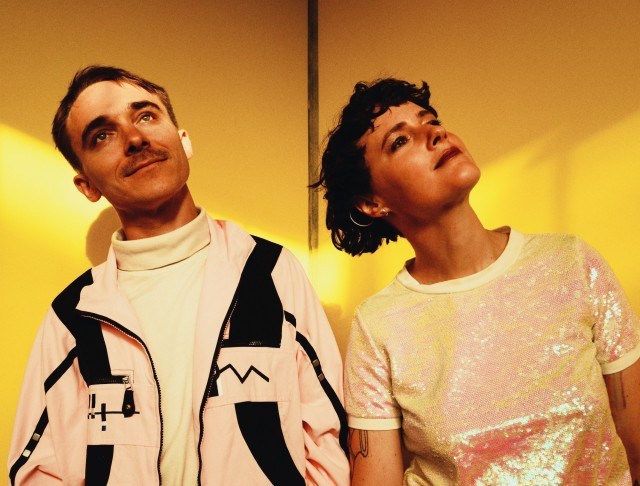
This Saturday, Brooklyn-based indie-pop outfit Rubblebucket will return to Gateway City Arts in Holyoke, MA, for their third annual Dream Picnic, which has grown from a DIY show in Queens to a full-on (still somewhat DIY) festival offering. This year’s Picnic will feature music from the host band along with STRFKR, And the Kids, Guerrilla Toss and more, plus the side projects of Rubblebucket’s singer-songwriter duo of Alex Toth and Kalmia Traver, Tōth and Kalbells.
Dream Picnic 2019 is a culmination of sorts for the album and touring cycle following Rubblebucket’s 2018 album, Sun Machine, which deftly captured the emotional turmoil following the breakup of Toth and Traver’s romantic relationship and subsequent strengthening of their efforts as bandmates (read more about that in this Relix feature from early this year. Toth took some time to chat about Dream Picnic’s growth and the band’s excitement for this year’s gathering, along with Rubblebucket’s plan to take a break in the next year to give more space for other projects, and his own experiences with the intersection of sobriety, meditation and inspiration.
Let’sstart with the upcoming Dream Picnic, which is in its third year and second atthis location. What solidified the decision to return there and to expand thegathering to more bands?
Itwas about six years ago when we decided that, for all of our Western Mass.shows, instead of going through the typical avenues in that area, we were gonnago through an independent [promoter], a smaller crew, what we felt was asweeter organization as far as people that were throwing shows. There’s anothercompany in that region that sort of has a monopoly on all of the venues there,and we didn’t like the way they were treating artists so we boycotted them anddecided to start working with Signature Sounds. We started doing shows withthem a little bit outside of town for a year and just immediately felt thedifference with the love connection. The whole thing felt like a human exchangeand there’s more TLC involved. We’ve been doing our New Year's Eve shows inthat region and it’s just sort of like one of our biggest homes, because westarted in Burlington, Vermont, and then we were in Boston. Kal and I have beenin Brooklyn mostly [in the years since] but we still have so many roots in theNew England area. Western Mass. just became one of the main hubs forRubblebucket, so it made sense and felt like a more open space than New YorkCity to build a festival.
Goingfrom the first year, which was in Queens, to the second year in Western Mass., immediately it was like, “Whoa.” Everything was smootherand we had all these local vendors and multiple stages; it was like, “Wow, thisis a real festival.” And we felt so amazing, so good about it. It really was adream come true, and we didn’t realize it until we were there. When you’re in aband, you’re like, “Yeah, maybe someday we’ll make our own festival.” It’ssomething really far in the future. It almost feels like we accidentallystumbled into it, because the first year was almost an experiment, and thesecond year at Gateway City Arts with the Signature Sounds folks, combining ourhistory with them with the rapport we built over the years, they immediatelygot us. We felt like the work they were doing to help us build it was anextension of who we are. So, without even realizing it, that the idea we hadof, “Yeah, someday we’ll do our own festival,” is happening now, and it justkeeps growing. I’m really proud of it.
Canyou talk about the specific highlights of this year’s Picnic?
Sothis year we’ve got bigger acts, like STRFKR, which is a band we’ve admiredfrom afar for many years—there’s definitely something kindred about theirlive-show. We’ve got our longtime buddies Guerilla Toss on there—they’re such awild band. The drummer, Pete [Negroponte], went to University of Vermont with Kal and I before hewent off to the conservatory, so Kal and I got roots with that crew. And TheKids are a band that we fell in love with many years ago and we play shows withthem basically every year. They’re just total kindred bands so it’s reallygreat to have them on this year at the Dream Picnic.
Andthen we have some other really cool acts like Sidney Gish and Sun Parade, andthen Kal and my other projects, Kalbells and Tōth, and that’s all on the mainstage. One way that the festival’s grown is that there’s bigger acts on themain stage—called Outerspace—and then local programming on the Innerspace stage.The local bands are so strong. Then there’s the Be Here Now Village, where ourbass player’s friend Samer [Ghadry] is gonna do sound healing stuff in thereduring the day, which was one of my favorite parts last year, going in thereand just lying down.
Then,from 5 p.m. through the evening, we’re doing something new this year withGateway City Arts, this experimental music thing happening ‘til very late. So,overall, the festival’s going later, there’s more local vendors, we’re doingthe thrift shop again, and our lighting-slash-party-facilitator-genius guy, Neil [Fridd], a.k.a. Terror Pigeon, will be here this year. He’s just a maniac, brings tons ofextra energy as far as projections and balloon creatures and stuff like that.And also this year we’ve got our full Sun Machineshow—we have these set designs with silhouettesof us dancing and there’s projections happening and the full thing. It’sdefinitely a growth and an upgrade.
Iremember when I went to the first Dream Picnic in Queens before you guys played,Kal was running a food stand, and I think her mom was there. Is there any ofthat still going on?
Thatwas one really cool thing—but also one really insane thing—about the firstyear, which is that Kal and Kal’s mom attempted to have their own food stand. Icould see that coming back in future years. She has this dream, called MiseryBusters, and it’s a concept for a café, so that was really special about thatKnockdown Center show, that she executed on the Misery Busters thing and then shealso had the local co-op that she worked shifts at, they also had a vendorthere. That was amazing, but I can’t even tell you how insane it was to pulloff. But I think as the festival grows, that can be more feasible. It’s justabout having more infrastructure and help doing that stuff.
Lookingforward, are there any thoughts about how you might want to grow the festivalnext year, if there will be a next year of course.
I’msure there will be a next year. With the flow and organic evolution that has happenedthus far, I’m sure it will continue to do that. I feel like there’s a number ofways that it can expand, such as expanding to more than one day and, if thattype of thing happens, then there’s always extra antics, like a lot of extrainfrastructure we could do as far as art installation stuff. We are doing oneart installation this year, but having more of that is a really excitingpossibility, furthur collaborations using three-dimensional space in aninteractive way, both with installations and with performers. I remember beingat High Sierra Music Festival years ago and being “attacked” by weirdperformance artists with crazy costumes, on mushrooms, like, “What the hell? Amazing.”I feel like there’s like little brass bands that can happen. We have very vividimaginations, and I think we’re building it in a very organic way, with so muchlocal community chipping in and working together for a symbiotic thing. I thinkwe can just keep building on that.
Switchinggears to Rubblebucket and your solo band, Tōth, what’s in store for you,musically, in the foreseeable future?
Basically,Kal and I finished the bulk of the Sun Machineclub shows—we did a couple rounds inthe US—and then we did some festivals, Bonnaroo, Firefly and Central ParkSummerStage, and I think we’re gonna continue to do occasional festivals andwhatnot as they come up, but for the better part of the next year, Kal and Iare going to be focusing on our other projects, Kalbells and Tōth.
TheTōth project is unlike anything I’ve ever done in a number of ways, and it’sreally exciting to take what I’ve learned over 10 years in Rubblebucket as aperformer and then see how can I integrate that into different permutations ofTōth, including a solo setup with stereo loops, then seeing what sort ofmovement-based stuff and visual stuff I can do to make a duo or trio show work.I’m gonna be going to Europe, and I did some shows in Japan. It’s just atotally new thing, which means there’s some growing pains where I’m like, “Ohthis doesn’t feel the same way as being on stage with a bunch of people and ajuggernaut live band that’s been together for 10 years. This is really weirdand I’m singing these sad songs.”
Butother times it’s incredibly powerful and it’s this totally unique thing. I’mjust figuring it out, and I feel like it’s quickly evolving. We have more spacefor projects over the next year, so it’s very quickly evolving in how I presentit. I’m really excited to get that record out there; it’s only been out forthree or four months. I’m also gonna go down to this beach house that myfriends have all been recording at in Long Island in a couple weeks with theband, the Tōth trio, which is two dudes from Rubblebucket. Ryan Dugreplaysbass—he’s the guitar player in Rubblebucket—and he’s actually from Holyoke,Mass. His family’s had a diner there called Lucky Strike for like 50 years orsomething
Ohthat’s cool—so Dream Picnic like a hometown show forhim.
Yeah,we went to his Dad’s diner last time we were there—totally classic-diner vibes.And then Jeremy Gustin, Rubblebucket’s drummer, is theother one in the trio. We’re gonna go lay down a bunch of songs. I’m justtrying to keep the momentum going and see how far it can take us this year.
Simultaneously,Kal and I are passing music back and forth—we’re working on songs together forRubblebucket and, hopefully, sometime in 2020 we’ll get in the studio andrecord another Rubblebucket record. For me, deciding to have a year off of Rubblebucket,without setting a fixed date to it, has something to do with this realizationthat I have come to via doing lots of meditation—meditation being a response tomy anxiety and me being a high-strung person.And I’m sober, so I’m throwing myself deeply into that without drugs andalcohol. In the process of doing that, when you stay out of your own way, youallow things to arise, versus try to grasp at them. I don’t know, there’ssomething for me musically that, when you give yourself the space to allowthings to arise, it just feels so much more powerful and deep. It’s a naturalthing.
Kaland I are intense, emotional, high-frequency people or whatever—there’s a lotof vibration. I think the idea of allowing the next music to come is a reallybeautiful thing. It’s kind of what happened in a lot of ways with Sun Machine—we took time on that, and it’s our favorite work that we’vemade, so we wanna continue that vibe, which is why I think it’s cool to haveour other projects rocking. The other cool thing about that is that three songson Sun Machine were products of me writing what I thought would be for Tōth.It just keeps generating creative energy.
Wouldyou call that inspiration?
Iguess that’s a word for it. I think, as the years go on, you learn you can’treally wait around for inspiration. The way the Tōth record came about wasthrough a song-a-day process, which started around Rubblebucket’s SurvivalSounds. I’m not writing a song every single day, but most days, when I’mhome, I’ll at least be writing like a 30-second birthday song to somebody or afunny text message song, if not a full song a day. So, before Kal and mybreakup, I was writing, and then we broke up and I was still writing. If you’realways connected and have a practice of it, there’s a creative momentum there.Then, if different things happen in your life, it’s just likedifferent waves passing through you. There was a period of time, the post-breakupwave, and I just continued writing—I was writing before, after, during it. Iguess that’s inspiration, in a way, but it’s also just giving yourself the spaceand structuring your life in a way, if you can, to be present and show up forthe craft. And sometimes a wind blows through that has something extra to it orhas more weight—and you’re there. Paul McCartney, I think, talked about that
, just showing up every day. You could go in everyonce in a while—and maybe your chances are just as good if you only show upwhen you get that feeling in your chest—but for me, if I show up everyday, thechances are much greater.
Youmentioned writing songs without knowing exactly what project they were for. Wasthat the case with “Down for the Count,” which appears on both Sun Machine aswell as Practice Magic and Seek Professional Help When Necessary?
Yeah.It seems like I’m a person of threes—it helps me to have three things cookingat once, and if I focus too closely on one thing, I can lose perspective Iguess. I start to get too involved—and by “I,” I mean my ego or my intellectualmind gets its hands too dirty in the thing. But if I’m moving between thingsand changing my gaze from here to here to here, it allows breath into all ofthem and doesn’t give my weird neuroses any time to really take hold.
[When“Down for the Count” began to form,] Tōth didn’t even exist yet—I was writingwith Kimbra, and Kimbra was the one who told me, “Hey, you should make a recordof this stuff.” We had been working on a version of “Down for the Count,” whichwas from an old seed made for Rubblebucket that never materialized. I was alsoworking on a couple other things with Kimbra, and I wasn’t sure if they weregonna be Kimbra or Rubblebucket or whatever this new solo project would be.
That’salso how “Lemonade” ended up with Rubblebucket. With “Down for the Count,” Ireally wasn’t sure—like, “Is this okay? Can you have the same song, basically,for both things?” I played some things for Kal, and she was like, “Yeah, let’sdo this one,” so then I figured out a way to arrange it. At first, I didn’tknow how to finish the song in a Rubblebucket context. I couldn't have finishedit with the same beat there. It made sense to me on the acoustic guitar. Ittotally worked as this sparse acoustic-guitar song, and once I finished the song in that context, then I knewhow to arrange it for Rubblebucket. I just couldn't finish it as a Rubblebucketsong. That’s something I’ve learned over and over again with the songwritingprocess—if I strip away all of the beats and everything like that, and if I canjust write the core song in a simple way, then I can present it in a lot ofdifferent ways,. Just make sure you’ve got the song first.
Thanksfor taking time to talk with us today. And best of luck with the third DreamPicnic.
Thanks, I’m definitely excited for this one. It just feels like a cool summary of Kal and my life’s work. We’ve got our friends there, we’ve got Rubblebucket in its prime form with our favorite show yet, with our favorite record yet, and then our new projects, Tōth and Kalbells, rockin’ in there. It’s got all the visual aspects and all the ways we love interacting with human beings and space. It’s just a great representation of the whole picture.





