

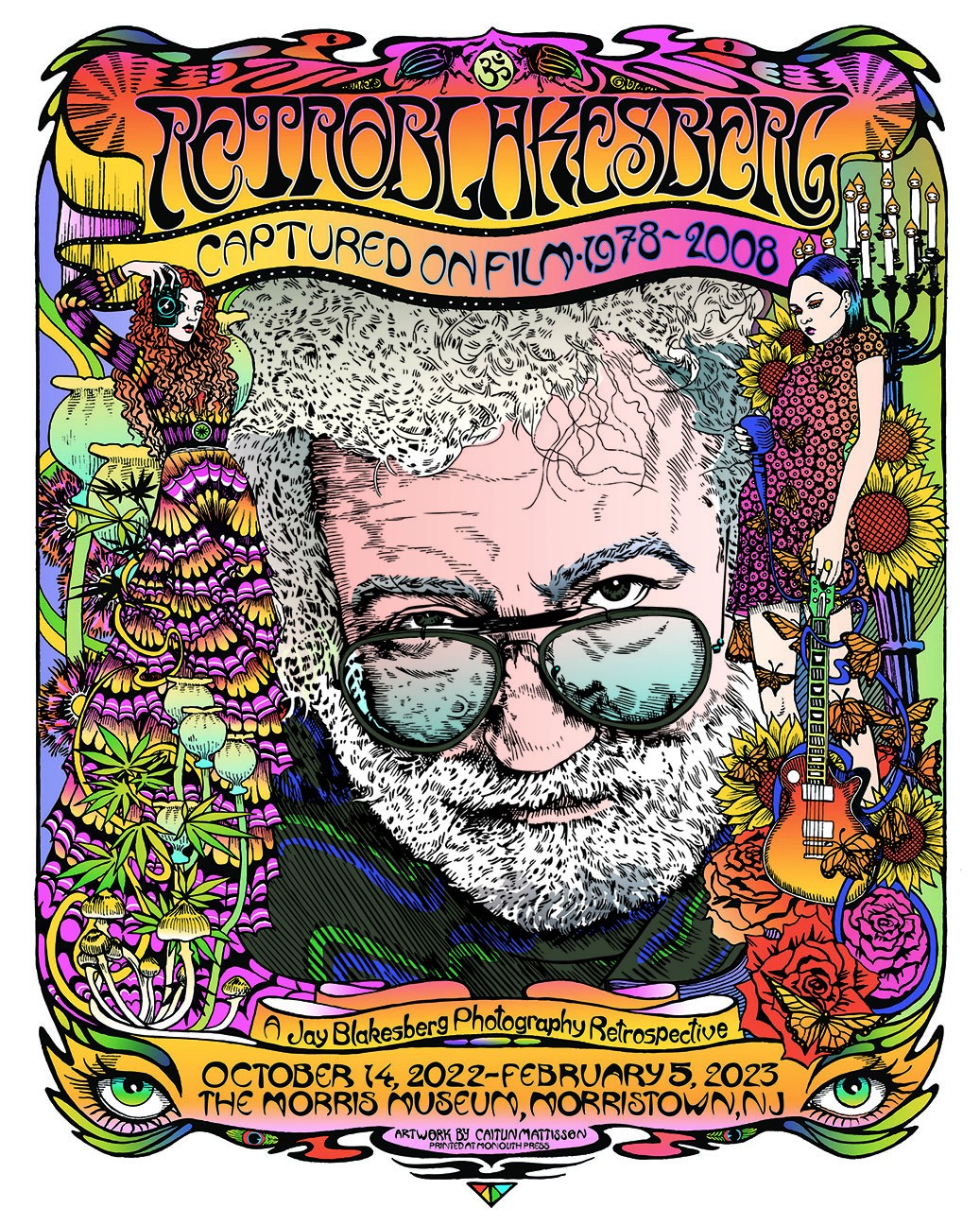
An organizing project during the early days of the pandemic took on several forms as renowned photographer Jay Blakesberg’s personal photos and images from his noteworthy career became the basis of an Instagram page, @RetroBlakesberg, and then a hardcover coffee table book, RetroBlakesberg - Volume One: The Film Archives.
A visual autobiography of his life documenting pop culture history, RetroBlakesberg presents photos from his high school days in the late ‘70s up to 2008 when he switched from film to digitally capturing musicians during portrait work and onstage as well as the exuberant crowds attending the shows. Each of the book’s decade-by-decade chapters begins with an original essay by him where he recounts the development of his life, profession and the evolution of music world during that period.
RetroBlakesberg also contains a Foreword by Wayne Coyne of The Flaming Lips and an Introduction by Michael Franti. For over 30 years both musicians have been his photographic subjects.
The Instagram page and the book’s origins developed from Blakesberg’s daughter, Ricki, who remained at home after losing social media jobs for music festivals and bands when COVID hit and the concert industry stopped. As she helped organize his vast catalog of work, she started the Instagram account, which consists exclusively of photographs shot only on film. Using new media to display older images of artists including Grateful Dead, Rolling Stones, Nirvana, Green Day, Red Hot Chili Peppers, Joni Mitchell, Neil Young, Radiohead, The Flaming Lips, Alanis Morissette and many others brought a new generation of interest in his body of work.
She not only curates @RetroBlakesberg but also did the same for the accompanying book. Both Blakesbergs then collaborated on the next phase of the RetroBlakesberg concept when an exhibit of his film archives will be exhibited from Oct. 14 through Feb. 5, 2023, at the Smithsonian-affiliated Morris Museum in Morristown, New Jersey. The public opening on Oct. 16 will include a slideshow presentation by Blakesberg, followed by a signing.
Additional presentations and signings are slated for the Morrison Hotel Gallery in New York City on October 11 at 6 p.m., as well as the Haight St. Art Center in San Francisco on November 1 and the Morrison Hotel Gallery in Los Angeles on December 3.
Prior to our conversation, Jay appeared on an upcoming episode of “The Good Ol’ Grateful Deadcast,” the official podcast of the Grateful Dead, to offer his firsthand accounts of shows at the World’s Most Famous Arena that coincide with the release of the Dead’s 17-CD boxed set, “In And Out Of The Garden: Madison Square Garden ’81, ’82, ’83.”
While he’s spent a great deal of time looking back, Blakesberg continues to add to his immense photo archives. Besides chronicling Dead & Company’s Citi Field dates and Phish’s appearances at Jones Beach last July, he recently had an exhibit and took photos at Sacred Rose festival last month and will be doing the same at the upcoming Borderland Festival on Sept. 17 and 18. Michael Franti will sign copies of RetroBlakesberg at 4 p.m. Saturday, while Wayne Coyne will be signing on Sunday at 5:30 p.m. at the Jay Blakesberg Photography Gallery on the Borderland festival site.
“I'm also going to do a slideshow while I'm [at Borderland] there on the history of Bay Area rock palaces called “Into the Mystic: A History of Bill Graham's Bay Area Rock Palaces,” he said. “I did this as a pop-up photo exhibit in San Francisco and I'm turning it into a slideshow that I'm going to do with the VIP gathering at Borderland.”
I got the two Blakesbergs on a Zoom call during a family vacation to discuss all matters involving RetroBlakesberg. As we start our conversation, Ricki is making her way back to their New York beach community home. Later, Jay’s son, Sam, a professional video editor, enters the room to work on a project.
JPG: Out of all the photos that are inside the book, why did you choose that particular shot at the 1982 Rainbow Gathering in Idaho for the cover?
JB: We didn't want to put a music photo on the cover.
Ricki curated the book. She really chose 99.5% of the photos. I argued for a couple of photos that I really wanted in because I felt they were important for me to tell my story. But, she essentially was the one who curated and edited what is in the book.
As far as the cover photo goes, we both talked about it. [He picks up a copy of the book and shows how the front image extends from the front cover to the spine and back cover.]
When you're looking for a cover photo, you're looking for space for text and what works. Then, we started talking about doing this wrap idea and it works with this photo. A lot of other photos it didn't work, like if we had put a vertical shot of Jerry [Garcia] or Keith Richards or Mick Jagger or anybody, it doesn't really quite work the same way as having a nice horizontal with that kind of dead space to wrap around. We were both in agreement on it, and we’re both really thrilled that it’s the cover photo. The photo is also in the book, uncropped.
This woman here [on the cover] is someone who's a friend of mine and has been for 40 years. I saw her a couple weeks ago. When we chose the photo, I contacted her and said, “I'm thinking about doing this” and I sent her a mock-up and she was like, “I'm honored.”
JPG: Tell me about the origins of RetroBlakesberg – Volume One: The Film Archives. I know the timeline started in April 2020, during COVID but what specficially led you launch the @RetroBlakesberg Instagram page and eventually this book?
Ricki Blakesberg: I was going into his office that’s attached to our house. So, every morning I would go into his office for about four hours and go through various forms of his archives, whether it was concert passes or some of his photos, reorganizing film binders and stuff like that. That's probably what ultimately inspired it but, really, I was lying in bed one night during the pandemic and I was like, “I really want to get more involved with my dad's work.” He has thousands and thousands of images that I’ve never seen and specifically images that are so targeted to my demographic -- people that are in their 20, early 30s -- that would love to see. And that's such a booming thing on Instagram. So, getting the gears turning. The next morning, I was really nervous to ask him. I said, “This is the idea that I have. I think that we should call it RetroBlakesburg. It’s all gonna be film. We're gonna showcase so many of your images that you don't really see. You don't have a say in it. I get to pick the photos.
At the beginning it was me and him discussing a lot of the stories behind the photos.Now, I feel like that's also really healthy for his archive, and it’s allowed me to become more independent in picking Grateful Dead photos or Phish photos or Red Hot Chili Peppers. I brought it to him and he was, “Let's do it. I think this is a great idea.”
Right from the start, it got a lot of good traction and people were into it. Me and Jay loved working together and doing it together, and the first three months of it we were in person together doing it.
JB: Also, there's a lot of people that follow RetroBlakesberg on Instagram that actually don't follow Jay Blakesberg or didn't know about me and she cultivated this new group of people that came from her own Instagram page and her followers.
Pre-pandemic, her job was doing social media for some music festivals and all of that evaporated, She was doing WinterWonderGrass and a couple of things she had, Pigeons Playing Ping Pong festival on the books and Greensky Bluegrass festival... She had all these jobs lined up and it all disappeared. All of a sudden, she had no job because she’s a freelancer, and as we know, there were no concerts. That's still part of her business today.
RB: I run various social media accounts for different bands and a record company.
I've always thought my dad’s work could also be reviewed as fine art, something that could be put into galleries and sold to different places than what the target audience is. That's something really important about RetroBlakesberg. We're creating this different side of the archive that isn't just about concert photography or rock and roll but looking at it as a form of fine art.
JPG: I am always excited to see your alternative rock shots because at that time of my life, I'd travel to see the Grateful Dead but then I was also going to see Red Hot Chili Peppers or Soundgarden or Iggy Pop or Primus…
RB: I love those shots.
JB: When I shot a lot of that stuff, those people were 22, 23, 24, 25 years old -- the Chili Peppers, Jane’s Addiction, Soundgarden, Beck -- they're 55 years old now. They're adults. They’re empty nesters. They're coming back and reliving that experience of 30 years ago of Lollapalooza with Soundgarden and Pearl Jam and the Chili Peppers.
RB: That's also a huge thing too with RetroBlakesberg. I feel that right now we're in this huge era of nostalgia. People are constantly trying to relive the past. Whether it’s coming out with another Jurassic Park or something like that, people are bringing back a lot of things that once happened. That's what's so great about RetroBlakesberg is that it is also doing that.
People want to go back to the ‘90s, whether it's in fashion or music or art. That's something that's really trendy right now.
JB: And that always happens when old becomes new again.
JPG: I see so many people wearing Doc Martens now. I had a pair or I used to wear boots if I was going to be in the mosh pit.
RB: That’s me. You did, too. (nods to Jay)
JB: In ’92 that’s all I wore were Doc Martens. They were comfortable. And that’s part of Ricki’s angle also. Looking at these photos from 30 years ago of these bands is the fashion side of it all. What was Bjork wearing? What was Anthony [Kiedis] wearing? What was Chris Cornell wearing? What was a Deadhead wearing?
RB: These styles are totally back in.
JPG: What is also nice about the book is it incorporates your personal world in the ‘70s and ‘80s with your photography world.
JB: I was just a kid with a camera, trying to figure out how to use it and documenting what I saw and taking those photos.
JPG: By the ‘90s and the 2000s, the narrative shifts and the images focus much more on the professional side of your life.
RB: That what he really became.
JB: That's what I was. At that point I was a professional commercial photographer, and I was on assignments.
RB: In addition to that, RetroBlakesberg -- Volume One, Jay has thousands and thousands of images that didn't end up in this book. He has so much street photography from the 2000s from when we traveled to Paris or Japan that one day they could ideally be in Volume Two. So, we narrowed in on what made sense for this book. It’s the first step of how Jay became who he is
JB: I'm calling this book, Volume One, my visual autobiography. It's the continuity of the decades. People have asked me to tell my story and I didn't want to write a book because I feel like my photos tell my story, but each one of those essays is a couple thousand words. Then, all those extended captions in the back of the book, which tells those stories, which I really felt like in a lot of ways tells my stories.
JPG: I always enjoy your stories because even though the photos do tell a story there's still something interesting about what happened to get that photo. Last time we talked about the infamous Jerry Garcia photo and how you just happened to be there at the right time when some crew member on the video shoot gave him that blank sign and you got the shot. Now, speaking of getting the images. RetroBlakesberg features your work on film. Like you, I enjoy shooting digital for that immediate result and ability to see what needs to be changed. But after doing this, do you want to use film again?
JB: I haven’t shot any film since 2008 and I don't see me doing it. Ricki shoots film on a regular basis. It's just doesn't work for my workflow and because I still am in a professional workflow mode. I still shoot for festivals and bands, Dead & Co. I need that quick turnaround.
I could see if …IF I ever were to retire and stop shooting commercially, I could see, maybe, going back and shooting film, just for the sake of shooting film. There's a whole mindset that is involved in shooting film that is a completely different mindset from shooting digital in terms of how you expose your images, how you compose your images, the number of images that you're shooting. There are all these different things that would have to be relearned and re-understood for me to go back and break out my Hasselblad or break out of a 35-millimeter film camera. A lot of these cameras have been sitting around and they're drying up. The oils are. We’ll see, but, as of right now, the answer is, “No. I'm a digital guy.”
JPG: You mentioned mindset and taking photos of Dead & Company. I looked at your photos on Facebook from the band’s Citi Field shows and Phish at Jones Beach and the Oregon Country Fair and what’s nice about it and relates to this book is that you don’t just post shots of the band but you also provide numerous crowd shots including the audience members dancing. How do you approach matters with the band versus when you're in the crowd?
JB: With Dead & Co a lot of it is intuition and knowing the music inside and out and being in the right place at the right time and putting myself in the right place at the right time because I know where the music might be goingto capture those peak moments.
With the fans, it's the same thing but a lot of times, the peak moment onstage is what's creating the peak moment in the audience, like the crescendo of “Terrapin Station.” TERR-A-PIN!! That's when everybody in the audience has got their arms up in the air and they're screaming at the top of their lungs.
But, it’s also when the band has got their arms up in the air and screaming at the top of their lungs. Which direction do you point your camera because you can only take a crowd shot when the lights are on the crowd, and the lights on the crowd at peak moments? You gotta figure it out and plan a little bit.
With Dead & Co I have all access and shoot the whole set whereas other bands, like Phish, I'm usually in the pit for just the beginning of the show and then I'm off on my own. So, I might want to shoot some wide shots with the lighting because I love what [lighting designer Chris] Kuroda’s doing or I might look for some fans dancing. On the fan side of things, at any concert, if you're not in the first 20 feet, 30 feet, the lights don't hit you.
There were some comments on social media from the Phish concert, they're like, “Why don't you come up and shoot on the lawn at Jones Beach?” The answer is that it's pitch black up on the lawn. The lights don't reach the lawn, and if they do, they're super, super dim. They're just skimming across the crowd. Those lights that are turned around from the stage. They're not strong enough to give you enough light to shoot when you're all the way up on the lawn.
So, it's a matter of…you're a photographer. What do you need to make a good picture? You need light. That’s the number one ingredient. No light. No picture. So, I can't go to the dark edges and the crevices of any concert at night and expect to get a photograph because you need light.
JPG: I don’t recall every single one of your Dead & Company at Citi Field crowd shots but the majority that I saw of people dancing, you're on the floor and it's the first set where you have sunlight. So, you shot the band mostly during the second set or at least when it was darker and the stage lighting was in effect?
JB: The other thing you have to remember is that the beginning of the set when it's still dusk out and you've got this soft ambient light with the stage lights is a great moment to be shooting the band. It's the best light because the ambient daylight is still filling in some of the shadows. You're not just relying on stage lights.
So, I want to capture some of that, and then, before it gets too dark, go over to the audience for a song or two and concentrate on that because I feel like I can't be away for that long. The band doesn't hire me to sit there and shoot pictures of hippies twirling. I have to go and shoot both. Also, at a big stadium gig, I’ve got to go up and shoot from up high, and that's another thing you want to do at dusk. Try and get the sunset.
I'm trying to get the last shots of the band with the daylight. I'm trying to get the last shots of fans during the daylight. I’m trying to get the last shot of the stadium at sunset. All of those things before it gets dark. It's a balancing act.
JPG: What I liked about those recent posts is that the photos have a similar approach to the new book, which shows that you’ve been chronicling the bands and fans since the beginning of your photography career. Other than the changes in technology to capture images, would you say your approach has changed over the years or been consistent?
JB: It evolves. It has to evolve. It’s changed over the years because of technology. I’ve had no choice. Obviously, technology’s a great disruptor and I had to make that whole shift with learning that technology -- camera, software, sensors, file size -- and understanding all of that stuff.
Back when we shot film, even if you had two bodies and one had color film and one had black and white film, if you put the roll of color film in early in the day, it might be ISO/ASA100. You can't shoot a band onstage with stage lights with 100 speed film whereas with your digital camera you could be messing with both ISO and color balance all within the same five shots. “Let me bump up my ISO. I need more light. I don't want to open my aperture but I want a little bit more light, something to go from 320 ISO to 640. Bump it up a stop. You can make all of these decisions and those also dictate you having to make changes in your approach.
JPG: Back to the book, you have a Foreword by Wayne Coyne and an Introduction by Michael Franti. How did those come about? Did
JB: Typically, when we make books, we look for somebody significant that has something to do with the book, which obviously helps from a marketing standpoint. Both Wayne and Michael are in the book. Both of those artists I've been photographing for over 30 years. I first shot Michael Franti in 1987. I first shot Wayne Coyne in 1989. So it’s 35 years into a friendship with Michael and 33 years into a friendship with Wayne.
So I called or texted Wayne and said, “Would you be interested? What I would like for you to do is write anything from 600 words, which is about a page for a coffee table book, up to whatever you want. You want to write a book, write a book, we'll edit it and use it.”
RB: Wayne was a good choice for us too because when my brother and I were kids, my dad would take us to Flaming Lips shows and we would dance on stage with them. My brother and I have all these photos of us onstage with the Flaming Lips and dancing with them. I grew up listening to their music and singing along to it. Wayne Coyne was very sentimental for it, too. It meant a lot to both of us.
JB: You probably saw Ricki wrote a little essay, and there’s a picture of her onstage at the 2006 Yahoo Christmas party that the Flaming Lips were playing at.
Wayne, who's a very creative person and very brilliant and writes amazing songs, he's not used to writing a thousand words about me. We said, “We'll help you. If you can't sit down and write it, we'll get a writer to come and interview you and give you notes back that you can write it from or if you write it, we'll edit it and clean it up.” And he wrote it.
Wayne is a funny person. He doesn't really use a computer. He only uses his phone. So he started texting it to to me and then I put it in a Word document and texted it back to him and then he kept working on it on his phone in the Word document. Then, he would send it back to me in notes and as files and stuff like that. But he wrote the whole thing and, of course, because you're doing it on the phone, there's all these typos but we’d give it to a proofreader, and they’d clean it up and make it all right.
Then, for Michael I said, “I'd love for you to write the Introduction.” I gave the same exact input. “We can help you. We can interview you. We can give you talking points.”
Wayne gave us two or three versions and I said, “This is great and this is great but can you take this section and expand it? Here's a really great point you're making but you're ending it too soon. Tell us more about what you mean there.” He was like, “Oh, okay. I get it. I get it.” I'm a pretty decent editor when it comes to text and making things so that they really make sense. I would feed him ideas back. I'm like, “This is great. Keep going.” “Okay. I'll give it a shot.” Then, three days later, I'd get another three paragraphs. I'd be like, “Excellent.” My editor, the same woman who wrote all the text for my Hippie Chick book, she's my main editor. She went in and cleaned it up and fact-checked the years with me and the things that he was saying and then we sent it back to Wayne “Here it is, cleaned up and edited, is this your voice? Is this your thing?” He read it. Probably changed one or two very minor things and then it was done.
Same thing with Michael Franti. I shot Michael in a small club with a band that he had called The Beatnigs back in ’87. Met him that night very briefly. His next band was the Disposable Heroes of Hiphoprisy and I shot the back cover of that record when it came out. I have two back album covers with him, magazine features. I've directed videos with him. We've done a lot of stuff over the years, and Michael was just thrilled.
There’s a limited-edition version of this book, 225 copies signed by me and Wayne and Michael and Ricki and I had to wait for Michael to come back from Bali to San Francisco. He was living in Bali during the pandemic.
They're my friends and they wanted to help and be part of it.
JPG: With Wayne it's like you're creating a song with him as far as the back and forth.
JB: That’s how a lot of songs are written these days over the internet because of the pandemic. It was a free-flowing exchange of creative ideas to help do the best that he could. Wayne doesn't remember all of the things we've done together and then I remind him, “The first time you walked in the Bubble at Coachella. I was there.” He's like, “Oh, of course.”
I also did a book with Wayne. We did a Flaming Lips book a number of years ago. So yeah, I would remind Wayne of “Remember that time that we walked into Beck’s dressing room when you were his band?” “Oh, right!”
JPG: It’s nice timing that your son came into the room to work because that leads to the idea of three generations of Blakesbergs being involved with images. You mentioned in the book about borrowing your dad's camera when you took your first photos at concerts. I'm wondering about the influence of your dad, Bill Blakesberg, on your photography or being helpful, in general.
JB: He was a serious amateur shutterbug. He just loved to take pictures. He was actually good at it. Back then, in order to properly expose color film, which was color slide film, you actually needed to have technical skills. He also had a good eye and he's always been a shutterbug. He's always had cameras his whole life. It's always been a hobby for him. He's a CPA. So, did he influence me on a professional level? No. Did he help me with my business starting out? Absolutely.
There's something creative that he had because he does have a good eye, and I think how many pictures did you remember your friends taking when you were in high school where you give them a camera and say take a picture with a film camera and it was from your chin up and then there was 10 feet of sky right above the photo because people don't have an eye. They don't know how to compose pictures.
RB: I think we still see that today.
JB: You give your cellphone to take a picture and it's like, “Why did you cut off me at the chest?” So, my father had an eye. I had an eye and she has an eye, and he has an eye because he shoots, produces and direct videos. I think some of that is certainly a natural ability that maybe you're born with and some people learn it but I was always able to compose a good picture early on for me. I didn't have the technical skills. That's something that I try to teach her to understand; how to be creative with your shutter speed and your f-stop and your ISO choice and how you can use those things that are technical tools on creative level. That's the next level you get to once you understand your tools that you're working with.
My father definitely was an influence and supportive. He loaned a stoned out 16-year-old kid an expensive, 35-millimeter Pentax camera with zoom lens, at the time was probably a couple thousand bucks of gear.
JPG: Tell me about the upcoming exhibit at the Morris Museum.
JB: An old friend of mine, my best friend since kindergarten, Mark Gershman, his mother, Jackie, was a volunteer at this small regional Smithsonian museum in New Jersey called the Morris Museum. And one day, she said to the curator, “My son, Mark, his best friend from kindergarten is a famous rock photographer. You should look at his work.” They said, “We'd love to talk to him.” Mark called me and we connected with the guy and we started a conversation. “We like the idea. Get back to us in 14 months.”
I literally put on my calendar to call them the third week in January in 2022. It was 14 months and I thought, “These people don't care about me. They're not interested in doing a museum exhibit.” About a week later I got an email from the museum that said, “Circling back. We want to talk to you about maybe doing this exhibit.” We had a Zoom call with, Ricki me, the curator, the assistant curator, the head of the museum, and they said, “We'll get back to you in a week and let you know.” And they said, “Okay, we want to do this. We want to do a career retrospective with you.” A week later, the curator who brought me on left, and I was like, “Well, that's the end of that.”
Then, the new woman came in, “We're gonna keep going. We're doing this.”
The Morris Museum is, my impression before I got a tour of the place and started to see photos, I just thought it was this tiny little museum in Morristown [New Jersey] but it's a 40 or 50,000 square foot museum that started out as a brick mansion that's probably six, seven, eight thousand square feet and then they built the museum around it. Steel and glass and everything cover the sides and the back of this original building. The front of that building is still an exterior. It's the only Smithsonian affiliate in New Jersey.
Me and Ricky went there in June and I was like, “Wow!” They have a giant exhibit, permanent exhibit, of the largest collection of musical mechanical instruments in the world that was owned by a member of the Guinness family who donated it. When he was getting old, he interviewed all these museums to decide where he wanted to bequeath his election of antique, worldwide musical mechanical boxes. These are boxes that are anything from this big (hands separate a few inchese) to half a room.
RB: The museum retrospective came at such a good time because “RetroBlakesberg” is a reference to Jay’s photography and life.
JB: We were already doing the book.
RB: We were deep into doing the book. We were in our final stages. So, when the museum came back to Jay, this is a really good opportunity for us to figure out a way to collaborate the two ideas. The entire exhibit is all film. It’s the exact same format as RetroBlakesberg. It’s just a really good opportunity for us to find the parallels between the two. We're exhibiting “RetroBlakesberg” it's all RetroBlakesberg, and it's really exciting. It's almost like bringing the book to life.
JB: And there's about 125 prints. There's four galleries. There's a portrait gallery. There's a performance, live concert gallery. There’s a Grateful Dead Gallery, and then there's an early foundation work gallery that's the opening years of my career, high school photos.
RB: And that was fun, too, because we got to collaborate in curating it, and he gave me most of the reins of picking the photos. He got final say but…we work really well together in this in picking the same images that we wanted.
JB: We credited the curation of the Museum to Ricki, Jay and Michele Marinelli, the curator at the museum. Me and Ricki picked out 100 pictures and sent them to her, and then she did it electronically on their program and made a PDF of each room. Then, we got it back and we went, “We’ve got to switch that photo and that photo...” It was nothing on her. We just picked the wrong photos at first. We couldn’t visualize it on their walls.
RB: Also, something to take note of is you’ve spent half of your life with these images. I just spent the last two years working closely with these images. So, our relationship with understanding what makes sense together, what needs to be on the same wall or what shouldn't be next to each other comes so much easier to us because of the relationship we’ve had with these images.
For us, once we had a layout of the gallery, it became very obvious what made sense, and it was really nice working with Michelle because she was so flexible, and she also helped us understand the layout, and all three of us worked really well to understand what made the most sense to produce an exhibit that’s wonderful.
JB: We thought we gave her a good selection of photos and after we saw what she did with them, we realized that we failed. The first round, we probably lost 50% of what we gave her, thinking, “These are the shots.” Then, we realized, “No. Those are not even anywhere near the shots.” That was just us not understanding the format and the layout of the rooms quite yet because we were just learning it. After we saw the rooms, we were like, “Now, we understand it even more” and we were able to make more changes.
RB: Once the exhibit does go up, this is something Michelle and I have been talking about, what can change up until the day you hang them. It might look different.
JB: The other thing that we're doing is we're printing them all on metal. They’re all going to be on archival metal. ChromaLuxe is the brand that gives us the metal and Magna Chrome is one of the very first labs in the country that do these metal dye sublimation prints.
JPG: Does the exhibit mimic the book or is it a little different -- timewise or photo selections?
JB: It is a little bit different photo-wise.
RB: There's a little bit of a timeline in one of the galleries.
JB: Out of the 125 photos in the exhibit there are 20 to 30 images that are in the gallery that are not in the book. To give you an example, in the book is the color Joni Mitchell portrait. In the exhibit it's in black and white, different shot, same session. That's because all the other portraits there are black and white and didn't work in color, and Ricki said, “Let's pick a black and white.”
We were also trying to balance it out between black and white, color, men and women, because we didn't want it to be like, “Here's a bunch of white guys that Jay's photographed.” That is a lot of what I photographed but we want to be equitable in terms of representing all these incredible people. I shot people like Joni Mitchell and Siouxsie Sioux…
RB: This is actually a good transition into understanding RetroBlakesberg. We want RetroBlakesberg, whether it's through the book or the museum exhibit or the Instagram, to be approachable for everyone. Jay has a very targeted demographic with the Dead Heads.
My goal with this exhibit and the Instagram and the book is to reach a wider net and say, “This is stuff that Jay has shot. He's captured so many musicians and artists and scenes since the ‘70s and ‘80s.” That’s what's important about this. It isn’t a Grateful Dead exhibit and “RetroBlakesberg” isn’t a Grateful Dead book.
JB: But there is a Grateful Dead gallery.
RB: And we’re always going to touch on that because that’s a huge factor of Jay’s work but keeping that in mind that this is a chance to showcase Jay's diversity and all the stuff that he has captured. That’s what so important about this retrospective and this book.
JPG: That leads to the final question, which I think I've always dropped every time we've talked – the last time being for Jerry Garcia: Secret Space of Dreams. Do you have any plans for your next project? At that time you were considering a Bob Weir book, a book on festivals and a book with essays from people changed by psychedelics.
JB: The Bob Weir is on the back burner because I was asked by his management team to wait until his autobiography comes out that he's writing. That’s fine.
The festival book is still on the radar and the “Psychedelic Cowboys and Other Outlaws” book, we actually went full steam ahead on, and the woman who was writing the book got COVID in January of 2021, pre-vaccine, and was sick for two weeks. Got better for two weeks, and then became a COVID long hauler. Couldn't get out of bed. Couldn't think. Couldn’t walk to the other end of the house. That went on for months and months and months. The deadline for all the text was like March and in January, she's like, “I can't do this. I can't even think. I can't even see straight.” So, we had to pull the plug on that book because she was no longer able to do it and a big part of it was the text in that book. I don't know if it'll ever come back. We have a lot of material on it. We have all the photos pulled for it but right now, it's just back-burnered.
Shortly thereafter, I was the one who brought up the RetroBlakesberg book idea to Ricki after I saw the Instagram going and I realized that “Psychedelic Cowboys” was paused indefinitely I said, “What do you think about doing RetroBlakesberg for a book?” And that's how that started.
JPG: Are there any others that you care to talk about as potential books in the future?
JB: My son has been working on a documentary that he's directing and I’m producing that's about Deadheads and me and my time following the Grateful Dead in the early 1980s. I'm super overwhelmed with projects that I'm not really thinking about the next book.
Although, in the back of my mind…Funny today, when I was walking the dog, I was thinking, “I’ve got to talk to Ricki about what our next book is going to be.” I think it needs to be either the festival book or JAM 2 but it's something that we probably won't even start for a year.
I'm helping David Gans do his self-published Kickstarter book and wrote the Foreword. I’m producing a book for a tattoo artist who specializes in Grateful Dead tattoos. That and the David Gans one are in production. I'm helping a couple do a book on the trajectory of Bob Weir and his symphony projects. They're the ones who got him into doing the symphony thing 10 years ago when he did a benefit in Marin [County].
The other big thing that's going on, which will still be happening when this article comes out is the San Francisco Airport does museum exhibits in the airport. They're putting together a small exhibit of around 20 to 25 images of the history of rock and roll in Golden Gate Park. I'm going to have about 12 of my photos in that exhibit in Terminal 3, the United terminal as part of a group exhibit. (It runs through Oct. 11.) That's another thing that got dropped in my lap. So, I've been hustling to get that done.
I've got so much stuff going on right now. I'm not really thinking about what my next book is because I’ve got to get through the “RetroBlakesberg” and the exhibit and the documentary film.





