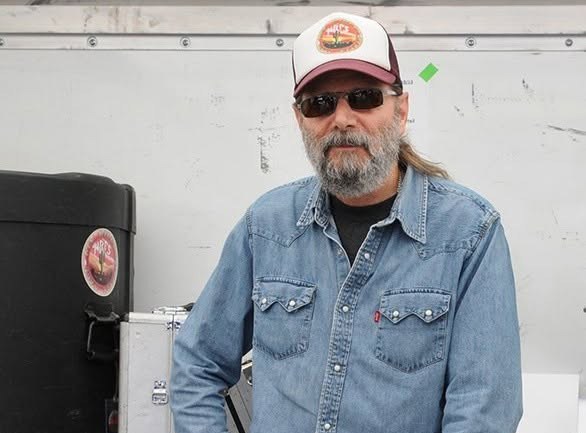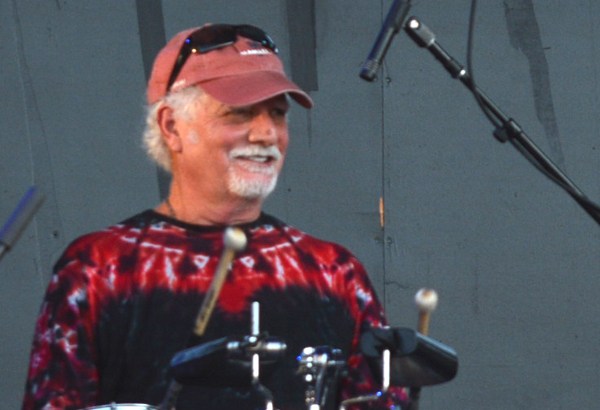

Richie Hayward at his final show – photo by Polly Gray
On August 12, 2010 Little Feat’s founding drummer Richie Hayward, who was suffering from liver cancer, passed away from complications of lung disease while awaiting a liver transplant. Little Feat’s Bill Payne has written the following essay on his longtime friend and band member.
Part One appears here, with a look at Hayward’s later years over on Relix.com.
***
Vancouver Island Music Fest 7-11-10
We were all in anticipation of seeing Richie. It had been almost a year. We traveled up to Vancouver Island to play a concert, taking the next day off to visit with Richie and his wife Shauna at their home. Throughout that long year I had many conversations with Richie on the phone. There was not one time I didn’t hang up without crying. He was a brother to me, to all of us. Family. Our family. So much had changed. Gabe Ford, Richie’s drum tech for two-and-a-half-years was playing with the band. My girlfriend, Polly Gray, was coming up to meet me from Seattle. She had her camera with her. This would be the last time to document Little Feat and Richie together. Shauna had been posting on CarePages the last year, keeping everyone, fans and band alike, current as to Richie’s situation. Hope is everlasting, they say. We all wanted him back in the band. Gabe was ready and more than willing to move back into the slot of his drum tech if that happened. In my heart, I knew it couldn’t happen. When we arrived at the gig he was there with Shauna waiting for us. It was a tearful reunion full of hugs and love. Shauna posted what happened that evening:
From Shauna Hayward:
Then the gig….. The weather had turned a bit cold, and the wind picked up….but did not take away from anything yet to experience. We kept Richie warm beside Dave’s board, with blankets, and love, then Paul invited him up to sing the Jamaican national anthem! It was amazing x Smiles and laughter larger than anything I could describe x Richie was beaming x He played three songs….Spanish moon, Skin it back, and Fat man. I cannot touch with words…all that happened….just know, that it was the magic of love, everywhere.
The band did several songs before they did Willin’. During Willin’ Paul stopped and called Richie out to sing Don’t Bogart That Joint with him. It was a huge singalong with the crowd. Richie then took over the drums from Gabe and played on Spanish Moon, Skin It Back and Fat Man. The band finished the set and all came to the front of the stage and did a wave and a bow. Richie stood slightly off stage only to play percussion for the encore: Oh Atlanta. It was amazing site and sound, lot`s of tears and cheers.
Polly took a defining photo of Richie that night. The joy on his face says it all.
A month later, August 12, 2010, Richie passed away. The band was in Falmouth, UK.
More tears. Where did all the years go?
Iowa Meets Hollywood, CA
I try and imagine what it must have been like for Richie Hayward to venture west from the confines of Iowa to the free-for-all of Hollywood, CA, La La Land, in 1966. Richie never struck me as someone with much patience; his entrance into the chaos and excess of that time must have resembled a balloon after someone let the air of it.
He was a buzz saw let loose in an environment of studied indifference to cultural norms, at least those norms associated with the 50’s that still lingered with some folks in the Midwest—one thinks of Iowa and conjures up images of fire flies flickering away on a hot summer night, the folks on the porch talking about the weather, family, Lawrence Welk, and the size of that pork tenderloin sandwich they had for lunch. Iowa. Flat, the heartland of America, flags, corn dogs, 4-H clubs and livestock at the State Fair, eating corn picked fresh right off the stalk in the ubiquitous cornfields. Then there was the weather everyone talked about incessantly and for good reason: the extreme heat and cold, incapacitating ice-storms, tornadoes, floods, droughts, locusts—Old Testament reckoning—more flat landscapes, and, ultimately, a place of mind-numbing reality conducive to over eating and inertia, or conversely lending to an over active imagination where one filled in the blanks. But for others it was a place for honing one’s skills to nuance, to an open mind and an acceptance of the beauty of simplicity, coupled with the desire to enhance it where one could. (I would recommend William Least Heat Moon’s book on Kansas, PrairyErth, for more on the minutiae of what lies beneath the surface of a place, its people and history.)
And while Richie tried and tested each of the above, nothing was going to keep him in Iowa. His imagination, along with one foot on the gas and one foot on the brake mentality, would never afford him that luxury (the foot on the gas took precedence).
He was destined to carve a place in musical history as one of the most unique and arguably best drummers there ever was.
The debut album
Jagged cut to Southern California: The famous LA haze could not obscure the confounding wreckage of tangled freeways, human lives, nor the anvil hanging over one’s psyche of potential disaster from the San Andrea’s Fault, which rumbled and shook the ground from time to time as a reminder that we were living on borrowed time. The noise and anarchy of Southern California resembled a fifty-car pile-up on the famous Grapevine, during an impenetrable fog. There was a “the dogs run free why don’t we” attitude led by Kim Fowley and his crazy crew of psychedelic adventurers. Fowley was part of Frank Zappa’s Freak Out album that heralded a break with the previous generation.
Frank had it right. LA was not cool. It was full of plastic people. But who cared? People, plastic or not, were living on the fringe at a frenetic pace and there was no stopping the tidal wave of youth claiming their territory.
There was the lemming-like migrations to the Sunset Strip. Cruising down the Strip on a sunny day, the top down, one could almost hear the faint strains of “Kookie, Kookie, Lend Me Your Comb,” echoing off the nearby canyon walls, residue from a less complicated era. And at night, Gazzarri’s, Pandora’s Box, The Whisky A Go Go, and further off the Strip, The Troubadour, where the hip and curious met, crushed together like sardines, some dancing like a load of laundry in a washing machine at slow cycle, while others on the outside fringes drank, smoked pot in the corners, shutting out the world of freeways and congestion for another type of congestion that involved touching. LA is a city of cars, creating a bubble between you and them, and no matter that you could walk somewhere, you always drove. The clubs were where you had contact, real contact with others. The promise of sex filled the air. Free love was not a slogan any longer. People would just as soon fuck as shake hands. Valley girls liked having sex, their underarms and legs sculpted smooth. That was Southern California, complete with bronze surfer dudes and dudettes, Everybody’s going surfing, Surfing USA.
The thread that held everything together, while conversely threatening to rip everything apart, was music. There was a revolution in the works fanned by FM radio. In Southern California you had KMET, KMPX, KLOS, and the DJ’s that pioneered the free format: Tom Donahue, Jim Ladd, B. Mitchell Reed, Jeff Gonzer, Dr. Demento, and many others, where one could immerse themselves in the best of what we now look back on as a truly Golden Age in music (Rock & Roll, Blues, Jazz, Folk). This free format stoked imaginations, gave a true sense of community in a part of the world that seemed devoid of any such concept, creating a soundtrack to people’s lives while providing context to events both local and global. The very basis of this experiment was to expand the idea of freedom and test the boundaries of authority. The Vietnam War and the attendant Draft drew the lines of demarcation between those pushing those boundaries and those who felt strict adherence to control of morals and duty to country. A collision course was set in motion like a huge wave hitting a jetty, the result manifest in the Sunset Riots. Nationally, the War protests, along with the Race Riots in 1967, fomented the Law & Order crowd Richard Nixon wielded into a political and philosophical base two years later—whose reverberations are still being felt today through the voices of Palin, Beck, Limbaugh, and Fox News.
What made it all so surreal was the lifestyle associated with the California experience, that still captivates people from around the world—sunny weather, fast cars, fast women, movie stars, the Pacific Ocean, and the varied landscape of mountains, beaches, and deserts.
Iowa and Hollywood might as well have been two completely different planets. And there was Richie Hayward in the middle of it all with a rage in his heart and mind that never really cooled out until he became ill some forty odd years later.
For those that knew him, saw him play, think of the motion in which he attacked the drums. A flurry of arms and legs, mouth opened, eyes wide open, a blur of sound and fury coming from cymbals, snare, toms and kick. It seemed that he could go off the road at any moment, crash and burn. That was the exhilaration of style and substance he brought to his playing, his life. It enamored many, frustrated and angered more than a few, was truly a marvel to witness, and left me more than a few times scratching my head wondering what the hell made him tick.
The Blur Begins
I met Richie summer of 1969. It is an absolute fog for me as to where I met him. Lowell George might have arranged for us to tag up the first time at a club around the Melrose area in Los Angeles—Lowell lived in Los Feliz, not too far away.
The club was dank, dark, and weird. There couldn’t been more than five people in the place. I have no recollection of a band playing there, although I’m sure there must have been some music going on at some point. What I do remember is seeing Richie and the two of us laughing about a guy that was semi-hidden in the recesses of the room moaning in a Droopy the Dog cartoon voice, “This is baaad, verwee, verwee, baaaad!!” He would quiet down for a few moments and begin the mantra again, always with the same inflection. And though we were laughing, there was a point where with arched-eyebrows Richie suggested we get the hell out of there. It was indeed, baaaad, verwee, verwee, baaaad! For years we talked about it wondering what the hell the poor guy was going on about.
Not too long after that we met again at Lowell’s, Richie set up his drums and the three of us played some various songs and riffs. Nothing particularly coherent. I loved what I heard, though, coming from the drums, which is to say I had never heard anything like it in my life. Not as polished as Keith Moon or Mitch Mitchell, but we weren’t in a recording studio, we were in Lowell’s living room. Lots of cymbals, a wild kick drum and plenty of toms. Later, after he left, I asked Lowell if he was going to be in the band—we were in the process of putting players together for what would eventually be Little Feat (the name was either non-existent or up in the air at that point in time). Lowell told me that Richie was with the Fraternity of Man (“Don’t Bogart That Joint”) that played some prominence in the icon movie, Easy Rider ). I said, “Lowell, how can he be in that band and be in ours?” He said, “Don’t worry, you’re going to play on their record and then they’re going to breakup, Richie will then join us.” Welcome to Hollywood!
The first year was spent looking for a record deal. We were approached by several labels, including Atlantic Records, where the President of the label, Ahmet Ertegun, after hearing our musical offering merely said, “Boys, it’s too diverse.” We jettisoned those songs shortly thereafter. Along the way we auditioned at least fifteen bass players at Lowell’s house, of which Paul Barrere was one of them—Lowell knew he played guitar, yet told him, “Don’t worry, the bass only has four strings.”
With a new lineup of songs, we finally approached producers Ted Templeman and Lenny Waronker from Warner Bros., this time successfully, which paved the road for bringing in the bass player we had wanted all along, Roy Estrada, from Frank Zappa’s band. He had been sitting on the sidelines waiting to see if we could land a deal or not. That said, Roy was a hero to me. The four of us journeyed into the beginning of musical history with Warner Bros. Records as our stewards.
Take a look at the old photos of Richie. He could’ve been a movie star. The mustache took on a D’Artagnan quality. Swashbuckling. Richie always had access to some great hats. On our first album, Little Feat, he is wearing a top hat taken from the Warner Bros. lot, I believe. They let us rehearse there in Burbank. There was a huge box with all kinds of hats in it, and, well, Richie took his pick. It fit him in every sense. For the album cover, we stood in front of a building in Venice, CA., of which was a winter scene painted by the L.A. Art Squad, featuring what Venice might look like if another Ice Age hit—no one was mentioning Global Warming back then, although it was nearly ninety degrees that afternoon and we were dressed in big overcoats and winter hats. Out of all of us, he was the only one of us with any style for the occasion. It didn’t occur to me that Richie was the only one with any real experience for winter, having been raised in Iowa.
The memories I have, many of them, are fragmented, especially from the early times. It was such a free-for-all back then. Paul, Fred, and I were talking with Mac Rebennack (Dr. John), one night in Clearwater, FL, about the craziness of those times. Mac offered his condolences. Earlier, before Paul and Fred showed up, he told me he had lost four friends in the space of less than a week. Life was moving fast. There was no doubt we lived through a remarkable time period, he said. It was all brand-new, and, in many ways, uncharted territory. I told Mac that when we joined Warner Bros. in 1970 the roster included him (Mac was actually with ATCO, which was part of the Warner family), Ry Cooder, Van Dyke Parks, and Randy Newman. I was absolutely floored that we were in that kind of company. It was a period of genuine financial help from the music industry. Warner Bros. funded our first tours, for example. Touring was a channel, as much as having a hit record—which Little Feat never had—to reach an audience. Live music. Real players. We were in heaven, and hell, as it turned out. This is where we really got to know each other. On the road.
An early ad, from Featphotos.com
Singing about Football
Little Feat’s first tour started December 25, 1971. We were in Cincinnati, OH, at the Reflections Club. It held about a thousand people. We had two nights booked. The place was packed to the rafters. We figured out very quickly that the crowd was not there to see or hear us but to engage in the raucous singing of football songs. Ohio State was going to the Rose Bowl. No amount of volume from us on stage could drown out their singing. Amazing. Richie had some ideas of his own to try the second night, though.
Same ol’ crowd was hanging out again…. (reminds me of a song). Richie said he wanted to introduce the band. Lowell and I looked at him, shrugged, and said go ahead.
He sauntered up to the mike, unzipped his pants, took out a sausage, cut off the tip, took a bite and introduced us to a thousand crazed Ohioan football freaks singing and screaming the same songs they had sang the night before. Not one of them took any notice. Richie stomped back to the drums, sat down and with a “FUCK IT!!” counted off the first song, hitting the snare as if he was punching everyone in the place out.
Years later, I discovered that a few folks did indeed witness Richie’s introduction, those of which included Craig Fuller, Craig (Sarge) Shertz (who many years later was our front of house mixer for the Let It Roll tour and follow-up tours—I had also worked with Craig on some James Taylor tours in the early eighties), some folks from the sound company Show Co, and a couple of folks from WB, all of whom were prominent in our career. All told about nine people out of a thousand. It was like something out of a Dickens novel. As in so many things in life, there is no way anyone could have scripted it.
(The Ohio Buckeyes, coached by Woody Hayes, lost the 57th Rose Bowl to Stanford, 27 to 17.)
That first tour also took us to Buffalo, NY. I was with Richie in a supermarket, he came around the corner and said, “Think Fast!” He threw a grapefruit right into my stomach, knocking the air out of me, doubling me over. I wondered why the hell he did it, and when I finally got my breath asked him he wasn’t being malicious about it, but he didn’t have a response either. I just figured I would have to watch him from there on out. In an attempt to save money, we had to share rooms. My partner was Richie. This lasted about two nights, as he would leave the TV on at all hours. I couldn’t sleep with it on, and he had no intention of going to sleep until he was damn good and ready, usually around 4 or 5 in the morning. This was not going to work. I later thanked him, as the result of our incompatibility warranted getting my own room, at least on that tour.
I never roomed with him again.
Carole Drive
Off the road I had more than a few times where I couldn’t afford to have a place of my own. Despite the fact we didn’t room with each other, Richie was always generous to me. I lived with him and his family on and off a few times over the years. One of those places was a Spanish-style apartment complex located on the border of Hollywood and Beverly Hills. We were just off the Sunset Strip on Carole Drive, adjacent to the Cock & Bull Restaurant and their parking lot—we had to park on the street. Bing Crosby’s brother, Harry, having consumed more than his quota of drinks, lost control of his vehicle and ran into my car, a 68’ two-door blue Chevy—it looked like something the narcotics squad might drive. I was encouraged mightily by the Hispanic parking attendants to sue him, which I couldn’t do. I felt sorry for him. Just down the street, an easy walk, was the Whisky A Go Go. Still, as close to the action as we were, there was a tangible tranquility to the area. The apartments were spread out and divided on two sides of a pleasant walkway. Hollywood scriptwriters, drug dealers, musicians, occupied the premises. Everyone knew each other. Richie and his family lived in one of the two-story-structures. He was married to Pam Hayward, one of the Price sisters. Pam was a dominant force in his life, and a disruptive one at that. (She had two other sisters, Patty and Pricilla (Prissy), married to Lowell George and Rick Harper, respectively. “Uncle Rick” was a dear friend of the band and our first tour manager. Their mother, Lulu Belle, was a famous session singer, having performed on records with Ray Charles, “I Can’t Stop Loving You;” sang the high part on, “The Lion Sleeps Tonight,” and the theme to “Star Trek.” She was a true Southern belle.)
Richie, Pam, and their young daughter, Rachael, lived in the apartment closest to the front on the left side as you entered from the street. It was tucked just far enough away to provide a realm of privacy. Richie and Pam held court there, night and day. There was round table just off the kitchen where everyone would convene for conversation, the partaking of sacrament (coke) and drinks to take the edge off, along with reefer madness. Lowell used to sneak up on the south side of the apartment, negotiating a narrow pathway between Richie’s and the apartments next door, and press his face against the windowpane scaring the hell out of us. Laughing, we would then encourage him to come around and join us. (On the Let It Roll album recorded in 1988, we made mention of Lowell and his antics in the song, “Hanging On To The Good Times.”)
Despite the high-octane drugs, there was also some of the best guacamole I’ve ever had, served with Richie’s favorite: chicken taquitos. Muy rico. The conversation was incessant. I’m sure we solved the world’s problems ten-fold night after night, day after day. Richie was quite manic a good deal of the time. More than once he wanted to kick in the fireplace in the living room so he could have a real fire rather than the fake, gas log variety. Every time we would have to talk him off the roof. No! Don’t do it! You’ll have to pay for it. Relax!! It got to be a routine scenario we would all play our part in. Clenching and unclenching his fists, he would invariably give up and move off to another room sputtering profanities. Funny thing is, a few years later the apartments were vacated—the owners had sold them, given us notice—and were scheduled to be moved and carted off to another part of town. They literally lifted them off the lot one by one. In the process, the workman had to rip through the fireplace in Richie’s apartment. They found a stash of sixty thousand dollars worth of silver certificates, apparently stolen in a bank heist from the Thirties. When Richie found about this he was apoplectic.
As I pointed out earlier, Richie’s life rotated between the one foot on the brake and the other on the gas, Part of the brake was his family. As crazy as Pam was—and he was right there with her—he would be the one to have to hold it together sometimes—a tough task given his desire to put the pedal to the metal and let it fly. It clearly frustrated him to be in that position. He loved his family, don’t get me wrong, but he clearly needed some help and wasn’t getting any. His solace was playing drums. Whether at a rehearsal or on stage, they formed the environment for his freedom. Sitting behind the drums and playing was one of the few places—other than racing his car around the curves of the canyons or straight-aways in the Valley, or later riding his motorcycle—where he felt he could just be himself. He loved motion. But, to his unending grief, whether playing the drums or riding his motorcycle, he was ultimately held accountable. The laws of human interference and physics were unbending. Richie held to the quick starts and stops, brake and gas, brake and more gas, as a means to deal with the fleeting freedom offered him.
Tripe My Shorts
Richie’s sense of humor was legendary. I’m convinced his irreverence and inventiveness with phrases and words was an Iowan concept—Iowa has many towns with different pronunciations: Madrid (Mad-rid), Cairo (Cay-roh), Nevada, (Nuh-vay-duh), Berlin (Burr-lin). He could take just about anything and turn it into something else. He would chant: Yom Na Ho I want a Pinto!! He wound up with a Mustang years later (I guess it worked to a degree). One of his play-on-words took place at Lowell’s house the first year of the band. Richie was listening to a song I wrote. He thought it sounded good and asked me what I called it. I said, “Thanks For Everything.” He said, “Snakes On Everything?” A nanosecond later I said, yes, “Snakes On Everything.” To this day I’m not sure if he was messing with me or really thought I said it. I never brought up the subject again. The song title stuck and appeared on the first Little Feat album in 1971.
One of the ironies of Richie’s use of words was the lack of them in our songs. He and I wrote one song, “Tripe Face Boogie.” He wrote the lyrics, I provided the music and melody. The curator at the Rock & Roll Museum in Cleveland, OH, eleven years ago, asked me if I had anything I would like to contribute. There were some notebooks I offered that covered the beginning years with Little Feat. Everything from the formulation of lyrics to a general list of ideas, hopes and aspirations, that I documented, some cartoon doodles, legal documents from Warner Bros. One of the items I was looking for was a lined yellow sheet of paper that had a character drawing of Richie’s along with the lyrics to Tripe Face. I was in my garage in Calabasas, CA, looking for it. The place was a mess, boxes and paraphernalia everywhere. I was balanced on some boxes, there was a ladder lying on its side. As I stepped from the boxes onto the ladder my right leg slipped through and I cut myself. I wasn’t badly hurt but the pain more than caught my attention. There was a sizeable gash that took many weeks to heal. All of that and I didn’t find the box with Richie’s lyrics. Later, I finally found it in the one place I hadn’t looked, had in fact said didn’t exist. Cheryl told me to look just inside the door to my studio on the left, there was small door there, and behind it were some boxes. I kept saying there wasn’t a door on the left; there was a door on the right with boxes, too, that I had looked at a few times with no luck. I was wrong, there indeed was another door on the left hand side. It held a treasure trove of lyrics, music, notebooks and day-at-a-glance yearbooks, along with tour itineraries and the accompanying financial results from our accountant. I also found Richie’s drawing and Tripe Face lyrics.
The Netherlands, June 1976
Little Feat’s Clubhouse
Over the years we rehearsed at quite a few places around Los Angeles. One of the places we hung out was on Cahuenga Blvd. West in Studio City. We rehearsed in the evenings, as there were businesses operating during the day. It was Little Feat’s clubhouse, in effect. Lowell was rarely there. He didn’t like rehearsing. For the rest of us it was a chance to just play, try things, jam. I had a cassette recorder, nothing special, to document what we were doing. Miles Davis had “Bitches Brew” out and we were doing our version of that kind of thing. The instrumental we came up with was called “The Jungle.” I used to record dialogue and music off of old movies on television with that recorder: The Marx Brothers, “A Night At the Opera,” “A Day At The Races,” and “Go West”(there was a section of music from a song, “You Can’t Argue With Love” that I did a take-off on for the ending of Paul’s classic song, “Old Folks Boogie.”) “The Jungle,” was taken from a movie of the same name with Cesar Romero, Rod Cameron, and Marie Windsor. The script revolved around a search for some elephants that killed Rama Singh’s (Cesar Romero’s) brother, and that Rod Cameron was responsible. Cameron, who had escaped a horrible death, was also frowned upon as a coward. He said that wooly mammoths (thought extinct, so how in the hell….never mind, it’s Hollywood, sort of, filmed in India) had killed everyone.
There was a wonderful score of Indian music accompanying the film. I played some of it for the band. We then took off on our own thing and starting jamming in a really aggressive groove. Paul and I got to one section and started playing a lick out of nowhere simultaneously. We couldn’t believe it! It went on and on. Richie was in a syncopation that I had never heard, Kenny right with him, Sam Clayton had an absolute lock on the groove. There was zero compression on the recording so everything was just huge. This jam was the antecedent to “Day At The Dog Races.” When I went to play it back I was listening to film. I heard Marie Windsor say, “Maybe they know where the wild herd is Rama Singh.” Somehow I hit record again, realized what I had done and let out an OHHHH NOOOO!! I was starting to record over our jam. Thankfully I stopped it in time—the tape is now missing in action.
This was the height of our taking off on instrumental excursions with our music. We simply carried that spirit over to the stage. It might have been why Lowell felt left out, and would literally leave the stage, later when we’d play “Dog Races.” It was our playtime, jamming was fun for us. We tried different grooves every night. In terms of the freedom we felt, particularly Richie, playing in that rehearsal room, I’m not sure it was ever quite the same again. The Alley, in North Hollywood, was another great place to rehearse, but we were a lot more regulated in what we played by the time we got there, and besides, there was a dramatic change about to take place with Richie and Little Feat while we were at that rehearsal hall on Cahuenga.
Lowell had had it with Richie and asked him to leave the band. There was concern about his playing, his attitude was defiant when asked to pull it back a bit and just play a regular groove. It was sad given how much fun we had been having. Lowell said let’s get someone else. We all went with the flow. Freddy White, whose brothers, Maurice and Verdine, played with Earth, Wind, & Fire, came into the band for a brief stint. Freddie was laid back in demeanor, to the point that we called him Mo, for Molasses. He was quiet and humble. He fit in nicely. He held a steady beat, simple but effective, a groove oriented player, very solid. We did at least one tour with Freddy. Back in town at the rehearsal hall on Cahuenga Freddie and I jammed together a few times and fleshed out the groove for “A Day At The Dog Races.” I cherry picked melodic lines listening to a cassette of our one-on-one jams to create and complete the instrumental. Later, a change of mind took place on all sides. Richie came back into the band, while Freddy joined Earth, Wind, & Fire. Maybe things had been running too smoothly, I don’t know. I’ve always thought we thrived on the tension, of which with Richie back in the lineup there was still quite a bit, but a wary truce was in order for the time being. The ups and downs of the band are more than I wish to relate, to be honest. Let’s just say trying times were in abundance.
With the exception of the first year of putting the band together, Little Feat was a launching pad for playing on other artist’s projects. We were, and still are, known as a musician’s musicians band. This is what Lowell and I had discussed from the beginning.
A Slave to the Music
Richie told me a story of working with Ike Turner. I’m not sure of the year; it was either 1974 or 1976. (It very well could have been in the time when Richie was not working with Little Feat.) Richie was at Ike Turner’s studio recording some tracks—Tina Turner was not involved in any of the following. It was a nightmare scene. Lots of blow, a gun on the console, a room where Richie could crash, but with all the drugs he was ingesting he wasn’t getting a lot of rest. Richie had told Ike a few times that he had things to take care of at home. Ike wasn’t letting him out of the studio. The gun next to the blow said it all. This went on for a couple of days or so. Out of sheer exhaustion Richie collapsed in the room provided for him, when someone burst in roughly waking him up and shouted, “We’re gonna play on Don Kirshner’s Rock Concert, GET UP, LET’S GO MOTHERFUCKER!!”
Kirschner’s show had a huge following. The filming was done in front a large and rowdy concert crowd. Filming is always a pressure situation, but this was through the roof. There wasn’t any time to run anything down. There were at least two other acts on the bill. Richie was completely crazed from lack of sleep, and wasn’t told until they showed up at the taping what song they were going to do. He told me, in fact, he didn’t know the song at all and was asked to count it off. On top of it all, the bass player in the band hated Richie. He had been on his case in the studio the entire time. He didn’t like a white guy from Iowa playing in the band. He was staring darts at Richie while hurling verbal abuse. Nice atmosphere for performing. Richie told me he was so scared he just launched into the song somehow and managed to pull it off. The whole episode sounded incredible to me; but years later, Jeff Porcaro, Toto’s drummer, told me essentially the same story of being held captive in Ike’s studio when he worked for him.
If You’ll Be My Dixie Chicken
In 1972 Paul Barrere joined Little Feat. Richie told me about Paul, a gifted blues guitar player and singer who was playing a concert with his band, The Lead Enema, in a loft in downtown Los Angeles. Richie and I agreed that Paul would make an incredible addition to the band. It didn’t take much to get Lowell on board, as he was feeling he wanted to play less rhythm and more slide. The band was in a major transition following the album, Sailin’ Shoes, and the subsequent tour that followed its release. We had lost Roy Estrada to Captain Beefheart’s Band. Roy needed a break. We needed a break. It was collectively what the doctor ordered, for us, at any rate. We needed a bass player. I was fearful we would be going through the same cycle we had been in the first year the band formed, with bass player after bass player trying and failing. Dolf Remp, one of the owners of S.I.R., heard we were on the hunt and told our road manager Rick Harper about Kenny Gradney. Kenny and I got together to play a bit, try some songs, and the search came to an abrupt halt. He was amazing. The band was rehearsing at the Warner Bros. lot in Burbank for a Hawaiian gig, The Crater Festival. Kenny said he wanted us to meet his partner, percussionist Sam Clayton. Both Kenny and Sam had been working with Delaney and Bonnie. Sam fit like a glove from the get-go as far as we were concerned, but he had reservations, which vanished after playing in front of forty-thousand people inside the Diamond Head crater in Honolulu. Our sound was looser, more aggressive, less song oriented, more emphasis on playing. We swung into a new gear entirely.
The next gig was at the Fox Theatre in Long Beach, CA. I was laying down on a hard bench between sound check and the show that night trying to sort out how to arrange “Tripe Face Boogie” and turn it into a jam. What I envisioned was Richie and I, along with Sam, going free-form and then, on my signal, doing a signature lick that was already in the song, bringing everyone else into familiar territory. It was the beginning of years of Richie and my excursions into the known and unknown. Jamming, but with a crucial difference. There were chord and rhythmic changes, patterns that turned familiar surrounding by much that was unfamiliar, evolving each night, each year, through many tours. It was not long after that night in Long Beach that the jam in “Dixie Chicken” materialized, leading to “Day At The Dog Races,” “Day or Night,” “Mercenary Territory” and others. A good formula, that to this day, with Gabe Ford, is still a very much an active part of the show and the way we approached our song writing.
I would like to thank the band for their additions and helpful suggestions to my stories. Thanks to Gary Bays and Bridget Nolan for an attentive eye as editors on multi-levels. Thanks to Michael Simmons for his generous suggestions and fact checks.
***
For more by Bill Payne on Hayward’s life and music, stop by Relix.com.