

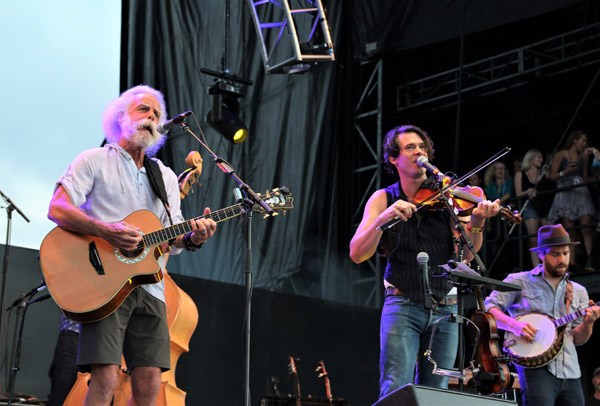
This Friday, Oct. 4, Old Crow Medicine Show will release their new album, Live at The Ryman, which captures various cuts from the country-folk stalwarts’ many performances at the famed Ryman Auditorium in Nashville over the past half-decade. Ever the torchbearers of down-home, old-timey, harmony-filled music, Old Crow have ridden the wave of the 21st-century folk-revival to awards and accolades over the years, but the group’s founders haven’t forgotten the musical and geographical roots that spawned their success.
Old Crow co-founder Ketch Secor recently helped with the creation of Ken Burns’ newest documentary, Country Music, which chronicles the myriad stories—both well-known and nearly forgotten—that have shaped the history of the genre for over a century. Here, Secor talks about keeping the memory of country, folk and bluegrass music alive through the documentary and in his own music and actions, plus his recent experience with playing alongside Grateful Dead guitarist Bob Weir at LOCKN’ Festival in Old Crow’s home state of Virginia (where they collaborated on “Mexicali Blues,” “Cumberland Blues” and “Will the Circle Be Unbroken?”) and why Old Crow Medicine Show might have a bit more jamband in them than they previously thought.
Let’sstart with this year’s LOCKN’Festival, specifically your set and the Bob Weir sit in—how did that cometogether?
Bob’speople reached out a few days ahead of our tour and let it be known that he wasinterested in sitting in with us, asking what we would play. So we sent himback a list of tunes, and he picked the ones that we played from that list.Then we warmed up in the trailer and we hit the stage together. There are justa few moments like that in the life of a musician, where it seems that somesort of spiritual butterfly will land on the headstock of your guitar and justflap its wings. It reminds you of where you came from, where the music camefrom, and lets you know you’re not alone and that your dreams are coming true,all at the very moment of your singing.
Didyou grow up with the Dead? How would a younger version of Ketch have viewedthat experience, being onstage with Bob Weir?
Well,it would have been unfathomable to me as a younger person—that the person I waslooking at, with eyes strained through an LSD hit, was going to be, like, afriend on the stage, years later. I saw the Grateful Dead at Giants Stadium thesummer that Jerry died. It was mid-June, in the burning-hot Meadowlands of NewJersey. I think that, if I wasn’t 16 in 1994, I probably would have been to alot more Dead shows—but I just got to go to the one. I loved the music, and I’vealways felt that our band was part of the same family—we were just a littlefurther down the line. Also, so much of our influence tended toward the earlierside of the Grateful Dead, so it sort of felt like, well, maybe it’s more of ahorseshoe shape?
Hadyou played with any of the members of the Dead before?
Well,we worked some shows with Phil [Lesh] this summer, but in the capacity ofWillie Nelson [on the Outlaw Music Festival Tour], so I don’t think Phil knewus, but he did watch our sets most nights—just awesome to have him there. Andthen there was some correspondence a long time ago with Billy Kreutzmann thatnothing ever came of.
Butthe thing is, when someone is your hero, they take on a life in your life thatis not their life, but something related to your own imagination anddreamscape. And then there’s this positively charged sonic landscape in whichJerry lives forever, and Pigpen never died, and they’re taking their firstbanjo lessons, and they’re learning to sing folk songs in the early 1960s, allin the same breath as singing “Cats Under The Stars,” and death and beyond. That’sthe kinship that I think the Grateful Dead embodies better than any other musicmaker. The immortality piece.
Andthe relationship of the music to a spiritual plane doesn’t need to be aparticular spirit; you can put any deity you want in that picture. That part’snot very important to me. Chuck Berry did the same thing—he lives forever—buthe didn’t talk about living forever, and he didn’t dance about livingforever. If he did, he did it in subtle ways. The Dead invited you into a worldthat very much was stated as a spiritual plane. The music undulates andmoves like the soul.
Doyou aim at something like that with your own music?
No,man, I’m a revivalist. I’m just trying to raise the dead—I’m not trying to coexistwith them.
Howdid you pick what songs you wanted to play with Bobby?
Well,I hope to check the list again sometime and get to pick again, because there’sa lot on that list. Our band has always played Grateful Dead music; we grew upon Grateful Dead music. I polled the band, because we’re all such big fans, soit was so easy to get a list of twenty tunes together. Most of them we had notplayed before, but we had a few regular songs in our rotation, and certainly alot of common ground. What’s interesting, I think, for our collaboration isthat we’re really from the roots-music world, like the Dead, but we’re not atall from the jamband world, so our crossroads happens in a veryless-than-obvious place, in a really deep and soulful place. I think that, whenwe started singing together with Bobby, it instantly felt locked in.
There’sso many people [at festivals] you might want to meet, but these [onstage]encounters, I think, go so much deeper than someone’s email address. I mean,they certainly require that, and Bob gets to play with all kinds of people—andyou’d have to ask Bob what he felt—but, for us, the man has loomed so large inmythology, in our arts, and in our music, that I still see Steal Your Face’severywhere. I can close my eyes and still see the Dancing Bears dancing to “Cumberland Blues.” So it was just a real homecoming to get to play with him.
Haveyou ever had that kind of experience with any other sit ins?
Youknow, it was like meeting Pete Seeger backstage. In the case of Pete Seeger,the part that was the most like making music with Bob Weir was sitting withPete while he talked. Story craft is just at the heart of Pete. He told thisreally long story that I just wanted to drink in. We’ve had such a specialprivilege in our lives as musicians to be able to be there with a lot of peoplewho aren’t on this earth anymore. Plus making music with Cowboy Jack Clement,or Merle Haggard. These kinds of things are what the newspaper men of thefuture—God willing, if I live to be old enough—will be asking me. “What was it like to play music with Bob Weir?What did Merle Haggard whisper into your ear?”
Didhe whisper something into your ear?
Yeah.
Whatwas it?
I’lltell you in 35 years. [Laughs.]
Beforethe festival, I was talking to the talent buyer for LOCKN’ for the LOCKN’ Times,and he was saying he’d been trying to get Old Crow on the lineup for years, butthe timing never worked out. So I’m curious what your thoughts of the festivalwere after your first time.
I’ma Virginian, so I’m always going to want to play in the Old Dominion. But, asfar as playing in Virginia goes, this was a really new experience, because I’venever done a big festival here before, with music going on [that late]. What I’mused to with playing in Virginia is more like a rock festival or a bluegrassfestival, or it’s a country thing or an Americana thing. But this was none ofthose, so it was exciting to be in the space of what felt like new, in thelandscape of what felt so old.
Youmentioned Old Crow not being too much in the jambands world, but I’ve heardthat you’re a pretty big Phish fan. Can you talk about that connection andappreciation?
Ihaven’t seen Phish quite a few years. I kind of stopped going in my earlytwenties—that’s something I really did a lot of in high school, though. A lotof—I mean, there was a minute there when I’d seen Phish as much as I’d seenBob Dylan. But Joe Andrews and Corey Younts in our band are still very muchPhish concertgoers, along with all the variations of Phish. They’re reallytuned in to what’s happening right now. I’m sort of tuned into Junta andLawn Boy. But I’m really tuned into them. [Laughs.]
Anyspecific highlights from your Phish-going days that pop out in your memory?
Oneof my favorites was going to a show in Amherst, Mass., and not having a ticketand figuring we were just going to go hang out in the parking lot—being 16,having some mushrooms in my pocket and being so excited about just going tohang out in the parking lot. Stopping off on the turnpike on the way there, wego into the glass house [regional name for highway rest stops/service areas]and there was someone handing out Phish tickets to the show we were headed to.Those are the kind of miracles that occur in the lives in 16-year-olds on wildweekends in boarding school. [Laughs.]
Ithink, if we had our chops, Old Crow would be a jamband. But we were just neverthat virtuosic. We were a three-chord band that was really song-driven, and thebest that we could do was with soul—not really the way we played, but thepassion with which we played. But it’s all very self-taught and rudimentarychord structures. Our biggest influences are probably like the Memphis Jug Bandand Workingman’s Dead. You can see, in the Dead, that there’s thispathway into the wilderness, from the sound of the Warlocks, or the musicbefore that, the undergirding of the Dead.
OldCrow is really rooted in the folk revival, which I think is one of the mostsignificant times in American music, when the first waves reappeared of aprimal sound that had made American popular music so powerful. That wave was sostrong that there were echoes of it resounding even 30 or 40 years later in theShenandoah Valley, when Critter [Fuqua] and I, in the late 1980s, startedplaying folk music. It was that colossal. What really inspired us was to betrue to it. The ideology of the band was still in its infancy and richlyaffixed to this concept of, “Gotta keep the old music strong, or else it’ll die.” And, you know, that’s the way a 20-year-old thinks. WhatI would tell that 20-year-old is just to rephrase it a little bit—you’ve gottamake the old time music strong so that you can give it away, again and again,so that it’ll be worth giving away and won’t make a memory, but rathersomething present and fun.
Doyou ever have that fear anymore?
No,I think it’s in great shape. I think probably more harmonicas, banjos andfiddles have been sold in the past 15 years than at any other time. So yeah, Ithink we’re doing great, in terms of the cultural preservation of the music ofthe state of Virginia and other places. But, as the band is growing into the21st year of its career, we have been able to change that loyalty considerablyand stretch out into lots of new directions.
HavingBob up there affirmed the feeling and emotion in the band that we couldactually play for a long time if we want. We could jam. And so, we startedplaying a couple of Phish tunes in our set—most of that is because we wereplaying in Vermont, and we always have the tendency to play [regionallyappropriate covers]. When we play in Detroit, we sing “The Wreck of the Edmund Fitzgerald”; in Seattle, we might do Nirvana’s [version of] “Molly’s Lips” or something like that. So, going upto Burlington, we’re likely to play some Phish. And our audiences down Southaren’t as appreciative of us doing Phish…and we’ve learned that the hard way. [Laughs.]With the blessing of Bob—in all his Bob-ness—I feel like we could probably goforth and sew a new roots-music/jam rowand grow some pretty unruly crops.
Inthe vein of keeping old-time music, alive let’s talk about your role in KenBurns’ new documentary, Country Music.
I’mso proud to be a part of the film. He’s been making it for eight years and it’s16 hours long. He conducted about 140 interviews, and 40 or 50 of them werewith people who are now gone from this earth. So I think that it was reallywell timed, to capture the real heart of the music, because there’s never goingto be anyone in country music like Little Jimmy Dickens, for example. Nor isthere ever gonna be another George Jones. So, the fact that we get to see them,as moviegoers… Merle’s gonna whisper something into your ears, too. It’s gonnahappen, and it’s gonna be all ever-loving powerful. Merle is like the bard ofthe tale that Ken is telling. Ken leans heavily on Merle at any moment that thescript needs a preacher.
Iwent up to New Hampshire, where the film company Florentine Films is, and I was an early advisor to the film. I read throughscripts, conducted an interview, and Ken, the two other producers of the filmand I went on tour together around Tennessee, drumming up publicity for themovie. It’s been really fun getting to know Ken. I grew up in the ShenandoahValley, where everything—every high school, every cul-de-sac, every shoppingcenter—was named for a battle, a general or some other dead man. It was allnamed for the war. And yet, nobody was talking about the war. When they talkedabout a general, it meant where you could go and buy, like, a stereo—the nameof a mall. I was 11 when The Civil War came out—Ken Burns really gave methe tour of my own backyard. And for four weeks or something, I was able towatch that whole series. And it really brought alive in me a passion for thesort of crossroads of history and soul. This feeling that, “Oh, they’re notdead.” It just changed. The echoes of the war were still so present in thevalley—not just in the names of the cul-de-sacs, but in the racial politics ofthe state. You know, Governor Douglas Wilder was the first black man electedgovernor of any state, and it happened in Virginia in 1986, when I was a kid,just a couple years before the movie came out. Seeing the response to that—inracial violence in my community—and just knowing that the cost of the war hasnot yet been paid, it made it feel really important to me to do something tohelp pay it, knowing that everybody shouldered the burden. The burden didn’tend with the armistice.
Whenyou got involved with the new documentary, did you hope that it would have thatsame kind of effect, teaching people that history and keeping those namesalive?
Yeah.I am hoping that, when the film comes out, a kind of reckoning can take place,because a lot of the labor that goes into the creation of country music, andthe stewardship and maintaining country music, is a sacrificial one. There’s alot of people who have been left out of the story, or were denied access,systematically, throughout time. There have been stories that have goneunspoken, and that’s why it’s so important to have the outsider perspective.Ken is an insider-outsider—he is America’s most beloved documentarian, and hecan talk about whatever he deems American. But Nashville music has always hadthe desire to talk about itself, and country music is built on this concept ofnostalgia and collective memory, because we seek to retell our story all thetime. I’m sure if you turned on the radio today, you’d hear at least a handfulof songs about the old days. And what the old days are in 2019 are differentthan what the old days are in 1923, when they were still singing about the olddays. But it’s important that the outsider come and appear and tell our story—becausewe’re all gummed up in the works. Nashville can’t tell its armpit from its ass.We’re all just swimming in the stuff, and Ken Burns is like a chopper, highabove.
Youmentioned people who have been passed over in the story of country music. Arethere any names in particular that the new documentary highlights that musicfans should know about?
Ithink all lovers of American music should know the story of DeFord Bailey, andyet we don’t. Not because it wasn’t a story heralded in its time, but you can’tdig up your great-great-grandfather and ask him. Thankfully, this documentarysets the record straight about DeFord. It really works to reset the context ofcountry music as a part of black music expression of the 19th and early 20thcenturies. You know, why did Bill Monroe sound so good? Because he learned toplay from a black man. And even though there’s no part of Bill Monroe’s careerthat you can point to and say, “This is the black period,” or, “Look, there heis with Ray Charles.” That doesn’t exist. But, you watch this film and you cansee—without Louis Armstrong, there is no Bob Wills.
Butit’s one thing to have it on the screen; it’s much more important to pay itforward. For example, I judged this fiddle contest this weekend at the CountryMusic Hall of Fame. This was a contest started by Roy Acuff, the Grand MasterFiddler Championship. It’s really sparsely attended—everyone’s comin’ in from outof town, and there are lots of young kids. This was contest fiddling—oftentimesits virtuosic, but it’s missing the performative nature of music. Anyway, theygave me 20 minutes just to do a little talk and play some, and I was quick tobe sure to play some music out of the black fiddling tradition. It’s momentslike that when I feel like there’s work that I can do in collaboration with thefilm. Because it’s one thing to have it up there on the screen and be like, “OK,it’s done. Everything is set.” It’s not done. It’ll be done when the CMA boardis a diverse board that looks like America. When the roster of top-ten recordson the radio has a whole lot of women and a whole lot of people of color.Because women and people of color have just as much authority in country music,just as much invention, they just don’t have it in their name. And I think themovie can help us move forward.
Shiftingto Old Crow’s new live album, recorded at Nashville’s Ryman Auditorium. Whatwas the impetus behind this release? Was there a similar connection to honoringthe past with some of the songs the band selected for the setlist, like “Willthe Circle Be Unbroken?”?
Ithink our desire to put the record out had a lot to do with the Ken Burns film,to be able to do a further embrace of the movie by letting an audience know: Here’sthis band that has asked itself the question, “Will the circle be unbroken?” forthe past 21 years, and has done its best in the spaces of country music to askthat question. The Ryman looms very large in the collective heart of countrymusic fans. We’re a band that’s had this really special privilege of being ableto be something of a house band in it. The Ryman, like country music as awhole, is a place that collects a whole lot of very different roots, all intoone tree.
Andthen you look at the fact that this place was built because of a divine decree.This guy, Tom Ryman, he’s a riverboat captain; he spends all his money onprostitutes, he makes a lot of money and he’s got to come clean. He goes to atent revival and sees this preacher, Sam Jones, the most popular preacher inthe South, and he gets a visitation from God that says, “Tom Ryman, build me a Tabernacle, and built it for all people.” So Tom built the UnionGospel Tabernacle, in the Confederacy. This is in the 1890s, so the echoes ofthe war, they’re right there. This generation of black statesmen have just beenexiled from leadership. And yet, he doesn’t build the Confederate Tabernacle,or the Southern Dixiecratic Hall, or anything—he builds the Union GospelTabernacle, a house of worship for people downtown. It’s not out by Vanderbilt,not out by Belle Meade; it’s right downtown. And then he dies, but the placefills up with Charlie Chaplin and Bert Williams and Jenny Lind and MartinLuther King and DeFord Bailey and Roy Acuff. I just think that the Ryman issuch a good example of the institution of country music, of how enriched it isby the offerings of so many cultures. I mean, I’m not a historian or amusicologist; I’m a performer. Not a conjurer or anything else—or a politician—but I know that, as a performer, our music does better inthe company of all of the ghosts of music past. Music has some sort of cellularthing where it gloms onto all of the other sounds. And when you play in placesthat are spooky like that, then your music just gets richer. It’s like, youwouldn’t want to lick the walls in the Ryman, because your head would spin. [Laughs.]
Withthis documentary, the Ryman album coming out, playing with Bob and thinkingabout all that—that headspace you’re in—doyou see that affecting Old Crow going forward? After two decades, what do yousee as the next chapter of Old Crow Medicine Show?
Thismight be a bit of a diversion from that question, but one thing that I thinkcould bring it all full circle would be for country music to take a good lookat the Grateful Dead. What is the country music part of the story of Bob andJerry and the guys? Because it’s obvious to me—and it’s not just thepedal-steel part on “Brokedown Palace.” There’s so many intersections of themusic of the Grateful Dead and country music roots. I mean, clearly, Bob lovedMarty Robbins—even sings like him sometimes. Or, looking at Old & In theWay and taking a more musicological approach to it. One of my favorite playersin Nashville is a 90-year-old mandolin player named Jesse McReynolds.Periodically, we’ll sing together on the Grand Ole Opry, and I’ve been over tohis house. He loves to do that—he even made a Grateful Dead tribute record whenhe was like 87. He played with The Doors, and he remembers Jerry arriving onthe pilgrimage to meet him. I’d love to see country music be so wide in itsreflection that it’s able to see and acknowledge the efforts from the hippiesof San Francisco. Frankly, they’ve had a lot to do with it. In some ways, thefilm tackles this—not with the Dead, but with The Byrds. That makes sense—it’sa little more of a leap to talk about the Dead with country. But I can see theday coming when there would be some tie-dyes hanging down there at the countrymusic hall of fame. And I’d like to be the guy to pin them up on the wall.





