

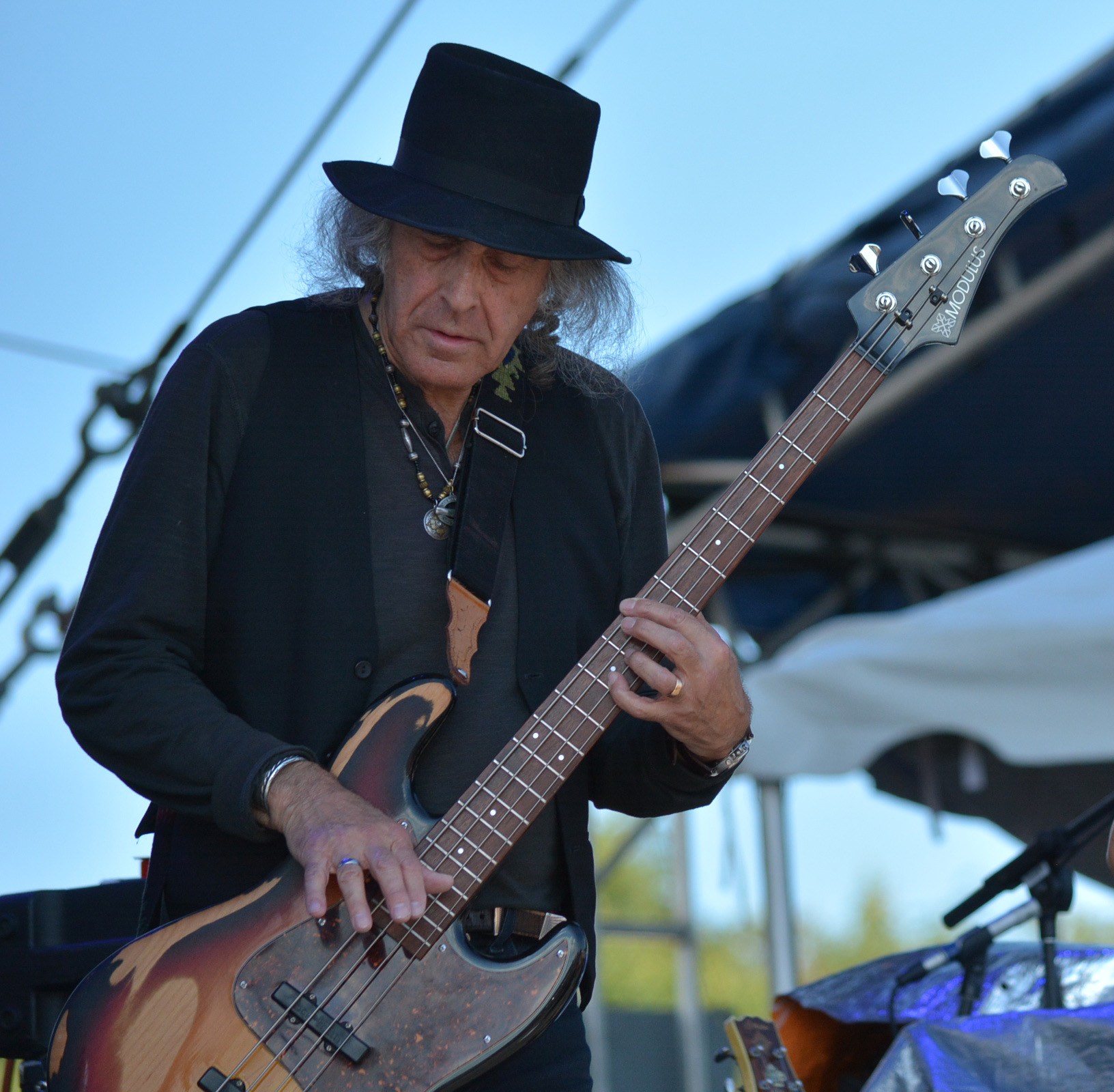
The Skull & Roses Festival originally slated for Southern California’s Ventura County Fairgrounds on April 2-5 has been postponed. The announced lineup includes Billy & The Kids, Oteil & Friends, Voodoo Dead, Grateful Grass, Melvin Seals & JGB, Circles Around the Sun, Midnight North and Moonalice. While we await additional details, Pete Sears takes a few minutes to share his musical journey and reflect on his connection to the event.
I was born May 27, 1948, in Bromley, which is essentially South London. David Bowie (real name David Jones) and H.G. Wells came from the same town, as a matter of fact. It was borderline country when I was growing up, but now it’s part of the city, really. My first musical memory was of standing on stage at five years old. My big brother (who is five years older than me) pushed me up on a box on stage in front of a bunch of rowdy kids as part of a talent show. I sang “Pack Up Your Troubles” and came second, for which I got a pencil case.
When I was eight, I started plunking on a friend’s piano, and I must have told my father, ‘cause one day I came home and there was this upright piano pulsating in the corner of my house. I took lessons for about four years and got as far as “Blue Danube” and “Für Elise” and got to read a little bit. My brother listened to [Dave] Brubeck and Jimmy Reed, so that was going in. My friend’s sister married a guy who had a Folkways-type record store on Bromley High Street, and he turned us on to people like Lead Belly and Champion Jack Dupree. He also made us a guitar, so we formed a band called The Strangers, the two of us through an amplifier. We were standing on stage behind the curtain listening to the school orchestra murdering Beethoven or something. Then we went on—we had our little suits, a bow-tie or something. I was maybe 14 at that point. The curtain opened and we played our one-chord original—“Twist and Twang,” I think we called it—and the crowd went absolutely nuts! It was like the movies: The kids were dancing and the parents were looking on in horror.
I then started playing with a friend in Biggin Hill, where the old World War II R.A.F. Spitfire Hurricane fighter base used to be. We had a band called the Spitfires, and we played at youth clubs—David Bowie was part of the same circuit, with a band called the Konrads. I got to know his guitarist really well—George Underwood, he became a famous artist—who did all kinds of album covers for the Moody Blues, T. Rex, and Bowie. Even then, David just looked like he was going to be successful.
When I was 15, I went to work at a publishing company in London as an office boy, running errands all over the city. I was also going to night school to get my G.C.E. (the English version of the American G.E.D.), but I met a really good guitar player, Mick Hutchinson, on the train one day. A week or so later, these guys in a van showed up in my neck of the woods. They were a band called Sons of Fred, named after the comedian Spike Milligan’s insane TV show, and they needed a bass player. I said, "Why not," jumped in the van, and plunged headfirst into a life of rock ‘n’ roll. We played R & B and blues, signed a deal with Capital Records, and found ourselves recording at EMI studios—Abbey Road, but it wasn’t called that yet. We released singles, but never did have an album. We were on TV shows like Ready Steady Go and Thank Your Lucky Stars at the same time as The Beatles, The Stones and The Yardbirds were taking off. We had a following and even got mobbed a couple of times, but we never really had a hit record—good band though.
I was next in a band called The Fleur de Lys for a little while, on piano, playing Motown stuff. Chas Chandler from The Animals was our producer, which is how I met Jimi Hendrix for the first time, at Eric Burdon’s house. It was before he started The [Jimi Hendrix] Experience, and we hung out for a while in the kitchen. He seemed like a cool, down-to-earth fellow. He played on the tune we were recording then, “Amen,” but the acetate disappeared—I’d like to find that.
I then embraced psychedelia after seeing a Pink Floyd show at the Marquee Club—by now it was 1967—and joined a band called Sam Gopal Dream on bass and keys. Sam was an Indian tabla player, and we had the amazing Mick Hutchinson on guitar playing ragas. We were a trio and played at the UFO Club, Middle Earth, and Alexandra Palace, often on the same bill as Pink Floyd, Fairport Convention, and Soft Machine. Jimi sat in with us once at the Speakeasy. We were all instrumental, had an underground following and played for hours, but we never got around to recording. Sometime after, Jimi’s drummer Mitch Mitchell asked me to join a band he was forming, but I came to the States instead.
The guitarist from Blue Cheer, Leigh Stephens, came to London and invited me to America, and he, my friend Mickey Waller (the drummer for Jeff Beck), a vocalist and I formed a band called Silver Metre, which Tom Donahue managed. After that, I went back to England. Tom then did Medicine Ball Caravan—a 1970 movie the Grateful Dead backed out of at the last second—with Stoneground, so when they got to England I became part of Stoneground, recording with Bob Matthews and Betty Cantor, who’d stayed with the Caravan when the Dead bailed. When we came back to the states, I was staying at a house in Mill Valley and met John Cipollina and we really hit it off. One night we went down to KSAN and John got Jerry on pedal steel and Bobby on acoustic guitar and John’s little brother Mario on bass, with me on an old upright piano, and it turned out to be KSAN’s first live broadcast—on the Richard Gossett show. I had the reel-to-reel of it in my parent’s closet because I was moving around too much at that point. Unfortunately, my father threw out his old tape recorder and tapes from the closet, and my reel-to-reel was accidentally thrown out with them. There is a rough bootleg that circulates, though.
I really loved Marin [county in California] and that scene, but I had to go back to continue recording with Jeff Beck’s vocalist, Rod Stewart. I never toured with him, but I had already helped record Gasoline Alley—I played piano on “Country Comforts” and bass on “Cut Across Shorty”— and then we did Every Picture Tells a Story, Never a Dull Moment, and Smiler. It was basically the Jeff Beck band—Ron Wood [on rhythm guitar], Micky Waller [on drums], myself on piano, Ian McLagan on B-3, along with classical jazz guitarist Martin Quittenton, who wrote a lot of the music and played those beautiful interludes. Then I came back for Picture, and on “Maggie May” I played the Celeste, which is the chime sounds you hear on the verse that starts “I suppose I could collect my books…”, and piano on the rest of the album—including “Reason to Believe"—except for “Losing You,” which was the only track that featured the “Faces” as a band.
John Baldry sang on Picture; I later played bass behind his first U.S. tour. Around then Jerry [Garcia] called and invited me to play on his first solo album but, sad to say, I couldn’t do it. So he ended up covering the bass himself—quite well, I’d say. Earlier, I’d met Joey Covington (also through John Cipollina), and he took me down to play bass on “The Janitor Drives a Cadillac,” a song by Joey on Papa John Creach’s solo album, Papa John Creach. Grace Slick sang, so this was my first introduction to Grunt Records. Then back to England [to play with] Rod [Stewart].
I came back to Marin and formed Copperhead with John Cipollina, and after a little while I realized it was home. The scene was strong, and it was so beautiful, and Mill Valley wasn’t gentrified yet….so I decided to stay. And after a lot of this and that, including working with Nicky Hopkins and forming a band with Greg Errico and Neal Schon, I was working with Kathy McDonald at Heider’s, and Grace [Slick] and Paul [Kantner] were upstairs recording Manhole. They asked me to join a band they were forming called Jefferson Starship—this is 1973. While I was in England recording Smiler with Rod, they called me a few times. So when we came back to San Francisco, they sent a limo to bring us to their house—that beautiful place they used to rehearse in, outside the Golden Gate Bridge, looking out over the Golden Gate channel and at Marin County, Land’s End. We hit it off well, so I joined Jefferson Starship, which was the next 14 years. That first day I started playing the piano and Grace ran up and got some lyrics and we wrote “Hyperdrive,” which ended up on the first album, Dragonfly. I would switch between bass and piano with David Freiberg. I played bass and piano on the hit “Miracles” on Red Octopus. The wonderful Papa John was with us in the early years, and there’s a live album of a show we played in Central Park in 1976 in front of a hundred thousand people. I also remember Jefferson Starship playing a Vietnam Veterans Benefit with the Dead in San Francisco. I grabbed Phil [Lesh]'s bass and played their encore with them while Phil went up front and joined in singing “Lovelight” and “Johnny B. Goode,” and that was fun. After another ten years, we eventually lost momentum, and I left in 1987.
After Starship, I healed myself with the blues, and played a lot of piano with Nick Gravenites. My wife Jeannette and I were also doing a lot of human rights work—some sanctuary work, some Seva Benefits. I put together the band, including Jerry, Micky, Paul, Grace, Greg Anton, and Steve Kimock—that was at the Soviet American Peace Walk in Golden Gate Park in 1988. At one of those Seva shows, 1992 I think, I was playing some blues piano backstage in the dining hall when I get a tap on my shoulder. I turn around and it’s Jack [Casady], Jorma [Kaukonen] and Michael Falzarano, and they tell me they’re recording a Hot Tuna album the next night at the (old) Sweetwater in Mill Valley, and would I like to come down? So I sat in on keys, and ended up staying with them for about ten years. It was just the healing situation I needed after what the Starship had become. I love the blues. Jorma was a warm and generous band leader, and we had some good times, with both Tuna and the Jorma Kaukonen Trio. I also played keys with Zero off and on during this period.
And after 1988, lots of things happened. Thanks to Jerry, my solo album Watchfire (which he played on), an environmental and human rights album featuring lyrics by Jeannette Sears, came out on Grateful Dead Records. After ten years with Tuna, I had my own band, the Dawn Patrol, which was put together to promote my second solo album, The Long Haul, with guest John Lee Hooker. I played with Leftover Salmon for a little while. Did some touring with SKB [Steve Kimock Band]. I did a weird avant-garde solo piano album, Millennium, which came out in Japan. There was some documentary soundtrack work, including The Storm That Swept Mexico, during which I worked with Los Lobos, who I met on the first Furthur Festival tour. I Worked a lot with Harvey Mandel. I Did an east-coast tour on keys with the Chris Robinson Brotherhood (with Neal Casal, Tony Leon, and Jeff Hill), and now I’m playing all kinds of honky-tonk songs with Chris Robinson and the Green Leaf Rustlers. I Played bass for Dr. John and piano with Los Cenzontles, over in the East Bay, as well as California Kind, which is Katie Skene plus Barry Sless and John Molo and Rob Barraco or Mookie Siegel on keys. [There was the] New Orleans Love Act with Phil Collumbato and Jimmy Vivino, and I played bass on an upcoming east coast Zero tour, which includes Melvin Seals on keys—it becomes wonderfully experimental at times. David Hidalgo and I did a benefit where we did “Killing Floor” and it was so much fun. We’re trying to conjure up a Cream-type band some day.
Eventually, I met Roger McNamee through Jorma and transitioned into the Flying Other Brothers and Moonalice, and then I did a few gigs with the David Nelson Band on piano, subbing when Mookie couldn’t make it. Their bass player, Bill Laymon, became very ill, so I took over the position. Fortunately, he’s OK now and has his own band. There are a lot of similarities between Tuna and DNB material. It’s a different kind of jamming, a bit more freeform than Tuna. We’re really bouncing off each other in DNB, me and Barry in particular—it’s almost like 1967 London and Sam Gopal Dream again. John Molo and I really connect, and the songs David wrote with Robert Hunter are classic.
[Skull & Roses at] Ventura is something I’m really looking forward to. I played there with Moonalice and it’s a great environment. And now we’ve added the T Sisters and Lester and Dylan Chambers, who really give the Dead songs a unique take. And their own material is strong. So I’m in two bands there this year. Twice the fun!





