

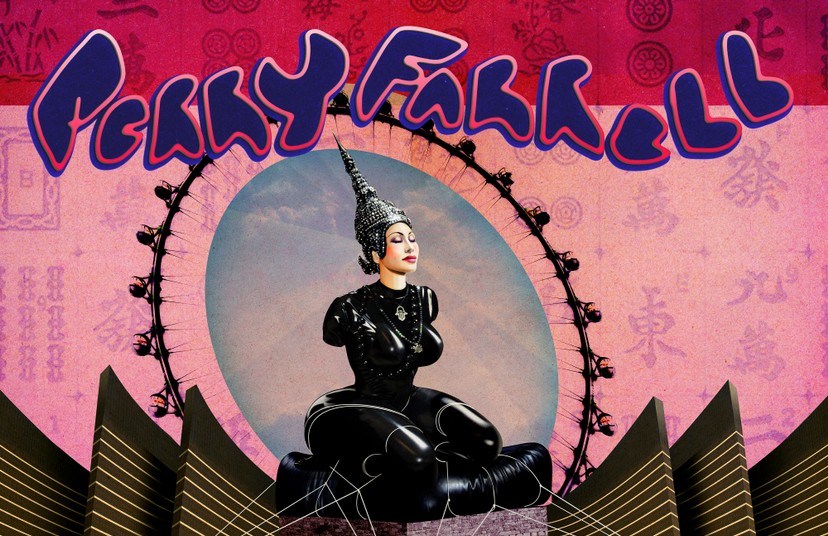
From his days as a member of Psi Com through his time as a provocateur and influencer in Jane’s Addiction to his current status as an elder statesman of the alt rock nation, Perry Farrell’s desire to create an expansive artistic vision surpassed his distinctive abilities as a singer, songwriter and frontman.
The cover of Jane’s Addiction’s Nothing's Shocking depicted a statue of nude conjoined twins while the menage a trois statue on Jane's’ Ritual de lo Habitual got the album banned from stores and was replaced with a copy of the First Amendment.
Encouraged by his art design work and success of hisband, Farrell moved on to larger concepts that unified the alternative rockworld -- the influential Lollapalooza festival morphed from a travelingroadshow to a weekend event franchised around the world – to confrontingconcertgoers with new experiences through his environmental, spiritual andwildly diverse musical lineup of the Enit festival.
After gestating for nearly a decade, Farrell'slatest project, Kind Heaven, continues its circular creative lifespan that willculminate next year with the opening of a $90 million immersiveperformance experience in Las Vegas. “It doesn’t have chairs like a traditionaltheater,” he explained to Billboard.“We have stages within the complex for music and other types of entertainment,but you’re basically walking through a 90-minute show routed in mythology andoriginal content.
“When you’re within the complex, you’refree to roam around and discover hidden alleyways, visit nightclubs and eatfrom Hong Kong-style street food vendors. There will be improvisational actors,musicians, acrobats and comedians, combining elements of sensuality andespionage into an experience that will be a first of its kind.”
He added, "There’s two different experiences -- one for families in theday and one for adults only at night. So, during the day you can learn moreabout the traditions and cultures of Southeast Asia. Then, in the evening itbecomes an adults-only experience with streetwalkers, nightclubs and sakebombs. Anyone who has traveled to Hong Kong knows it’s a much different citywhen the sun goes down.”
Offering a preview of what’s ahead,he debuted the Kind Heaven Orchestra in late 2018. Earlier this year, hereleased his second solo album, “Kind Heaven.” Produced by Tony Visconti (DavidBowie, Morrissey) and with appearances by Taylor Hawkins (Foo Fighters), TommyLee, Elliot Easton (The Cars), Mike Garson (David Bowie), Dhani Harrison, MattChamberlin (Pearl Jam) and his wife, Etty Lau Farrell, it represents a sonicretrospective of Farrell’s musical world that coalesces the rock of Jane’sAddiction with the laidback vibe of Porno for Pyros and experimental and EDM elementsfrom his work with Satellite Party.
JPG: The firsttime we talked was when you were promoting the Enit Festival.
PF: I get lots of great comments aboutthe Enit Festival because it was such an interesting time I had. So alright,listen to this story. I was at that time very enthusiastic, stillam...there was no such thing as EDM at that time. It was only amazingpeople like The Obrb and Orbital plus Dirty Dozen Brass Band and SunRa…So, I got to feed people my way. I got to work with musicians thatmost promoters wouldn’t have thought to put us together. And then, Igot to feed everybody with the Krishnas. The Krishnas when they feed the poorand they have these giant vats of food -- they are really delicious -- if youare going to be poor, I would suggest finding a Krishna Center and asking themif they’re giving away some free meal.
So anyway, we got to do all that even send intospace...We were shooting out into space, music. Well, it was more like sound.And what it was was the sound of, I guess you would call it the chemicalequation or the chemical compound of things like brass and copper and gold justto see if there was any intelligent life out there that could pick up on thetones and the frequencies what we were trying to speak and say intelligentlythrough sound and music. I had a great time putting that thing togetherand I’ll never forget.
JPG:I was going to ask this later but since we discussed Enit, it made methink about the Kind Heaven installation that’s going up in Las Vegas and now Kind Heaven the album and Kind HeavenOrchestra on tour. Are you able to go to someone and bring up Kind Heavenand say we need $100 million dollars or whatever amount it is because youstill have artistic, cultural along with business and commercial cloutfrom Lollapalooza and your grand ideas that have blossomed?
PF: Yes.But, here’s the thing. Let’s focus on that word “blossoming." Anythingthat blossoms starts out as a bud, right? And the best blossoms startout with a very, very small plant. So, we’re out on the road right now in smallclubs. They’re not supposed to jam 500 people. They should be jamming 250-350in these, I’m calling them residencies. I’m looking to start very smalland as intimately as possible but, of course, looking to turn into an oak or aredwood, eventually. So, it’s really exciting but you know that any treethat will eventually become an oak has had to have fertile ground and it’s hadto have time and it’s had to have roots. The roots have got to be real, real strongso that it cannot be blown over when it’s between years and it has to makeit through inclement weather and have that strength.
So, the way I’ve done it is…yes, wecan go to the Enit Festival. I lost a million dollars of my own money. I didn’tuse any sponsorship for that and I didn’t have that money to lose but I knewpsychically somehow there was a presence of mind about the future maybebecause I knew I was doing the right thing. I was basing the projectaround art and drawing in the interest of the people and trying to make fineart. Now, here I am. It might be 20-some odd years later, I’m talking toHollywood film producers and Las Vegas hotel owners, the gambling boardbut they trust me because I’ve proven myself. I’m shooting for themoon. I don’t have that much time left on the earth.
It’s kind of like if you’re a basketballplayer and you get a rhythm but then you know that the final two minutes,you’re going to have to take some risks and show that you’re capable of makinglong shots. That’s what the champions always do. So, I would love to be achampion in my lifetime. That’s what I want.
JPG: The album KindHeaven, when you came up with the concept for the Las Vegas installation,were the songs already there or were you like, “Okay, this place has to have asoundtrack, now I’ve got to work on some music.”
PF: Well, theprocess went like this. The idea of Kind Heaven came seven years ago butthe idea for making immersive theater and even in Las Vegascame to me earlier than that. I did another record with Etty (Perry’s wife)called Satellite Party. In Satellite Party I had ideas and a visionto create an immersive experience in Las Vegas, and it wasn’t to be. Thiswas 12 years ago. It wasn’t to be. We were signed to Sony or Columbiaand Columbia’s walls caved in at that time. Don Ienner, who was thepresident and Steve Lillywhite who was our A&R/producer were dismissed. Iuse a lot times an analogy of sports and entertainment, they’re so intertwinedin everything. You can start with the players to home officeexecutives. Just like in sports when they get a new coach or newgeneral manager, everything starts to change. Players, sometimesthey’ll fire or trade the quarterback immediately and bring in the quarterbackthat the coach wants. That happened to us with Satellite Party. We had thoughtthat we were going to be able to go into Las Vegas then.
We were undeterred. Theidea of immersive theater was important to us because I’m looking at theworld now…you know I love Bill Graham and everything that he accomplished andall the people that surrounded him. We’re living in days now, Bill Grahamdidn’t have the internet and technology and Atmos surround sound toconsider. I bet you anything if Bill would be alive, The Dead would be workingwith surround sound Atmo and everything else. That’s where we are now‘cause they were always ahead of their time when it came to the sound systemsand the technology.
Now, where I amas an artist and a promoter is I am looking to give the experience, one thatimmerses people into the sound. In other words, I want to surround people with soundand vision. So, next project that we did after Satellite was KindHeaven, and with Lollapalooza’s success, I had that in my portfolio and,of course, Jane’s Addiction and Porno [For Pyros] and the others, I wasable to convince these Hollywood producers, that were also by the way to givethem great credit, they were also looking to get out of movies and into thismulti-media world that is live entertainment. Today’s live entertainment.
JPG: Since you mentioned the Grateful Dead, I think Jane’sAddiction’s version of “Ripple” is probably one of the best Dead covers. It’s original but it keeps the spirit of the Dead withJane’s Addiction, which is what a good cover song should do.
PF: Yeah. Thankyou. I’m so happy that I got to do that. Just knowing that Jerry enjoyedour music meant the world to me. He was the first big brother in musicthat spoke and said I like these guys. I swear, I could fall apart just crying.How happy I was when I read his article in RollingStone.
Then, in 1991when we did our first year of Lollapalooza, it was the great Bill Graham, whobelieved in my dream. I asked Bill for certain things, like I wanted art to bearound, perhaps a gallery, and a few other things that are food, bands goingfrom noon until 10:45 or 11, and Bill blew out my dream and he made it into theuniverse. It was there. It meant the world to me that he was helpful and amentor to me. So, that whole camp, they’ve become my family.
One of my best friend’s isAlex, Bill’s son, who is a great promoter and he has a sound company. So, he’sa great man in his own right. We remain best friends, yet, making thatconnection, they’re the ones that helped my root, root me towards becoming anoak.
JPG: I do want to bring up the album and I want to bring upa couple sounds specifically in a second but I was going to say the albumitself seems like an encapsulation of Perry Farrell, the musical artistfrom the past 38 years. Was it a happy accident or was it the influence of producerTony Visconti or was that the vision for it?
PF:Well, as I say, today we’re living in a day, Bill and The Dead are, youknow, they didn’t have software that I and Tony and all the other musiciansthat our contemporaries have today. I’ll give you a funnyhappenstance. So, these days, I’m getting into the origins of jazz.I’m studying 1930s and ‘40s period, so basically Kansas City Charlie Parker,Lester Young, Count Basie etc. etc. Louis Armstrong, BillieEckstine...the list goes on. I’m studying them and I love them because oftheir enthusiasm, their dedication, their sense of improvisation and creativityas a musician. Their dedication to their craft caused them to transcend whatthe world heard asmusic and moved the needle. It made the worldhappy. It brought people together that might not have liked black people,and it caused them to overlook their prejudices and open their arms and embracethem because the musical message that they had was so attractive and so needed,which basically, it’s causing them to dance and be in joy.
And so, I neverwant to forget or leave out in the analog, the soul of amusician. However, I should say, in my 60 years, I’ve beenintroduced to this wonderful technology that can enhance the experience by...itwas first mono.Everyone was into Louis [Armstrong] on mono and then itbecame stereo, and then we can do this really cool thing called panning. Anddid you notice that the voice, the backgrounds are on the left and then itwas on the right and the guitars move to the left, and that was novel.Then, we picked up quadraphonics, and so there are certain things that you canput in the back, but now we have delays, basically, it’s dub. I’m pickingup from the Lee Scratch Perry’s of the world and the King Tubby's, all thosegreat dub artists that taught me what you can do with delay andfiltering and chorusing. But now, I wanted to apply all the things that Ilove in a most contemporary way that I could because it’s the mostexciting.
So, even thoughI love and I honor and respect and really hold upthe artists and the music of the past, I know that we can make music thatwill be passionate for people, give them joy, give them wonder now, awonder that they never experienced because of the technology if we use itproperly.So, we use surround sound to whip the delays around you. Weuse the filter for the strings to show up just behind your left shoulder, andthose things are what are going to excite people when they get to really fullylisten to it or they can put on some binaural headphones. We also mixedthe album in binaural. We mixed it in Atmosand we mixed it in stereo.
In the next twoto five years, the full extent of what we did will be realized. First, when wego to Las Vegas and we hear the sound coming from out of the walls, coming frombehind us, around us, maybe we’re wearing headphones and we get whispers. I candirect sound directly to an individual among thousands of people, I can whispera message to one person as if an angel was speaking in their ear.
JPG: Hearing that brings up this. Sound, the collection ofnotes, and how they can directly influence a person’s thinking and it makes methink of a track I really, really love off the new album, “(red, whiteand blue) Cheerfulness.” because it has a peppy vibe. It’s almostlike “H.R. Pufnstuf" in that it sounds like a children’s theme song.
PF: Want me to fill you in on the song?
JPG: Sure...
PF: I’m looking right now at twoAmerican flags, an amazing architectural eagle very close to GroundZero. The eagle is called the Oculus. I am basically looking at theWorld Trade Center. I was in New York City deejaying forMarc Jacobs, the great fashion designer, the night before 9/11 and, ofcourse, I woke up in the morning, walking distance from the World TradeCenter. I couldn’t understand what I was looking at because I was seeingthings out the window and on the television that matched. Can you imagine that?I’m watching on TV and in front of me and it didn’t make sense. At first I thought, "I’venever seen this footage before. What is this?” Isn’t that crazy?
So anyway, “(red, white and blue)Cheerfulness.” I have become a newshound because of what all hasgone on in this country. I cannot ignore politics, although Iwish I could. I am not a politician. I’m not interested in it atall. I am interested in art and the closest I get to it is there are goodpoliticians out there that care about people and then there are those that arevery, very selfish and will ruin the world and will ruin your time here onearth if you let them. So, I make it a point everyday to watch thenews. I do not watch Fox News ever. I only watched it one time justto almost guarantee myself that it was full of shit and I was right. Then,I went back to MSNBC or CNN. I know that they’ve got their issues, too,however, they have some very, very smart and liberal men and women, gay andstraight, black and white and brown, Jewish, Hindu, Muslim, Christian...I liketheir pool of idealists. So, I listen to them.
I am open-minded there. I watchspecifically, I love Rachel Maddow and Lawrence O’Donnell. So, Iwrote this song because Rachel is always telling us really, really importantinformation that could be a bummer. But, if you watch her, she is always laughingand smiling. It’s a nervous laugh of, “Can you believe those guys?” Almost likeshe’s talking to a friend. And so, I wrote about her and Lawrence. If younotice, Lawrence is the same way. He’s got a glimmer in his eye and he’s like,"Yeah, this guy did that.” They get heavy but then they come out of it asthey should because if it’s too heavy people are going to jump out of abuilding. Jump off the Brooklyn Bridge, you know? And so theyreel us back with a smile and a cheerfulness, and I think they’re true patriotsand I love ‘em.
And so, I wanted to write a song that was startingout with simple basics like The Beatles or The Who or The Stones. TheBeatles started out doing residencies in Germany, in Hamburg, and that’swhere they honed their craft. And it was a simple mix. So, I wanted to startthe record out just that way and my friend, Taylor Hawkins, who's one of mybest buddies, too...Brought him in because he’s a guy that’s all aboutanalog. And so it was perfect for he and I to get together and write thissimple song as Sly Stone said.
JPG:So, you sang a simple song, as Sly would say.
PF: Yes, but seeing the simplicity assophistication. It’s like dressing up. Look how elegantly and simply they’reput together. They’re not overdressed and there’s beauty in that.
JPG:Someone once said that Beatles songs are like children’s tunes because at theircore the melodies are so basic that children as well as the child in everyadult can find it appealing.
PF: Yes, the simplicity in theirmelodies and then there’s a sophistication that comes into their harmonies whenthe resonancies to spread out. It’s all beautiful and digestible. And thebasics of it, you can take into a very small room with an acoustic guitar.
JPG:Tony Visconti producing "Kind Heaven." Love when he produces stuff.Even though he didn’t produce David Bowie's "Aladdin Sane,” the finalnotes on your song “More Than I Could Bear” remind me of the finalpiano notes at the end of Bowie’s song “Time.” Also, “Let’s All Pray For ThisWorld,” that is you singing on that correct?
PF: That’sright.
JPG:It’s a very different voice.
PF: A little John Lennon there. Itried to sing it various ways at that speed. I didn’t initially, and I didn’tset out to sound like John Lennon but, of course, I’ve listened to John Lennonfor my whole life. And so, I was trying to get articulation out in thisspeed.
Interesting note about the song, it waswritten with Joachim Garraud,whose a French house producer.He was writing everything at a speed of approximately 130 to 135 beats perminute. The piano, which was originally a synthetic piano because Joachim canplay piano beautifully…As I say, he’s a French house producer, so the speed of(Perry mimics the speed of the backing track. Then, sings a line from thesong.) So, it was an articulation thing that I had to navigate and it workedout.
It’s one of the songs, I warm up my voice to but I don’tsing it at that speed. I sing it acoustically with one acoustic guitardown almost a step. It becomes (he sings a line of the song) but that’s not howit was recorded.
To answer your question about Tony, weshould also speak about for a momentHarry Gregson-Williams, whowas the composer of the 30-piece orchestra and the arranger. We broughtJoachim’s tracks to Tony and we brought Harry Gregson-Williams tracksto Tony and my vocal tracks were done in part to Tony.
What I had done was, I’d begun writing that record,believe it or not, it took me seven years in completion, starting with theconcept from a dream. Then, the concept became storyboard, as a PDF [file]. Iconceptualized a story, a scenario, where we’d be living in a time where thereturn of the Messiah, the second Messianic era if you will, and we were on thethreshold of it. We hadn’t passed it yet because we first have to go throughthe anti-Christ and Armageddon. That’s where I wanted to put the story; thepresent tense of the story was that. Then, I began to write poetry andthen I reached out, originally to digital artists because it was a quickway of getting amazing beats and the latest technology. Then, Ibrought in the great Chris Chaney who is our bassist in Jane’s Addiction, hadhim as the first organic analog musician so that when I brought in Tony, he hadvoice and bass and a few drums. So, a rhythm section. We had Taylor Hawkinsrhythm section. We had Tommy Lee rhythm section. And then, myvoice and Etty’s voice.
So then, Tony took all that as I knowhe’s more than capable, he is a master. He’s like a Rembrandt. Hetook all that and then we added the great Elliott Easton of The Carsand Peter DiStefano from Porno for Pyros. Also, there’s a secretsauce in the mix and his name isBrendan Hawkins. He has been one of mybest friends also. My technician. He helped record the voice of Etty and myself.Brendan Hawkins knows the latest software that he applied to myvoice and gives sweetening in addition…the way that the electronic producerswork is they send files back and forth using Dropbox or whatever else they havegoing. I give them voice and song and lyric. They would give me beat and melodyto start with. And then I could completely change the arrangement. I could say,"Well, you know what? I hear it this way” and give it back to them. We goback and forth in this beautiful – what would you call it? – badminton. We’revolleying back and forth ideas to each other.
Then, when it came time to bring inTony, we had all these pieces that we put together, listened to and then weadditionally took out things that were too processed that didn’t allow for thesoul to thrive and play it again – again, we volley back and sweeten tweaksthat are as modern and contemporary as we have available to us. So, if youlisten to the voice, there’s crazy backwards masking on it that we workedwith to try to bring a freshness and uniqueness to the production of avoice. Things like that that will come in handy later when we mix inAtmos. That was what we were trying to achieve.





