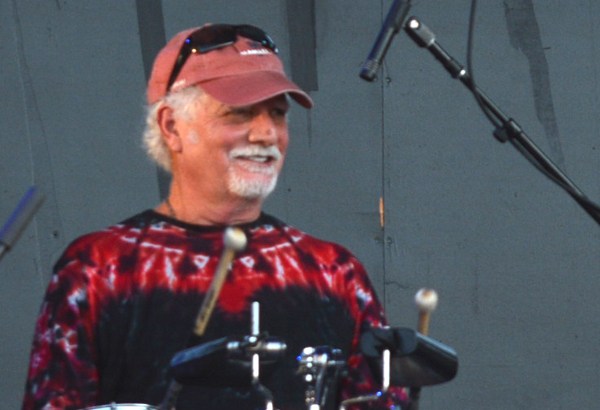

Papadosio is a rising quintet now based in Asheville, NC. The group made the festival rounds this summer from Camp Bisco through The Big Up and its own Rootwire. While the band originally performed as a four piece with Mike Healy (drums), Rob McConnell (bass, vocal), Anthony Thogmartin (guitar, vocals. keyboards) Billy Brouse (keyboards), Papadosio has since expanded with the addition of Billy’s brother Sam on keys. Another recent change has been the relocation to Asheville after emerging in Athens, OH. The group’s stated goal is “To combine eclectic musical traditions with modern Electronica to stir the heart and fuel the mind.” In this Conversation, which took place at The Big Up, the band members share some thoughts on how to achieve that intent.
Joe: Each of your albums has a specific vibe that makes it feel as if the songs were written in unison. What is your writing process and is it different for each album? Where does the inspiration for your lyrics come from? What about the album you are working on now?*
Anthony: It’s cool that you say that because we were just talking about how we feel that we write albums that are sometimes scattered when it comes to how the music goes. There’ll be a jammier track or poppier stuff. I guess Observations was in kind of a crazy time because we were experiencing a crazy updraft, much like what we’re experiencing right now. When we started touring on it, it was pretty steady, but while we were writing it, all kinds of stuff was going on. We were really busy, so we were like, “Try to record this and get it down.” It was more representative of where we were at the time than even our first album. It was like we did it, we hit it and quit it and that was the music we had.
Billy: The first one took a year and a half.
A: Yeah, the first one took a year and a half and that one took eight months to put together.
J: A lot of your new material has been tested live this summer, how are the songs going to change in studio?
Mike: Well sometimes there will be a song that we have that’s written for the album. We’ll play right through it and don’t jam out super hard on some parts, but live we’ll take a section and be like, “All right this section we’re just gonna go crazy, do whatever, improv it out,” and then we have some fun signals to get each other ready for the next part. I feel like some songs on the album, we’ll jam out on them, but sometimes we don’t do that, we’ll just do that live.
Rob: I think with making an album, after it’s done, it always goes into making the live show more concise and completes the song a little bit after going into the studio and hearing it.
A: Yeah, we record songs and after we’ve recorded them we listen to them, just our base tracks and we’re like, “What were we thinking?” We don’t feel like the song is done until we’ve laid it down in some way and been able to step outside and listen to it, or at least a live show.
M: We’ve laid stuff where we’ve listened to it later and have had to go back and do the drum take completely differently, change the part up because we need a different feel. That’s really fun too, because we do it ourselves in our own studio so we have the ability to really nitpick and go in there and do what we want and not have the constraints of having to pay by the hour at any other studio. We do it all ourselves.
J: So, did you just build this studio?
M: Yeah, we’ve kind of done that over the years, tried to throw our money back into recording and gear for ourselves. Over the years, we’ve gotten better and better stuff and learned a whole lot more about the process. This year we moved to Asheville, we rehearse outside of Asheville, and we have a cabin that we turned into a nice little studio room, control room, and a jam room, where we can talk back and forth.
How’s the new pad?
A: It’s radical! We’ve always lived with our gear though. If you wake up you might stumble over a guitar cable or a microphone, that’s just how it is.
M: There’s just cables everywhere!
J: You said there are sections where you may not know where the jam is going to go and then you come back into the song. Is there a cue or a riff or something that sends you back into it?
M: It’s different for different songs. Recently we’ve come up with a couple different gestures that we all know what mean different parts. I guess it really depends. Sometimes there is a riff that you just know how many times that riff goes through until you have to slam into the next part. Sometimes you just feel it out and just take it wherever it goes.
B: There have been some really funny signals over the years, though.
M: Yeah, there have been.
A: We tried to do hand signals, but that doesn’t really work.
B: If we’re in an improv, Sam will throw up a one or maybe fifth just to go just to chord changes.
Sam: That has proved to be really hard to do.
M: You can’t see each other in the fog.
S: Well, Rob and I will do it because it’s really important when the piano and the bass change at the same time and then these guys can play around on top of it.
R: It can get stagnant too because it’s hard to almost throw out changes, sometimes you wanna half-up the changes.
A: I think we’ll figure it out this week. Don’t you think? I feel I’m on “The Gestures of This Week.” This week’s gestures are…(makes a surprised face, all laugh)…You throw the eyebrows up and drop your jaw like you’re surprised. That means that everyone’s gonna stop what they’re doing, but not change key, we’re just gonna do something different real quick. That’s in an improv and if we’re gonna go to the next part, we’ll just do that again. So you’ll see us do that tonight for sure. But to answer your question, in the song format we try to have songs still because we watch bands sometimes and they don’t really have songs. You don’t walk away from it remembering anything. We try to do songs that have a verse and a chorus and then there’s usually a break point somewhere, maybe even after the first verse there’s a jam, but you always come back to something written because I feel like people like to relate to the music just as much as they like to have something new happen. So we’re trying to take on both and try to find a balance.
S: Especially with the new songs we’re writing in the studio, the newest new ones that we haven’t even played live yet, we’re finding it kind of challenging to find the mix because right now they’re just songs we haven’t even played them live. We’re trying to find the mix between a super concise indie rock song and a jam. It’s really confusing right now, but it’ll work out eventually.
J: Sam, you were just added on keys to the band almost a year ago. Do you find it hard to balance electronic and organic layers with five people working electronics now?
A: He is a producer though and he was a producer and he went to school for it before we added him, so it wasn’t as hard it might have sounded. Some of us produce more than others, some of us are much better just at their instrument, and some of us are not as good at their instrument, but better at composition. That’s kind of me. I produce a lot more. I feel like I’m still developing live skill and it’s cool because we make up for each other.
S: I knew my role coming into the band before we probably talked about. I’ve felt like there are times when I could shred and stuff, but that’s not what I’m in the band to do. I’m not in the band to stick out, I’m in the band to be sort of like the glue behind what was already going on and mesh it together. It is a little bit hard when there are four of us playing melodically in a jam, so you really got to know what’s going on and who is playing what. Basically a lot of listening because it is really hard to improvise with five people.
A: It’s a conversation.
S: It is a big conversation and if you don’t know your role you can’t really do it.
J: Is there a new dynamic to the band? Is there any sibling rivalry now that Sam is around?
B: No, not really at all.
A: Except for that fist fight that one time. (Laughter) I’m just making stuff up.
B: He pretty much just meshed right into the band. He had known all these guys forever.
M: He used to sit in every once in a while.
B: I grew up with the kid, he is basically my best friend in the whole world. There really has never been any sibling rivalry.
J: How many years apart are you?
B: Four.
S: And we grew up playing guitar together, then piano came later. Like I said, I knew my role coming into the band, it wasn’t like… I was ready to rock or anything.
M: It’s cool because in some older songs we had a lot of sequences or loops that we would drop and then Sam came in and he was able to play them. Then we were able to have that more live element and less of pressing play on a computer and playing along with it.
A: I think we can be concise with this one too. I think besides musicians, many people don’t know there are really two types of keyboard voicings. You have the keys, which are the Rhodes piano and the organ, which is kind of what Sam focuses on, and then there is the synthesizer where we sequence and stuff like that and that’s what Billy focuses on. So there really are two different instruments there. Two different roles.
S: I can’t really play the synthesizer very well.
M: Completely different roles.
R: It’s kind of like bass guitar and bass synth, too. I don’t play bass synth.
B: Rob refuses to play bass synth.
R: I just straight up play bass guitar. It works though because sometimes we blend together and it ends up being a really big sound. So it’s more about knowing and dealing with your role and being like, “Whoa it’s cool because I’m really good at this and he’s really good at that.”
S: I didn’t quite know that until I got in the band because they were like, “You’re a keys player, you should be playing keys,” and I was like, “Hold on I’ll try to play this synth part,” and it just got completely lost, this is not the same feel, not anything.
B: You’re also just trained for weighted keys.
S: I know how to make a piano sound how I want it to sound.
J: Who are your influences and what other jam/electronic bands do you look to for inspiration?
A: We listened to Pink Floyd the entire way here. Some Radiohead…
B: And some Arcade Fire.
M: I’ve been diggin’ em hard lately.
R: This band kicks ass live! (points to the June issue of Relix) My Morning Jacket, I’ve seen them a couple of times.
M: Nine Inch Nails, Tool, super huge influences. Aphex Twin, all sorts.
J: You guys have four sets at your festival, Rootwire, Acoustic, Electric (Day and Night), and a Live Looping PA set. Is this the first time you’re doing a looping set and how did you prepare differently?
A: Well, the first time we did the looping PA set was about 3 days ago. Basically we’re doing a set up where everyone is plugged into my computer through Ableton Live except for the live drum set, but Mike’s sample pad, which has live sounds, is all ran through. Everyone plays into the computer, but I have the ability to add effects to the whole band.
B: He’s basically DJing us.
M: He can beat repeat, add electro drums, add effects on everyone.
S: I would like to do it where one day, Anthony was out in front and we’re in a little box behind him.
R: Or we’re in little boxes or cages. Something completely stupid…I think it’s gonna be really cool though, last year at Rootwire we debuted an acoustic set, we had never done that before and totally winged that. We were just like, “All right!”
B: We tried to rehearse and lightning struck the telephone pole outside our house and took the power out for about an entire day.
M: So no rehearsal, and it went so well.
A: Acoustic renditions are some of the easiest things. I think it’s really easy to render something acoustically because all you have to do is think about it simplistically. You can’t do the same thing with an acoustic guitar as an electric guitar. There are no sustained notes. You gotta think, it’s already gonna sound different, so you don’t have to sit and think about your instrumentation.
J: And have to be treated much differently too. Mike, what were you doing for the acoustic set?
M: I pretty much do a lot more rim shot stuff and play quieter. I’ll have the full set, but I’ll probably have some bamboo sticks called hot rods, or wire brushes. I’ll also have some hand drums and shakers.
A: Well here’s the thing, the acoustic set is the last thing that happens at Rootwire. It’s the last thing that happened last year and basically all of our friends came up. Everybody was sitting down, it was magical, we couldn’t believe it. We had the whole tent set up and for some reason everyone decided to sit down. It was a long weekend, everyone was just dead and there were just hundreds and hundreds of people all sitting down, we were like, “This is just too cool.”
B: It was really cool. Everybody needed it.
A: It didn’t last long though, maybe by three songs in everyone was up and dancing again. But it was like that little section of, “Has this ever happened before?” You know what I mean? It was just magical.
S: This year is gonna be really funny because I get to play some of the songs I grew up listening to by Papadosio and I get to play some of the songs on guitar for the first time and I haven’t played in four years. (laughter)
A: Yeah, we’re bringing back some olds ones. Then we got the day and the night set back to back. The day set were trying to focus more on our prog. stuff, like our sing-songy like story-telling songs and as the night comes more of the dance oriented and psychedelic oriented music. We try to take people through the whole gamut in one night of the electric stuff we do.
R: We’re trying to do everything.
A: Also, at the same time we’re not trying to take away from the spotlight of the bands we’re trying to introduce to the people. We could easily do six electric sets during the week, but I feel like it’s almost self-serving to do that kind of thing. There’s so much music out there that people don’t know.
B: I wanna go see some music, too.
R: These are all our close friends and up and coming bands.
A: That was really the whole point of Rootwire. We could get some investment money together and get some big bands and have a guaranteed big show, but we rather try to introduce these new things.
J: With the biggest Rootwire yet, what are your expectations for this blend of music, art, and spirituality?
A: The workrite of Rootwire was to come inspire and be inspired. Once again, if you’re there and you see someone painting a portrait to a show and you haven’t done that before, or you haven’t even seen that maybe, and you see that and you’re like, “Oh, I could do that.” We have what some people may consider shamanistic healer type people; apparently there are some here [at the Big Up]. I have a Cherokee guy coming to build a bunch of teepees just like they have here. I’m really excited to see that kind of aspect come into play because, here, at a festival setting, people feel like they don’t have to be anything, they can just be themselves. So say you felt like you wanted to be part of a meditation, you can do that. You can be free of the day-to-day judgment and get into it and meet people of like-mind and talk to them about that kind of thing. That’s kind of what Rootwire does, same idea. You wanna make art? You don’t have to feel weird about it. You have an opportunity to access other people and have reciprocity with those people.
S: Also, like at Electric Forest, the forest was so sweet. It was awesome, but I feel like at Rootwire, what I would like to see happen, not to pick on Electric Forest, is instead of only being able to look, but not touch, you can just create.
M: Make a sculpture of the stuff you find in the woods. It happened last year. Way out in the very back, I hadn’t even been out there really, maybe once. I think the third day came around and the owner of place was like, “Ya’ll see all them sculptures? Them hippies all made them out in the woods.” I’m like “What you talkin’ bout, Bill?” and we went out there and they had made some crazy stacked rocks and a whole little area. Stuff like that.
A: So we have like five installation artists an installation crew coming. We have the Human Mandala Project which is really cool. One of my friends, Josh, basically climbs up scaffolding and takes pictures of people laying in these geometric forms and things like that. It’s kind of like you’re on the roller coaster and you get your picture taken. It’s progressing forward with all these new artistic outlets that I feel like if people could learn how to not repress those things we could be a healthier people and that’s what we’re trying to do.
J: So how big of a role do you play in planning Rootwire?
A: Last year it was blood, sweat, and tears. We got about five hours of sleep the whole weekend.
M: The whole week, just setting up like crazy, everything.
A: We don’t roll it on a limo and play our set. I camped in my tent, which had a puddle in it.
R: All my friends were there so I camped right in the thick of it, ya know, everyone is keeping you up. Let alone, we didn’t have a lot of volunteers last year, so I was doing the front gate after our set on Saturday.
S: I set up the giant PA.
J: Hard work pays off, right?
M: Absolutely, we figured out how to get volunteers this year, let’s put it that way.
R: It will be a little bit less work, but we’ll probably still end up having to work the gate. (laughter)
S: I’ll be there. That’s what I’m most excited about. Being there and setting it up.
R: It’s so cool to see it come up. Especially the stage.
M: We tried to start it off right last year by making a nice production level just so people can walk away with like, “Whoa, they did it really awesome the first year” and we’ll try to keep that happening every year; making it look really awesome and creating that experience that people take home with them and tell everyone about.