

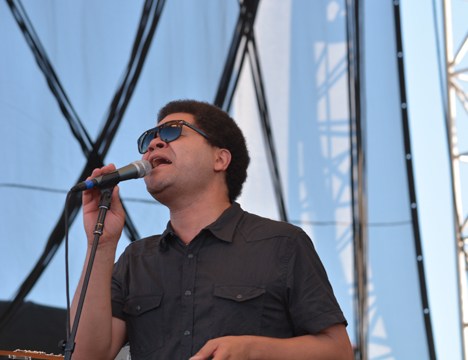
For much of his time these days, Mike Mattison is a vocalist and occasional guitarist for Tedeschi Trucks Band. The Minneapolis, Minnesota native, and Harvard grad, is also a songwriter, founding member of Scrapomatic, and solo artist in his own right. Six years following a 2014 solo debut, You Can’t Fight Love, Mattison is back with Afterglow, an album of rich Americana and blues he recorded with TTB bandmate Tyler ‘Falcon’ Greenwell and Scrapomatic collaborator Dave Yoke. Mattison had intended to support the record’s release, returning to the road in April with a classic Scrapomatic lineup that features Greenwell, Yoke, Paul Olsen, and Ted Pecchio, although the coronavirus pandemic has postponed these plans.
What led you torelease a solo album?
We’ve been working on it for over a year. It was recorded by our drummer, Tyler‘Falcon’ Greenwell, and Dave Yoke, who plays guitar with Scrapomatic. I had kind of a surplus of songs. Usually I have two different avenues I can gowith them: I can bring them to Tedeschi Trucks Band or do them withScrapomatic. Scrapomatic was kind of onhiatus; my other partner, Paul Olsen, had a bunch of stuff going on in hislife. The stack (of songs) was gettingkind of high.
High enough for analbum, obviously.
I’ve realized if I don’t record something, itdisappears. I’ve tried in the past tosave things for some future date. I’verealized that songs that don’t get recorded die where they are. I liked this stack of songs, and I noticedthere was kind of a narrative throughline, in that they are allturning-the-page-themed songs; closing the book and moving on.
I’m guessing thattheme is connected to the title.
I like the idea of afterglow; moving into a new chapter ofyour life, hopefully looking back wistfully. Not always, but that’s the hope. I thought it would make a nice album that had an interesting theme andstory.
Was there a catalyticevent that inspired the writing or just coincidental?
Both, probably. Ijust turned 50 last year, which was a wonderful thing. I had a great celebration and 50 isgreat. For me the decades have justgotten better and better because you just give less and less of a shit; whatpeople think of you; what you may or may not have accomplished. It was a great release. It’s a great place to look back and be, like,‘What was all that about?’
You’ve also had a lotof loss among your musical peers.
People just started disappearing: My bandmate, KofiBurbridge; former Derek Trucks Band drummer Rico Scott; Col. BruceHampton. Having to kind of reckon withthat, I’m lucky that it really hasn’t happened to me in a serious way, in termsof friends and colleagues, until now. There are things you can’t control and things you can, that are fadinginto a rear view mirror, and how you think about that.
You had the fortuneof getting Kofi on the record before he passed. Tell me about that.
Kofi was a prolific songwriter. He was brilliant. Everything he touched had so muchsophisticated melody. He was kind of asecret hit writer, because he didn’t write hits; he wasn’t in the hit-writingcircles. Through the years with TedeschiTrucks Band, we would collaborate. Thesong that made it on to Afterglow- “IReally Miss You”- he wrote that about 17 years ago. It didn’t really fit the Derek TrucksBand. It’s more of a CurtisMayfield-slow jam. He asked if I’d beinterested in putting lyrics and a melody to it. It’s this idea: you miss somebody and all youhave to do is pick up the phone and you don’t. That theme spoke to me. I alwayshoped we would get it on a record and we never did. So when we started Afterglow I said we really need to do this.
What was the sessionlike?
He came to Falcon’s garage and recorded it. He really gave us all a great lesson inmusicianship. We had to ask him what a diminished diminished chord was. He’s like, ‘Ugh. Idiots.’ (Laughs) It was actually quiteeducational and entertaining recording it. Looking back over his passing makes it weirdly poignant. I’m glad we got that piece of him put downpermanently.
Tell me about Falcon.
I’ve always loved Falcon, from the day I met him. I met him in 2002 or 2003. He was playing with Col. Bruce Hampton. I was living in Brooklyn. They were playing in the basement of theKnitting Factory after an Allman Brothers show. Paul and I were always looking for drummers we could play with inScrapomatic. At setbreak, I told Falconthat his drumming was devastating. Hewas like, whatever. He kind of blew meoff and walked away, which I always found humorous.
And now, almost twodecades later, he’s producing your album.
Having played with him in Scrapomatic, and then in TedeschiTrucks Band, I’ve seen that he’s one of these guys that’s so brilliantmusically. Not necessarily from atechnical point of view, but just his intuition. It’s so advanced. He’s a really fully formed musician. It’s fun to collaborate with him. There’s a very fertile imaginationthere. He’s a really talented engineerand producer. He’s a dynamo. We had a really good time.
What is there in asong that tells you where it should go? To TTB, or Scrapomatic, or as a solo entry?
It’s more intuitive than anything. I just kind of know what’s for me. And even though the people in TTB andScrapomatic are my dear friends, it’s always weird presenting material topeople. It’s a really vulnerablething. You’ve dug deep, you’ve broughteverything to bear, you’ve put yourself out there, and sometimes people arelike, eh, whatever. They don’t mean tobe rude, but sometimes it doesn’t hook people. These (on Afterglow) are onesthat didn’t find a home in either band, but ones I was adamant that there’ssomething there. There’s a reason whythey were written.
Do you start with anintended landing spot- as in, writing specifically for TTB- or just see wherethe song takes you?
I kind of wait and see where it ends up. I can kind of tell, when a song is starting,where I might bring it first. WithScrapomatic I’ve known Paul for something like 25 years. We really share a musical sensibility. With Paul I don’t need to explainthings. We share this dark, Midwesternhumor. I also know with Tedeschi Trucks,they’re a little more austere, for lack of a better word. Their music is more triumphal. Muscular. The more personal stuff is what ends up on my records.
Do you ever make noteof how an audience reacts to a TTB song and allow that to influence how youwrite?
It’s usually flattering if they like it. I try not to write towards what an audiencemight want. I think the fun andexcitement and beauty of songwriting is that you’re explaining something toyourself by creating it. If you canre-create that in an audience or an individual, that’s the gift of it. If you start following an audience orreactions or applause I’ve always found that you’re pretty screwed. It’s a little scarier, a little lonelier, togo with your gut feeling but in the end, when it works, it really makes it worthwhile.
What did you takefrom the experience of your debut album, YouCan’t Fight Love, that informed this album?
Those (songs on YouCan’t Fight Love) were even more misfits. I had such a good feeling about those songs, but they weren’t superrelated. With Derek Trucks Band and TTB,there is some multi-faceted stuff to what I do, but really it’s one kind ofthing- a blues, shouting thing- which is fun and a great ride that I reallyenjoy. But I also do other things. The first record was really eclectic- somepeople think it was to a fault. Idon’t. Because it’s me. (Laughs) This time I tried to focus a little more. I’m trying to think of other people’sfeelings, for once. (Laughs)
I feel like listeningto your album evokes a walk, at times, through the last 50 years of Minnesotamusic: from Bob Dylan to Prince to The Replacements to Husker Du? Is that fair to say?
Oh, yeah. Absolutely. Those artists youmentioned really informed who I was, especially when I was younger. As a teenager, we’d go out and listen to TheReplacements. When I was in high school,that’s right when Prince really hit it big. Husker Du. Dylan. Soul Asylum. It was an interesting time to be young and musical. Weirdly the focus of American pop culture wason our strange little Midwestern town. It was the oddest place to be.
Sometimes the most creativethings happen where and when it’s unexpected.
There’s not a lot to do in Minnesota. Up until 25 years ago, it was a prettyprovincial place. I’ll probably getyelled at for saying that, but it’s the truth. And yet it allowed for an environment where these very unique thingsarrived and affected pop culture in America. It was really exhilarating. Istill stand by all of those bands.
What’s your expectationfor your return on this investment of a solo album?
Good question. Thereason I do it, the impulse, is to maintain a rich creative life. You have to feed the creativity to getsomething out of it. I’m alwaysworking. I’m always writing. It’s something I’ll always do. It’s fun to put it out in the world and seewhat people think. I can’t imagine itwill make a ton of impact, but you never know who is listening. And, I think it’s good for my spiritualself. You have to peel off from the commerceof it. You have to find value in it thatcan’t be indicated by income.
Aside from yourcontinuing work with TTB, what are you thinking about next?
If this pandemic will let us, I look forward to bringing some ofthese songs out on the road, playing them live. There’s a song on the album- “Charlie Idaho Shot the Mercy Man”- about alevee camp boss who murders a ‘Mercy Man’ sent by the government, that has ledto all these other songs; about 15 songs for another album, based on aMississippi River theme. We’re alreadymoving on to the next thing.
Soundslike 50 is the new 25.
For me. Not foreveryone. (Laughs)





