

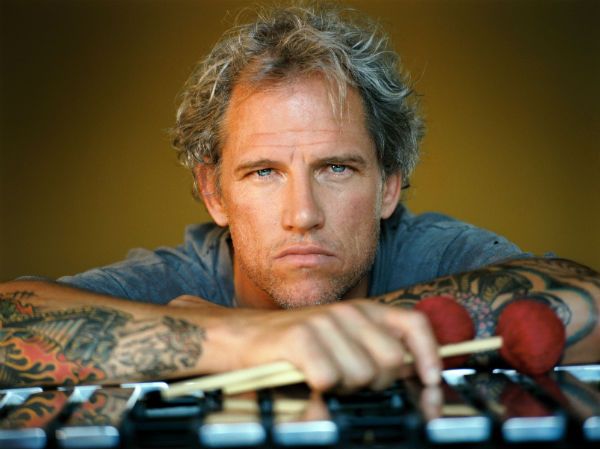
MikeDillon may not be from New Orleans originally, but he loves it like home. Afterfirst experiencing Jazz Fest in 1999, the percussionist was hooked and eventuallymoved from Texas to the Big Easy and hasn’tlooked back. During the recent 50-year celebration of the New Orleans Jazz& Heritage Festival, Dillon played in over 30 shows throughout the two-weekcelebration.
Whilehe may be best known for his eclectic, energetic and enigmatic work with hisown solo bands and supergroups like Garage A Trois and Nolatet, Dillon has alsobacked up the likes of Ani DiFranco and is currently in the midst of a springand summer of touring with singer-songwriter Rickie Lee Jones. Just beforeheading to Japan for a run of shows with Jones, Dillon recaps his impossiblybusy Jazz Fest, talks about his musical history with fellow weirdo LesClaypool, expresses his love for the unique qualities of New Orleans, explainswhy he’s all about “playing for the music” nomatter who you’re with and hints at what sort of music he has in store for theworld later this year and next (including some more Elliott Smith marimbacovers).
Youjust got done with a very busy Jazz Fest with a ton of shows. Do you rememberhow many?
YeahI started in on the Tuesday before Jazz Fest and my lastJazz Fest gig was this past Monday, and counting sit ins with Claypool Lennon[Delirium] and String Cheese and one with Anders [Osborne], I did 31 alltogether. And one of those was the Megalomaniacs Ball, three complete setswhere I was involved with each set. So a lot of music, but it’s always fun
There’ssome point, where you think, “Oh my god, why did I take this many gigs?” This last weekend was really crazy, like four a day. Like[Les Claypool’s] Bastard Jazz started a three in the morning, played untilfour-thirty, got out of the venue, got to sleep at six, woke up at noon andwent right to the Fairgrounds to play with Galactic. That’s the way it’s alwaysbeen. The energy comes from the fans, and everyone in the city is so alive andexcited about the music. The first time I’d seen Jazz Fest was 20 years ago1999. I sat in with Galactic at House of Blues, then Stanton and I went to see Zig [Modeliste] play down the street. AndI was hooked. Then the next year it was like three gigs and then after that itwas more.
Didyou even get a chance to rest or eat with all those shows?
Idid eat. I actually even got some jogs in in the morning. I have to train formy touring and my gig schedule. I can’t party too much; it’s a full commitment.
Anyspecific highlights from the 31 shows?
Well,I do so many different kinds of music, from the more creative, jazzy things wedo at the SideBar with James Singleton and Steven Bernstein. That’s like our version of The Stone, or what Tonic usedto be in New York City. So it’s a lot of improvising. And when I say improvise,I mean we have no roles, and we’re not doing a set of specific songs to getthrough the night. We start playing and see where it goes and there’s the magicthere. So pretty much all those nights were incredible. And then on the firstFriday, my percussion ensemble played the Music Box Village with Martín Pernafrom Antibalas, and we had a wonderful collaboration that was amazing. Such aspecial, unique musicalart installation. Then as far as my band, we had anamazing set at Crawfish Fest Tuesday.
Justso much. And every one of them, literally every little thing, even myone-minute sit in with Anders Osborne, playing congas, was just amazing.And I know that sounds maybe cliché or something, but that really is the powerof music. Everyone’s so pumped and excited. I played with Cha Wa and Galacticout on the Fairgrounds, and both those sets were incredible. And the Bastard Jazz thing, there was a lot of hype and excitement aboutthat gig, and that was my only gig with Skerik the whole Jazz Fest. I play withStanton all the time, and there is that history with Skerik and with Les ofcourse. When we get on stage together and we just start playing it’s like, “Wow.”I mean, rehearsal that day was even amazing, and we played for 45 minutes—songswere being composed on the spot. And then Steven Bernstein was in town withLittle Feat. I’ve always been such a fan, whether its Sex Mob or anything he’sdone with Henry Butler or going back to The Lounge Lizards. So to get to closeit off with him was a great way to go out. And then there’s Frasco! I mean Isat in with Frasco and literally staged dived during his set, which I used todo that in the ‘90s with my old funk-punk band all the time, but the spiritjust grabbed me, and next thing you know I’m stage diving andhitting my head on a monitor, like, “Wait, I’m not 23, I’m 53!” But that’s thepower of music; it just grabs you. Whether it’s making you stage dive, or agroup improvising and playing some amazing music that you’ve never done before,that’s what we’re all looking for, the fans and the musicians.
Couldyou talk about your musical relationship with Les Claypool?
Well,I first started playing with Les back in 2002, and I did all his solo bandswith the exception of Bucket of Bernie Brains, so I did a lot of touring withhim for like 10 years. This was like our third Bastard Jazz gig where. He just feltlike he wanted to get together with a group of players he really likes playingwith, to improvise and see what happens. Some nights he might quote a Primustune or we’ll go into “Dee’s Diner,”and I think he quoted a part of a Claypool Lennon Delirium song the other night when Sean [Lennon] sat in with us. It’svery free and very open. You play so many gigs together, there’s a languagethat you develop over the years. It really is that cliché of just getting on abike again. It always feels good. There are those times when you get togetherwith people and you play and there’s no magic left, but I’m grateful that itstill feels magical when I play with those guys. They’re all such greatplayers. Stanton and I live here in New Orleans, so it’s easy to go play a gig—Isit in with Galactic all the time, so he and I have developed a language.
Thiswas our first Bastard Jazz gig with Stanton on the drums, and I think it wasthe first official gig that Stanton played with Les. And Stanton’sconcept of funk is coming more from The Meters and the Mardi Gras Indiantraditions, and of course he’s a student of James Brown and all the other greatFunkateers.Stanton is a student and he studies all the music diligently. And Les is like aWest Coast, Tower of Power kind of guy—super tight funk.But I thought it really worked together. They were dynamite, so it was easy toplay over them. The thing about playing with Les and Stanton, they know how tobuild a solo and make you sound amazing. That’s what a great rhythm sectiondoes, and that’s why great a rhythm sections are sough out. Otherwise, everyonewould just get a drum machine. Even like bands like Pretty Lights hiring Adam Deitch, because he’s such a bad motherfucker you know? I mean, thedrum goes back to Africa, India—it goes back.And that’s what moves us all… I’m rambling now.
Didyou get to see any Jazz Fest music that you weren’t playing in?
Well,I watched a bit of the Claypool Lennon Delirium while I was sitting to wait forsoundcheck, and they sounded amazing. I saw some of Corey Henry when I waswaiting to play—not the Snarky Puppy Cory, but the New Orleans Corey. A littlebit of Tank and the Bangas when I got to Jazz Fest—they played right beforeGalactic, and they sounded amazing. I did see some improvised stuff that wasreally good. I heard a bit of Jeff Coffin and Helen Gillet; that was reallygood. I do try to watch other bands play to get out of myself and get inspired,but the short answer is that this year I did so many gigs and didn’t get to seeenough other bands play. I was playing on Karl Denson’s Aretha Franklintribute, playing congas and percussion, and it was like having the best seat inthe house. Same thing with Galactic, they were playing their new music at Tip’sand they had that artist Boyfriend come up and sit in with them. And it wasreally my first time seeing Boyfriend. I’ve known about her, living in NewOrleans, and she’s freaking awesome. And then I hadn’t seen String Cheese inages, and my buddy Jason Hann had me come up and sit in with those guys. Especiallywhen you’re waiting to sit in and you have the in-ears, if you take a second asa musician to listen to what every band is doing, you can go, “Oh wow, I neverthought of it that way.” Whether it’s life or music, we all get into our tunnelvision, you know, and that’s what someone like Trump counts on.
Lastnight I saw this amazing poet named Kalamu ya Salaam speak right before Iplayed this gig. He’s an activist, probably in his sixties, and he was reallycalling us out to think about what we’re doing. Like are we really doingsomething new or are we just regurgitating? Are we being ourselves or are webeing what we’re taught to be? All that stuff was in his poetry, and it wasreally cool to hear an elder like that make me sit there and think about it,like, “Yeah, what am I doing here? Am I really trying to get to know myself andto dig deeper as a musician, as an artist?” And I think when you’re diggingdeeper and trying to be a better musician, sometimes you have these blinders onand you’re just digging deeper. You don’t take time to check out what everyoneelse around you is doing. I’m always listening to music in my van, and [NewOrleans radio station] WWOZ is amazing. I was listening last night and I heardthis old blues track with this killer vibraphonist. There’s so much music outthere to check out, it’s never freaking ending.
Iwent to Festival International and played, that’s this festival that they do inLafayette where they have all these amazing bands from all over the world, andright before we played there was this amazing Morrocan band. Two years in a rowI’ve seen these amazing Morrocan, Northern African bands, almost likeTinariwen, along those lines. I didn’t get the name of them; I just sat therewith my jaw on the ground.
Youlive in New Orleans now, but you came from Texas originally. When did you move?
August29th, 2006, is when I moved my stuff here, but starting right around Jazz Fest 2006, after Katrina I was sort of couch-surfing atStanton’s house. Then I was leaving Texas and wanted to move to New York, andthen all of a sudden I got offered a place in New Orleans and that’s when Imoved here. I was playing with Johnny V[idacovich] and George Porter and folkslike that. I got offered a cheap apartment, so I decided I was gonna go do theNew Orleans thing and become immersed in the culture here. My music is weirdwith the Mike Dillon Band, but it’s all firmly based in rhythmic music, whetherit’s salsa or cumbia or the music of Fela [Kuti] or good ol’ funk. And forgroove music, there’s no better place to be than New Orleans.
Hadyou had much experience with New Orleans before that first Jazz Fest in ’99?
Myold band Billy Goat that used to play Wetlands in New York, we toured nonstopin the ‘90s and we would play Baton Rouge and New Orleans; that would be aweekend trip from Texas, because that was when I was in Dallas. So, we hadamazing shows starting in 1990. Baton Rouge would always be sold out, packed,everyone going crazy. And we would come over and play the old Howlin’ Wolf orthe old Jimmy’s and have really good shows in New Orleans, but for me at thetime it seemed like our shows in Baton Rouge were always more well received.But I was still intrigued by New Orleans. I read a lot about it. Confederacyof Dunces is still one of my favorite books. New Orleans is just magical.Baton Rouge, Lafayette, all this part of southern Louisiana—there’s just amagical thing, and I learned real quick that people love music. Back in theearly ‘90s, people were like, “Aw man, you gotta go to Jazz Fest sometime andcheck it out.” So that’s how you get an itch. And I remember a promoter sayingto me, “You gotta see this drummer Johnny Vidacovich play.” So I was hearingabout Johnny and then I was starting to get into jazz again.
Imoved up to Kansas City in the mid-‘90s and based our band there, because itwas essential to touring. It was great—you could be in Chicago in three hoursor be in Ohio in eight hours and over in New York or to Denver in eight hours.Johnny V and James Singleton’s Astral Project came up to play the Kansas CityBlues and Jazz Festival, and I remember thinking, “Wow, I want to play withthose guys someday.” And then that second Jazz Fest I came, to I rememberseeing James Singleton walking around Jazz Fest with his bass and, you know,his really colorful pants and crazy ties—he always dressed very eccentric. Iwould go see him play and I was always just like,”God, I love this guy.” Theneventually our paths crossed and we started playing. Five of my gigs at JazzFest were with him, and I had one with Johnny V this year. On Tuesday nightafter Jazz Fest, which is still sort of Jazz Fest, I saw Johnny play a duetwith this guitar player I think he’s from Tangier or somewhere in NorthernAfrica—Morocco maybe. He was incredible. New Orleans is great.
I’vealso been working with Rickie Lee Jones for the past three years—greatsinger-songwriter, and she lives in New Orleans now. She’s from LA, but she’slived all over. In the late ‘70s her first record broke big with that song “ChuckE.’s in Love,” and she and Tom Waits were dating back then and writing songstogether. She’s got an amazing voice. Just the other day, we were at a gig andshe was singing on her and Dr. John’s song, “Makin’ Whoopee.” We did her new record back in the falllast year, October/November, and it’s coming out June 1. I’m getting ready togo to Japan with her, then we’re gonna tour all summer, going to Europe andplaying festivals there.
Youknow, she talks about it on stage: It’s walking down the street seeing kidswith horns and tubas. I don’t know anywhere else in America that’s like this.And the whole Mardi Gras Indian thing is a whole other depth of music. As apercussionist, it really has started to make me appreciate Mardi Gras and thattradition. Because for years, I would just get out of town during Mardi Gras.Just a bunch of drunk tourists coming in to toss beads and see tits orwhatever. Then one day, Stanton took me over to Big Chief MonkBoudreaux’s house, and we walked behind him, and there’s just that onetambourine rhythm that everyone plays. There’s an encyclopedia of drummingparts—everything from Earl Palmer to even John Bonham or Elvin Jones, toZigaboo, to Stanton and on and on—that people have taken from that rhythm,knowing or not knowing. I love it.
You’vebeen sober now for a while. Living in a city like New Orleans, especiallyduring a time like Jazz Fest and Mardi Gras, does that come into play? Do youstill think about it?
Ithink about it when it’s over. It’s like, “Oh, sure would be nice to getloaded.” I haven’t gotten loaded in years, you know. And my version of gettingloaded is different than most people’s versions of getting loaded. Anyway, I’mjust glad haven’t had a heroin habit 19 years; I’m really thankful for that.But, you know, it’s always there. With the opioid epidemic that’s going onright now, it calls your name. But I’m scared shitless of opioids. All the stuffthey’re putting in it, and all the people we’ve lost, young kids… I just feellucky that I got out alive. I used to think I was some sort of magician thatoutsmarted heroin but, as I’ve gotten older, I’m like, “No, you just got luckythat you didn’t overdose and it’s that simple.”
Asyou’ve said, you play a lot of different types of shows and music. What sortsof different things do you personally get out of playing a show with your ownband versus sitting in with an experimental group versus backing up someonelike Rickie Lee Jones?
It’scool you bring that question up. I try to be a really well-rounded, diverse musician. If one person comes to see me with the Mike Dillon Band,where I’m fucking freaking out, screaming and playing really aggressive andhard, and they like that side of me, then they come and see me play with RickieLee Jones, or play a beautiful ballad with James Singleton, they might beconfused and go, “I don’t know; I don’t like that music.” When I was touringwith Ani DiFranco, someone told us, “Oh, Mike looked bored.” But of course Iwasn’t. If I played with Ani the way I played Les, she would’ve fired me afterthe first gig.
You’vegotta play for the music, you know? And that’s what I love. When I play with myband, I get to do my songs, and do my stupid sense of humor andamuse myself. And that’s why I do it. I don’t make any money doing my band it’sa break-even [situation]. I pay my guys and we pay the hotels, but I get thatspiritual satisfaction of making my records and becoming a bettermusician at my music. And trying make a better record as acomposer. Whether Mike Dillon Band or Nolatet, I write for thosebands, so I get the thrill of hearing a band play something I came up with inmy bedroom. It’s fucking awesome. There’s no feeling like that; money can’t buythat feeling.
Andthen, when I go out and play with someone amazing like Rickie Lee Jones andlook out to see someone from her generation that likes her music, I know I’mpart of something bigger. I’ve sat in the studio [with her]—I got aco-production credit on her new record—just hearing take after take after takeof amazing vocals, something that I could never ever do because I’m not a goodsinger. Like, there are good singers and then there are great singers—and thenthere are shitty punk-rock singers like me who just scream then go, “Yeah,alright, sounds good!” But to be a part of an amazing human voice isincredible. So I look forward to the challenge of adjusting to that.
Atthe same time, it’s all sort of the same. When I started to play with RickieLee, right away we had a connection on the time. That's what I tell mystudents: Everyone wants to play with this drummer or that drummer because theylike their time filled. You can play all the great licks and all the fills andfancy stuff you want, but at the core of it, people want to play with peoplethey like sharing a sense of time with. The sonic space, that’s what you’resharing. So, with Rickie, I love sharing a sonic space. With Claypool, thesecond we start playing together, we liked sharing each other's sonictime-space, and we communicate on that level. So in some ways, it’s all thesame. You’re still speaking the language of music; it’s just little subtlenuances. I play a lot of shakers and hand percussion with Rickie, which I don’tdo in any other gig. She’s playing guitar and singing, and I just get toimprovise and color it every night—like it’s a beautiful flower. And with Les,you know, he’s fucking playing beautiful, intense, badass, improvised,in-your-face funk bass. And I get to go, “OK, how can I make this stupidinstrument I’m playing sound cool with that cool instrument.” And then somehow you find a voice. That’s what I like. Ilike the challenge. Another long answer. [Laughs.]
Withyour upcoming plans with Rickie Lee, do you have any time the rest of this yearto work on your own stuff?
Wellyou know I had my last record, Bonobo Bonobo,come out. Inaddition to that band, I have my amazing percussion ensemble, and I have a newrecord in the can that’s all percussion music. The last one I did, FunctioningBroke, had a bunch of Elliott Smith songs and a Neil Young song on it,marimba versions of songs I love. So I got another one of those coming out thatI’m going to release probably at the top of next year. In August and September,in between tours with Rickie Lee, I’m picking up a few more weekends to get outand maybe try to hit a festival or two. I had to turn down a couple thissummer, because we’ll be playing festivals in Europe with Rickie. This is thefirst summer I haven’t at least done one of either Summer Camp or moe.down orsomething. The guys in moe. called me and asked me to do moe.down this year,but I’m doing Glastonbury with Rickie so I had to pass on it. But it’s like, “Ughh!”
That’sa pretty good excuse though.
I’vegot a good excuse! I’m going to be in Europe, and I’ve done a lot of jam bandfestivals—which are fucking awesome, man. I mean, the jamband fans are the mostsupportive, and they’re pretty open-minded. Some of these kids love everythingfrom Phish to Eric Dolphy to punk rock. I’ve said it before: Sometimes I thinkthe fans are more open-minded than us musicians. Especially the older you get,you start turning into an old crab like, “Ehhhh, I don’t like that. I don’tlike what the kids are doing.”
Wellit seems like you’re not doing too much of that yourself.
No no.I got a cousin who’s a producer, this guy named John Hill. He produced [andco-wrote] that last big Portugal. The Man song, [“Feel It Still,”] and right now he’s in the studio withTank and the Bangas in New Orleans. And he always sends me music to check out. Like,before Tame Impala broke big, he’s like, “Here, check this out!” So I’mglad I have people sending music my way to check out. My other buddy, MattChamberlain, the Critters Buggindrummer… That’s a band I miss. I’ve gotta sayI miss Critters Buggin. It was an amazing collection of oddballs that madeweird music, and now everyone’s too busy to play music together. It’s totallystupid. But at the end of the day, Matt and I still talk about new music. Hesent me some crazy shit to check out at three in the morning last night. Myfavorite musicians are always out there looking for new music.
Speakingof jamband festivals, the Jam Cruise lineup recently dropped, and both Garage ATrois and Les Claypool’s Bastard Jazz are included for 2020.
Thatversion of Garage A Trois is without me. That’s like the OG. They did Stanton’s[1998] record, All Kooked Out!, which was basically Garage A Trois, thenthey had some outtakes that they called the Mysteryfunk record, and thatwas Garage A Trois’ first EP. And it wasn’t until the first full-length GarageA Trois record that they got me on board. But they did a couple of tours withoutme. I think it just worked best for them as a trio not to have that loud,obnoxious percussionist around, you know? Stanton called me up and was like, “Isit cool?” I was like, “Hell yeah it’s cool.” I was on tour with Primus whenthey started doing that again, and from what I hear they’re having a greattime. I’m going to be on the boat with Bastard Jazz, so I’m glad I’m going tobe able to check out OG Garage A Trois. And I really can’t believe that CharlieHunter—talk about crusty, crabby musicians—agreed to get on a boat. He used tosay, “I’ll never get on Jam Cruise unless they promise me world peace.” So Iguess he knows something that’s coming. Maybe world peace is on its way [laughs].And I say that with a wink, Charlie!
Youmentioned the Elliott Smith covers that you’ve done. I’m curious about yourinterest in him as a songwriter.
Yeah,and on my next one coming out, I did “Can’t Make a Sound” and “Talking to Mary,”plus Johnny Cash’s version of “Hurt” by Trent Reznor. I just read the MilesDavis autobiography, and he was such an expressive player. And I love learningstandards, but to become a better, more lyrical player, I wanted to play modernsongs that mean something to me. And I don’t know, maybe it’s because I’vebattled depression or whatever, but I relate to a lot of what Elliott Smithsaid in his lyrics. And one day I just learned one of his songs, and I waslike, “Wow, this sounds really cool.” Then I played it and people thought itwas nice. So the whole Elliott Smith on the vibraphone thing was kind of ahappy accident. And that first record, Functioning Broke, I was justgoing to the studio to record for me. Carly and Adam had just left the band togo do their own thing, and I was pretty depressed about everything—the implosionof that version of the band. So I just started recording, and the engineer,Rick Nelson, was like, “Dude, this is really good. Let’s do a record.” So Ikept working on it and people liked it. There was some review that said, “Checkthis record out. It’s vibraphone covers of Elliott Smith songs.” On thesurface, it might sound cheesy and corny, but what I like and what some of thereviewers seemed to get right was, “Oh if you play an Elliott Smith songinstrumentally, you don’t hear [the lyrics].” And maybe you don’t want to hearall the existential angst and anxiety of those lyrics. And those songs becamekind of like little nursery rhymes. They had that quality to them. And thenplaying all the different instruments—bass marimba, xylophone, timpani—and justlayering it and keeping it in the percussion family. That was a big part of theconcept for that record.
I’vegot this new song that I did with Eddie Roberts on Color Red, “TikiBirdwhistle.” It’s taking that concept of Martin Denny and Les Baxter, whatthose guys were doing, playing happy music with vibraphone and marimba, tryingto do something new with it. There’s so much stuff to be inspired by. And ofcourse, because I’m not any good at actually doing something 100%, I can’t eversound like a song when I cover it. To quote Claypool, it sounds like a bastard.But I think that’s the way covers should be. They should always sounddifferent. What’s the point of trying to sound like Led Zeppelin? That’sanother reason I love playing with Rickie Lee. Her version of “Rebel Rebel,” itgot back to her that it was David Bowie’s favorite of any cover. I learned thatright away, playing with her. We were doing “Sympathy for the Devil,” and I waslike, “Ooh, I got bongos. I can play the bongo part.” And she just looked at mein front of a packed house was was like, “No. Do something different.” I waslike, “Awesome!” So I started playing fucked-up shakers.





