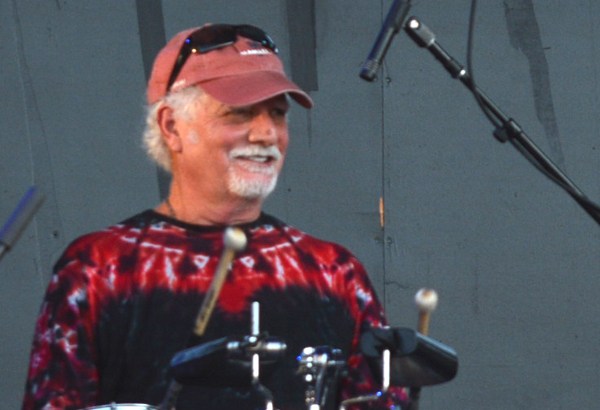

While Mark Karan has played with many artists over the course of his career, he first became known to Jambands.com readers through his work with The Other Ones and then RatDog. He’s also loaned his musical skills to a diverse host of performers, including Huey Lewis, Dave Mason, Delaney Bramlett and Jesse Colin Young. He is a cancer survivor, a road warrior and an inventive guitarist whose style ranges from R&B, blues and pop to psychedelic and beyond.
How are you doing these days?
I’m feeling good man.
You live in Marin County. Is that where you grew up?
We lived in a few different places when I was growing up, so it kind of depends on what period of my life we’re talking about. Technically, I was born in Los Angeles, though I only lived there for three months after my birth. We moved around a bit. But if I had to say I grew up somewhere, I would say San Francisco.
How’d you first get into music?
Well I’ve always loved music. My dad was a jazz trumpet player and we always had music around the house. I couldn’t really imagine a life without it. I played folk guitar as a kid and I listened to all kinds of stuff on the radio, including groups like The Ronettes, The Shirelles and The Chiffons. I loved the popular music of the early ’60s. But when I saw the Beatles on the Ed Sullivan Show for the first time I had a flash. I was like, “Yeah, I’ll be doing that all my life.” (laughs)
At what age did you first pick up the guitar?
When I was about 9.
What kind of guitar did you have?
It was a horrible guitar called an Orpheus (laughs). My parents bought it for me. Of course they had no idea it was horrible, they just wanted to buy me a guitar. They found out later that it wasn’t that their kid was whining and didn’t want to practice. My guitar teacher tried to play the guitar and was like, “Uh, we’re gonna have to do something about this.” (laughs).
You’ve been playing a bit with Melvin Seals and the band Terrapin Flyer recently. How has that been going?
It’s going pretty good. We usually go out for about three to five days at a time. Most of the gigs are around the Midwest. It’s a Dead cover band based out of the Chicago area. One of the guys in the band, Doug Hagman, originally reached out to Melvin several years ago and brought him in. And then about two or three years ago Doug asked me to join them. We tend to lean towards JGB material because Melvin knows more of that. It’s definitely fun to get out and honor my connection to the Dead with these guys and I love any project that allows me to play with Melvin.
In terms of Dead covers, I’ve heard you remark that “All roads lead to ‘The Other One.’” Was that a joke?
It was a joke in a way, but also not. Something about the African-based cadence of that jam and the open musical architecture of it makes it so that any groove that you’re having could wind up going there. It doesn’t matter what key either. It doesn’t have to be in E. I’m specifically referring to the jam part of the “The Other One.”
What other Grateful Dead songs really resonate with you?
I have about two dozen Dead-related songs that I really like to cover. But just off the top of my head, a few songs that I feel a strong connection to include “Deal,” “Easy Wind,” which I liked enough to include on my last album, “Friend of the Devil,” which I really enjoy singing, “Death Don’t Have no Mercy,” “Turn on Your Lovelight,” “Tennessee Jed,” “Loser,” “Ship of Fools,” “Sugaree,” and “New Speedway Boogie,” of which I do an interpretation.
What is it about those songs that draws you to them?
It’s usually that the chord progression, the melody and the lyrics move me. A good song will capture my attention. Something where the progression provides a font of ideas for my guitar playing and the singing is in my wheel house. For me, that applies to music by any one. If I like a song and I can connect to it, I’ll do it, whether it’s by the Grateful Dead, Joe Jackson, Peter Tosh or whoever.
Do you ever feel limited by your association with the music of the Grateful Dead?
I believe in making art that is unique, and I definitely don’t like to be pigeon-holed or typecast as someone who plays just one kind of music. I like a lot of different kinds of music. When I first started playing with The Other Ones, I actually hadn’t played a bunch of Dead music since I was a kid and was learning to play with friends who were Deadheads. I’m never gonna be the kind of guy that is 100 percent satisfied playing someone else’s sound book and mimicking someone else’s musical style, but I love the Dead’s material. I find it especially fulfilling to play Dead music when I’m playing with members of the Dead, because they are the guys who created it and it’s fun to be a part of developing their sound. I’m thrilled that I have a connection to that world. My years with RatDog were fantastic. More recently I have loved playing with Phil (Lesh). We’ve been playing a fair amount together since he opened Terrapin.
Indeed, you’ve been playing at Terrapin Crossroads in San Rafael and the Sweetwater in Mill Valley quite a bit. Can you share some thoughts about those venues?
I think both Phil and Bob both did a great job with their venues. And since they have opened their places, a few other live music spots have cropped up in Marin County as a result. They’ve really done a good thing for the local music scene. They both put a lot of time and energy creating cool places with a good vibe and good sound systems. They’re just really fun places to play. I enjoy the Grate Room at Terrapin quite a bit. Phil completely re-did the sound there and made it into one of the best sounding rooms in which I’ve ever had the pleasure of playing. And of course the Sweetwater is a blast too and has its own special vibe.
Are you still playing with The Ghosts of Electricity?
Yeah, it’s a Dylan cover band that I do with Stu Allen, Robyn Sylvester, Pat Nevins, Greg Anton and Mookie Segal. It’s always a blast to play with those guys and dive into the Dylan songbook.
How many guitars are you holding these days? Any cool new additions to your collection?
It’s been a while since I counted. I’ve got about 20 or 30. I’ve let a couple go over the years. I have a bunch of older American made instruments. I like the way they look, feel and sound. I don’t so much have top of the line collectible guitars, but more what are referred to as “player guitars.” I do have some nice older ones, but I’m not a collector per se. I buy stuff that’s been refinished and re-fretted as well as heartbreaks that have been repaired and thus aren’t technically something collectors might want. My guitars are beat up because they’ve been loved. I got a cool Kay guitar (1960 Barney Kessel “pro” model) a few years ago that was a fun addition.
Can you tell me a little about the envelope filter guitar pedal that you helped create a few years back?
Sure, my friend Theo Hartman’s company (Hartman Electronics) makes the pedal. It was a really cool project that we got together on. Filter pedals held a real appeal to me. I thought the envelope filter was a great pedal to work on as the market isn’t completely crowded with them. I’ve always really dug certain things about certain pedals and envelope filters have always had a few drawbacks. So, we took a couple of features from the Electro-Harmonix Qtron that were different from the original Mutron, which was what Jerry used, and we to took the basic circuit of the original Mutron and put some of the feature sets from the Qtron on it and modded some of those feature sets to be more functional for me. For example the filters usually open up or down on the old Mutron. There’s a switch, and you have to learn over and redo the controls depending on which position the switch is in. One of the cool things about this pedal is that we put the switch for up or down on a foot switch, so you don’t have to reach down and flip the switch on the pedal, and we designed the controls such that they change direction if it’s opening or closing. They work for either position. So you don’t have to reach down an change all the settings — which is unusual.
Where can these pedals be purchased?
Hartman sells them online at www.hartmanpedals.com and they can be bought through my website, www.markkaran.com. I offer a special deal for people who buy through my site.
You’ve had the opportunity to play with some of the absolute greats, including Pinetop Perkins, Dickey Betts and Warren Haynes. Are there any specific artists that really blew you away when you played with them?
Well, all of those opportunities were blessings frankly. The fact that I played with Delaney (Bramlett) was huge for me. I was a monstrous Delaney and Bonnie fan growing up. Not to compare myself, but the people who were in that guitar chair before me included Duane Allman, Eric Clapton, Jimi Hendrix, Dave Mason and George Harrison, to name just a few. Delaney had some pretty good guitar players in that band (laughs), so I was flattered that he included me. And you mentioned Pinetop. I was on stage with Pinetop Perkins at the Great American Music Hall in 2010 with Willie “Big Eyes” Smith and Hubert Sumlin [from Howlin’ Wolf’s band]. These were three of the greatest bluesman in history. I got to share a stage with them and I got to sing “Wang Dang Doodle” with them. And a year later they were all dead. I feel so blessed to have met them and privileged to have actually played music with them. That was a huge standout for me. And obviously first meeting the guys from the Dead was a thrill for me. Getting to play with them on and off for the past 14 or 15 years has been a joy. Some of the people who have sat in with RatDog over the years have been amazing. You mentioned Dickey Betts, that was awesome. And Warren (Haynes) and I did some serious playing together during our RatDog and Gov’t Mule run. We became appreciative and respectful of each other’s playing. I’ve gotten to do a lot of stuff. Dave Mason was one of my childhood heroes. Touring with him was incredible. I’ve been really blessed in that way. I’ve played with a lot of people who mean a lot to me.
You have had some profound, and what might appear to be almost life-changing, moments on stage. What do you take away from that? Has it changed you?
It would be hard not to change you. Like a lot of people in the world, I have had some personal bugaboos in my life, including self-esteem issues, and other stuff that I have struggled with. Having given my entire life, from the age of about 10, to pursuing music and then, in my 40s, stepping into The Other Ones and RatDog — that was an incredibly validating experience. I had gotten to a point in my life where I was like, “Well I’ll always play music and this is a lot of fun but it’s time to let go of my dream of becoming a rock star.” And then all of a sudden the guys from the Grateful Dead said come play with us and I was like,“Uh maybe it’s not so much time to let go of that dream.” (laughs). These experiences give me a lot of hope and faith in life.
Do you have a life philosophy?
Do you have a few hours (laughs)?! For the last eight or nine years I’ve been focused on spirit and energy, work and personal growth. Of course my bout with (oral) cancer ramped that up and gave me some pretty amazing insights. And truth be told RatDog going away did the same thing. Also, a year and a half ago, my wife and I split. I’ve had a few things happen where there has been an option to rail against the universe or God, or whatever, and say it was unfair and get angry and get hurt and curl up in a little ball and disappear. But I’ve decided to take these events as growth opportunities. The things that I learned from cancer serve me well. To begin with: what is is what is. You can bitch and moan and complain, but that won’t change things. Whereas, if you can accept life on its own terms then you are empowered. I try not to lament and live in fear around things. I just try to say oh that’s what is, now what? And the other thing is that it’s all about self love. It’s trite, but you can’t love anyone else until you love yourself. We as humans project our true beliefs about ourselves in all kind of ways. So if you don’t love yourself, it’s hard for the for the universe and the people in it to love you.
How did you develop your vocal style? Who were some of your influences?
When I was a kid I was in the San Francisco Boys Chorus. I’m not sure that experience had a direct impact on what I do now in terms of singing, but it provided a starting point for using my voice. I sort of wear my influences on my sleeve — singers like Ray Charles, Delaney Bramlett and Lou Rawls. I love their voices and their phrasing. And any of the Stax Records artists or Muscle Shoals singers. My vocals are rooted in blues, R&B and soul.
Does that love of the blues, R&B and soul extend to your guitar playing?
Definitely. My guitar approach is informed by those influences, but at the solos I jump off the boat entirely (laughs). The classic old songs generally have a little eight-bar solo that supports the vocal, but when I solo I I like to build things up and really explore the nuances of a given progression. I like to stretch it out. I like to adopt the policy of the good ol’ Grateful Dead
Are there any contemporary musical artists that you are into?
Oh yeah, the world would be a boring place without new music. I tend to like the older stuff I will admit, and when it comes to the newer stuff my new likes tend to be of artists that are rooted in the older stuff. But off the top of my head, I like bands such as Wilco, Radiohead, Alabama Shakes and The Civil Wars.
Do you have plans to release another album?
I’ve got a bunch of stuff written that I want to get out, though I don’t tend to move very fast. I’ve got some basic tracks cut for a few of the tunes. Like so many of us in music these days I’m trying to figure out how this works. I grew up in a completely different paradigm. Nowadays artists might release an EP at the most. So I’m trying to learn from that wisdom. I still have a real attachment to an album, or a collection of songs, that is designed to be taken in as a whole. I’m not in a rush to get something out but I’m working on it and I want to do it in a way that makes sense.
Would you release something on vinyl?
Yes, in fact I’m thinking maybe no CDs at all. If anything I might release something by offering higher resolution sound files as well as nice art and more in-depth liner notes. Vinyl would be really cool. I’d like to do a limited vinyl run. 500 copies total.
Do you have any gigs coming up that we should know about?
I’m very excited about playing on the summer solstice (6/21) at the Sweetwater Music Hall in Mill Valley with my band. It’s going to be a great evening of music with all kinds of surprises. I’ve got some acoustic stuff planned as well as full electric sets.