

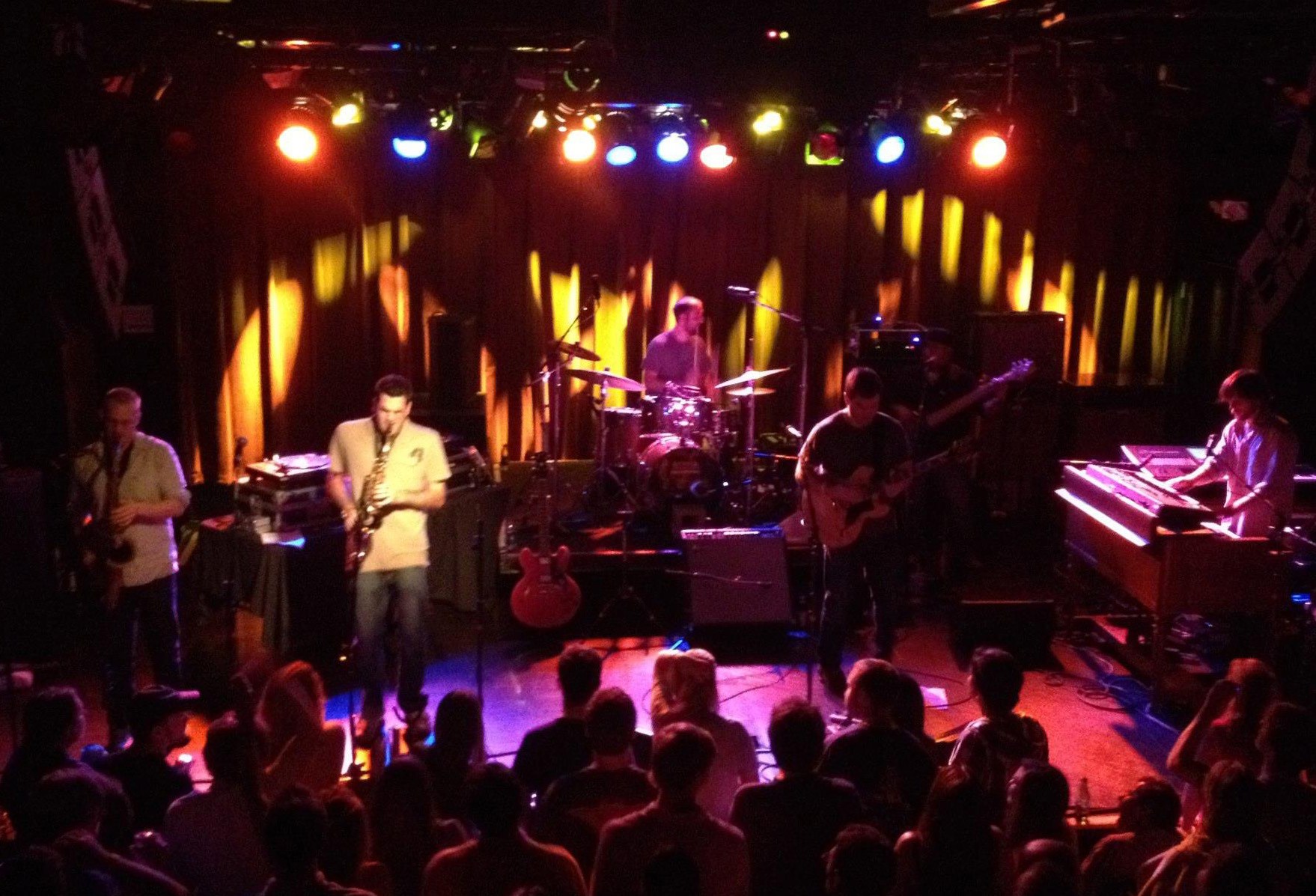
“I remember we saw their name on the preliminary round lineup and assumed they were probably pretty good,” keyboardist Rob Marscher says of the first time he heard about his future band before a Boston Battle of the Bands contest his high-school group was also a part of in 1997. “The band name makes us cringe a bit now but back in the ‘90s, ‘groove’ music was a new term.”
At the time, high-school friends John Hall (bass), Brendan McGinn (guitar, trumpet, vocals), Andrew Keith (drums), Dave Adams (alto saxophone) and Ben Groppe (tenor saxophone) had been already performing together around their native Wellesley, Mass. for a few years, honing in on a singular sound that mixed their relatively new interests in funk and jazz with a range of then-current second-wave jam and alt-rock influences. Addison Groove Project won that competition, Marscher’s band came in second and the keyboardist ended up joining the nascent outfit. As Marscher notes, though funk is now a signature stylistic element often associated with the jamband movement, the Northeast groove scene was still in its infancy at the time AGP coalesced. “I vividly remember going to Newbury Comics on Route 9,” Adams says. “I must have been a sophomore [in high school]. I asked the person that worked there what a good funk album was. She handed me a P-Funk album [Greatest Hits (The Bomb)]. Popped it in the CD player right when I got home. My life was changed forever.”
AGP continued to perform regularly as its six members attended various colleges throughout New York and New England, growing into true “weekend warriors” on the road and building a sizable catalog of originals and covers. As they began to fold in some of the early ‘00’s ascendant indie influences, the group also began headlining a mix of notable venues—including New York’s Wetlands and Bowery Ballroom, Vermont's Higher Ground and Boston’s Paradise and Middle East—and scored choice spots as marquee festivals like Gathering of the Vibes, Berkfest and the third-annual Bonnaroo, where Trey Anastasio Band horn players Dave Grippo and Jen Hartswick sat in. Along the way, the musicians shared the stage with heroes like Maceo Parker, Trey Anastasio and Jon Fishman, as well as peers and friends like Lettuce, Dispatch, Matisyahu, Uncle Sammy, Umphrey’s McGee, Benevento/Russo Duo, The New Deal and Assembly of Dust.
However, shortly after Hall graduated from college in 2003, he was diagnosed with cancer, eventually passing away a year and a half later, just a few days after his 25th birthday. The remaining band members soldiered for a while, with Marscher covering the bass parts on his keyboard; they released a final album, Waiting Room, which they worked on with Pete Carini, of Phish fame, at Anastasio’s Barn, before eventually parting ways in 2007.
The band turned in a pair of reunion gigs in 2013 but have been largely inactive ever since, though Marscher continues to perform with Matisyahu and as part of Star Kitchen. And, in the coming weeks, the quintet will come together for shows at Cambridge, Mass.'s The Sinclair on March 29 and New York’s Drom on April 5. For the dates, Adams’ teenage daughter Ruby Golden Tiger, who achieved some viral fame during the pandemic and performed with Karina Rykman, will cover Hall’s parts on bass. Here, the group discusses their first performances in over a decade and looks band on Hall’s legacy.
Let’s start with a little history for those who may not be familiar with AGP and its backstory. How did the band originally come together in middle and high school and evolve into the classic sextet, with Rob on keys?
Rob: The origins of AGP go back to middle school in John Hall’s basement in Wellesley, Mass. in the ‘90s. John, Brendan McGinn and Andrew Keith started jamming—John on bass, Brendan on guitar and Andrew on drums. Brendan performed on trumpet in the jazz band at school and John and Andrew were on bass and drums. That’s where they started performing with Dave Adams and Ben Groppe.
The band had friends with older siblings that were seeing Phish shows, like New Year’s 1992 at Northeastern University in Boston. Brendan, Ben and Dave started writing original material—they were playing at school dances in the school cafeteria and other parties and events. There was a big Boston high school Battle of the Bands competition that started in 1994. I think it started as a spin-off of Boston’s Rock ‘n Roll Rumble competition. Some members of Aerosmith were judges along with the Boston Globe music editor and DJs from the radio station WBCN. Addison Groove Project entered the competition in spring of 1997 during their junior year of high school. The band didn’t really have a name since they added Dave and Ben on horns, but they needed to pick a name to submit their application for the competition. They liked “Groove Project” as being descriptive of what they were trying to do—learn how to groove like the JB’s and P-Funk. So they were brainstorming a word to stick in front and “Addison” was suggested. Addison is John Hall’s father’s name. That’s whose basement the band had been practicing in. He was the reverend at an Episcopal church in Wellesley, Mass. and he’d later be the subject of our song “The Reverend.” Not surprisingly, I think John thought the name was a little weird, but he was out-voted.
I grew up a couple of towns over from the rest of the band. I had a band in high school called Roadside Attraction. We were in the high school battle of the bands in 1996 and came in second place. We entered again in 1997 and that’s how I first encountered Addison Groove Project.
My band came in second place again with Addison Groove Project winning first place. We were both performing at a concert a few weeks later. My band was breaking up because we were graduating and going to college. There was some equipment backstage, and I heard Brendan practicing “The Landlady” by Phish. I saw Phish for the first time at Great Woods in the summer of 1995 and was pretty obsessed at that point. I had transcribed a bunch of their songs, including “Punch You In The Eye,” so I played along and we got to talking. During their set, my keyboards were still up on the stage, and I sort of “bum-rushed the stage”—as our friends in Lettuce would say—on their last song and played what Dave called the “holy chord” on the organ. The keyboards brought the energy up a level for the band to close out the show.
They invited me to join the band after that and I started getting us gigs opening for bands at clubs in Boston. My previous bandmate in Roadside Attraction, Matt Wasley, had worked hard to get us on shows produced by Gamelan Productions. He saw that they were the ones putting on all of the jamband shows at the Somerville Theater, like Aquarium Rescue Unit, moe. and MMW. As long as we didn’t care about getting paid much—I think we got paid $50 at first—and were going to bring out a bunch of people to buy tickets, they would give us the first slot on a multi-band bill. Matt’s dad also knew about Wally’s Jazz Café as the spot near Berklee and NEC where the best blues, jazz and funk players would perform and jam. Once I got to college at Boston University, I would be there a lot and sat in and jammed a bunch of times.
What type of music did AGP focus on when the band first formed and did the founding members all have similar roots in the rock and jam worlds?
Rob: I think initially they were covering bands like Nirvana and Red Hot Chili Peppers and called themselves Supramundane, among other names. A lot of us were into similar ‘90s grunge, hip-hop, classic rock, a bit of the Grateful Dead and the “new” jambands like Phish. But it was the discovery of funk music that brought the band together. I don’t think any of our parents were playing a lot of funk in the house growing up. The Maceo Parker album Life On Planet Groove, the JB’s Funky Good Time: The Anthology and the DJ Greyboy and Greyboy Allstars albums were also in heavy rotation.
Brendan and I also bonded over classical music. He was pretty serious on trumpet and piano, in addition to guitar. I had been studying classical piano performance and composition at the Longy School of Music in Cambridge, Mass., through middle school and high school. I landed on Herbie Hancock as my new obsession after Phish in high school. I pretty much stopped listening to Phish and switched over to ‘60s and ‘70s Miles Davis, Coltrane and all the funk stuff we were covering with AGP. John Hall remained our biggest Phish fan. I remember he played us some tapes of Phish’s Island Tour in ‘98, and we were pretty surprised to hear how they had gotten into long funk jams.
While funk and groove are key subgenres of the greater jamband scene at this point, in the mid-to-late ‘90s those sounds were actually quite novel in this world. What was your introduction to the funk side of the improvisational world and can you talk a little bit about how that style played into the jamband puzzle when the band first started making its name?
Rob: Medeski, Martin & Wood performed with Phish in 1995. Trey put out Surrender To The Air. I think those connections were enough to open the door for a lot of new fans to the jazz music that was happening in the ‘90s—“bringing jazz back to the dancefloor.” That intersected with hip-hop bands that were sampling classic-funk records and bands that were covering those classic funk records that were being sampled.
One of Addison Groove Project’s first club shows was opening for Michael Ray, who played on that Surrender To The Air album. Phish also performed at New Orleans Jazz Fest, which started a late-night after-festival scene with Galactic being one of the first bands to do that. There were also prominent bands on the early ‘90s scene like Aquarium Rescue Unit that had plenty of jazz chops.
That paved the way for funk and groove bands to get swallowed up into the overall jam scene. Plus, all of us that got into it in high school were now going to music school and forming bands.
AGP is the rare band who gained some national attention while still in high school and you continued to tour throughout college. For those readers who are a bit younger, where did the five of you matriculate and what was it like going out on the road most weekends throughout the academic year?
Rob: We had a big meeting about whether we should go on tour right away and defer going to college. Our parents were strongly encouraging us to go to school first. We ended up deciding to go to college, keep the band going, tour in the summer and continue after we got our degrees. We went to colleges spread throughout the Northeast. Andrew and I had parents working at Boston University, so we received free tuition to attend there. Brendan went to Brown in Providence. Dave went to the University of Southern Maine jazz program. Ben attended the jazz program at Hartt School of Music at the University of Hartford in Connecticut. John Hall took a year off while his older sister was graduating college and then he enrolled at Skidmore College. We had several other close friends attending Skidmore, including our future tour manager Aaron Cohen.
We got the band to perform at our college events and parties and a lot of our other friends got us to come up to their schools. We were driving around the Northeast almost every weekend performing at clubs and colleges.
After college, AGP was a full-time project for several years before you all started focusing on your other interests. Was there another discussion about dedicating yourselves to the band after graduation and how do you feel that level of focus helped improve the music?
Rob: Yeah, that was the plan and we were all waiting for John Hall to graduate to hit the road and see if we could take it all to the next level. Unfortunately, John Hall was complaining of stomach pain toward the end of his senior year. At first, the campus nurses thought it was stress related. But eventually, it was discovered that he had a tumor and needed to stay home while our tour started. Shortly into the tour, we found out it was colorectal cancer.
We probably played over 200 shows that year, touring out to California and back. We certainly got very tight, and I learned how to cover bass parts on the keyboards. But we never got to realize our full potential. Listening back to recordings, the time right before John got sick was probably our peak.
I always felt that the two Wicked Live official live albums represented two solidly different eras of the band. Can you look back on where they were recorded and how they captured the band at each of those moments?
Rob: After the summer of 2000, we were coming off our first big summer tour and had a lot of new material. We had production and recording contacts up near Skidmore College from all of the times we had played up there. We were having epic shows every few months at Falstaff’s, the on-campus student bar at Skidmore. We recorded Wicked Live there. It still holds up surprisingly well considering most of us were not even 21 years old.
By the fall of 2002, we had released our second studio album Allophone earlier that year. But we already had another album's worth of material and recorded two nights of shows at the Paradise Rock Club in Boston. Songs like “Neo Geo” on that album showed where we were heading with more electronic and prog-rock influences.
AGP also released three studio efforts that still hold up over time. Can you look back on the recording of each and where the band was at that moment? I always felt that Waiting Room, which was tracked more piecemeal, was well represented by the album art.
Rob: We made our first album, the eponymously titled “orange album,” using studio time that was awarded for winning the Battle of the Bands. It was the senior high school project for most of the band. I was a year older and had met a producer named Zoux at a concert on campus at BU. He agreed to help us make the album, which is probably a big reason why it holds up. He was able to give the album a pretty cohesive sound and make sure everything was recorded professionally.
We didn’t get into the studio for the second album until the beginning of 2002. This time we worked with Craig Welsh to help us produce it. We first met him when he was the live audio engineer for the band John Brown’s Body. I had done several sessions at his studio with different Boston-area musicians. I had also sort of dreamed of getting to record at Fort Apache Studios in Boston, which was one of the more legendary studios and had hosted many of the biggest Boston bands, as well as Radiohead, David Bowie and many others. They had a ton of amazing in-house instruments that we used on that album. Craig also brought in a lot of interesting effects and processors. I think we made it in about 10 days on 2-inch tape. I wouldn’t say all of the songwriting and arrangements are perfect, but the album sounds really good.
We recorded the albums independently without a record label. The only reason we were able to do that is because we didn’t pay ourselves for most of our shows. We were doing it on the side while going to college. We slept on floors and spent very little money.
In 2003, we switched to doing music full-time—we created an LLC and got health insurance for everyone, which we felt was important. By the end of 2004, John died, Brendan enrolled in med school and we stopped booking tours. The band was effectively over, but we still had some hope of keeping it going and we continued to perform a bit. We also wanted to document the dozens of compositions we had written that hadn’t been recorded in the studio.
We had a friend, Adam Kushner, who was originally an intern for our manager Lee Seelig’s company GoTime, who was studying in the music production department at NYU. He got us free late-night studio time there. I think some of it was with the really nice SSL console they have. We recorded basic tracks and some overdubs with myself, Brendan and Andrew. Brendan and I had moved to New York City at that point.
I met Pete Carini first through Jennifer Hartswick and then he came to an AGP show at the Higher Ground in Burlington, Vt.. He’s a well-known former Phish crew member who was the main engineer at Phish’s Barn studio in Vermont at the time. Trey was letting some bands come in there and record and Pete took on our project, recorded a lot of overdubs, cleaned up the existing tracks and mixed the album. In retrospect, I wish we just all went up there and re-recorded it in the same room together. But it was already hard for us to coordinate schedules as we were needing to get full-time jobs or go back to school.
AGP also came of age at a point where the jamband scene started to expand its palette to include some more modern and indie-leaning influences. Rob, I know there was a point where bands like Tortoise started to influence your songwriting and that there was a key jam session after you were displaced due to a fire that changed your musical path a bit.
Rob: Yes, in 2001, I had graduated college and was performing in various groups in Boston, mostly made up of musicians from other Boston-area bands. I was living with a few of the AGP band members in Boston. We had a weekend of shows and came back to find an oil spill in our basement from the neighbors in the duplex we were living in. Despite cleanup efforts, the house caught on fire a few nights later while our tour manager Aaron was sleeping. Thankfully, he got out of the house unscathed, but we lost a lot of possessions. Our gear was still in our van because we were too lazy to unload it, so that actually saved us.
I had a recording session the next day with Johnny Trama and Garrett Sayers, among others. I think Garrett and his brother were DJing and played Tortoise’s Standards album and Stereolab’s Dots and Loops album and those were pretty game changing. The New York record store Other Music opened a store in Cambridge, Mass. and that was also huge. I picked up The Flaming Lips’ The Soft Bulletin from seeing the reviews on the cover and first heard about LCD Soundsystem at that record store.
I had also been following Radiohead since a live show from The Bends tour was broadcast on the radio in Boston. I got everyone into them when OK Computer came out. Brendan discovered Wilco pretty early on. We also saw Olivia Tremor Control, Tortoise, Super Furry Animals, of Montreal, Grizzly Bear and others in concert.
2004 was a turning point for AGP for several reasons, but the group did have a few milestones, including playing Bonnaroo and having both Trey Anastasio and Jon Fishman sit in in with the band at Higher Ground. Can you look back on those key moments and, for the Higher Ground show, talk about how that came to be?
Rob: We had been performing at Higher Ground for five years at that point. Trey’s brother-in-law Kevin Statesir was one of the managers at the club and helped us out a lot. In 2004, they closed the original location in Winooski and moved to a new place in South Burlington. They had all of their favorite bands perform to close out the final weeks of the club at the original location. Trey was home and planned to come sit in on as many of the shows as possible. We were already friends with Trey’s horn players, Andy Moroz and Jennifer Hartswick, and they were sitting in with us. I think Kevin and the other club owners made some calls and Trey showed up during the second set and stayed up with us for the entire rest of the show and encore. Fishman was there too and took over the drum kit for a song. The energy in the room was off the charts.
As you mentioned, Jen Hartswick is also a longtime friend of the band and Rob has continued to perform with her in a mix of settings. How did she first connect with the band?
Rob: Jen went to the Hartt School, which is where our tenor sax player Ben also went. One weekend, I went down to visit Ben and his friends—both named Jen—were hanging out and making pasta, if I remember correctly. That was how I first met Jennifer Hartswick. AGP would play at the music venue on the University of Hartford campus. She also came by once or twice when we were playing in Burlington.
Jen didn’t stay too long at the Hartt School, but she stayed in touch with the friends she met. Once she started the Jennifer Hartswick Band, we started playing shows together and did a co-bill tour later in the fall of 2004. Jen is still one of my best friends and I have performed many times in the Jennifer Hartswick Band and other shows with our friends The Nth Power.
Another old friend of the band was your high school pal George Langford, who went on to find some buzz-band success with Javelin. When did he start performing with AGP and does he continue to make music today?
Rob: George was actually involved in the early jamming sessions back in middle school with Brendan, John and Andrew. We did a show in someone’s front yard on the Boston marathon route back in high school. I think that was the first time I played with George and then we would frequently have him sit in on guitar or percussion. He also went to Skidmore, and we had some great times with his late-night campus radio show.
I believe George has been doing a lot of commercial music work. But it has been a while since we last crossed paths. It has been fun to reconnect with a lot of people from AGP’s past that I haven’t seen in years recently. I’m pretty sure I hadn’t even seen Brendan since before the pandemic until rehearsal last weekend.
A final former AGP tourmate who has continued to appear in the pages of Relix is Matisyahu. I have vivid memories of seeing you share the stage at the Mercury Lounge in New York in 2004, when he was actively part of the Hasidic movement. Rob, can you talk about how you first crossed paths and then ended up not only joining his touring band but also performing in that combo with AGP collaborators the Dub Trio?
Rob: My college friend Jacob Harris went on to be a part of JDub Records after school. They put out Matisyahu’s first album and Jacob sent me a demo saying we should do some shows together. Matisyahu opened for us in Boston in the fall of 2004 and we did co-bill shows in New York City and Baltimore. It was clear he was already blowing up. He sat in with us and I sat in during one of their sets. Once we stopped touring, a couple members of our crew joined his tour.
We performed a lot with the band Actual Proof in the late ‘90s and early 2000s. We were first on a show together with Lettuce in 1998. They lived down the street from me and we would jam at parties and side gigs around Boston. They moved to New York after college and became Dub Trio and put out some great dub records.
Matisyahu and I both happened to be at the Dub Trio CD release party and that partly led to me auditioning for his touring band. A few years later, Dub Trio became part of the touring band as well. I also really connected with Matisyahu’s guitarist Aaron Dugan and performed on many of his solo projects. There’s a handful of us that still perform with Matisyahu and have been friends for 20-plus years now.
John Hall was my Skidmore classmate and introduction to AGP during my freshman year of college. He was such a thoughtful, funny guy, in addition to being a skilled bassist, music-history scholar, live-music taper and the band’s on-stage MC. For those who weren’t lucky enough to see him play, how would you describe his role in the band and musical legacy?
Rob: John Hall was the heart of our band in a lot of ways. As you said, he was the main MC to talk with the audience during our shows. And he was the one that was hanging out and connecting with fans the most. We always thought he was a solid bass player, but our admiration for his playing has really grown over the years. He was very solid and tasteful. We recently uncovered video of an uncut bass solo of his and posted it to instagram.
It’s been a number of years since AGP stopped touring and eventually went on hiatus. What led to the band’s decision to take a pause and what are the five of you up to professionally today?
Rob: When John got sick, one of the reasons we toured without him was hoping that we could keep growing the band so it would be even more successful once he was feeling better. Once John stopped treatments, we didn’t have that motivation anymore. Brendan enrolled in medical school and that put an end to the touring we had done for about a year and a half, 2003-2004.
Brendan became a doctor, Ben is a chef, Andrew is a clinical psychologist, I’m a software engineer and Dave is a middle school band director. I also have been really fortunate to go on tour and record songs with Matisyahu and Jennifer Hartswick and perform special projects with The Nth Power. And then I formed a band called Star Kitchen in 2018 with Marc Brownstein from the Disco Biscuits, plus Danny Mayer and Marlon Lewis.
It’s been over 10 years since AGP played a show. How often does the band get together, even just for hangs, and do you have other ways to stay connected?
Rob: It has been a lot less since most of the band has been raising young children. Dave and Andrew live near Boston but not very close to each other. Ben lives north of Portland, ME, Brendan lives near Syracuse, N.Y. and I’m outside of Philadelphia, Pa. We try to meet up when we’re in Boston, but it has been a really long time since we were all together at the same time.
We have a text group chat called Loose Moose where we talk pretty regularly and stay in touch. Dave and Brendan were saying they play NYT’s Connections every day. I don’t think I can keep up with it every day, but I’ll have to give that a try.
Dave’s daughter will be playing bass for most of your upcoming shows. How long has she been playing music and what has it been like rehearsing with her? Did she have any hot takes on the music?
Rob: Dave started teaching Ruby bass when she was around 8 or 9 years old. You can read more on her website. Dave has been a middle school band director for many years so he’s used to teaching young students on different instruments. But Ruby picked it up really quick and spent a lot of time learning songs during COVID. They started making videos in their basement and Dave was picking all of the great R&B and funk songs for her to learn. The videos have gone pretty viral with a lot of famous musicians—like Questlove, Flea and Snoop Dogg—sharing and commenting on their posts.
At first, we thought maybe Ruby would just play on a few songs with us. But Dave worked hard on transcribing bass parts and Ruby learned it all. She’s really good at reading music. We have pretty complicated bass clef notation and she’s crushing it.
She has been pretty quiet in rehearsal and focused on playing the material. The rehearsals have been pretty long compared to what she’s used to. She’s excited about getting to perform with us. Her mom said Ruby noticed how we all talk like we’re family members. We really still have a tight bond from that 1996-2004 time period that has stayed with us.
What has been the process of selecting two setlists that represent the band’s years together? Has the archival work you have been doing swayed your decisions?
Rob: We have a lot of favorites that form most of the setlist. Our interpretation of our “greatest hits.” Unfortunately, we did have to draw the line somewhere with what we thought we would have time to rehearse and pull off well. There are a lot of songs on my wishlist that aren’t going to make it. I think we weren’t quite sure how it was all going to come together but things were sounding great in the last rehearsal, just like riding a bike. So I hope we get a chance to do some more shows and work in remembering how the other songs go. We’ve had funny moments in rehearsal where we can’t remember how we did something when we’re talking about it, but then it comes back if we just try to play the song together.
I have been digitizing tapes that go all the way back to ‘96-’98 and I miss some of the energy that we had at those early shows. We’re bringing back one cover that we used to do in that time period. We’re also covering a new song off one of those early records that first inspired us in high school.





