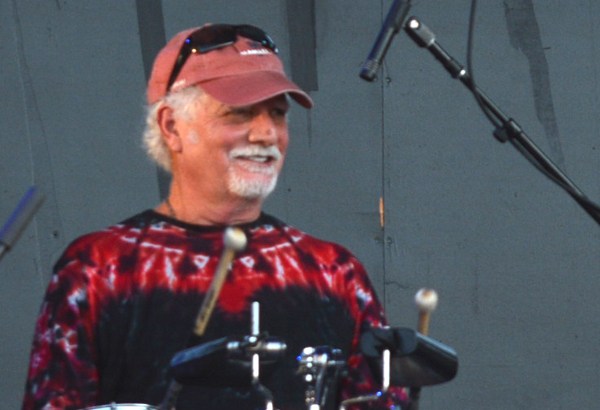

Gregg Allman and Derek Trucks, MGM Grand at Foxwoods, CT 11/16/10- photo by Dean Budnick
It’s been a painful year for the Allman Brothers Band’s musical family, beginning with the tragic suicide of Butch Trucks in January. On May 1, Col. Bruce Hampton collapsed on stage, with ABB guitarists Warren Haynes and Derek Trucks only a few steps away. The theory that bad things come in threes proved unbearably true last week, when Gregg Allman finally succumbed to his long-ailing body.
Hours after that sad news spread, Trucks took the stage in Jacksonville, his hometown, and lit into the Allman’s “Ain’t Wastin’ Time No More.” His stirring slide reminded us that just as the Allmans carried on after Duane Allman and Berry Oakley left this world, the best treatment for sorrow is a joyful sound.
Even if there were there no family connection to the Allmans, Tedeschi Trucks Band would still be filling halls on the strength of their performances, exhibited in their new DVD/album release, Live from the Fox Oakland. But the two bands’ parallels are undeniable. There’s no doubt that if Duane, Gregg, Butch, Berry and Bruce are together in heaven, their smiles stretch across the sky when Derek and Susan Tedeschi take the stage.
On Friday, May 26, the day before Gregg left us, Derek Trucks spoke about the significance of Tedeschi Trucks Band in the wake of his uncle Butch’s passing. Trucks acknowledged that carrying the ABB torch is a responsibility he’s been given and has come to embrace, partially through grooming and mentorship by Hampton as a teenager.
Once the boy-wonder guitar prodigy, Trucks is now a father, a husband and a bandleader. And with the Midnight Rider on his journey down the forever road, he’s a living legacy and a figurehead of the modern Allman Brothers musical family.
These extended excerpts from a casual conversation, unaware that we’d lose Gregg mere hours later, reveal how Trucks perceives and embraces the opportunity and obligation to keep the Allman Brothers Band’s spirit alive.
On Col. Bruce Hampton’s practice of gifting Trucks with books and albums during his formative years:
In the early years when I was a kid, he was always doing that, from 12, 13, 14, 15, 16, when you’re that age where your brain is starting to form these connections. I remember him taking me to the record store once and there was a Sun Ra record and A Love Supreme. They had the Hampton Grease Band on vinyl and he picked that up for me, which is pretty amazing to have.
He would just always drop the right stuff on you, you know? At that age, your eyes start opening up, your ears start opening up and you’re trying to figure out your way through an insane planet. He was the guy who most directly would deal with those things and kind of point you in the right place.
I think what was so different about him was he was never preachy. He was never telling you what to do. He was just kind of leaving a trail.
On the legacy of Col. Bruce:
There are people that occupy a space and if they stop playing, there’s somebody that can take up the slack, but with somebody like the Colonel, there was no mold for him before he was here, and there’s nobody that can take that and roll with it. He taught a lot of people a lot of things, so that spirit will spread. He was a singular individual and a keeper of this oral tradition and history.
I think people don’t realize how many things he was there for. There’s a little Forrest Gump to it. Not in his mentality—it’s just he was there for everything. At first, when you hear some of these stories, you think, “There’s no way that’s true,” and then two, three, five years later, something will come out and then there’s definitely proof, that was a true story. The more outlandish, the more probable that it’s true with him.
The thing I keep coming back to, with the Colonel specifically, is you’re fortunate to know people like that or get to be in their orbit, or to spend time with certain people. That’s really kind of a blessing and you have to hold onto that. There’s not many people like that on the planet and to get to spend time with him and learn and all of those things, those are real gifts that you can’t take for granted.
On being on stage with Bruce when he collapsed:
The synchronicity is just absurd. There was an interview, I think a few days before all of this went down, where they’re asking him about his favorite song of all time, and he said, ‘Without a doubt, ‘Turn On Your Love Light.’ It’s the first song I ever sang on stage, and it’s still my favorite song.’ The fact that that’s what was going on when he passed, it’s all kind of miraculous.
It’s a weird thing because you don’t want to totally hold it up as this awesome beautiful thing because it’s tragic and there are people that are really coping with what happened, but there still is an amazing beauty to the coda. The Colonel is all about spreading the myth and the mythos and all of those things, and that just happened. There will be a statue built of that dude, somewhere, some day. I don’t think that’s in question.
On his own role filling the shoes of the Allman Brothers Band:
I’ve been thinking about that a lot, you know. In some ways, I started thinking about it when we did the Mad Dogs and Englishmen thing, and then Leon (Russell) passes and we had been spending a lot of time with him and that music. And then B.B. King passing…By the end of his life, B.B. was really outwardly talking about passing torches and making sure that music keeps rolling…and with someone like B.B., you’re like, ‘Yeah, no one’s taking your place either. I hate to break it to you.’ He’s such a singular character.
But then when Butch’s thing happened, it became really crystal clear. Yeah, there’s not going to be another Allman Brothers show. That is done now. It’s it. We played a few Allmans songs the following week as a tribute to him, and you realize at some point, that music needs to be played when the time is right. At least, that spirit needs to be alive and well.
When the thing with the Colonel happened, you start thinking…It’s kind of your role and your job to keep that spirit and that musical ethos rolling, and it’s daunting if you think about it too specifically that way. But then you step back and go, ‘We’ve all been groomed for this. This is what we’ve done for our whole lives.’ Sitting in with the Allman Brothers at 9 and 10 years old, and being a part of Bruce’s nucleus since I was 12 or 13. This stuff is engrained in you. You really don’t have to do anything differently. You just have to be conscious of it and keep doing it.
Another Bruce thing, he was like, ’80 percent of it is just showing up.’ You’ve just got to do it, you know? I do think a lot of people tap out when the energy gets too strong or it gets too hot or you start thinking about it maybe too macro and it feels like too much. But I think the beauty of all those guys and the music they played is that you just get up and do it. Shooting from the hip is kind of what made all that stuff so great in the first place.
Those influences and those lessons you learned along the way, they’re not going anywhere. They’re a part of your DNA at this point. I think, just by continuing to hit the road and putting as much energy as you can into what you’re doing, I think that becomes your role.
And you know, the perception and the torch bearing aspect, that’s kind of what happens to you. It’s not necessarily something you decide to take up. It’s kind of put on you. And you either keep charging along or you crumble under the weight of it. But I’m not worried about that. When I hear Susan sing or I see the way she plays, or I look around the bandstand at our group, this is what these people do. It’s no different than breathing or raising your kids or other things. This is what we were trained and groomed to do for 20, 30, 40 years for some of the people in the band.
But you know, it is something, it definitely crosses your mind when you see all of your mentors and heroes and contemporaries either slowing down or stopping, and it’s a weird feeling, I guess for me, to start on the road at 9, 10 years old and you’re always the youngest guy in the room, so everyone’s a teacher and a mentor. Everyone you’re surrounded with, there’s something to learn from, and at some point, you blink and you look up across the stage and you realize there are people ten years younger than you on stage. That was a weird feeling for me, the first time it dawned on me like, ‘You’re not the kid here anymore. You better get your shit together.’
On the path ahead for Tedeschi Trucks Band:
To be honest, we just did a European tour that was about a month long, and it was more of a grind that the previous four or five months, playing wise and traveling wise. We had a few weeks off and we’re about to gear back up and reset, and I think it was a good time for a break.
I think with the weight of the year, and this was before the Bruce thing went down, I think everyone needed a little time to breathe and process things.
It’s not a straight line, the trajectory of things cruising along musically. There was a bit of a bump in the road in the middle of the European tour, and by the last two or three gigs, we kind of got back on track, which felt good.
(After playing Jacksonville and Orlando last weekend), we hit the studio for about a week. It’s the band reconnecting and kind of reflecting on what the fuck is going on in the world and what just happened, and I think that’s where we need to be. There’s a long road in front of us and there’s a lot of work to do this year, a lot of touring ahead of us.
We have to make sure we know who we are and what the point is, and what part of the storyline we’re a part of, whether you ask for it or not. There are certain things you have to honor, and there are certain things you have to blast through and destroy.