

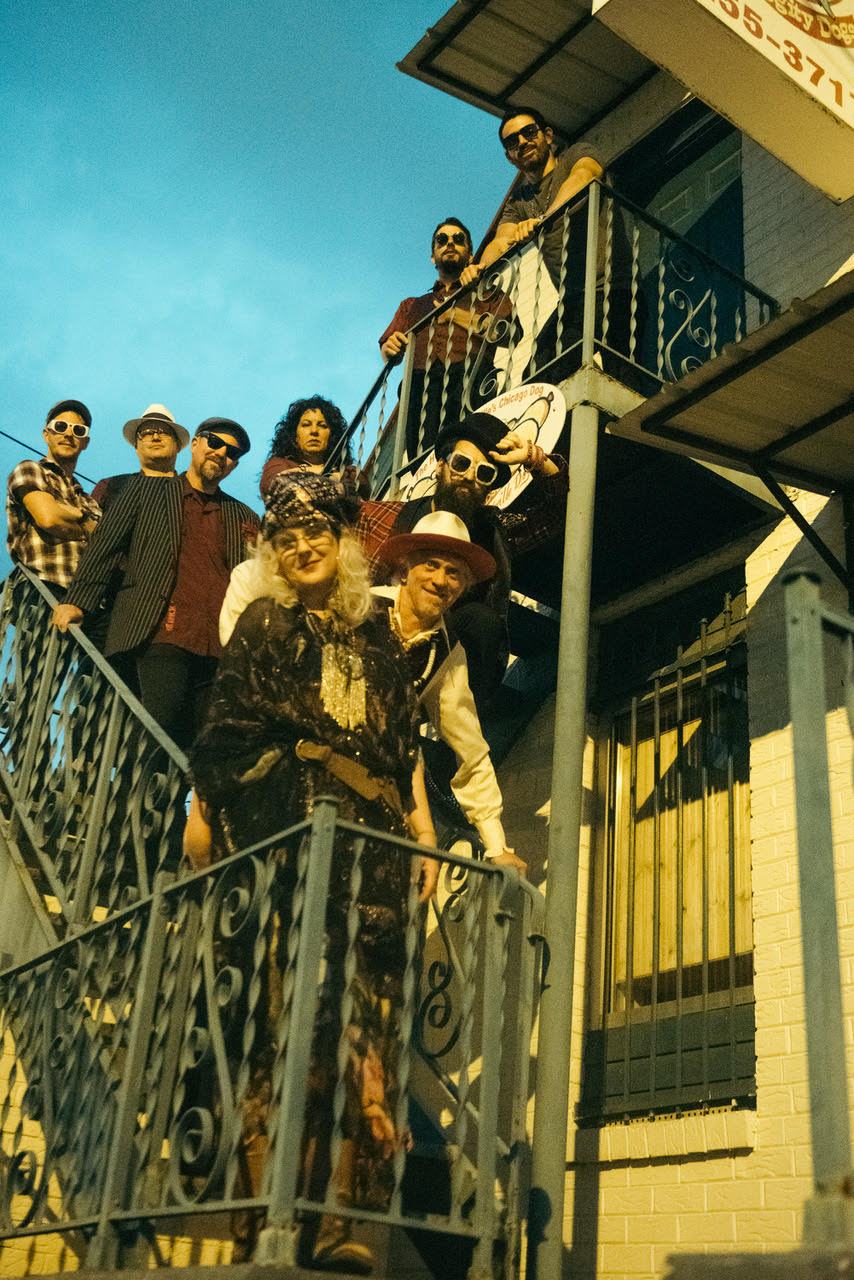
Working hard is what Jimbo Mathus does. As a young boy he not only took part in his family’s music circles but also helped with his father’s business of raising hunting dogs and horses. After stints in high school bands and a brief time studying philosophy in college, he moved on to life as a deckhand and tankerman in order to travel around America. Settling in Chapel Hill, North Carolina, the music world took firmer control of his life as he founded Squirrel Nut Zippers. Then, with its demise became a member of Buddy Guy’s band and followed that with a lengthy solo career that includes 15 releases and numerous singles.
The Squirrel Nut Zippers got their start in 1993. Swept up among the jump jive ‘n’ wail swing movement in the early ‘90s, the outfit had a major hit with “Hell” off of 1996’s Hot and sold millions before inner band squabbles led to a break up a few years later.
A whole new grouping of musicians joined Mathus in 2016 for a 20th anniversary tour celebrating the release of Hot. Viewing it as a rebirth or a revival rather than a reunion, Mathus and his New Orleans-based cohorts recorded and released Beasts of Burgundy in 2018.
Two years later the band had to scrap its touring plans due to COVID-19 but will still release a new album, Lost Songs of Doc Souchon. “This new album was inspired by all of the mysterious characters from the history of New Orleans jazz music,” said Mathus. “It speaks to the hidden roots of where our aesthetic, interests and philosophy comes from. It pulls on the hidden thread.”
Lost Songs features several Mathus originals along with Zipper-arranged covers of Jelly Roll Morton, Frankie Valli and the Depression anthem “Happy Days Are Here Again” as well as contributions from Andrew Bird on “Train On Fire.”
Last month the North Carolina Music Hall of Fame announced the Zippers among its 2020 class of inductees for their “important contributions made to American music.”
Mathus has also been involved in a number of other releases this year with a major collaboration already completed for 2021.
Emboldened by the artistic and commercial freedom of his Bandcamp page, he has put out a series of singles as well as used it to re-release his 2001 album with Knockdown Society, an explosive blues effort titled Stop & Let the Devil Ride.
Finally, his recording sessions in 2007 with Jim Dickinson and sons Cody and Luther of North Mississippi Allstars, Charlie Musselwhite and Alvin Youngblood Hart known collectively as New Moon Jelly Roll Freedom Rockers finally came out earlier in September.
During our time together we discuss all of Mathus’ current musical offerings as well as a collaborative album recorded with Bird.
JPG: You grew up in the Oxford, Mississippi area. How did you originally end up in Chapel Hill, North Carolina where you formed Squirrel Nut Zippers?
JM: When I was about 18, I realized I wanted to be a musician. I knew that was my path, but I wasn't quite sure how to go about it just because I didn't have any resources available down here at that time. So, I worked as a river boat deck hand and a tankerman for a number of years. I'd get shore leave for extended periods of time -- work a month straight, two six-hour shifts a day for a month and then you'd get a month off.
And so the month off, I would take the time to explore America with the eye of looking for a place to relocate. The place I found that I was drawn to, that I felt I could get going what I wanted to do was Chapel Hill, North Carolina. As soon as I wandered in that town…I mean, I would just go out and visit places and camp out and stuff. As soon as I hit Chapel Hill, I was there just a couple of hours, I called the barge company and said, “I quit.” That's where my gut told me that's where it needed to go down.
JPG: You’ve had such an affinity for New Orleans throughout the years that I’m surprised that you never moved there or that you didn't start your music career there instead of Chapel Hill.
JM: Well, the company I worked for was called Canal Barge and they're based out of New Orleans. So, I started prowling around there in my teens, spent a lot of time there on shore leave. Stay down there a week or two before 'd travel out.
But, I don't know why I didn't pick that place. Seemed kind of overwhelming. The music was, I didn't understand enough about it to feel like I could get a hold on it. It seemed too complex. Chapel Hill was simple. It was more the small town environment that I was used to. Once I got more confidence up there then I started taking projects to New Orleans. So, about ‘96 was the first thing I really did down there in a big way.
Most of my work over the years has been going down there for studio sessions. That has been my main thing. I almost didn't want to ruin it for myself. I loved it so much time as time progressed. I didn't want to, I don't know, I'll leave it at that. The affinity was always there but it just seemed overwhelming.
There was so much music. There was so much that I really didn't know anything about, like the brass and all that stuff. Carolina, it was more the string band stuff and that was what I grew up in. So, it seemed more natural and as I got confidence and built confidence up there that in ‘96 I started working down there a lot. It's been a long love affair and a long study of that town. A lot of friends and peers I have down there even though I've never lived there full time.
JPG: You’ve drawn on some New Orleans musicians for the latest incarnation of Squirrel Nut Zippers. How did that come about?
JM: It really wasn't on my radar until 2015 when some associates of mine that I've been involved with in the Zippers days—a manager and a publicist that I had worked with a long time—approached me about doing a reunion tour for the Hot album, a 20 year reunion. It really didn't interest me, but I thought about it for awhile and I thought, “Well, I might not be interested in a reunion. It's a lot of work to get the Zippers together. It's not easy stuff to do. It's a big band and it's a lot of work. If I'm going to take the time to even try that, I'd rather just put the band back together again and move forward with it.”
When I put the feelers out in New Orleans, I wanted this dude on trombone. I wanted this dude on piano. I wanted this dude on fiddle, et cetera. When I put the feelers out, their response was like, "Hell yeah! Let's do it.” And I got some new life and new talent and new artistry came into the equation. Then, it became more appealing to me. So, rather than rehash something, it was like reinventing it. That was appealing to me. That's what I did. That was 2016. We hit the road. They’re good people, incredibly talented, humble, no egos, just pure musicians. I love them and we're able to do a lot more with the old stuff and branch out into new horizons. Now, this is our second record with the new revival.
JPG: Did the idea of keeping it going, did that occur to you during rehearsals for the 2016 tour or during the tour or when you were making the Beasts of Burgundy album?
JM: Right along all three of those times. Initially, it was just like, “This sounds really good. There's people bringing a lot of fresh ideas in here that I couldn't possibly think of myself because I don't want to do it all. I like collaborating and I like being influenced by people, my peers." So, it was just through that process.
When the first tour went along I shook out a couple cast members. A couple of cast members got replaced and just really got a strong core. That's what inspired me to make Beasts of Burgundy. I said, “Well, I gotta do something with the new cast so they have some skin in the game, so they feel a part of, where they're not just recreating the music that happened 20 years ago but we can play music that we're making now and just to keep the morale, the excitement, my own level of joy and excitement.” That was part of that process. Touring that. Seeing the reaction from the audiences. It was just working, and you know in show business if it's working and if it's not working (laughs) and it was working.
Eventually, this made me decide to move to New Orleans—my wife and household down there. I was going to seal the deal with that and just all be in the city but that's been put on hold for now.
JPG: Zippers music, when you're talking about it, it encompasses so much from Delta blues, ragtime, jump blues, early jazz, barrelhouse, gypsy, klezmer, swing...
JM: Tin Pan Alley, some Eastern European.
JPG: Yeah. Exactly. Then, I read a quote of yours where you said, "We're still a punk band at heart.” (He laughs) What did you mean by that?
JM: There are a lot of bands, there are organizations that play the music of Jelly Roll Morton. There are artists that play Charlie Patton, and they do that really well or they play Piedmont blues or hot jazz or they read Fletcher Henderson charts and do big band arrangements. So, that's more of a recreating, more of a scholarly, approach to it. You're not adding anything new to that. You're just replicating what other people have done. The punk rock thing was like do it yourself, write your own stuff, make your own posters, make your own light show, whatever it takes. Leap around. Leap into the crowd. We still do that. As a jazz band, as much as a historian and a researcher as I am, that's not what I'm about. I like the high energy shambolic, anything could happen approach onstage and in the writing, in the studio and rehearsals. So, that's what I meant.
JPG: With that idea you could look at the approach and arrangement on the instrumental “Purim Nigram” off the new album Lost Songs of Doc Souchon. It starts off sounding like a klezmer tune. Then, it transitions around the 4:31 mark into something that’s more New Orleans jazz.
JM: That was all arranged by Dr. Sick. He’s my main bandleader. He's a brilliant arranger. That's the kind of thing you hear in New Orleans, where all of a sudden you're somewhere else that you didn't think you were going to go. If you were just doing a Purim song Sick is able to really just take that and throw it into high gear. That's what I love about this band. Rather than us recreating a Purim song, it's this whole new ball of wax,
JPG: Another song off the new album, a cover of “Can’t Take My Eyes Off You" (He laughs) It’s an interesting choice with a real cool and different arrangement from the original.
JM: Again, that's a Sick arrangement on that, and that's him on the vocals on that. I have four different singers on the album. They're all in the band, of course. Sick arranged that and, for me, it just worked. It wouldn't have been something I would have ever thought of but I loved it and I love what he did with it.
It's a menacing…Frank Frankie Valli and the Four Seasons did it. It's more romantic there but with Sick, there's this underlying menace (laughs). “You're too good to be true. You’d be like heaven to touch." It sounds almost like some sort of a serial sociopath. Just the arrangement with the strings, it blends almost like a classical, Latin American orchestra and it goes across all borders, which I love.
JPG: A couple others here, "Happy Days Are Here Again," which is true according to which side of things you’re on and how you view things. A perverse choice for 2020 but a fun song.
JM: Really. It was a perverse choice when it was popular back in the early '30s. It came out during the first Wall Street Crash. It was perverse at that time. It was a song that was not true. It was designed to make people feel better. (slight laugh) So, you're in prohibition. You're in the stock market crash, Great Depression, and here's the most popular song in America.
JPG: I always thought it came out during the Roaring Twenties when everything was going so well economically.
JM: It came at the end of that. Then, Franklin Delano Roosevelt took it for his theme song. He got elected president a few years after the song was popular he made it his theme song. It played on the train as he drove through towns and bands played it at the depot and at his speeches. So, it's a perverse history there.
Last year, when we recorded it last February it seemed perverse. Now, even more so. I had no idea. I thought it was just Trump America, which I did not agree with, but in the year-and-a-half since then look how much more it's gone in the wrong direction. So, it's even more perverse now.
One of my guys was like, "We can't put that on the record 'cause see what's going on.” I was like, "No. That's why we're putting it on the record. (laughs) That's exactly why.” It's pretty dark humor there. Again, a great arrangement and Sick pulls it off with the vocal, just a really amazing delivery. You can tell he doesn't mean it. Those are some of the cover songs I picked. This record is about half originals, half cover songs.
JPG: I just wanted to mention one other cover, “Summer Longings," mainly because of another quote where you described its writer, Stephen Foster, as your “spirit animal.”
JM: He was like the original rock and roller. He made popular song in America. So, he's like Sam Phillips but of the late 1800s. Also, he represented the typical rock and roll life, which was dying penniless, selling your songs in the back of bar rooms, a hopeless alcoholic, and he's still writing these Victorian, beautiful melodies. He's the original dude in America to popularize, that made American music, if you really want to get to the nuts and bolts. He was the first songwriter, the first one to publish his own songs, made it so people could play them in their own homes. They weren’t orchestra scores but they were piano and vocal.
If you study him, you really see what he did. Then again, to have the stereotypical rock and roll lifestyle and to end it really badly. That's the one thing the Zippers do is sing happy songs about some morose and dark topics.
JPG: You mentioned the originals, is it easier or is there no difference in writing stuff like “She's Balling” or “Train on Fire” or “Mr. Wonderful" for Squirrel Nut Zippers as it is writing blues numbers for your solo work.
JM: No. No. It's no different. You just gotta look at it like, “Okay, what's the band consist of? Well, I have a horn section. I have a big rhythm section with a full piano and have multiple singers.” So, I’m picking it over there. If I'm writing rock and roll or honkytonk or blues or anything like that, it's just in the honkytonk field. You look at Hank and look at Charlie Patton, look at Muddy Waters and that's where that goes.
I write from titles anyway. So, if I get an idea, the title like “Mr. Wonderful,” that just sounds like a Lester Young type, Teddy Wilson jazz ballad. That's what's the title insinuates to me. I write from the title backwards. When I think of a title I’ll hang on to it. If I don't write the song immediately, which I usually do, but I have a list of titles just laying around and, sometimes, I'll go back and look at ‘em and go, “I know where this goes now." Then, I'll knock it out. That's how I'm able to crank out the hundreds and hundreds and hundreds of songs that I’ve released over my lifetime.
JPG: That's an interesting approach.
JM: A lot of people don't do that and it’s so much easier (slight laugh) than racking your brain over something. A lot of times the title, they're just something I hear somebody say wrong. I hear somebody say something. I say, “What did you say?” And they tell me, and I go, “Oh, I thought they said X.” And it's just a weird combination of thoughts that fire in my mind. And I'm like, “Okay, there's a new song.” (laughs) And it’s done.
JPG: Speaking of titles, the new album is called the Lost Songs of Doc Souchon. That implies that you found a songbook but it's more of an inspiration. Elaborate on that.
JM: Doc Souchon is a little known New Orleans character. He was born in the late 1800s so he grew up in the vaudeville, pre-jazz days and the dawning of the jazz age. He had a great memory as well. So, he could remember songs that he saw in vaudeville shows when he was a kid and he could remember things he heard at circuses. A lot of the early American music was done in circuses. That's where a lot of the bands were who became jazz players.
So, he had this great memory. About in the ‘50s, later in his life, he started realizing that all this stuff that he knew, he was like the only one who knew it. He also helped start the National Jazz Foundation and was instrumental in saving and starting the jazz revival in New Orleans and getting people to care about that again because it had fallen out of favor and out of style. He realized he knew all this stuff and so he paid to have a record made in which he tells little stories. Then, him and his little buddies who he still played with, his friends they were old then but they would come over to his house and bring the clarinet, bring the bass, and the piano player would come and Doc had his guitar. You just hear him telling little stories in his New Orleans brogue, how he learned the song, where he got it from. He said, "I learned this in the old Triangle Theater with the Fuzzy Wuzzy Twins. They had a piano and vocal duo. I truly believe that this song has never been recorded." Then they'd play the song.
They probably made 500 copies of this record (“Doc Souchon and His Milneburg Boys”) and a mentor and an older friend of mine told me about it back in the ‘90s. And I got lucky and found a copy at a junk store in New Orleans. I bought it back in the '90s, and it's been on my mind ever since. So, my version of "Cookie” and also my version of “Animule Ball” [off the new album] came from the actual Doc Souchon record. We’re just preserving something that's lost, a central character who did something very important. And a lot of people in New Orleans don't even know about it. It's very strange. He has descendants that still do music though in New Orleans. It's sort of an eternal circle be unbroken type deal there.
JPG: When you mentioned mentor who mentioned the album to you’re referring to Jim Dickinson?
JM: I am. Dickinson told me about it and how he found out that it is anybody's guess. That's just the kind of dude he was. Like, he knew shit. (laughs) He saw what was happening with the Zippers and go, “You need to hear this.” Within literally days after he told me that I found the record. Literally, a matter of a few days, the record was just sitting there. (laughs)
JPG: The influence of it, why did it take so long to acknowledge it? Was it incorporated right away into the Zippers or finally with this new album?
JM: No. It's just one of those ideas that I let them lay around until the time is right. I'm not going to try to shoehorn something in there just because I dig it. But, as I've gotten older, I've gotten better at making albums that are cohesive pieces of art rather than being collections of songs and recordings.
I started getting there on “Dark Night of the Soul,” running a thread of storytelling through the whole thing. I did a good job I thought on "Beasts of Burgundy." I needed a cohesive idea before I even started the record. That's the way I like to look at it now. I want to know what general direction I'm going -- north, south, east or west. With that idea, I said, “Okay, now I see my parameters. It’s a lost songbook and Doc Souchon is the main instigator of this.”
JPG: Since I have you here and it's been awhile since the last time we talked, you have had your name attached to a number of releases in 2020. I wanted to touch on a couple other things besides the new Squirrel Nut Zippers album, and the transition comes out nicely with the mention of Jim Dickinson to the two of you playing on the New Moon Jelly Roll Freedom Rockers debut, “Volume 1,” that finally came out. How did those sessions come about? What were they like?
JM:It was just one of those things. I think Luther has talked about it in some interviews recently where he and Cody and the [North Mississippi] Allstars were on a package tour back in 2006 or so with Charlie Musselwhite and Mavis Staples. They were backing them up and Luther and Charlie were just talking. Luther is one of my favorite heroes out there. I trust him implicitly with everything. He just called me one day and goes, “Charlie's coming down and Jim’s here, of course, and we're just going to just pass the mic around,” which we had done before. I played rhythm or mandolin or lead guitar, whatever. We just passed the instruments around -- banjo, sing harmony or just shut up, whatever the song needs.
It was a two-day session. The sessions are always pretty short. It's not like we're in there all night. We run them pretty short. It's just what you hear; just a bunch of great cats around a mic doing their thing. Jim had his studio sounding really good then. He had that new Baldwin piano that they had given him that he really enjoyed -- he was very proud of -- a cherry red baby grand that they gave him because he's from Arkansas and they make those in Arkansas. So, they gave him this piano, which he was just blown away by. He was so proud of it. So, he the new piano and he had the new drum room built. He had always wanted to build this drum room that's lined with rock, and he did that in the barn there. And so, the studio was sounding really cool and comfortable and they had it just like they wanted it. We just tracked and just moved the mic around. “Jimbo, you sing one. Okay. Charlie, you sing one. Alvin, you sing one. Jim, you sing one. What's it gonna be?” (laughs) “Well, it’s “Let's Work Together.” “Okay. What key’s it in?” And, there you go.
JPG: I don’t have the album credits so did you play on all of it because the song titles just mentioned you being featured on “Shake It or Break It?"
JM: I also sang on “Night Time.” I played on all of it but we don’t really go into who does what because it doesn't really matter. You can't tell if I'm playing mandolin or if Luther is playing mandolin or Alvin because we all do it the same way. And it's kind of hard to tell the guitarist’s parts. Well, obviously, Luther’s got that slide. You always know it's him, but we also know how to blend together. So, we don't go into that on the credits. Those are the two on that volume. I think I have two more on the next volume.
JPG: Was there any reason why it was held up for so many years because it was recorded in 2007?
JM: I think Charlie played it for the dudes at Stony Plain [Records] last year, sometime. He told them about it and they wanted to hear it. He got a copy from Luther and the ball got rolling. Of course, Jim has passed in that interim. Luther has a way of making things happen when they're supposed to happen. That's all I can say about that is that it's a psychic instinct he has about when things are right. And the timing is right. It’s a nice document.
JPG: It's really cool that finally came out because it's been 13 years.
JM: Yeah. It's just a lot of fun. A lot of stuff in the blues world like that gets really overdone in the studio and it makes it hard for me to listen to. I like the rough and tumble aspect and the mistakes are fine. We never talk about mistakes. We just look at the end of the track, “That's it.” Somebody doesn't go, “Oh, I fucked this up. I gotta punch this.” Nope. If the track's good, that's it. That's where a lot of people mess up in the studio is if they overthink it.
JPG: True. Sticking with the blues, Stop & Let the Devil Ride by Jimbo Mathus and Knockdown Society came out earlier this year. What was the hold up on that one?
JM: It did come out on a real small label in early 2000. So it had been released but before I had any kind of way of really promoting it. It’s a great record. It was right on the heels of all my stuff with Buddy Guy. I did it in the same studio I did the two Buddy Guy records here in Oxford and Dennis Herring mixed it and it’s just a nice, loud, clear, psychedelic blues record.
With my discovery of Bandcamp. I'd never done that, and I realized, “Well, shit! That's like having your own record label for free.” I was encouraged by a couple people to start a Bandcamp page. Then, when I did, I said, “Well, we should just put everything out and then let's make a special little big deal about “Stop and Let the Devil Ride.” So, that was the origin of that. It really was the Bandcamp.
JPG: And you put out singles on Bandcamp as well this year.
JM: Yeah. It’s just like having your own record label. That’s what it is.
JPG: Do you think you might stick to that idea and just put out a song every so often or do you think you'll still go back to the album format at some point?
JM: I have one more thing in the works right now, which is this duet record with Andrew Bird. We actually have a major record deal. That's coming out in January. That's more of just duets of he and I in a real folk Americana roots feel, just guitar and fiddle and voice, no overdubs and very stripped down. So, in that regard I have the biggest record deal probably I've ever had in my life. What we'll be able to do with it, I don't know, but we have a record that's mixed, mastered, sequenced. Artwork's done. Copies are about to get pressed of vinyl, and I think 5,000 copies of vinyl they're gonna press initially. So, they expect to sell some of these things. They're saying, “We're going for the Grammy this year.” So, there's that.
JPG: Is the material based at all on Live from the Great Room session with him or is it completely different?
JM: It's all new material and it's based on that concept of me and him sitting there and playing together like we did so much back in the day. We always had an affinity for one another and we complemented one another very well. So, that kind of got the juices flowing in his mind, I think, to do a stand-alone project. It's all brand new in that regard.
We've never really done anything like this before but the response in the industry was overwhelming when people started hearing it. We had several labels that were after it. What a blessing. Unreal.
So basically, I've got a blues record, I've got a Zippers record and I've got an Americana folk record all coming out with just a few months. I'm proud of them. They're all excellent in their own way and all very different. So that expresses my ethos anyway.
It’s done. Of course, the contract is the last thing to be done. I don't want to say who it is but it's a group I've admired and have wanted to work with and work for a number of years, if not a decade, and that's the one that has it. So as soon as that's done, you'll be hearing about it.
JPG: This kind of encapsulates everything here. Another quote from you, where you said that “Songwriting is a form of ancestor worship.”
JM: Yes. Well, I've always been kind of attuned to my own…I got into genealogy at an early age and into preserving the history of the family. It started my interest in history. There’s a lineage of musicians in my family going back to both Scotland and Italy. Exactly what do I mean by that? It sounds good as a quote anyway. (laughs) I'm not sure how to farther elaborate.
Let me think for a second. (pauses for 10 seconds) Okay. I know what it is. All the songs I write, especially in my solo career, are about certain people, places, events that have been in my life that have affected me. You lose people in life and you don't have them anymore. They die or something happens and you move away from one another. Well, I can point to almost any song in my hundred songs in my solo career and go, "This is about this situation that this person was involved in.” So, when I sit there and listen to the song, it immediately transports me back to that place in time because I remember everything that was going on. I remember what I was thinking, what was happening in my life, be it good or bad.
So, it's as much a reverence and a dairy type thing. I'm also into animism and dualism and things like this so I appreciate the science world and I appreciate the psychic spiritual world, My ideas just come out of the ether so I have to treat them as something unique and something spiritual and magical. That's just the inspiration I get. I don't sit there and analyze my songs and try to construct something out of nothing. Emotions hit me and it tends to be when I'm recalling something from the past, even the recent past or long past. So, that explains it a little more.





