

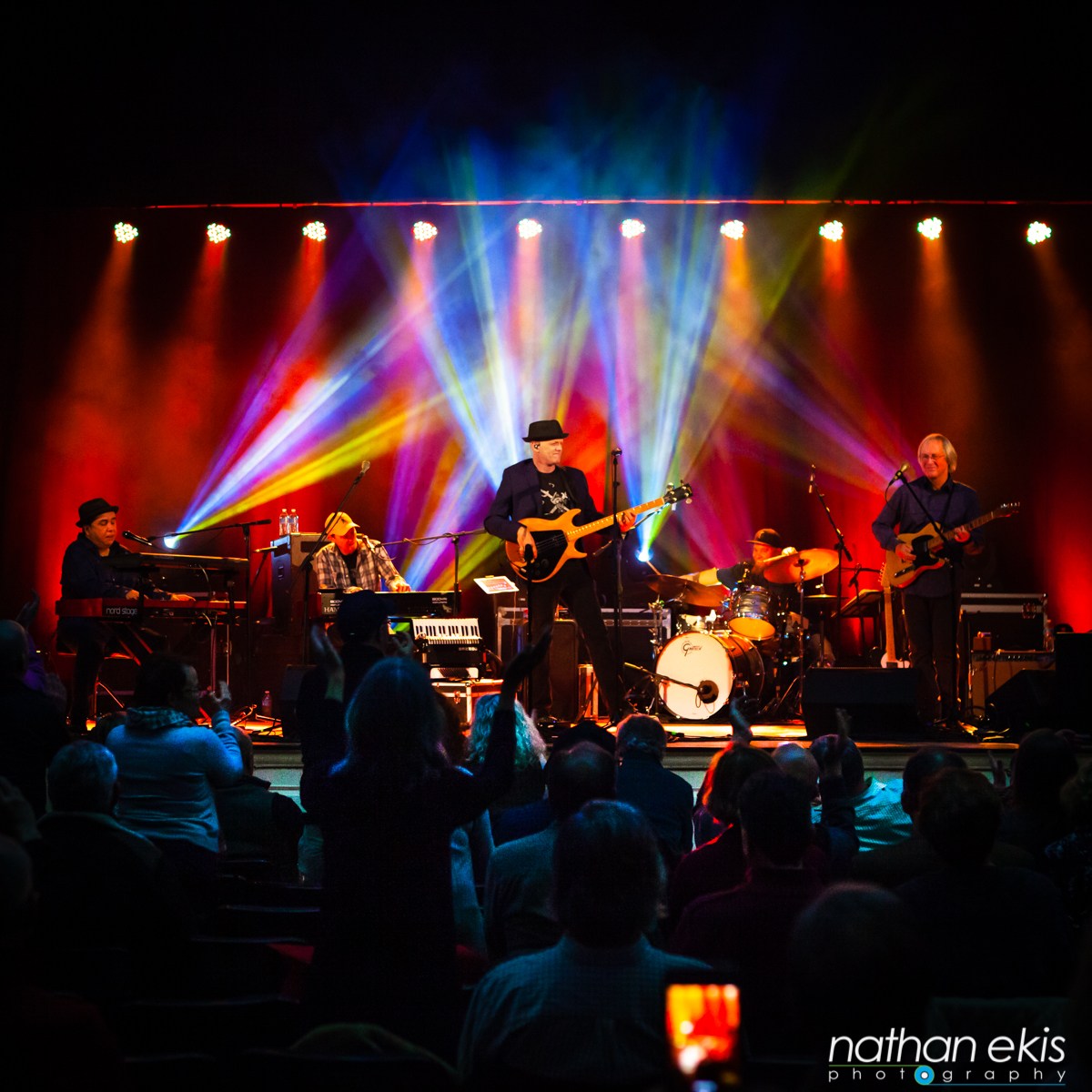
When Jim Weider joined The Band in 1985 as RobbieRobertson’s replacement, he already had a long history with their music. Bornin Woodstock, N.Y., Weider began seeing The Band early on in their career, andtheir signature blend of folky, funky rock music was a significant influence onhim. “They were a local band and I loved them,” says Weider. “As soon as theycame out, it was like, ‘Whoa.’ [They were] mixing roots, rock ‘n’ roll and folkmusic with an organ going through a distortion box. I was an instant fan.”
That fandom soon turned into a steady gig. When Weider movedback to Woodstock in the early ‘80s, he subbed in on a gig featuring LevonHelm, and from then on, he was Helm’s resident guitarist, eventually joiningthe band for their 1985 tour with Crosby, Stills and Nash.
Years later, after The Band ended their illustrious run, Weider started his own band in the same vein: The Weight Band. They play a mix of The Band songs and original music inspired by that Woodstock sound. On Dec. 20, at the Capitol Theatre in Port Chester, N.Y., Weider and The Weight Band will present a performance of The Band’s 1972 live album Rock of Ages.
Calling from his Woodstock home, Weider discusses theupcoming Rock of Ages concert, hisinfluences and his long history with Levon Helm.
Let’s start with The Weight Band’s upcoming Capitol Theatre gig. You guys are playing Rock of Ages in full, right?
Yeah, we’re really excited about that. We’re doing the Rock of Ages, the 1971 show, which wasactually the first time that I ever saw the band with horns. I remember I wentto that show. I was there and it was an amazing show at the Academy of Music.Being a local and since they’re hometown heroes of mine, I saw them when theywere just starting. I got to meet Levon [Helm]way back then in 1970, and that’s where I firstmet Garth [Hudson] and Rick [Danko]. Long story short, we’re gonna do prettymuch the whole show. All the horn tunes and as much of the other part of theshow without horns as we can do. It was 28 songs total from all the outtakeswith all the nights, so we’ll definitely do all great tunes that don’t havehorns, and all the horn tunes.
Who willbe joining you at the show?
We’ve got the Dap King horns, which are awesome. They’re really amazing. And Clark Gayton from Bruce Springsteen’s band Levon’s band will be the horn band leader and the trombone player with us. And then we’ve got Willie Nile doing the Dylan songs. We’re going to do the four Dylan tunes that Dylan did with The Band, and Willy Nile is going to sing it. Willy just did a record of all Dylan tunes, so he was really excited about it. I think it’s going to be fantastic. And the opening act is Remember Jones. They’re doing some Joe Cocker songs from Mad Dogs and Englishmen.
Youmentioned that you were actually at an original Rock of Ages show, so you saw Dylan play with them?
I saw Dylan, I saw The Band with horns and it blew me away.To hear those songs that we all loved, and some new ones--and to hear them withhorns--was such a revelation for me. We used the horn section when we didWoodstock ‘94 with The Levon Helm band and with the Midnight Ramble Band. Levonloved to have that horn section and of course they did that on The Last Waltz,but that was five years [after Rock ofAges]. This was very early on and it was fantastic. I was in the audienceand we were all feeling really good, as you can imagine in 1971, and this oneguy yelled out, “Hey Gaht, play the organ!” We almost fell out of our chairs,we were laughing so hard. “Hey Gaht,” with that New York accent, instead of“Garth.” We were dying laughing and it was just a fantastic night. I believethey did it four nights. Maybe next year we’ll do four nights, but this isgoing to be one night only. We just want to pack it, have a blast, and celebratethe New Year coming.
Going backin time a bit, I’m wondering what it felt like seeing a band that you wouldeventually play in. Looking back, what was it like to see them in a small venuewhen they were just starting out?
I saw them when they went out after Big Pink in ‘68 at NewPaltz college, which had fantastic conscious back then when college kids wantedto see live music. This was pre-YouTube [Laughs]. So, I got to see them there;it was great to see them locally. And then I met Levon. They would come intothis local stereo shop and I met Garth there a lot. Or there was a place calledDeanie’s restaurant and Richard Manuel and Rick would sit around the piano andsing tunes until four in the morning. But, long story short, they were a localband and I loved them. As soon as they came out, it was like, “Whoa:” mixingroots, rock ‘n’ roll and folk music with an organ going through a distortionbox. That combination of blues and folk music was something else. And I mean thesongs are so great. They were about the times, about the American people andstrife and what people were going through. You could totally relate to it, allthe songs. It was a great time and great music. The songs will live on forever.
And thenyou eventually joined The Band in the 80s?
Yes, in 1985. In ‘83, I started playing with Levon and Rick.I got in Levon’s band and Levon’s All-Stars, and then me, Levon and Rick wentout. Then Richard and Garth moved back and they asked me to go on that firsttour in 1985 with The Band and Crosby, Stills & Nash. That kind of went onfor 15 years until we finally lost Rick Danko at the end of 1999 in December.It was a rough, amazing, rocky road, but we made three albums and did a lot ofamazing stuff. And I got to play with all of the people that really inspiredme.
When youjoined, how did you see your role in The Band. Were you looking to RobbieRobertson as inspiration or were you trying to create your own sound within thegroup, or a combination of the two?
I had been playing with Levon, so we would do a few Bandtunes. So I was very comfortable. When they first asked me, we played thislittle bar called The Getaway where I was playing with Levon. I sat in a weekbefore they were heading on the road and just played a lot of those tunes. Iwould play those intros, those great guitar riffs, like the beginning of “W.S.Walcott Medicine Show”, or the beginning of “Up On Cripple Creek,” with thatpinched harmonic. He would have these great intro licks, but when it came tosoloing, they never gave me any rules. Just: “Play. Be yourself.” I would justsolo, but I would do those trademark Robbie licks, which were really part ofthe song. Those are classic licks, like the beginning of “Makes No Difference.” So, yes, I would dothose, but I wanted to establish my own style of soloing. So I would just playhow I felt and what I’d learned up to that point. They were also loose about itand supportive. I mean nobody said, “Don’t play it like that, play it like therecord.” Nobody ever said that to me in 15 years.
You had a long history of playing with Levon Helm. How did you come to perform with him for the first time?
Well, I had moved back [to Woodstock, N.Y.] from Atlanta,Ga. I was working at Axis Studios down there and Robbie Dupree had a single outcalled “Steal Away.” Robbie asked me to come back so I came back from theSouth. Artie Traum, who has passed us now--well, Happy and Artie Traum were afolk duo. Artie says, “Jim, I can’t make a gig with Levon. He’s playing withCindy Cashdollar and the guys. Can you cover me? Can you do it?” So I went downto Joyous Lake in Woodstock and played with them. And from then on, I wasplaying with Levon. It went from there for thirty more years, until the end ofLevon’s life when I joined back with the Midnight Ramble Band. If it wasn’t forLevon and his faith in me--I mean he really opened the doors. There were somany other great guitarists that could have done it, I just happened to bethere. You know how that all works out; it was kind of meant to be. That wasthe path that I kind of got led into. I joined The Band and I just stayed withthem. We had quite the tromping around the world. They were a rough bunch.[Laughs]
Clearlyyou had a strong connection to that music. If you weren’t the right fit,they wouldn’t have wanted to keep playing with you for that long.
Definitely. At the time when I grew up, Woodstock had thisbig folk thing. You had The Band, Dylan, and Van Morrison, who was juststarting out with Moondance and Tupelo Honey. So there was this reallystrong folk influence. John Hall was playing around with the trio. Hendrixlived up here also during that period, but he was up in West Shokan. Basically,what I was getting at was this folk thing that was very strong here, from TimHardin to Happy and Artie. I would be sitting in and playing with thesedifferent folk singers, like Gary Cooper and other local players. I learned howto back up a song and really support a song, like a folk song or whatever itwas. That’s where I met Ben Keith, who ended up producing for Neil Young. Wehad a band up here with Billy Mundy and Roly Salley. All these people went onto do other things, but they were big influences on me on how to record and howto back up songwriters. Dylan was in and out of here too, so that whole sceneup here in the Catskills--the Band, Dylan--that’s a real Woodstock sound.That’s a sound that was created here. The Band was recording at Big Pink andBobby Charles was up here. They were all kind of following The Band and Dylan’svibe of recording, really funky and loose. Those were my influences.
Now ontoThe Weight Band. What is your mission with this project?
With The Weight Band, we’ve got an album out called World Gone Mad, and what we’re trying todo with it is carry on the legacy of The Band’s music. Of course this is a fullBand show that we’re doing. The Weight Band has five singers and two keyboardplayers. We have Brian Mitchell from The Levon Helm band. Matt Zeiner, who'sour new keyboard player, is from the Dickey Betts Band; [he] brings anamazingly strong voice and fantastic harmonies from low to high, and he’s agreat organ keyboard player. Michael Bram, the drummer, plays with Jason Mrazwhen he’s not playing with us. And Albert Rogers is a great singer and bassplayer from down in the south. So, we’ve got a really good team. What we’retrying to do is carry on that Band sound--that Woodstock sound. We’re workingon a new album; we just cut an acoustic record at Big Pink. We’re kind of chippingaway. I’m enjoying myself, The Band is great, and this is going to be a totalblast to play these tunes with a full horn section and do the Dylan stuff. I’mreally looking forward to it.
I waswondering a little more about the original music. When you started The Weightband, did you expect to end up writing original songs?
It kind of started with me and Jimmy Vivino and Garth Hudsonfrom The Band. We went out and did a couple of shows: We did one at Levon’s,and then we went out and did a couple more. Then Garth wanted to play with hiswife, but I saw the reaction of people hearing The Band tunes, so I said, “Youknow what? Let me do a few. Let me do a couple shows and see how it goes.” Ididn’t think I would ever be a straight up cover band of a band I was in for 15years, and I don’t want to be called a “cover band.” When Garth did it, I said,“Well, if he’s going to do it, I’ll go out and do it.” And we had a ball. But Iknew that if I was going to keep playing and doing this show, I wanted to writean original record and that’s what we did. I’m working on the second album nowas we speak. I knew that I didn’t want tojust do Band songs; I wanted to carry on that sound with original records.I can always still do five or six classic Band tunes in the show and then we doour original stuff. When I wrote the record, the song had to weave in exactlywith The Band songs. You didn’t want to hear a hard rock tune and then a Bandtune; it had to sound like The Band. That was tough, but I think I accomplishedthat on World Gone Mad.
Certainly.One thing that strikes me about The Band is that over the course of theircareer, the person who was looked to as the driving force has changed overtime. At least when viewing from outside of the band, Levon, Rick and Robbieall seemed to have leadership roles. I was wondering about your experience withthis, which is clearly one of the closest experiences with these people. Howdid you feel about who you were looking to as the leader?
For me it was always Levon. Robbie was a strong songwriterand an organizer of great songs. He could write to the voices and he had thosethree strong voices. But I think Levon was always the band leader when I was inThe Band. It always boiled down to him. Rick was a very strong part of it, buthe would always talk to Levon.





