

After doing hundreds of interviews, my conversation with Jim Donovan contained a first—a discussion of our mutual near-death experiences. In both cases, putting off surgery nearly led to casualties on the operating tables.
His medical situation took place after the release of We See Through It, the second album by Sun King Warriors. Just as preliminary work began on a third album, Donovan’s health, understandably, took precedence while family matters affected other band members.
The obstacles brought SKW closer together as a familial musical unit when they finally convened, post- COVID, for the writing and recording on what turned out to be Like a Light. Like the previous releases, the songs take their classic rock influences while adding the rhythm-centric “two tons of drums.”
As he described the third album on the band’s Indigogo crowdfunding page, "It's a collection of songs that speak to the core of who we are, celebrating connection, hope and transformation. It's about reminding each other that we are still burning brightly even through challenges and darkness. We believe in the power of music to bring people together and make a real difference.”
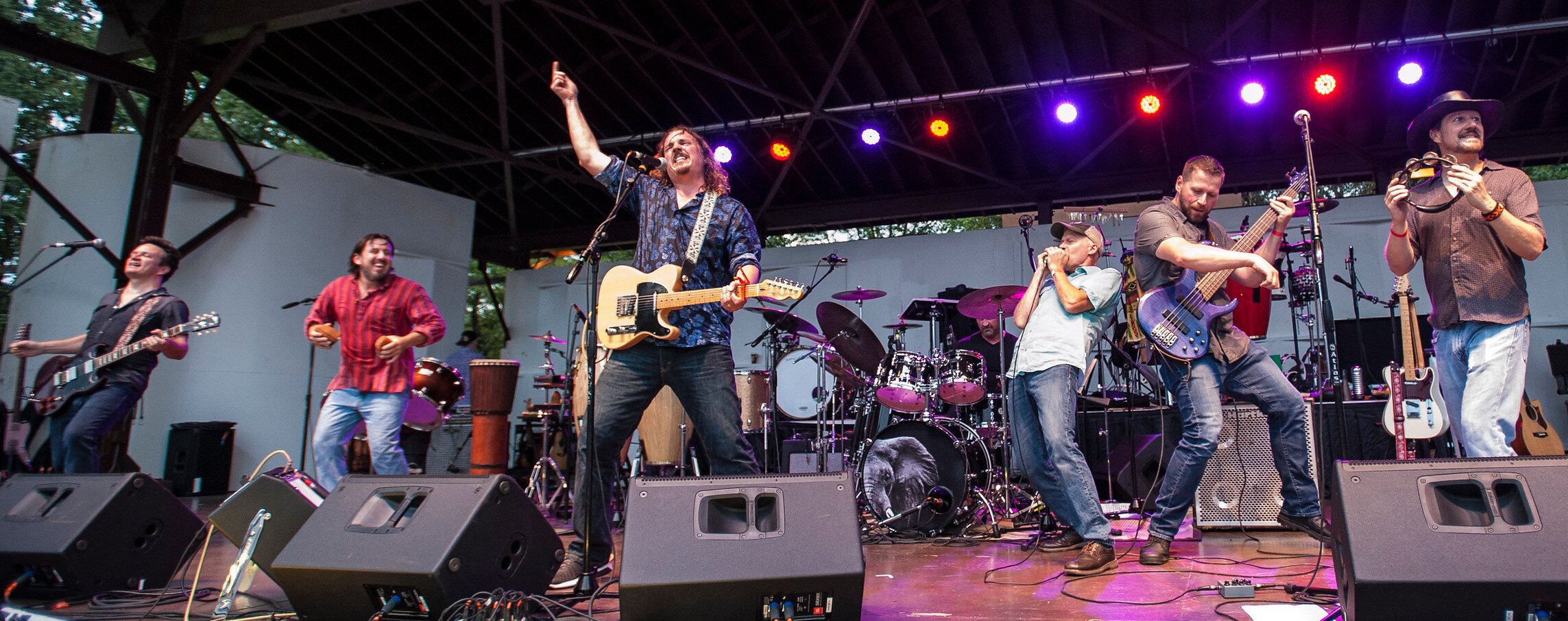
Donovan started Sun King Warriors with guitarists Dan Murphy and Kevin McDonald, bassist Kent Tonkin, drummer Joe Marini and percussionist Bryan Fazio as a way to combine his years as a musician that included being a founding member of Rusted Root (its enduring hit “Send Me On My Way” led to sharing stages with the Grateful Dead, Santana, Dave Matthews Band and Page and Plant), an educator (assistant professor at Saint Francis University), a facilitator for drum circles and creator of the Great Rhythm Revival retreat and other wellness programs.
Like a Light provides the next chapter for him and his bandmates that aims to unite artist and audience in a combined joyous experience rather than desperately vie for a social media presence in order to pursue music as a career.
JPG: Hello Jim, how are you?
JD: I’m good, man. How are you feeling?
JPG: I'm good but how are you feeling?
JD: I'm good. I’m like six years into it. Just starting to feel normal. (laughs) It took me about five years until I was a little better.
JPG: I lost patience two months into it, somewhere in January.
JD: Oh yeah. (pause) It’s a road.
JPG: I read your post on Facebook. [It described his years of dealing with diverticulitis, finally getting surgery for it and the complications that occurred on the operating table and in ICU.]
JD: I'm glad that we're able to talk, that we're both still here.
JPG: Yes. As far as a near-death experience did you see a light at the end of a tunnel or anything like that?
JD: I did. [There was a moment when] they put in an NG tube and everything just went white. And then I came back. This could have been all hallucinations, but I had little voices on my right shoulder, saying, “Hey. You can be done with this. You don't have to stay and do any more of this. You've done enough but you have to decide right now. Decide if you're gonna stay or if you're gonna go. Everybody will be okay if you decide to go. You don’t have to worry about it.” And I was like, “No, no, no, no, no, no, no.” And then it was gone.
JPG: Connecting it to Like a Light, your situation back in 2019, obviously, put a wrench in recording the album.
JD: Yeah. A couple months before that we put out our second record ("We See Through It") and then everything went dark. I was off work for six months. I would never wish a situation like that on anybody, but it did change me. I feel like I became a better person afterwards.
JPG: In what way?
JD: First of all, I'm not afraid of dying. That’s a nice thing. I think about death differently. My wife, her dad died. I was there for the death. I wanted to be there. It was sad, but it's not a fearful thing.
I've been motivated to become a better person for a long time, but this just rang the bell. It's really time to, if there's things that are left over, you need to get them right and not hold back on anything. Music. Don't hold back love from people. Don't think you're gonna have extra time to go see people later because you've already seen what that looks like; just getting more connected with people.
Say the things that you need to say. Cut out any extraneous bullshit that is meaningless, whatever it is, because you have a short time; just an appreciation of being alive may be the biggest one.
JPG: I recall photos on social media of the band in the studio. At what point did you re-enter the studio?
JD: For the new record, we started it in 2022. It took almost three years, getting in there and making sure that the writing was up to par. In the middle of it all, Sean [McDonald], our producer, and our guitar player, Kevin [McDonald] -- they're brothers -- their mom was dying. So, there was a lot of stops and starts because they had to deal with their mom.
We had been playing a lot of the music out. Maybe three quarters of it playing out since 2018. So, we really knew the songs. Once we were in there, they weren't super hard to record. It just took longer than usual, pandemic and all that stuff.
JPG: I didn't know if it took six years altogether because, if you are like me, you get a burst of energy and you're good for a little bit. Then, you’re like, "I gotta sit down and take a nap."
JD: Yes, I still do that. That hasn't gone. There's some days, if I'm home, I'll wake up for a few hours. I'll take a morning nap for maybe 30 minutes and then I'll do another one in the afternoon just because I know I'll feel better. The energy at first was really tanked, where I could sleep a whole night and then take two, three hour naps. And they told me that would be the case, that I should sleep anytime the sleep says, “Go to sleep.”
JPG: Going back to the album, the song "No Time Dying" nods to your health experience. Was there other material…?
JD: Interestingly, I wrote it before it even happened. I didn't know what the heck it was, which is what happens a lot of times when I'm writing. Ideas will show up and I try to put them down on paper. I try not to read too much into anything because I know better. Then, in the next year, all that happened. [Laughs.] “Oh. This is exactly what I experienced.” It was weird that it came before.
“Right into Your Love” was post-surgery. “When the Rains Come,” I wrote it in the year 2000. I was still in Rusted Root at the time. I wrote the verses and melodies, but I did not know how to finish it. I couldn't figure out what the end was going to be. And I didn't have anybody to play it. Rusted Root was never gonna play something like that. So I just kept putting it on the backburner. It would bother me every few years, and I would try to finish it and nothing would happen. Then, this past cycle, I finished it, mid-2023, finally realized, because I had the right players that could do what it needed. With the Sun Kings it was able to go and be finished.
JPG: Like A Light opens with a cover of The Record Company's "Off the Ground." You played that live for years. What was it about that song that attracted either you and/or the other band members and then you decided to put it on the album…at the beginning?
JD: Our bass player, Kent Tonkin, was the one who suggested that we cover the song. When we cover stuff, some of them I feel like I can really sing from a real place in myself. Some of them I can't but we play them because they're fun. That one always has some juice to it.
We deliberated a little bit about the order of songs, but it just felt like a good opening for the record. There wasn't much more thinking behind it than that. It just felt like a good place to start. I think it speaks to a lot of people that are having a rough time.
The phoenixes on the cover are about emerging from the ashes together. Almost every person in the band had some sort of big loss between album one and album two and album three. It kind of fits what we've all been experiencing, so that song made sense to go first.
JPG: There have been six years between albums. Other than your medical experience, do you think it would have taken that long between We See Through It and this one?
JD: Probably could have gone a little quicker but my health got in the way. We're middle-aged men trying to do something to the highest level, a high-level recording, which is different than going in for a week and you bang it out. We’re very meticulous about it and that process is super time consuming. I don’t think health got in the way. That’s just more how we decided to do it.
JPG: Do you and the Sun King Warriors’ members bring more of a sense of excitement because music is of secondary importance to you? There's less pressure. It's there as a joyous hobby rather than, "We gotta make our advance back"
JD: It is more joyful because there's no pressure. There might be three or four people that are waiting for our record. [Laughs.] One of them is probably my mom. Without any pressure, knowing that it's self-funded and partially crowdfunded, so no debt. We're doing it because we truly love to do it and want to do it. We're lucky that there's some people that like it because that's not always the case.
JPG: Is that your attitude towards writing and recording albums, no urgency?
JD: It's as urgent as we are compelled to do this and we are going to do this, and we're going to make that happen. It's so much work, but it's not like we have to make it big. We don't need it to happen. We're just gonna do this, and if it does [go big], fine. We're still gonna do it.
JPG: Is it more satisfying in that it’s a lot of work but it’s your work?
JD: It is. At this stage in the game I’d like to see what can this do? How will I react when I play? How will I feel? How will the guys feel? How does the audience react? It's just interesting. There's some things that I can predict. People will like this one. There's some things I can't predict. All those little surprises are fun. I see it differently than when I was doing it as my living. You gotta pay your car payment with it. I do other things now for that.
JPG: Songwriting-wise, the three albums are consistent as far as the albums have catchy tunes on each one. I was listening to all three yesterday. At its core the debut's a little poppier and upbeat. The second one, very heavy drums, big production. This one seems to be a combination of the two. Do you agree or how do you view the transition from one album to the next?
JD: The first record, that was really like a Jim Donovan record. I didn't know if I was gonna release it. I was in the studio just to see if I could record again. I had been writing since the mid-'90s but I was afraid to death to sing in front of people. So, I didn’t tell anybody and just kept them. Those songs have been in the hopper for a long time.
At the end of the process, then, I decided I'm gonna bring some people around this, and let's go play it live. Let's see what happens there. All experiments. I didn’t have any vision of going on the road, doing that whole thing that we used to do. But I was interested to play. I was missing music. So, that record really came out like this experiment of, could this happen?
The second record was, “Okay, I've got these people and they all have different strengths.” So, I was writing to them, writing things that Joe and Kent would be really excited to do, like in the middle of “Hey! Let It Be,” that whole breakdown jazzy section. Double time on the ride cymbal stuff, that was for these guys. The mindset was different.
Then, on this last one. We've congealed like...it's a solid unit. We know each other. There's a ton of goodwill and love and all that stuff. It was more like, "How can we further establish that this is a sound that we like to be? There's lots of different variations of it. It's rock. It's got a little more percussion than some rock.
JPG: Definitely one track on each album that is all percussion. Speaking of the drum tracks, "Revival Drums," off the new album, what year of Great Rhythm Revival was that taken from?
JD: I think it was 2022. We had to skip a year because of COVID, and that next year everybody was just on fucking fire because they missed everybody.
JPG: Do you think that because you led drum circles, lectured and taught at Saint Francis University, all of that prepared you to be a frontman for a band? Made it an easier transition?
JD: Yeah, for sure. Just having to speak in front of people every day, think on my feet and be in charge. When you're playing drums, you're driving the songs, but it's a secondary position. I like it, but I was bored with it. I wanted to try…I've always wanted to, but was afraid. Now, I'm not because I stood in the fear.
JPG: And succeeded, obviously. When you were talking about the other members being more involved, writing with them in mind, is that what led to the change from using your name on the debut, then Jim Donovan & Sun King Warriors on the next one to the new album being just Sun King Warriors?
JD: With my name on the front, honestly, it's too long. [Laughs.] It doesn't look good on a shirt. The only reason I put my name in the beginning was because I have a little bit of name recognition and I thought it would help us connect some folks that knew me, and it did. I don't put them on the t-shirts or anything like that. Sun King Warriors is fine. It's a powerful name.
JPG: That and the elephant image you use is a powerful image, especially the images on the first and second album covers. I was doing some research on elephant images and read that it represents strength, wisdom and good fortune among other things. What is your reasoning behind the elephant image?
JD: In Hindu mythology, the elephant is the remover of obstacles. I like that. This is why we play. It removes obstacles for us, and, hopefully, for the audience. Be in your joy, be your best self.
JPG: You mentioned the album cover earlier, what about the album title Like A Light?
JD: That's a line from "No Time Dying.” The whole line is, "How can I be I/Like a light in the dark night." It's like we're in this nasty existence here and it's noisy, and all kinds of shit swirling, but how can I poke out of that…and be big?
JPG: Among those that appear on the album are your three children.
JD: All three of them came in and sang on something. I've been doing that from the beginning, and it just feels good to do that.
JPG: It's Tupelo, Oliver and Ella. Now, do they have much of a musical aptitude? I recall seeing Tupelo sing onstage with Sun King Warriors.
JD: All three of them do. Tupelo's probably doing it the most. She’s in a couple of bands and has two records coming out this year. When she was five, she told me that she wanted to be a singer, and I'm, like, "Oh God, no. please." But she's doing that. My daughter, Ella, was a musical theater kid. Did that in college a little bit too but she's not pursuing it. She wants to be in the music business and work behind the scenes to make the shows happen. Oliver, he is a visual artist. He's one of those people that likes to do everything.
JPG: I was looking over the Sun King Warriors Learn section on the band's website. On there, you recommend articles with exercises that use music to improve well-being. How does Sun King Warriors’ music align with that?
JD: All the systems that I've got from the Revival to Sun Kings to the work I do at Saint Francis University, it all has that thread of having music that was at the core of it, getting people together, doing things together, meeting each other, hopefully feeling better and remembering what it feels like to be alive.
They're just different mediums for the same end. I like to connect it all. I have a wide life currently. It's all these different things. It won't always be like that. Each part of it is independently functioning and may also function together. The Revival is a good example of it. That's a place where all that comes under one tent.
JPG: The Revival is probably nice for you since I imagine that even though you're there, you can kind of let go and delegate. So, it's not all on you.
JD: I’ve gotten so much better at delegating. I teach, and then I don't have to worry about much else during the event, and that’s all by design.
JPG: Also, you traveled regionally hosting drum circles. I'm looking at your schedule now and see instead Sound Healing Facilitation, Wisdom of Rhythm and Sound Retreat. Are those technically drum circles or something different?
JD: They are workshops. There is drumming in the workshops, but there's also lots of education. There are mindfulness techniques, sound techniques, social connection. Drum circles tend to be...It's not just you sit there and drum the whole time, and you go home. This is a lot more involved.
JPG: There's also your podcast.
JD: I did a whole bunch of them in the 2019, 2020 zone. The podcast is on hiatus just because of the wideness of my life got too wide. [Laughs.] But I am contemplating bringing that back. With all the AI tools now, it's a lot easier to do some of that stuff. The editing was so hard, that it was challenging to have time to do all that.
JPG: You mentioned AI. Are you wary of AI like other creative artists are?
JD: I'm amazingly wary of it but I am using it and I'm learning about it because it's here, and it's not going to go away. I want to at least know how to work with the stuff and silently praying for the best. [Laughs.]
JPG: Last thing. Besides the new music, you've been teaching at Saint Francis University for how long?
JD: It's my 20th year.
JPG: And you're an assistant professor. We never discussed this previously. What do you teach?
JD: I teach music and wellness when I was hired by Chuck Olson, who’s a really phenomenal guy. He said, “If I could get you a position here and you build a program, would you take it?” That was a week after I left Rusted Root. I didn't know what I was doing but I did know that I didn't have a source of income anymore. So, I said, "Yes," thinking I would be there for a year or two while I got my shit together. And here we are, 20 years later. It's been a wild ride. Like you, just glad to be here.





