

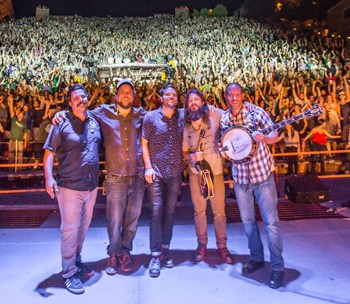
Let’s establish this at the outset -- Greensky Bluegrass may reference that old time country picking style in their handle, but they’re anything but old fashioned. Call it what you will—nu-grass, grassicana, Americana or any number of other terms concocted to describe the mix of classic and contemporary, Greensky’s music decidedly defies boundaries. Granted, the prominent place that banjo, mandolin and other arcane instrumentation finds in their sound may evolve out of reverence for their roots, but the arrangements take them well beyond any traditional template and into realms that are decidedly different and diverse All For Money, their seventh studio album to date, confirms their determination to expand their parameters and make music that’s decidedly of their own invention. It’s not that the group -- consisting of Michael Arlen Bont (vocals, banjo), Anders Beck (dobro, resophonic guitar), Dave Bruzza (guitar, vocals), Michael Devol (bass, vocals) and Paul Hoffman (mandolin, vocals) -- have deserted their rustic roots entirely, but they have created a sound that’s incisive, inventive and further affirms their populist appeal. Now in their 18th year, the group has gained a reputation as festival favorites and developed a rabid following that eagerly anticipates each successive outing. We recently spoke with Bont and asked him to offer his insights into the band’s fervent following and the unique elements that have made them so successful so far. Greensky Bluegrass has developed a loyal legion of fans over the course of your career. How do you account for that diehard devotion? It’s about the music as well as the community around it. It’s kind of this community that we unintentionally created by doing what we do. It’s really great. You’ll be celebrated your 19th year in October. What has allowed the band to maintain its enthusiasm and continue to progress? For us, it’s about keeping it fresh. It’s about trying to be more improvisational and then taking some risks. That means we’re not stuck playing the same songs. How many songs are in your current concert repertoire? We probably have 1,000 songs we can choose from, although some of them we’ve only played once. But that’s what keeps the interest for us, the fact that we’re always trying to expand our catalog. We used to play a lot of bluegrass and played the songs pretty fast. So trying to fill up three sets of music with songs that are about 2 1/2minutes can be challenging.
How do you determine what you’ll be playing on a particular night? Three of us come up with a setlist and with a flow, and then try to make it different every night. We have an idea of how we want things to go, but there are sections that are open to improvisation, so that keeps it interesting for us and for the audience. Do you sometimes feel like you’re unfamiliar with the material when you haven’t performed it in awhile or very much at all? When do you have time to rehearse on the day of a show? Most of the songs we generally know, and we do a rough run through during soundcheck, so we at least know how the chords go. Is it a challenge trying to convey the energy and spontaneity of your live concerts to your studio albums? Does the music lose anything in the transition? It is and it isn’t a challenge. We try not to limit ourselves to the three to five minute box that is generally typical of recorded music. We like to remind ourselves that we can make this song longer if we want. We don’t have to be limited in the length, and with this album, we wanted to make it a combination of what we could do live with the standard three to five minute album songs. Our songs always had some boundaries, but the last few had two or three songs that could stand outside that box, and this is the first album where we said, okay, it doesn’t matter, we’re going to record this album and see what happens. Is there any sort of template that you adhere to when you’re working in the studio? Usually when we record something, we think about what do we do and how it fits the song. With this one, we kind of threw that out the window. (laughs) It worked. When I listened to the demos, I wasn’t really impressed with how the songs sounded, but after we recorded them in the studio and put them under the Greensky microscope, they took on this whole new meaning, and it was just amazing how this album turned out and how much I really love it. The bulk of your band has been together from the beginning, and even the newer members have been with you for a decade or more. How do you account for that cohesion? We’re definitely more of a brotherhood than a band at this point. We’re still a band, but it’s always been a brotherhood, You don’t get to choose your brothers, but you still have to love them. (laughs) Greensky Bluegrass have always been road warriors, but now that you have families, are you inclined to cut down on your touring time? There is a definite push and pull, but when a family situation arrives, nobody’s ever forced into doing something they don’t want to do it. That’s important to a band like ours, and it’s one of the reasons we’ve been able to stay together so long. It’s also the reason that many bands break up, that someone is pushed into doing something they don’t want. You have to set boundaries, and we’ve found that’s what works for us. As you get older, you don’t really have to play as many shows or as much. There was a period after we first formed, where we were playing over 200 shows a year. Now we limit ourselves to around 100 shows a year, which is still a lot. So now we’re trying to get it to under 100 shows a year just so we can spend more time at home. And as we get older, we find that that’s more and more important to weave into the fabric of what we do. So we may be on the road a month straight, but then we’ll be home for several months at a time. And of course that drives my wife insane. She literally had those months off. In many ways, it seems like you’re living the dream. As far as dreams go, we’re living a pretty good one at this point. It took us awhile to get here, but that’s part of the reward -- to go through the different stages to get where we’re at. It involved taking a lot of risks, but those risks are starting to pay off.





