

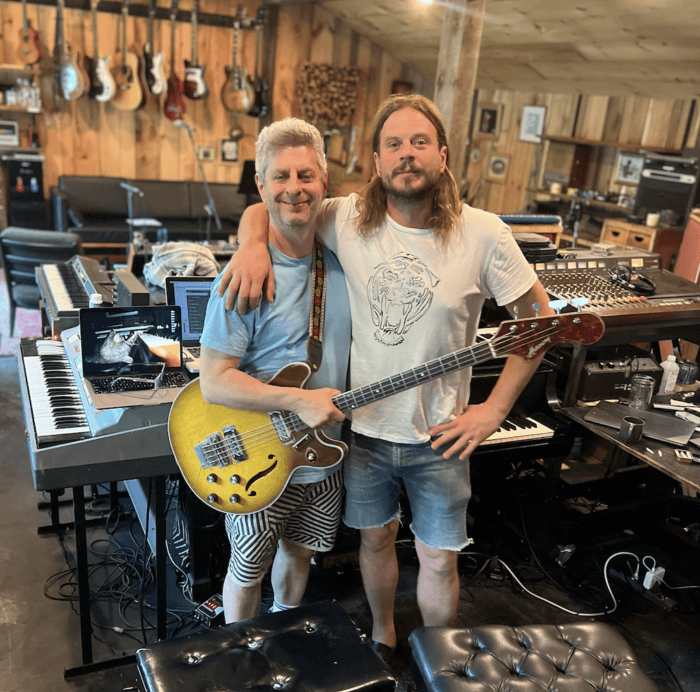
Both Marco Benevento and Mike Gordon are known for duos. The Phish bassist has collaborated, on and off, with revered guitarist Leo Kottke for the past 20-plus years. At the same time, the keyboardist first made his mark on the national live-music circuit as a member of the instrumental combo The Duo alongside Joe Russo. During a particularly fertile period from 2004-2006, most of which took place while Phish was inactive, Gordon also mounted several short, spirited runs with The Duo as well as a larger outing with Benevento, Russo and Trey Anastasio as part of a project unofficially known as the G.R.A.B.—including a run of amphitheater shows with Phil Lesh & Friends.
Along the way, Benevento and Gordon played a proper duo show of their own at the now-padlocked New York experimental music venue Tonic on Nov. 1, 2006, where they covered the music of Benny Goodman and welcomed The Slip’s Brad Barr, who headlined a CMJ show at the venue later in the evening, for a sit-in. (Benevento, who used the night to kick off a residency that effectively launched his solo career, also sold signed keys from an old organ at the gig.)
Though Benevento and Gordon remain close friends and have occasionally shared the stage during the past 18 years, they haven’t put together a formal project since that intimate Tonic gig. They also haven’t performed together publicly since Gordon sat in with The Duo at the Suwannee Hulaween festival in 2017—which isn’t totally surprising given that Benevento now plays with Joe Russo’s Almost Dead and leads his own trio; Gordon balances his time between the fully reactivated Phish and his solo band and that they both now have teenage children.
However, on June 29, the pair will reunite for a duo set at Benevento’s annual Follow The Arrow Festival in Accord, N.Y. The stacked lineup will also feature appearances by Os Mutantes, Ghost Funk Orchestra, Witch, Sam Cohen, Dave Dreiwitz, the Benevento Family Band and several others. As expected, the family-friendly event will also set the stage for additional collaborations. (On June 27, Follow The Arrow's promoters announced that the festival will move to the recently renovated Bearsville Theater in Woodstock due to inclement weather.)
While traveling between tour dates with his current keyboardist, Robert Walter, during his solo outfit’s June run with Vampire Weekend, Gordon caught up with the Woodstock, N.Y.-based Benevento about what’s in store for their upcoming Follow The Arrow set.
Marco, you put together some interesting and unique collaborations for Follow the Arrow every year. What was your initial pitch to Mike for this year’s installment?
Marco Benevento: Mike has always been on the radar for Follow The Arrow. And by “always” I mean for the last two years, since we started the festival. [Laughs.] I’ve reached out to him before and, just because of scheduling, it hasn’t worked out, but for some magical reason this year it did, which is awesome. When I was thinking about what the heck to do with Mike, I was like, “Well, let’s just see if Mike can come by himself and maybe we can revisit the duo thing we did back at Tonic a long time ago [in 2006]—just keep it simple and with the vibe of the festival.
The festival is only one stage—all the backline is set up onstage and there’s 50-minute changeovers, which seemingly shouldn’t even be a working scenario for any festival. But for this festival, it’s gone swimmingly so far. There’s five guitar amps, two drum sets, and one or two bass rigs and amps set up onstage. People can choose what they want to do, or people can plug in and play on the fly. It’s super loose—the festival only holds about 1,200 people, so it’s a very small, daytime fest.
So I thought, “If we’re bringing in Mike, we should keep it loose, too.” As I said, there’s also a bunch of that gear set up onstage, so we may have some people come up and play a tune or two with us, which is what I’m all about, musically. I have always been into the spontaneous side of things. My mentality is: “Sure, we can think of some songs we want to play, but let’s leave room for the unknown” because that’s really when you’re walking the tightrope in front of everybody. And people at the festival love to see musicians searching and being unpredictable. You never know what’s gonna happen.
I love that about life in general—and sometimes I hate that about life in general—but that’s really my whole being. [Laughs.] Mike and I got on the phone, came up with some ideas and we have been texting during the past few weeks. We came up with almost too many songs to learn because now it’s like, “OK, remember, we have to leave room for the unknown.” I even went back and listened to some of the stuff we did at Tonic in 2006, and I was pleasantly surprised at how good it sounded. I remember it being fun, but it also sounded good! At that show, we did the music of Benny Goodman and we can potentially do some of that this time too. Since then, Mike and I have started singing more with our bands as well, so we can maybe sing some of those songs together.
But, mostly I’m excited for the the headlining band to just be piano and bass. As I said, the festival is a day fest—2 p.m.-9:30 p.m., so no one’s camping out, no one’s staying overnight. There’s no crazy Silent Disco tent or wild DJ party at the end of the night. It’s a very Woodstocky and downhome.
Mike Gordon: Marco and I have done all kinds of things together, and I have all sorts of memories of us playing together. But to touch on the Benny Goodman one for a second, when Marco reached out 18 years ago and asked me to do a show with him during his Tonic residency, I wanted to challenge myself. So I said, “OK fine, I’ll do it as long as we only play Benny Goodman songs.” We called it “Guttman” because that was his real name. At the time, Sue and I were on this “The No Itinerary Adventure.” For the first time in our lives, we went on a road trip where we didn’t know where we were going each moment. We ended up on the Blue Ridge Parkway. We had a convertible car, I had this tiny bass that had a speaker and amp built into the body, she drove and I played Benny Goodman stuff that whole trip—sometimes along with the radio, sometimes just by myself. I was trying to get all of the different clarinet parts right, and there were even some piano licks that I wanted to learn. I barely scratched the surface, but it was a funny little challenge. So then, when this thing [festival offer] came up—and flash forward many years, with other memories in the middle—I thought, “I was thinking of else we can do?”
I did the thing with Joe Russo recently [as part of the This Is Gonna Be a Blast! series at New York’s Sultan Room], where there’s nothing planned, no rehearsal, no songs. I thought, “We could just do that,” but then again, I did just do that. [Laughs.] So then, here we were and, as Marco said, we started throwing around song ideas. Since the festival has an easy-going vibe, we want to leave room for the unknown. We don’t know who’s gonna sit in, so there is that unknown, but we also want to leave room for deeper levels of the unknown, like, “How many songs are we gonna do? How much are we gonna sing? How much are we gonna jam?” We’ve had lots of ideas, but I like the idea of just simply not knowing where it’s gonna land. That’s where the fun is.
MB: I remember, 18 years ago, when you said that you wanted to do the Benny Goodman thing—the Guttman thing. I was on tour with Joe at the time. I didn’t have a travel keyboard with me at that moment in my life, so I had to go into the lobbies of the hotels we were staying at to practice and learn these Benny Goodman songs. I remember thinking, “We’re really going for it, we’re challenging ourselves to learn a lot of music. There’s some heavy piano stuff in here.” We pulled it off, and it sounded great, but this time I thought, “Let’s revisit that, but let’s be a little easier on ourselves and learn a couple songs that we can sing.”
Since that initital jam at Tonic, you have both launched solo projects under your own names and made a concerted effort to focus on your lyrics and vocals. It must be interesting to connect with each other as your original catalogs have continued to expand and diversify.
MB: Yeah, definitely, which is why I was like, “Wait, we have actual songs that we’ve written that are, like, maybe easy two or three chord songs. We can listen to them twice and know how to play them for people and have it be entertaining.”
MG: This person who’s speaking right now, Marco, is someone, by the way, who once showed up at a band practice with the three of us—me, Marco and Joe—having learned all of “Foam,” a Phish song, which is a fugue. He learned the singing parts as well, and maybe three instruments worth of parts on a song that’s already daunting enough to learn. And then, another time, the three of us went into the studio with Trey [Anastasio, for the album Bar 17], where he had these arrangements for songs like “Goodbye Head” that are over the top crazy rhythms. One’s going up and some other ones going down, while the leader is dabbling in D-R-U-G-S all the time and trying to execute these takes. So it’s pretty cool when I experience someone like you, or Robert [Walter], who goes so deep into learning different kinds of music and then just forgets it all for the sake of incredible energy and smiley-ness. So, it’s a really good combination to walk into at any time for me.
I feel like “incredible energy and smiley-ness” could be a slogan on one of your next t-shirt design, Marco. Speaking of “Foam,” the two of you and Joe once played a 50-plus minute version of that song that took up an entire set. Do you remember why you decided to do that?
MG: And then there’s the seven-second “Foam” from the next night.
MB: I forgot about that! [Laughs.]
MG: The B-side [Laughs.] I remember liking the idea of taking songs that had these compositional parts that I played over the years and changing them so that what used to be a written part could open up and become a vamp. And so we took some parts of the song and just paused something that would normally just be played all the way through. I really wanted to try that, and it worked out really well for that “Foam.”
MB: I also remember being at the gig, which was at the Georgia Theatre, [in Athens, Ga.], and it was kind of undersold. We had done a bunch of shows together during the couple of months—or even year—before that which did well, and I remember being like, “Where is everybody tonight?” And we were like “OK! Look, just to let everybody know, you gotta come to every gig because you never know what might happen that one night you miss.” I remember being like, “We’re just gonna give them a huge surprise because the room is half full and that’s messed up.” [Laughs.]
MG: That’s what we did when Phish did Dark Side of the Moon. We had done [The Velvet Underground’s] Loaded in Vegas for one of the Halloweens years and years ago [in 1998], and then Phish had a show in Utah two days after that. People were like, “We’re gonna do the Halloween thing, we’re gonna blow our brains out and then skip Utah and maybe we’ll see you in Colorado for the show after that.” So that was the night that we decided to learn all of Dark Side of the Moon, two days after having done this Halloween show where we covered another album—not that that was the crispest Dark Side of the Moon. [Laughs.] And now I’m sitting here with Robert, who became the keyboard player on the new Dark Side of the Moon tour with Roger Waters.
Speaking of Robert Walter, Mike, Joe Russo was in his 20th Congress around the time that you started playing with The Duo. The first time you sat in with them was at the New York club Tribeca, on keyboards, and then your first official gig with Marco and Joe was at a HeadCount benefit at New York’s B.B. King Blues Club almost exactly 20 years ago. Do you remember how you first connected?
MB: I do! Obviously, growing up in New Jersey in the ‘90s, Phish was the big band, and there were a lot of Phish fans in my high school—and I was definitely, absolutely one of them. But then I went to college at Berklee and, in the early 2000s, I linked up with Russo, who I had actually known since seventh grade, once again in New York.
We started playing together and then, the first amazing new step for us was that Andy Hurwitz at Ropeadope Records was like, “We wanna put out your record and we wanna record you.” And I remember being really excited about that and then Mike had a record out on Ropeadope around the same time
MG: Inside In—that was my first solo record [in 2003].
MB: So The Duo and Mike Gordon were both on the same label for a second there in the early 2000s. And then, from what I remember, Joe got a call from you because you were looking for a new drummer for something and Andy Hurwitz recommended you jam with Joe. I remember Joe being like, “Dude, I’m going to Mike Gordon’s apartment and I’m gonna jam with him.” And I was like, “What?! That’s incredible!’ and we were both just like, “We’ll see what happens.” And he went to your apartment, which was by The Old Knitting Factory in New York, and jammed with you. Then, immediately, he came to my house and told me all about it and I was like, “That’s so cool!” We didn’t know what would become if it then, but that started our relationship
MG: I also remember coming to a show the two of you guys did at The Bowery Ballroom [for the Ropeadope New Music Seminar in 2003]. I remember being up on the balcony and taking it all in and that’s where I caught the bug and drank the Kool-Aid [Laughs.]
MB: And the rest is history. You came to one of our gigs at Tribeca Rock Club in early 2004. Warren Haynes came over and sat in with us as well. My parents were at the gig, and I remember the next day they were like, “Who was that old lady that came up and played keyboards with you?”—because you had really long, curly hair covering your face and it was getting a little gray. And I was like, “That’s Mike Gordon! You drove me to see Phish when I was in high school, and that’s the bass player from Phish!” And they were like, “Oh my god, I’m sorry.” [Laughs.]
MG: And then, less than two years later, we’re driving through the South in a convertible—the three of us, just cruising the strip, cruising the gigs, with all our suitcases and guitars sticking out of the back of the convertible.
MB: And then, somehow, Trey caught wind of it and then we were like, “OK fine, I guess you can join the band.”
MG: [Laughs.]
When you linked up with Trey, you focused on material from the album you did together, Bar 17, as well as some fun covers, a few originals and songs from his catalog. But when you were touring as a trio, you played these largely instrumental reworkings of songs from The Duo and Phish catalogs, as well some of other choice selections. What was the process of choosing those tunes like?
MG: They had their staple songs that their fans knew pretty well, so there was already this incredible energy. They were just super nice to welcome me into that. And then—and I am still doing this today—I tend to bring in these kitschy, old covers from my childhood that I wanna sing. So it ends up being a real smattering—it’s pretty eclectic.
MB: I remember liking a lot of those instrumental jams that you threw on the table, like [Betty Wright’s] “Clean Up Woman.” Maybe we should do that at the festival?
MG: We also played “Roundabout?” And also I know that you had one…
MB: I feel like we did like, [Rush’s] “Xanadu” or something.
MG: “Xanadu,” right, and we had Joe singing. [Laughs.] In fact, we opened for Phil Lesh right when that tour with Trey started. This was the three of us, before Trey came on board. And we were late to our own show, so we had to do our set after Phil, instead of before. And there we are, at that arena in Asheville, N.C., with Russo doing his best Geddy Lee after Phil played.
Speaking of Phil, in 2006, you both played the Bonnaroo SuperJam with Trey and Joe. Phil was the set’s special guest that year. They didn’t announce the SuperJam’s lineup before the show and I remember everyone being incredibly surprised that it was actually the debut of the G.R.A.B. project.
MB: Trey had a gig with his band somewhere else earlier in the day [in St. Louis, opening for Tom Petty] and had played with Oysterhead earlier in the festival, so it was unheard of that he could make it back to Bonnaroo to do the SuperJam.
That was a huge one for me. I was 24 or something and Trey called me and left me this message that I saved. He was like, “I got an idea.” He was just laughing the whole message—he wanted to put on superhero capes and masks because it’s the SuperJam. The message ends with him just cracking up. And I was like, “Woah! OK, Trey’s ready for the gig. Yeah!” I remember playing “Casey Jones” with Phil and that was the first time I played that. And I remember Trey really wanting to learn some Duo songs and I thought that was really cool. He wanted to make sure that we got a chance to play our own original music, which was like, “Yes! Awesome! Thank you!” Nobody knew who we were at the time and we played two Duo songs in front of thousands and thousands of people. The fact that Trey, the almost leader of the group, was like, “Let’s play some of your tunes” was really inspiring.
We played Bonnaroo this year with [Joe Russo’s Almost Dead], and had Bonny Light Horseman come out with us for "Row Jimmy.” As Joe joked, we were fulfilling their “band with instruments” quota at the festival now, but it was still awesome.
Since your initial run together, you have both not only started families but also sang with your daughters in professional settings. What has the experience been like watching your children come to love music and then playing that music in public with them?
MB: Has Tessa come up and played with your band, Mike?
MG: Yeah, actually she did. We’ve done a lot of sit ins—some of them big, like with Old Crow Medicine Show, which was 3,000 people and she got up there and belted. And then we’ll do little things. We’ll play in a park and people will give us $5. And last year, when my band played at [New York’s] Webster Hall, she came up for the encore. We had done a lot of country songs together already—old honky-tonk things—but we were adding some funkier stuff, and so we actually brought up a horn section for the encore and Tessa sang a couple of songs. It was an indescribably beautiful experience. We’ve been singing together publicly since she was 9—usually in little bits here or there or at a benefit show once or twice a year.
But when we’re at home, we try to sing together every night. There’s something about the chemistry of family members collaborating and the sound of it. Her voice is so beautiful and her heart is so pure. We’ve gone into the studio over the years, but I like to make a little cell-phone recording when we first learn a song and capture the spark of, “Oh, that sounds great!” So I have six years of cell phone recordings on my phone now. What we do is we try to learn a new song at night—and she’s been writing too—but we’ll usually do covers and then, the next day, I will be sitting in a coffee shop with my earbuds on, and I’ll just start crying—“Oh my god, how did this person come into my life that’s willing to sing with me and who is teaching me more than I’m teaching her.”
When someone is young and has a pure heart, it comes out in their singing in a way that’s just undeniable. As singers, and when we’re older, jaded adults, the biggest thing is to try to get back to that childlike wonder that’s gonna come out in the voice as this pure thing—as opposed to when we are adults, with all the second-guessing that ends up coming out into the voice. I don’t know what your experience is, Marco, but to take inspiration from that, for me, has been amazing.
MB: My experience has been, honestly, the overwhelming feeling of, “How the hell did you just become a singer? I didn’t even know that you could do this.” I’ll go the concerts at the school that my daughters go to up here in Woodstock, and my older daughter Ruby sang a Radiohead song and killed it. And I was like, “I can’t even sing like you! Where did you get that from?” She’ll do these vocal inflections, like almost like gospel-esque, and I’m like, “I don’t sing naturally like that!” We were listening to a song recently and she was like, “Oh, no that’s C! That’s the note C,” and I’m like, “What do you mean?” And she was like, “That’s C.” And I was singing the note C.
MG: She’s got perfect pitch.
MB: Well, that’s the thing. And I went to the piano and I played it, and I’m like, “You can sing a C. Tomorrow, when you wake up, come down for coffee and just sing the note C when I see you in the morning.” I thought maybe it was a relative pitch thing. So, the next day, she came down the stairs and I was like, “OK sing the note C” and she sang it and it was the note C! She was 16 then, 17 now, and it took me almost that long to realize that she has some sort of perfect relative pitch.
MG: We should pull families together. The Double Family Band.
MB: Exactly! Her pitch is like, dead on—laser beam connected to somewhere in there. Music filters through her and my younger daughter Illa. And it’s just the beginning of it all too, so we’ll see what happens from here. On a whim, Illa sang with JRAD at Red Rocks. She sang a Beatles song that just happened to be a cover we were doing and also, coincidentally, was a song she had to sing at the school concert a week before that. She knew all the words and everything and Joe was just like, “Well, do you wanna come sing it with us?” And she was like, “OK.” And then she came over to me at the piano and was like, “I don’t have to stand up there, right? I can just sing into your mic, right?’ And I’m like, “Yes, just come sit right here by me.”
MG: Aww, that’s so sweet.
MB: And, without hesitation, she was like, “Sure, I’ll sing in front of 10,000 people.” It’s amazing to see their confidence but how oblivious they are of how good they can sing. There are things that are in their blood, that have just been growing in their brain through listening to music with such a musical family. It’s mind blowing but at the same time you also don’t wanna push it! And I hope that maybe they find another job. [Laughs.]
MG: Yeah, you also want them to find their own passions. If it doesn’t come from them, then it’s worthless.
Marco, you have also been performing with the Benevento Family Band at Follow The Arrow. How did that project come together?
MB: The Benevento Family Band stems from the fact that, every year, all of us—cousins, aunts, and uncles, who all miraculously still get along—all get together for a week down the shore in New Jersey. It’s 24 of us in a house, and we’ll wind up playing guitar with uncle Frank or Mikey or Eddie or the cousins. My dad comes over and starts singing covers he knows.
So, when the festival was coming together, Drew Frankel, the promoter, was like, “Don’t you have a Benevento Family Band?” And I was like, “Yeah! I’ve got my cousins. We could just sing songs that we do, like “Me and Julio Down by the Schoolyard” and just play. And he was like, “Let’s just do that.” So the announcement was made, and my cousins called me up and they were like, “What is this Benevento Family Band?” And I’m like, “We’ll just get up there and wing it.” And they were like, “No, we gotta get together. We have a gig! We gotta really dial this in.” And I was like, “I just thought we’d keep it loose, like what we do down the shore.” And now all my cousins are stepping up to the plate, being like, “We’re gonna come to your house and we’re gonna rehearse. This is the song that I wanna do, or I wanna play drums.” And then Ruby’s like, “I wanna do this song,” and I’m like, “Wow! Like, this is impressive.”
Everyone’s now taking it a little bit more seriously, which is great. Everybody’s name is Mike because my grandfather’s name was Mike and, in the Italian tradition, the first-born kid was always named after him. Everyone had nicknames, so Big Guy all of a sudden now plays bass. He owns a bass and bass amp, and now Mikey has guitars and Eddie plays a really cool electric guitar. It’s covers, though maybe we will have one original song in there. And everybody sings a different song. My dad comes up and sings an Italian song. It’s hours and weeks of practice for a 45-minute set. But it’s really great. [Laughs.]
When you think back on your collaborative history, is there a particular concert, session or hang that comes to mind?
MG: Actually, I have a little memory, which isn’t any of the above. It’s not a concert or a session or even a hang. It was a dream that I told Marco about. And, in the dream, I’m coming into this town on a 100-year-old yellow carriage—I don’t know if it’s a pedicab or a horse-pulled—and Marco’s there too and he jumps in. We are sitting in this bucket seats in this old-fashioned, highlighter-yellow, old-fashioned carriage, and we’re coming right down to the middle of the town. And there are these gigs going on both sides of the street.
It was almost a premonition of the whole festival, but he was gonna play on one side of the street in a club, and I’m coincidentally playing on the other side of the street in this restaurant. And we just decide we’re gonna hang and we’re gonna cruise the strip again—except, this time, instead of having Joe in the convertible, we have this little yellow carriage and we come right into the town and people are yelling different things. Some people are jumping in with us and then jumping back out. And that’s my memory, even though it’s out of dreamland.
MB: That’s a beautiful memory—I’d love to see a comic strip of that or see it as a drawing. I’ve got nothing after that, honestly. Although, one time when, I first moved to Woodstock, N.Y., Mike called me and said, “Are you home?” I was like, “Yeah.” He was like, “Well, Phish tour is over and we are heading home and the amount of hours our bus driver can drive before he has to stop is basically right around where you live. You said, “Can I just come over? The driver will sleep and he’ll just pick me up later. And I was like, “Yeah, sure.”
MG: We brought the whole tour bus over.
MB: I just bought this house in Woodstock and this tour bus rolls up. Ruby was little, and I think on the old Blackberry microchip-card I probably have a video of her jumping on the bus and hanging out with Tessa.
MG: That was great. I remember you had a peacock named George walking around.
MB: I just remember walking around being like, “I’m so happy I moved up here and have all this space, and Mike’s stopping by—with his tour bus. And, coincidentally, Mike recorded the song “Escape Horse,”which is out there on that record I have called Tigerface, while he was here. And then we had dinner, you got on the bus and went back to Vermont.
MG: You also reminded me of the time that, before Robert was in the band, we came and we had a jam session with you and some of my band members in your barn. It was really vibey, there were a lot of drum machines and things we were playing and a lot of acoustic instruments just all blended in. And we made what was gonna be an album, or we conceived of the idea of an album, which was gonna be called, N is for Pillow. It was super fun. [Laughs.]
MB: I remember that jam being really fun, and I think you even used some parts of it.
MG: I did. The first song on my most recent album, Flying Games—I’m still kind of touring and playing that material—is “Tilting,” and that was a jam straight out of that barn. There were some grooves that just came together, as they sometimes will—some really fiery grooves. And that was one of them. When I was working on the song, I just kept that original recording from our multitrack right next to it, so I could make sure that it was kind of honoring that jam—a moment happens and the moment is gone. It is what it was. So it’s always gonna sound different, but that jam was was a big inspiration.





