

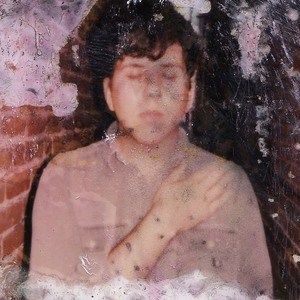
No animals were hurt during the creation of Eric Slick’s new Bullfighter EP—but, as he describes, there was certainly some emotional wrestling. Slick is best known as the drummer of beloved Philadelphia psych-folk outfit Dr. Dog, but he’s always been a man unwilling to be defined by one thing alone. Slick has long been a part of punk band Lithuania; more recently he’s been on tour with subtly funky singer (and his fiancé) Natalie Prass; and his 2017 solo album Palisades was a dreamy, psych-rock success. Slick’s latest release, a stark and jarring four-song, string quartet-anchored EP, won’t do much to pin him down either. Bullfighter is an evolution for Slick, not merely as a musician, but as a human. What began as a collection of compositions about his family’s Jewish history evolved to incorporate the story of America’s first matador in Spain: Sidney Franklin, a Jewish New Yorker who became a celebrated bullfighter in the 1920’s and 30’s, befriending Ernest Hemingway along the way. But as Slick dug deeper into Franklin’s story, he found parallels to his own—a distancing from Jewish culture, a creative reinvention—and Bullfighter was born. We caught up with Slick to talk music, bullfighting and why Chanukah is better than Christmas. Your mother is Jewish, and your father comes from a Christian background—and I understand as a kid you celebrated both Christmas and Chanukah. Which wins out, in your mind? Chanukah is better than Christmas. It’s beautiful: the lighting ceremony with the menorah, the Hebrew chanting. I love Chanukah because it’s succinct. There’s nothing left to question: you get, at the most, eight gifts, and they’re usually practical. With Christmas, you’re always asking how many presents to get everyone. Plus, Chanukah is an excuse for me to make potato latkes, which are delicious. I make them vegetarian so I don’t use any rendered fat; I substitute with Earth Balance. You’ve described this project as your method of coming to terms with your family’s Jewish identity. Can you tell me about how that process began for you? At a time when most of my Jewish friends were having Bar Mitzvahs, my parents were veering towards agnosticism. I was envious; I thought the rite of passage was beautiful, but my family were liberal hippies and even a Bar Mitzvah seemed too structured. And yet I still felt really connected—every time I was at a Bar Mitzvah I knew I was with my people. At the same time, I was deeply involved with after school music programs, and reading from the Torah when I spent all my time learning music… music won. By my teenage years, we didn’t have a set religion in the house. So during my 20s, I went on my own spiritual path, discovering this new spiritual identity through daily meditation. When you meditate, you’re uncovering a lot of different stones inside you. Every day I find something about my past life that I wasn’t aware of, especially regarding my connection to Jewish culture and that part of my family. So a lot of this record was wrestling with my own origin. How far back did you reach? I mean, the musical side of my family is the Jewish side. My grandfather’s name was Joseph Steinberg, a jazz musician who played with Buddy Rich, Billie Holiday. That’s my musical DNA. But he was Joe Stone, not Joe Steinberg. He endured a post-WWII America where he had to sound like a gentile to get more work. He was a deeply troubled person, addicted to drugs like so many jazz musicians in his era. Like me, he felt distance from his identity—and I think that’s become a trope in our culture in America. So I started writing this group of songs about that fight, referencing specific things that happened in my family. And I felt the songs getting very personal. It’s art; it can’t be a diary entry. How did those initial, very personal lyrics transform into Bullfighter, which also highlights the story of Sidney Franklin—the first American matador in Spain. The idea first came to me during a meditation. Often when sticky or fascinating phrases come up to me while meditating, I’ll write them down: bullfighter. So I looked up the first American bullfighter, and found Sidney Franklin—and found out he was Jewish. He grew up in Brooklyn, had a really bad home life. He scorned being Jewish, so much so that he basically created a new character for himself. He tried to distance himself from his culture so much that he ran away. He was violently gored during his career, and he hobbled through the rest of his life until he died in an old folks home [in 1972]. It felt tragic to me. And the parallels felt interesting. I have this super American name—no traces of my Steinberg family name. And I feel so far removed from my culture, just like this guy did. Beyond the Jewish part, also—I mean, I’ve lived my whole life as a drummer and now I’m diving into the songwriter piece. The EP cover is a decapitated bull’s head. This whole process is a self-decapitation; I’m trying to start over and get back to the beginning. And I think the analogy is there with all of us.
So as you researched Sidney, what captured you the most? And how did his life really factor into the songs you were already writing? I didn’t want to do a Sufjan Stevens thing: like writing a song about John Wayne Gacy, where it’s very direct. I wanted to keep these songs elusive and ethereal, but also retain the intensity of what I’m talking about. The first song in the cycle is “Bullfighter,” which is the clearly about Sidney. In 1931, he got gored by a bull and it ripped right through his abdomen—I sing, “The sacred sight of the animal let loose, the emblem tore my abdomen in two.” In Spain, Sidney was close with Ernest Hemingway. There’s speculation that they were actually lovers, but neither of them would admit their bisexuality. To be Jewish and queer, for Sidney, I’m sure felt super, super unacceptable. So he’s posing as this matador, weighted down by the knowledge of his own truth. That’s the chorus of the song: “Weighted lovers living in despair.” The sound of these four songs is far different than the music you’ve created in the past—from Lithuania to Dr. Dog or your last solo album. When did the idea surface to use a string quartet? From the beginning, really. I want all my solo projects to be different. After this, I’m sure I won’t make another gothic-sounding string record. I long for the days when a Neil Young would put out Harvest, then a few years later put out Trans, this wild vocoder album. I get really inspired when a musician takes a risk that could lose a lot of people. If you’re not pushing and challenging yourself, I just don’t see the point. You have to have some skin in the game and try to challenge yourself with every release. People might like this or hate it, but I’d rather it be polarizing than sound exactly like a Dr. Dog record or Palisades. Not only the style is different for you, but the tone. This is really heavy, even spooky music. The word ‘fighter’ is intrinsic to the nature of the project – it’s a fighting piece of music. I don’t want people to passively listen to it. if it scares the shit out of you, that’s great. I’m usually a pretty happy go lucky guy, and friends are asking me why I made such a scary, unsettling record. I feel like in my art, I’m trying to take the things from my subconscious that are darker, but I’m not necessarily suffering through that stuff. People find meaning in spite of suffering – I think about that quote [from Holocaust survivor Viktor Frankl] a lot. The cover of Bullfighter was painted by Cal Schenkel—who also famously created cover art for Frank Zappa, Captain Beefheart and tons of others. How did that connection come about? I used to play with the Zappa alumni, and Cal was aware of me because he stays in touch with everyone. We were Facebook friends. Last year my mom bought me a Cal piece for my apartment. When it came time to decide the artwork for the EP, I was wracking my brain. And I thought maybe I’d just email him, just to see. He got right back to me—and he doesn’t live that far from Philadelphia, so we had a lot to talk about. But I still didn’t know what I wanted on the cover. I meditated on it. I closed my eyes and the image that you see is what I saw in my mind. He turned the art around in a week, and it’s so him — I was really happy it retained all the qualities about his art I love. It’s kind of cartoonish, a little grotesque. But doesn’t feel threatening. It’s a cathartic picture, not just a dark picture. Between this EP, playing with Natalie and releasing a Dr. Dog record — has 2018 been overwhelmingly busy, or perfectly busy? Overwhelmingly busy. It’s been a lot. Next up, I’ve got a tour with Natalie in January, then Dr. Dog in February. But my March to August is totally open. I’ll use that time to finish the 12 songs for my next solo record. Then, maybe, I’ll take some time off.





