

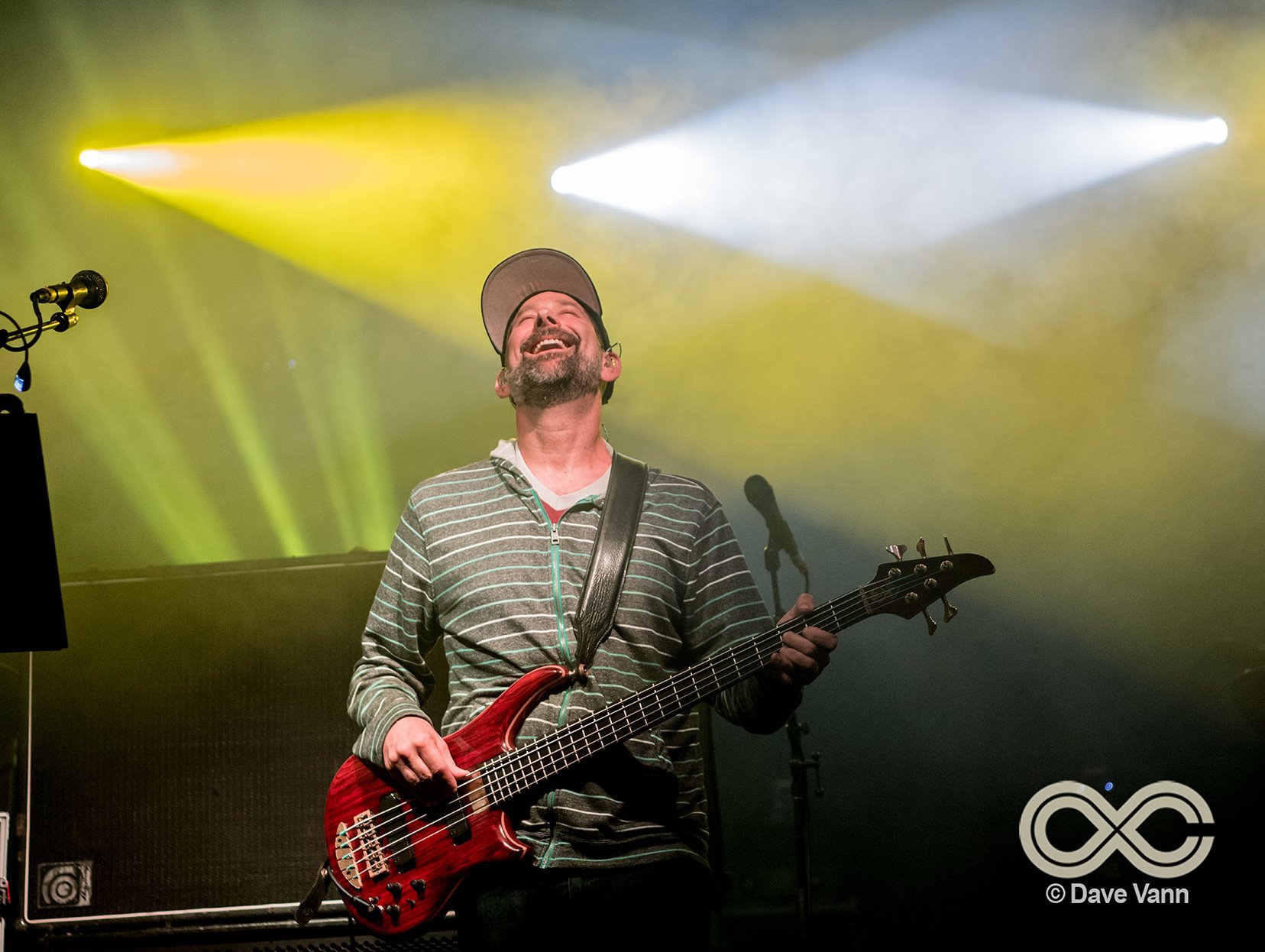
“Wehave a slogan, it’s ‘improve not improv,’” Marc Brownstein says, discussing theDisco Biscuits’ techy TractorBeam interludes. “We have three and a half hours:30 minutes of songs, 2 hours and 45 minutes of pure improv and like 15 minutesof composed house music. The point of that 15 minutes is we want to workthrough it as a band and learn all the different kinds of dance music. Itsounds like the Biscuits, but we undertook this as a project and said ‘Let’ssee how much we can learn from the hugely vast library of music that is outthere.”
Callingfrom Denver, in a pre-quarantine world, the bassist discusses his recovery fromeye surgery, his work with Star Kitchen, the state of the jam scene and more.
You’ve been recording with StarKitchen. Is there an album coming out?
It’skind of a writing session and recording session- so we started from scratch andwe wrote two new original songs and they'll be released in a couple months, oneat a time.
I obviously want to ask about yourhealth and your recent eye surgery. How are you feeling?
It’shard to talk about a little bit because I don't wanna sound dramatic. Butsaying it as it was, it's very dramatic. It's a very slow recovery process andit’s gonna be going on for like four months or five months or something likethat.
Wow.
It’sslowly getting better, but very slowly gettingbetter. It’s just- it's a little frustrating.
Ihave to have a second surgery and that's gonna take place three or four monthsfrom the time of the original surgery. Without getting too medically technical,it’s two surgeries. I’m like, “Wow, this is intense.” I cannot believe that Ihave to do this again in a couple months.
But,you know, I have perspective and understand that in the grand scheme of things,in like a year or so, I'll look back and it'll all be in the past. But it'sbrutal while it’s going on.
You said in January that you startedlosing vision in the middle of this year’s Jam Cruise, but you still went onwith a DJ set and a high-energy, event-closing Electron set. Tell me about thedecision to go on with the show and keep your ailment on the down low?
JamCruise is a magical place and I just wanted to let everybody have their magicalexperience. I talked about it with [Electron bandmates] Tommy [Hamilton] andAron [Magner], but if you’re telling somebody that something’s wrong with youreye... I knew it was a serious thing and that I was going to have to go forsurgery, but I still figured, while I'm there, play the show and just try totake it in stride. There was nothing I could really do. I could’ve taken ahelicopter off of the boat and skipped the shows. My surgeon said that's what Ishould've done. So if anybody is out there listening, PSA here: If your retinadetaches, immediately take that to the medical center, that’s what my doctortold me.
So it got worse because you didn’tleave the boat right away?
Probably,yes.
Do you feel like it's impacting yourplaying at all? Even in like a weirdly positive way?
Inthe first week or two, that was the thing, you know? Like, “Wow my hearing ison point right now!” Musically, it was just very acutely in tune
I want to pivot a little bit andtalk about the Disco Biscuits. Set break is over and you guys are more activethan you’ve been in years. What precipitated that?
You know, I think that these things for the Biscuits come in waves and you know, in order for it to all work, everyone in the band’s gotta be on the same page, at the same time. That’s where we’re at right now, you know? Starting about a year ago, it just became clear to everybody that what we wanted to do is put all of our effort in making the Biscuits the best that it can be, musically. And you know to be- I think a lot of it was precipitated just by Jon just went into a creative era like he had in 1998 and 1999, writing and writing and writing. Now, with all this new material we’re putting full effort into it.
That’s great.
Byfull effort- I mean playing a lot of shows, playing in places that we haven’tbeen in a lot of years and, of course, working to try to break down creativeboundaries that are part of the Biscuits allure in the first place. When westarted playing electronic music over rock music, most people hadn’t heardanything like that before. And when you find some music that just sounds likenothing you’ve ever heard before, it’s worth exploring that creatively andexploring it as far as we can. For us, we always wanna continue to push thatboundary and do things we’ve never done before. So that became a big focus forus in the last 6 months, how can we make ourselves better twenty-somethingyears in.
Digging a little deeper into thisnew material, are these all Barber writing credits? Did you guys flesh thisstuff out together?
I know that Magner and Barber spent like a week together working on the stuff and they brought a lot of his ideas to life in the studio. [Barber] had like 25 things that he thought would be relevant to the Biscuits. And he just recorded little demos of each of them and put them into a Soundcloud and sent it to us, and said, “What do you guys wanna work on? Take as many as these as possible and just start playing over them live and then we can continue to develop some of the themes in the studio.” After not doing that for so many years, going out and playing that many shows in a row and having so much new material to flesh out, it made every show super creative and very inspired. That's the key to having a healthy band, having everyone feeling creative, inspired, energized.
People theorize that there’s an “endof the decade” thing with the biscuits- you’ve had big years and in ‘09 and ‘99and, obviously, ‘19 was big for you guys. Do you see that?
Mustbe something like that. There must be some sort of, you know, subconsciousdrive to finish a decade off really strong and just have everyone look back andfeel good. As we turn into a new decade, it feels good about the state ofaffairs. This time around we’re a lot more mature, a lot older, with a lot moreexperience and wisdom. We’re able to figure out how to get there and be at thehigh level without the debarchy that we did in 1999 and 2009, which was, youknow, party-fueled. It was crazy.
What are the techniques or thelittle things you guys are doing that make the difference in that way?
We’veall changed our habits in life outside of the band. So once you change yourhabits you kind of want to stay on track. I mean, for me, going to the gymeveryday that I’m home. I go to the sauna every single day.
Othe creative side of things, howdoes Tractorbeam fit into this puzzle?
Yeah,the thing about Tractorbeam is we’ve had ideas in the past where we’d work onthings for two months and then do it and it wouldn't quite work the way thatwe'd have envisioned that it was gonna be. After the first night of tractorbeam, there was a question I think, in between the first show and second showof, “Are we gonna stick to it here or are we gonna succumb a little bit to thepressure of what we think people are gonna say?” It was definitely somethingwe’ve never done before, which is to play essentially the same show, two nightsin a row. I don’t know if anybody has done what we’re doing in Tractorbeam. Idon’t know how deeply [Barber] has gone into explaining what it is that we’retrying to do with Tractorbeam.
Theshort story is that we’re recreating DJ mixes in a live setting. We’re allcurating this by choosing great segments of great DJ performances of the last10, 20 years and then learning them and trying to come as close as possible torecreating the performance. And to us, we’re looking it like “Drums/Space” for theGrateful Dead. It was just something that happened in the middle of the secondset every single night- not everybody loved it but it was there. It didn’taffect how big the Grateful Dead was or maybe it did because it broke the setup in such a way that when they came back out of “Drums/Space,” there was acertain energy that you wouldn’t have had if the show had just continued on.
Andthen for us, we’ve got this incredible cool part of this show every night wherewe’re just taking 10, 12, 13 minutes recreating somebody’s famous house mix.And some of the fans have like figured it out, what’s going on and some of thefans don’t even know. I say for the majority of the people are not really surewhat we’re doing- it might just sound like cool jams. If you come to a lot ofshows, and you hear the same one a couple different times then maybe you’d havea better concept of what it is. But I have friends who I’m hanging out withhere in Denver, and I’m having to explain to them what it is. And they’re like,“Ohhhh!”
So these compositions arenote-for-note? Not just a rough sketch?
We’retrying to play exact; now, there is some improvisation inside of it, but not aheck of a lot. In the hourlong ones we take sections and we’ll be like, “Okayin this particular section we’re gonna open up a little bit.” There’s justsections that lend themselves to improv, because it’ll be like two or three minutesof just open trance, but a lot of the sections we’re playing it right as it is.Like there’s this Todd Terje song, or a mix of Todd Terje’s three songs.
What are some other DJs you guys arepulling from?
We pulled from Carl Cox, we pulled from Solomon, We pulled from the Magician. What’s cool is in the Magician's mix, there’s a Justice song in there so it's like we’re playing lots of different songs, but we’re playing it the way that the DJs are doing it.
I want to circle back to StarKitchen for a minute because it’s interesting that while you can play all thesebig rooms with the Biscuits, Star Kitchen has you going back a few notches andplaying the smaller and more intimate rooms. Is it nice for you to have thatvariety in venues now?
Yeahfor sure, even with Star Kitchen we’re lucky enough that we also got to playThe Cap with Star Kitchen, and we got to play Mission Ballroom with StarKitchen here in Denver. We played The Anthem and The Fillmore with Umphrey’s.Star Kitchen over these past couple months has had a run playing classic,awesome venues. On Star Kitchen tour on a normal week we might go from theMission on a Friday, to Ullrs Tavern in Winter Park on a Saturday, and it’sjust like a little tavern. It was amazing: After playing the mission which islike an arena, the next night we got onto this small little stage and we knewwe were gonna kill it. We were like, “Oh we’re going to kill it in here, thisis our bread and butter.”
Do you feel a certain thrill inwatching your new band grow?
Imean that’s the whole game. But you know, for Star Kitchen, we’re recording,very slowly and writing slowly and trying not to put that kind of pressure onthe band. But having those moments where there are 700 hundred people at ourshow is amazing because we go out to other places, like out around the countryand we’ll play in front of 100 or 200 and that’s a huge success to start. Like,going out around the country and having anybody show up is a thrill, such athrill. We look forward to taking the next couple of years, or five or 10 yearsand jus keeping with our plan: Build itslowly and be at the right spots. Star Kitchen is just trying to be in theright place at the right time.
And you have the experience. You’vebeen on this road before.
Yeah,having the wisdom to know what works and what doesn’t work and how to keep agood balance so you can keep growing a band. That’s the key here. We have tofind the right balance so that we can keep this thing working. I mean last yearwe did like maybe 25 shows or some with Star Kitchen. I would hope to be ableto do the same 25 or 30 shows every year and I look at how Mike Gordon manageslike his side projects. This guy has kept this band together over seven oreight years and now he has a really solid lineup and they’re committed to eachother and they do a certain amount of shows, whatever it is, a year and it’sgrowing. So I look at that, and take it as inspiration for letting two worldscoexist peacefully. And finding a way to keep so that everybody's committed tohis side project. If you can do that, like anything is possible.
Any thoughts on the state of the jamscene? It seems like everybody’s firing on all cylinders.
Yeah, the jamband scene is in great shape right now. It's funny because when you’ve been around it for 25 years, you’ve seen the ups and the downs on the scene-wide level. What I say is that a rising tide lifts all boats, and that's just the truth. You’re rooting for all of the bands to do well because when all of the bands do well, they really all do well together, you know? The scene is in a really healthy place right now. A lot of that has to do with the bands playing great music. Dead & Company, you know, they’re locked in and Biscuits are locked in and, obviously, you know you can’t have a conversation without mentioning Goose blowing up. Every year, there's another band that comes along and has an experience like that. Right now that band is Goose and my close friends who are into the Disco Biscuits, but who got into the Disco Biscuits in that one year that we exploded, in that same way, which I guess is 1999. They’re all super excited about Goose right now. That’s fun to see. A couple years ago it was Pigeons, you know what I mean? These small bands come up and kind of explode out of nowhere. It’s just a testament to how strong the scene is still, and how strong the word of mouth in the scene is. You can't manufacture hype. You can't make it up.





