

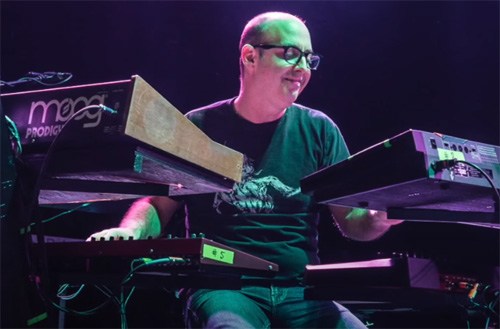
Jamie Shields has been a part of the post-Grateful Dead jamband scene for nearly its entire existence; his band, The New Deal, began in 1998, just three years after Jerry Garcia’s passing and the Dead’s dissolution. During that time, Shields was a pioneer of a new genre dubbed “livetronica” by many, gone through multiple hiatuses and lineup changes and performed with fellow jam scene stalwarts Brendan Bayliss and Ryan Stasik (of Umphrey’s McGee) in The Omega Moos. Below is a pre-quarantine discussion with Shields about The New Deal’s latest lineup, the different attitudes behind his projects and the current state of the jam community.
Last year, The New Deal announced its second return, with a new drummer, Davide Di Renzo. What was the process like for deciding to return and picking a new drummer? And which came first?
Well, like most things in The New Deal it was a fairly organic affair. I mean, Davide, for those that may not know, was supposed to be the very first drummer in The New Deal way back when.
We’ve known Davide forever. We had jammed with him at a couple gigs, and we were like, “This would be a cool band if we put something together.” And so we started improvising, Davide was--and still is, but especially at that time--a very busy session drummer and couldn’t really commit to doing what The New Deal needed to do at the time. So it was like, “Okay, cool,” there was no feedback then either so it was like, “Alright, let’s keep on keeping on” and then luckily we had hooked-up with Darren [Shearer]. And for that segment of The New Deal, we know what happened. That was a good session of The New Deal.
A good run, to say the least.
This time around, we weren’t planning on returning to playing. We were busy doing other things and figured that The New Deal had run its course. We were happy doing the other musical things we were doing. Ran into Davide at the supermarket. And he had suggested, you know, he didn’t know that much about The New Deal, certainly didn’t know about the scene that we’re in. We should get together and jam. We’re like, “Yeah, sure. Let’s get together and have some fun and be musicians and hang out.” And we did. And we started to do this twice a week. And we realized fairly quickly, Dan and I were like, it’s hard to play in The New Deal. There’s this crazy social musical dynamic that goes on where you have to be completely open and free to improvise but then on a moment’s notice switch to some other piece of music we may have. Or you may have to lead and then immediately start following but be ready to lead again. And all kinds of things are tough for drummers. Drummers are taught at an early age to follow, right? They’re taught to follow the bass player, follow the song, follow the music, whatever it may be. So it’s a high expectation for drummers, especially to play in the style that The New Deal does, very free, very organic, very open. We feel we’re creating music. We’re writing songs on stage. We’re jamming. We’re trying to create bodies of music. So that took a little while for a guy as talented and musically aware as Davide, it took him awhile to understand what was going on. But, during all these jams we were recording them. Because we record everything. Because we are obsessive about recording. Because The New Deal wouldn’t exist if it wasn’t for recording our very first show as The New Deal. We recorded just by chance and that became our very first album.
We record everything. It’s a good thing we did, cause we ended up with about 50, 80 hours of amazing music. Which has done two things. One, sort of encouraged us to be like, “You know this is a pretty good iteration of The New Deal, it’s very creative, it’s sorta return to form from the early years. But it’s also got Davide’s stamp on it, which is very progressive. He sort of fell right into what we’re doing. After a while, he understood it completely. And we never had to say anything again about what to do when we improvise or jam. And as a result, we have so many hours of music that we started something that we call, The Asylum Sessions. And we’re just releasing all the music. It’s just hours of us just improvising in Dan’s Studio. So the album, Phoenix, which we put out about six months ago was Volume 1 of The Asylum Sessions. Volume 2 was called The Asylum. And our next album, which is coming out tomorrow, is called The Age of Discovery is just another hour and a half of amazing music that we improvised live in Dan’s studio. You know, we never made that plan to release it. But when we listened to it, much like our first album, we didn’t make a plan to release that but when we listened back, we were like, “This is amazing music.” So when we put out and, you know, it’s tough to get a machine up and running again like The New Deal, I mean, you’ve got a bunch of people engaged and as pumped as we were about it, but once they listened to the music we had made, plus it’s hard to get everybody back on board, Dan and I made the decision at the time, “Well, if we’re going to do it, this would be the guy we’re going to do it with.” So we were like, “It would be a waste of quality music if we didn’t share this with the people that listen to The New Deal, listen to this kind of music.” So we made the decision to play some shows and put up some albums. We played, I mean, it’s been transformative, the past month. We were out, played about 15 or 16 shows in January, the reaction to a lot of people was nothing short of incredible. The people that were listening to us were so happy to see that a) we were still playing music and b) returning to a form that we feel that we can be at which is a high level of quality music. So it’s been great to see a large return of people who were always in our corner and a lot of new fans who are like, “Wow, these guys actually are pretty amazing.”
It was nice to take that gamble and sorta make that prediction that people would be into what we’re offering at this stage of the band. And that was the gamble we took when we said, “Alright, well let’s get this back up and running and go on the road and let’s see what we do.” So we had decided early on, we were like, “We call this the Smallest Room in the City Tour,” like were just going and playing really, really small venues, in some cities, much smaller than we should be playing. But it was our intention to just go out and make music and not worry about selling tickets. If you just think about it from a musical perspective, then nothing else matters. And if nothing else matters when you’re on stage, then you can just do what you want to do. Which is to inform the world about how great our shows are right now and not worry about anything else. So that was our plan from when we started playing again back in June, and it has been, to say the least, wildly successful. Enter stage 2 now as we move into 2020 and sorta increase the size of the venue and put out more records. The New Deal never put out records. I mean, we put them out, but they were like once every 4 years. We’re putting out 3 records in the space of 6 months. It’s a whole different approach to music than we’ve sorta engaged in in the past. And I guess it’s cause we have the content and the energy, the creative energy, to do it.
To go back in time to the beginning of The New Deal, it’s safe to say you guys were one of the first to adopt the electronica style of improvisation.
Some call it, “Livetronica.”
Right, “Livetronica.” So, when The New Deal was just starting, did you guys think to yourself, “This is like a niche that hasn’t been tapped yet and we’re gonna tap it,” or was it an organic discovery, where you looked around and thought, “Oh, look at this, this is a niche that hasn’t been tapped yet.”
Yeah, it was; if you think about it, if you were gonna have a plan that The New Deal followed, which we didn’t, but if you were gonna have a plan it would have to be described as making 45 minute instrumental pieces of improvised music. That doesn’t sound like a good business plan.
Yet you have two other guys going, “That’s great.” If you found two other guys that are into that concept, then you kinda go with it. At the time our goal was just to play what we wanted to play and make the kinda music we wanted to make. Which was, I’m just going to play kinda what I want to play and our band aim on stage is, as I’ve said before, is to just create songs, try and write songs on stage. As it turned out, you know, I mean, the line that I’ve thrown away in the past, “As far as I can see, I’m just playing soft rock up there and the other two guys are making modern beats underneath.” I’m into electronic music to a degree, but, you know, if I’m going to put anything on my computer or on the stereo, it’s probably gonna fall closer to something like either Frank Zappa or Brian Wilson. And the things I have in common with those types of people, and I would never compare myself to those two guys, if there were any sort of overlap it would just be my love of beautiful chords and my love of taking chances, love of sort of creating interesting music that maybe hasn’t been done before. But I’m not stepping out everyday saying, “Today I’m going to make something that’s never been heard,” right? I’m going to step out on stage like, “Okay, we don’t have a set list and we don’t know how we’re going to start. I can kinda start,” right. That was what I was feeling at the moment and that’s been the thing for The New Deal since the very beginning, for better or for worse, is just play what you feel. And that’s why, if I refer back to what we were talking about drumming in The New Deal, or being a member of The New Deal, where you have to be ready to lead or you have to be ready to follow, you have to play what you feel. But if someone else is also playing what they feel then you have to find your way to compliment that or support it or take it somewhere else. So your brain is tired at the end of a New Deal show cause there’s a lot of signals and instructions going on inside your head. Which is like, “Okay, I’m gonna play what I feel but at the same time I can’t step all over everybody else.” So, returning to the question, were we thinking about a niche, no. We were thinking about making music that everybody enjoyed. And when I listened back to our very first concert, I remember I said to Dan Kurtz, our bass player, who was with me as we listened to it, “If we can find 0.5, a half a percent, of the music listening population that feels the same way as I do when I’m listening to this right now.” Because, it was a very special feeling in what I was listening to, it was hitting me on a gut level. “There are 0.5% people in the music listening population in the world that can feel the way I do, then we should do this.” That was the antithesis. That I feel something that I haven’t felt before when I was listening to music. And I think that other people would feel the same way, right? And it was true. It was the people who engage in The New Deal and the experience and engage in the experience of a live concert know that it’s exactly in the moment and that it will never be like this again, no matter what we play. Now we have, we’ve gone back and are playing a lot more songs than we used to. But you know, The New Deal can play about 50 or 60 little sorta, I don’t know, they’re almost like little ‘jazz-heads,’ right? That can take up a good 6 minutes of a 60 minute set. The other 54 minutes are completely improvised. Completely of the moment and of that time, and you are lucky or unlucky, depending on how you feel about that, if you happen to be in the audience for that concert, you know that what you’re experiencing no one will ever experience again for better or for worse.
It’s in that moment, and that’s the approach that we take now. “Hey man, there’s going to be good and there’s going to be bad but I tell you this, it’s going to be something that you never experience again, even if you come to five shows in a row.”
We did it with Umphrey’s McGee [earlier this year], and we did the last five shows as a live stream. And, you know, people were like, “I listened to all five of those shows,” and you know, they listened to all five of them because they weren’t going to get the same show. They knew that when we stepped up, forget that, you know, we make sure that we try not to play the same songs two nights in a row but even without that, it’s like even if we did.
Yeah, it wouldn’t be the same.
I challenge someone to line up those two concerts, play them at the same time and see exactly where they repeat themselves. It doesn’t happen. It’s like yeah, you’ll get a minute here or there if we play the same tune but immediately following it and immediately preceding it would be completely different. That’s kinda the mandate that we have, just go up there and make music that you feel. Everyone feels differently everyday. So when you step on stage, the environment you’re in, the mood and feeling you’re in, the relationship, your musical relationship you have with fellow musicians that particular night, is going to effect and impact and color what you decide to play that night. And that’s how we approach every night.
That makes complete sense. And I think that’s part of the reason why there are so many rabid fans for bands such as The New Deal and others in the scene--they know that every night is special. Like you said, even if it's not good, you get to watch the musicians attempt to make magic. Even if they fail that makes it more exciting when they do create it.
Exactly. And it makes the good moments even better because you know there's no safety net, there’s no fall back. If it hits and everything falls in place, then you know that what you’re experiencing is an aligning of the musical planets at that exact moment, it worked. It’s a cool feeling.
Yeah, absolutely. When I used to play in a jazz band in high school, my band director used to say that: “After a show, you should be much more mentally tired than physically, because your mind should be working by far the hardest, which would lead to your body working less hard.”
Oh yeah, 100%. I am exhausted mentally at the end. We require fifteen minutes of silence just to get our act together at the end of the night. I like to see my friends and I like to see people and talk to people who are into listening to what I do, but at the end of the show, I need to let my brain simmer for a little bit.
Yeah, that makes sense; you need some time. Speaking of taking a break, I want to talk a little bit about the New Deal’s timeline. In 2011, you all decided not to be active as a band for some time, so I’m curious what led to that. Why did you feel that you needed some time away?
I always say about touring in general, that “The 2 hours of performance a day on the road have to outweigh the other 22 hours of the day.” Because the other 22 hours of the day are fairly painful in a number of ways, between the travel or the ruthlessness or just the general change everyday, that’s the deal. It’s life on the road. And in order to make that sustainable, the 2 hours on stage have to outweigh the other 22 hours. So what started to happen for us, the 2 hours were not outweighing the other 22 hours anymore. The reason was not personal, we all, I mean Dan, the bass player, and I have been best friends since we were 13, and still are. That’s a pretty strong bond, if we’re still best friends after being through this band for however many years.
That’s not the story of many other bands.
Absolutely. I try to explain to people, “When you’re on the road, pick 5 coworkers. And imagine waking up and they’re there, eating breakfast with them, sitting next to them in a vehicle, a bus or a plane, then being with them in a room backstage and then being really creative with them on stage and having to succeed, then getting off stage and being back in that room with them, and then going to bed and waking up to doing it all over again with those same people. You have to be durable. Not just durable with those other people, you have to be durable within yourself. You have to make sure that you understand that I have to modify how I act, because I’m responsible to other people and I’m responsible to making sure that this operates well. We were still friends but we were just reaching a point, I think creatively, we had to readjust. We found that we went to the well and there wasn’t enough water there at that point to continue making the quality kind of performances that we felt people listened to The New Deal needed to make, you know? So it was like, “Okay, we’re just gonna take a break.” And we had taken breaks before. We had been on the road relentlessly for the first 6 years of the band. And in 2005, I had my first kid at that time. So we took about 8/9 months off, right?
That makes sense.
It was like, I needed to take some time off to sorta see what life is like when you’re not on the road. So we did that and was like, “Oh I like life not on the road but I do like life playing as well.” So at that time, that was sorta just a little break…That’s what informed our touring for the next, say, five or six years. “I need to balance between being at home, being a non-musician.” And that worked. Then we’d get on the road and the creative zaps the body just wasn’t there. It felt broken. If I’m not getting off on creating music on stage, then why am I here?
I’m here to try and create sorta sublime musical experiences for myself and for the people that have paid good music to come and see me. And if I feel that I am not doing that to the best of my ability anymore then I shouldn’t be cheating people out of their ticket money. So we said, “Okay, we’re going to stop.” And were we going to come back? Maybe yes, maybe no. It wasn’t really a concern at the time. But our drummer Darren, who sorta made the choice at that time that he was going to stop playing drums and he was going to pursue other activities in his life and move to LA. I’m certainly on a friendly basis with him. I don’t really speak to him that often but there’s still no ill will between us.
No bad blood between you guys.
If I saw him I would give him a hug and I would talk. But we’re not in touch. He sorta put this part of his life aside.
It’s like an old high school buddy or something.
Basically, and it’s funny because people who now hear the band with Davide, as far as I’m concerned, it’s as good if not better, with all respect to Darren. I think this is the best iteration of the band that I’ve ever been in. It is as exciting if not more exciting than in the premiere era of The New Deal. There is far more depth and breadth now than there was back then. Back then, I mean there was much more. I would say that what we do now is much more reminiscent of maybe the first 18 months of The New Deal when we had sorta decided we were going to become solely an electronic improvisation band. There are a lot of different things going on now that I really, really love. So that part of it was exciting, but it wasn’t at that anymore when we took our first break.
Yeah, I was going to say, you know, that you could feel the best in the band now and it has nothing to do necessarily with the skill of any of your drummers, considering all of them are quite excellent. It’s not like, “Oh Davide is the best drummer therefore this is the best band.” Your mind and the way you’re approaching the music right now is as good or better as it has ever been.
As a unit, 100%. And that is what this is about. There’s not a lot of solos. Some bands decided that their version of jamming is that a bunch of people are going to vamp on a groove and some one is going to solo. Right?
The Grateful Dead model, basically.
Or even the Phish model. And I saw 45 or 50 Phish shows, so I was into Phish. There’s not a lot of that in The New Deal; it’s all as a unit. So, you know, I listened to something right now, a show of ours from a couple weeks ago in Colorado. And it was interesting cause I was taking a little solo and I thought to myself, “Huh, this is rare, a solo.” The thing is, that it’s all about the unit. The whole is much greater than the sum of its parts. You can’t have three guys doing it, you have to have one single unit. And right now, I definitely feel that the unit, that the musical unit, is stronger than it has been in a very long time.
Well, speaking of, I guess we never really touched on the middle period of The New Deal when Joel Stouffer was the drummer. What led to uniting for the first time with Joel, and how did that partnership--or, I suppose, trioship--play out?
It was, good question. TND 2, which we’ll call that era, was a very important era because it very deeply informed the decision that made TND 3, which is now. One of the reasons that we stopped [in 2011] was that we felt there was a shift in the music scene that we were in. We would go and play a bunch of festivals and it was a lot, a lot, a lot of DJs. In the year leading up to that it was a lot of DJ stuff. And we found that we weren’t fitting in anymore, in say festivals or multi-artist line-ups. And we felt like it wasn’t our moment at that time. So as the years progressed into 2014 or 15, and we saw a sort of resurgence, and some of this has to do with Daft Punk, I think, when they released their Random Access Memories album, that there was sorta this return a little bit to live based playing. And those guys are anything but live based playing, but the album sounded a lot like live.
Guys like Pretty Lights started doing live band stuff also around that time, I think
Exactly, exactly right. Or a guy like Tyko or whatever when they have a full band. So it felt like the time was right to try and return to the stuff we were doing. And we took a little bit of a different approach at the time. The reason that Joel came about was that Dan, the bass player in The New Deal, also had another band called Dragonette. They were huge, had a lot of hits, did a lot of stuff. And Joel was the drummer for Dragonette. We couldn’t find a drummer in Toronto that we could practice with once or twice a week to sorta teach the ways of The New Deal. And Joel, who I knew for a long time before that, is a good drummer. We decided to just give it a fling with Joel.
In the beginning it seemed to be moving in the right direction. It felt right at the time. As we moved along, I was feeling that it wasn’t as collaborative on stage, as it should be. You know, what we were talking about a couple of minutes ago, it has to be as a unit. It has to be everybody pulling and contributing musically on stage. And as we started to play shows, it felt to me that it wasn’t a full New Deal experience. It was getting a little tough for me in particular to improvise and create the music I wanted to make on stage with Joel. That’s not saying that Joel is a bad drummer, what it’s saying is that as I said earlier, that it’s really difficult to be the drummer in The New Deal. Like it’s really hard. And not everybody can do it. We found out after a little while it just wasn’t feeling good. And to be perfectly honest, it was reflected by a number of people that were coming to see us play. And I don’t blame them. Cause I felt at the time it wasn’t as good a New Deal experience. And we sorta burned that trust with our fans. So at the time, which was about three years ago, I said, “I can’t do this right now. I’m not excited to get on stage because I don’t think it’s going to be some sorta sublime transformative experience.” When I say that informed our decisions for TND3, I’m not saying that lightly. When we decided to come back, we made a list. I made a list of things that had to change in our approach to The New Deal. Not just onstage, but off stage. We would approach our offstage New Deal experience much the same way we’d approach the onstage, which is “Okay, let’s see what happens.” We couldn’t do that anymore. The seismic shifts in protocol and accountability, expectation, responsibility, all the boring things you don’t want to know about but you need to have to have a happily working band business, those things had to change. I equated it to, nobody wants to, if you have cockroaches, nobody wants to turn on the light and see them. You’ll just keep the lights off and pretend they’re not there. That’s what we did for a long time with our band.
The decision was made that if we’re going to do this now with Davide then we owe it to him, to ourselves, to our fans, to the general New Deal band to do this right and to make the changes we need to make. That took a lot of time as well. A lot of that was informed from TND2, I didn’t try to solve the problem, I just went along with the problems. Not to say that anyone else was the problem. I’m not saying that Joel was a problem or whatever. It was just general issues that we weren’t taking care of, just letting pass, and then they were coming back to haunt us later. And so, you know, it just kind of sizzled out in late 2016. We had made Mercury Switch, which to me is a great record, it has like at least 4 or 5 great songs, a bunch of which we play in concerts. I’m proud of that record, we play it in concerts, but it’s not particularly a New Deal. At least, when we would play the songs live on stage, they weren’t particularly New Deal. You know, what we do with those songs now is very, very different than how we played them when the album came out. So it’s far more of an experience now than it was previously, which was, “Let’s just play the song as is and move on to something else.” That’s not how a New Deal concert is supposed to be, it’s supposed to be a journey from the minute you start to the minute you end. And it wasn’t a journey, it was kinda like an elevator ride. Okay now this floor, now this floor, now this floor, like that.
Speaking of Dragonette, I was just wondering if they are still active at all or has that sorta run its course?
The Dragonettes aren’t playing anymore for a number of reasons. One of them being that split between Dan and Martina [Sorbara]. But I think that it had already run its course. It was sorta shifting from being a band to being Martina. And that happens. Martina has become a solo star and [has collaborated] with various music stars in Europe and wherever else, so there’s no real need for a band anymore.
That makes sense.
So when you combine that with the split then there wasn’t much of a reason for Dan to try and keep that going. Then you add in the fact that The New Deal was revitalized, then there’s absolutely no need for Dan to keep going with that. For us it’s about a positive experience: a positive musical experience, a positive social experience, and a positive creative experience. And, I don’t think that Dan was getting any of those things by the end of Dragonette.
And then, the last thing about the Dragonette sphere. You mentioned that you’re not in touch with but are on good terms with Darren. What is your relationship or collaboration, if ever, with Joel?
I am still friends with Joel. I don’t see him that often. Joel has now become more of a songwriter and producer. And he’s doing some good stuff. He’s been working with some artists, he’s getting some good play, and I think he signed a publishing deal. So he’s definitely using music. And I think that, that’s kinda what he wanted to do. He joined The New Deal with the best of intentions and we had him in with the best of intentions. But, you know, it wasn’t really his cup of tea. And like I said, it’s not everybody’s cup of tea. You have to kinda take it if you want to do it. He was far more interested in songwriting or arranging or production for other artists. Even while doing The New Deal stuff and that’s what excited him. That’s what excites him. And if you can find something that excites you musically, then you have to go with it. And that’s how he keeps busy.
If I saw him I would have a drink with him, for sure. We don’t have a lot of fights. We don’t have a lot of people that don’t like us. When we find people that don’t like us, we’re like, “That’s odd.” Because we’re usually billed as the nicest guys around. We’re friendly with everybody. We try to be fair with everybody. We haven’t made a lot of enemies as The New Deal. And certainly not within the band’s inner circle, I can’t think of really anybody that would be like, “Oh those assholes.”
Of course. Speaking of side projects, I want to talk a little bit about The Omega Moos, your project with Brendan [Bayliss] and Ryan [Stasik] of Umphrey’s McGee. I believe you’ve known those guys for a very long time. What’s the mindset with The Omega Moos, and what are you trying to get out of that project that might be different from The New Deal?
The catch phrase that we use in The Omega Moos that we use for anything is, “It’s the Moos.” What that means is, what “It’s the Moos” means is that “It’s cool.” That anything goes, if you screw-up, that’s fine, “it’s the Moos.” By no means am I putting down the Omega Moos; that [catchphrase] crystallizes the focus of the band, which is: It’s supposed to be fun, it’s supposed to be hanging with friends and it’s supposed to be a lot of laughs.
And that happens a lot when we’re with the Moos. We’re constantly laughing. We’re messing lyrics up, we don’t mean to. But what we’re doing is we’re trying to respect our musical friendship. This started as a means, it’s funny, I was just talking about this with someone the other day, The Omega Moos have created this aura. We don’t care, like it’s all good, anybody can come and have a good time with us. You can get sloppy with us, maybe we’re gonna get a little bit sloppy. But we’re all here just to have some fun. And one of the purposes that it serves, if you take a band like The New Deal, but you particularly take a band like Umphrey’s McGee, those guys are one of the hardest working bands in music today. Those guys were on the road
for 120 shows a year forever. They’ve scaled back a little bit.
Not even that much. They still play a crazy amount for how big they are.
They still play a crazy amount. They’re huge. Every single success is deserved. Every single success is the result of crushing hard work, like immense hard work. Like stage stuff, the lights, the PA, the arrangements, the sound, the amount of time, focus, and energy put into their fan engagements, their love of their business, building their business, the chances they took with their business. And that makes it a very serious operation. As it should be when you have that much money on the line. Everything is very serious and it has to be at the level of Umphrey’s McGee. The Omega Moos are the opposite of that. So what it does is it enables two very hardworking, very focused, very serious guys, like Brendan and Ryan, to be able to get on stage and make music and just have fun with their friends. And not worry about fluffing the notes, not that they would get in trouble with Umphrey’s if they did that, they’re all great guys, they’re the nicest guys I know. But, you have a responsibility when you’re in that band to be doing what you’re supposed to be doing. The arrangements are incredibly complex in that band. The musical stuff is like Zappa Ask, you got to be on your toes, you got to have your brain going 100% and that’s that.
Your brain is definitely tired after an Umphrey’s set.
Yeah, so in The Omega Moos, it’s like a relief valve. It’s like: “I’m going to open a beer and I’m going to play some 80s covers with other great musicians, and I’m going to have a great time doing it.” And that is like a relief valve, for them and for me and for Davide, who is the drummer in The Omega Moos as well.
When did Davide join the project?
Just pretty recently. His first gig was two weeks ago in Columbus. He’s got the same sense of humor and the same musical knowledge as me and Brendan and Ryan and I knew that he would be a perfect fit. The previous drummer, Nick, good drummer and there was no problem with what he was doing. But I knew that Davide could click a little better with what we were trying to do and the fact that I play in a band with him would make him available whenever I was available. Not that Nick wasn’t available, but it just made it easier. And he got it, right away. He fit right in there with the humor. And Brendan and Ryan love him. So it makes for a fun time. And it’s got to be fun, the mood can’t be work, it’s got to be fun. And that’s kinda the purpose. It’s supposed to be fun for us and that rubs off on the people in the audience. “Fine, this is supposed to be fun, I’m not going to worry about if they mess-up a verse.” You know, it’s just a good time, which is what it’s supposed to be, which is kinda rare in music when you reach a certain level, it’s not really a good time anymore. It can be creatively fulfilling but it’s rarely a good time because of the travel, because of the expectations, because of the work. It’s a business.
When did the Omega Moos start initially?
We started around when The New Deal took that eight month break when I had a kid. Dan had moved to England to do Dragonette. Darren and I were looking for something to do. (Darren was in the Omega Moos originally.) We started a side project called The Join, eventually, which was me, Darren, and somebody else just sitting in. It’s been Marc Brownstein, it’s been Aron Magner, it’s been, you know, a bunch of people. It’s been Joe Russo and Marco Benevento. We just go off and start jamming. Yeah, we had two drums and two keyboards, that was incredible.
That would be a serious moment.
I’ve been in like 12 side projects with Marc Brownstein. We used to play with every single person you could ever think of. We’d always laugh cause we got all these bands and we just have to decide if we were just going to use one of them and play. We couldn’t find those people, cause it’s all different people. But Moos was a thing where Darren and I got in touch with Ryan, and we were going to do some trio shit. We were just going to play some covers, we didn’t really know what we were going to do and Ryan said, “Why don’t I bring a guitar?” And so we were like, “Sure, sounds great.” And we just played a lot of covers and jams. And that just kind of morphed into… We would laugh and be like, “Okay, so we’re going to have a mandate. The covers have to be between 72 and 85 and they have to be sorta dance party-ish, a little bit. And those are sorta the only rules that we have.” And sorta anything else goes. “It’s the Moos.”
I’m curious about your take on the current jam scene, considering you are someone who’s really seen it all. The beginning of The New Deal to now has spanned most of the post-Grateful Dead jam community.
I think it’s better than it’s ever been. It’s really, if you spend just a second looking around as a music fan, it’s really hard to ignore. Right? Like it’s there, you may not like it, it may not be your cup of tea, you may be into country music or hip hop or rap.
It’s impossible to ignore. If you uncover it, then it’s like, you know, it’s almost like walking down a quiet hall, hearing a sound, opening that door, and it’s the world's biggest party happening inside. “Well, how did I not know about this? Look at all the people that are here.” And that’s kinda how this is, it’s like, you can spend your life not knowing about the scene, but if you decide to sniff around then this world of possibility, that people who are not aware, opens up. The level and depth, breadth and sheer number of bands that are making quality music out there that are sorta improv based, I don’t think has ever been bigger.
One of the things that make it such a big scene is that there are other bands that aren’t particularly jammy or improvised that are also related to this scene. Take a guy like Jeff Tweedy or take a guy like the dude from My Morning Jacket, there are..
Yeah, Jim James.
Yeah, exactly. There are these connections that one may not necessarily think they existed, but they do. There are all these sort of non-improvisation, non jamband, for lack of a better term, musicians that you know about, that are out there, that are connected to the scene, and that expands the scene exponentially.
Yeah, like we recently, over the summer, we had Vampire Weekend on the cover of Relix. And they’re a band nobody would think of as relating to jamming at all. But, as it turns out Ezra Koening is influenced by The Dead and the drummer Chris Tomson, likes Phish. There’s all these connections that really open up the scene to a wider audience. Which is great.
One hundred percent. Any time that somebody can be introduced to a new style of music - and that goes both ways. That goes jambands being introduced to a new style of music, whether that be Vampire Weekend or My Morning Jacket. Or the other way around: a My Morning Jacket fan whatever being like check out the Disco Biscuits. [That] does nothing but good for our scene.
To wrap up: Going forward with The New Deal, are you going to see how the tide takes you, as it were, or are there concrete goals and plans for the future?
We can’t allow the tide to take us anymore. That was one of the changes in terms of expectations, accountability, and everything else that we decided when we started TND 3. We’ll be releasing an album every three months, basically.
Got it, and that would be like The Sessions?
Yeah, the Asylum Sessions. I think Volume 2 [came out] February 7th. But it’s like, we have so many albums that a release doesn’t matter anymore. I mean I just want to review our set album No. 1, which is called Phoenix, read a review of that yesterday and someone pointed out that, that album was released in the middle of the night. Yeah, we’re just putting it out there. What are we going to do, get a billboard? We have another album coming out in three months later and another one coming in three months after that and we got a fully mixed multi-track live album coming out in about two months.
Oh wow.
Flushed with music, it’s an amazing album. It’s a concert from Charlotte in November. The New Deal has put out live albums before, but it was few and far between; it has to be a special album for it to be there. So this is an amazing record. And the album that’s coming out tomorrow, it’s tough to finally agree on which awesome piece of music you want to put out there for people to hear. We never had that experience before. Right, we never had all this music ready to go. We relied on our live improvisation in concert and that was that. But now the future plans are basically, release an album every three months and you can’t, you have to go and play. When we decided that we were going to do the Smallest Venue in Every City tour, the intention was to introduce Davide and to introduce New Deal back as a viable band. That has succeeded. You can’t stop playing now. You can’t stop playing concerts, it’s like, people are fired up to see the band. What am I going to say? No? There are tens of thousands of bands that would kill to be in my position now. People really want to see your band play, they’re really into the music you make, and if I was on the outside looking in, I would be saying, “What is that idiot doing? Why is he not going to play concerts? Isn’t he a professional musician? Go and play concerts, what are you doing? Get on a plane and go play a concert, like what are you doing? Why are you here if not to play concerts?” Like, that’s why I’m here, and I said to my wife the other day, “This is what I’m built for, like I’m built to be the keyboard player in The New Deal. This is what it seems that I’ve been put on Earth to do. I’ve done a lot of other things in my life, some of them have been good and some of them have been fulfilling and some of them have not been fulfilling, but I can tell you that the one that feels the most natural to me is the one I’m doing again now, which is being the keyboard player in The New Deal.” It just feels what I am built to do. That’s my future plan, is to be true to myself, be true to my musical self, continue to be the guy in The New Deal. It’s what I love to do.





