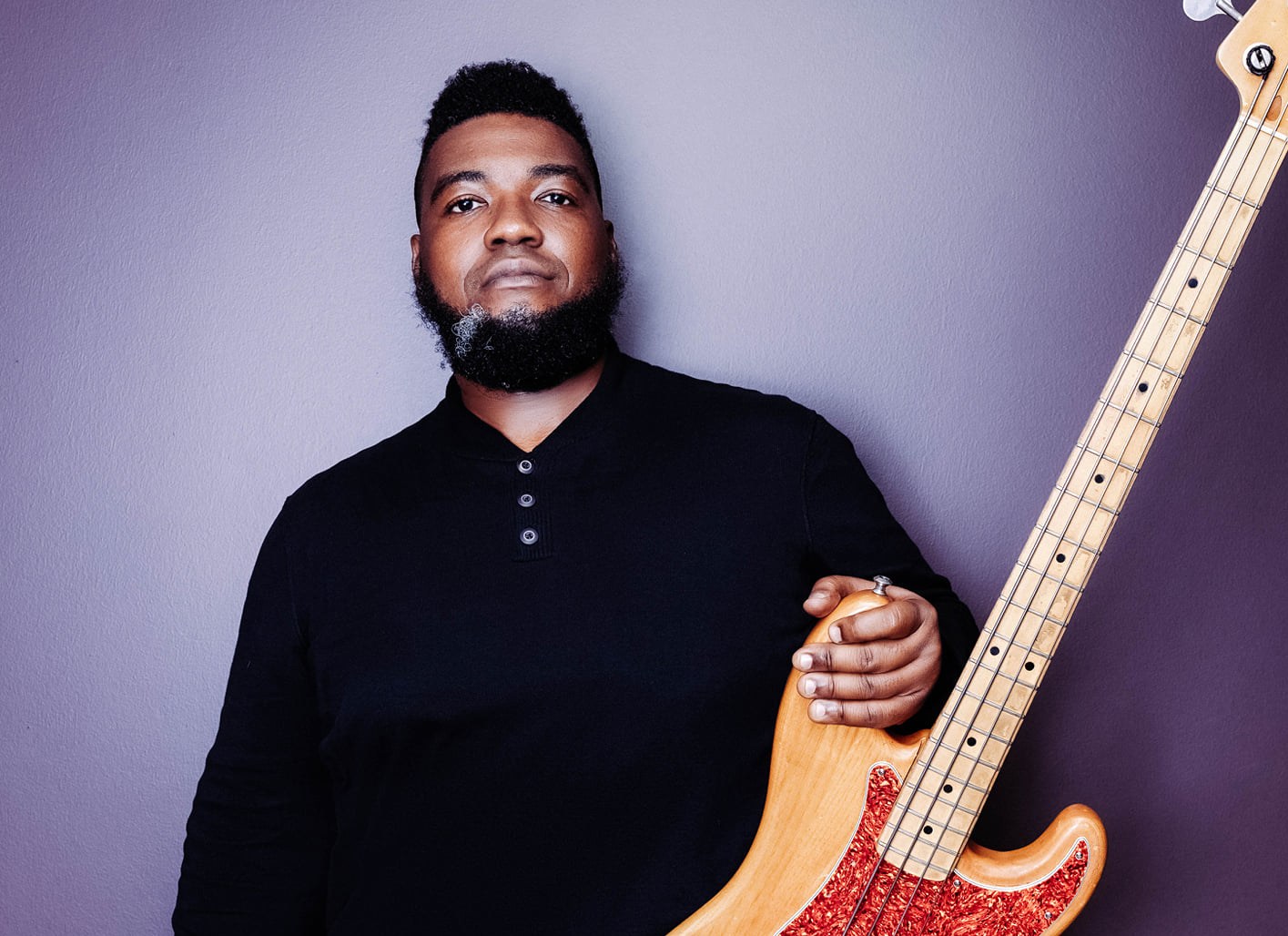
Dezron Douglas may be a new addition to the Trey Anastasio Band’s lineup, but the bassist has actually been in the project’s orbit since its inception. A musical prodigy, the Hartford, Conn.-bred Douglas grew up playing the low-end instrument in church and studied African American Music at the Hartt School of Music. While in that prestigious program at the University of Hartford, he met trumpeter Jennifer Hartswick, who left the Hartt and began playing in an early incarnation of TAB. Hartswick and Douglas stayed in touch during the years and the bassist eventually met and befriended the other members of Anastasio’s current touring combo: late bassist Tony Markellis, trombonist Natalie Cressman, drummer Russ Lawton, keyboardist Ray Paczkowski, percussionist Cyro Baptista and saxophonist James Casey. Following the April 2021 passing of Markellis—TAB’s charter member—Douglas felt like a natural addition to the ever-evolving ensemble and he will make his live debut with the group on their fall tour. However, he won’t be the only new face onstage during TAB’s fall tour: After Casey revealed that he will have to sit out the run after being diagnosed with cancer, longtime Dap-Kings member and Robert Walter collaborator Cochemea Gastelum was announced as a sub saxophonist.
Shortly before the band’s Maine tour opener, Douglas discussed his deep connection to the members of TAB, his own spiritual journey and why you may have seen him in the parking lot of a Dave Matthews Band show decades ago.
You were recommended to Trey Anastasio by Russ Lawton but your deepest connections to the Trey Anastasio Band are actually through Jen Hartwick. How did you initially become involved in their circle of musicians?
Well, it started in 1999 when I met Jen Hartswick. We met at the Hartt School of Music in Hartford, Conn.—in the Jackie McLean program—and we became instant friends. This is right before she got the gig with Trey. [Hartswick appeared on Phish’s 1998 album The Story of the Ghost and Trey Anastasio’s 1998 solo debut, One Man’s Trash before formally joining his band in 2001.] After she got the gig with Trey, she left Hartt, and I felt like I lost a best friend. She was one of the great trumpeters in the program.
Then, in 2003, she had a gig at Berkfest opening up for Medeski Martin & Wood, and she called me to play with her. There were a bunch of bands at that festival. That was also the first time I saw The Motet. Their bassist, Garrett Sayers, and I go back to our high school days in West Hartford, Conn. We went to rival high schools, and he played in a band called Miracle Orchestra
So I drove up and that’s where I met Russ and Ray [Paczkowski]. It was one of the first, if not the first, incarnation of the Jennifer Hartswick Band. We all became instant friends and, since then, I have spent many, many years playing different venues and bandstands with Russ and Ray. But it was all through Jen.
I met James Casey and Natalie [Cressman] through Jen as well. Jen had been talking about them just about every time we connected so, when we finally played a few gigs together, I felt like I already knew them. I just officially met Cyro [Baptista] when we had a rehearsal a few weeks ago, but I did have the chance to talk to him when TAB was recording Live at The Fox Theater a few years ago. That same weekend [in 2017], I was playing at the San Francisco Jazz Center with Ravi Coltrane, and Jen called me up and invited me to soundcheck. So I hopped over the Bay and came to the soundcheck. That’s also where I actually got to hang out and talk to Tony [Markellis] for at least 15 minutes during the soundcheck. We just chopped it up.
It’s funny, Jen had been talking about Tony for years—and I was a big fan of his playing and his musicianship—but we had never officially met. It was even funnier because I had been playing with Russ and Ray for over 15 years. So I have shared many moments with everyone in the band besides Cyro—who has already become an instant friend—over the years. It is definitely a family. And it’s a family who all possess a high level of musicianship and also a high level of love. There’s just a high vibration and, more than anything, I am excited to join a family that thinks the same way I do.
When did you and Trey first cross paths?
The first time I actually met Trey was also a little over 15 years ago. Phish played a show in Vegas right before their [2004] hiatus, and Jen was hired to play the after party. So, of course, she called me for that gig. And Trey showed up right at the end of our set and sat in. We wound up playing for another hour or so.
Did you have an official audition for Trey Anastasio Band?
Trey called me up and asked me if I would be interested in working with him and playing with him, and we got together for a jam. We set up a little rehearsal—Trey, Russ, Ray and I. Along with Tony, those were the original members of the band. [Paczkowski joined in 2001 but has toured as part of Classic TAB since 2008.] I shedded the most recent album and checked out some of his tunes and we had a great little session over the course of two days. It wasn’t really an audition because I had been playing with all of them for years. So, what I would say is that Russ recommended me, Ray cosigned it, Jen cosigned it, Natalie cosigned it and James cosigned it.
Tony’s groove-style of playing has long been a foundational element of TAB and your style of playing is quite a bit different, though equally distinctive. How did you balance paying homage to Tony’s style and showcasing your abilities during that rehearsal?
My first thought was that I could never replace Tony. It’s been tough for them, for me and for the fans. Tony was a key member of that band. He played Trey’s wedding. You can’t replace a heart and a vibration like that. All I can do is be me and have fun playing the bass. I’m always going to be paying homage to everyone that comes before me. So I’m not trying to change anything that Tony created. All I want to do is share my take on the vibration of the band.
You mentioned that you studied at the Hartt School of Music. After you finished school, did you immediately head onto the road?
Jazz is really African American classical music. And it is really the only classical music that the United States has. I actually learned it from the source—it’s been in my family. My great-uncle played drums and was a great composer who worked with Stan Getz and was one of the original Birdlanders. So the city of Hartford is rich with African American classical music. And I studied with Jackie McLean at the Hartt School and he’s very much an influential figure in my life—continually, posthumously. And through the faculty there, there were so many amazing artists who came up and spent time. It was just a fruitful ground for information if you wanted it. You just had to ask and the information was there for you if you wanted to graduate.
Two years into my time there, I actually went on my first tour. I toured the country on the Chitlin’ Circuit with a deep blues musician named Johnnie Marshall. It was a trio and we toured all around—it was my first time in Chicago, it was my first time in Denver, it was my first time in Montana and Texas. We drove in a van and, through Johnnie Marshall, I actually got to work with a bunch of blues guys: Carl Weathersby, Phil Guy, Johnny Rawls, Guitar Shorty.
But Jackie McLean was upset that I left school, and he made sure that I promised to come back and finish, which I did. That was my total intention, but I also thought, “Man, you need to go out here and learn what the blues is. The blues is a heavy influence on everything.” So that was my first tour and then I came back and finished school and then, when I graduated, my first trip to Europe was with Pharoah Sanders.
Pharaoh took me to Paris and the Middle East. I was actually subbing for my mentor Nat Reeves, who is in Pharaoh’s band and recommended me. That was an experience and a half. I also went to Europe with Michel Carvin, who I had recorded with around 2005. A lot happened in 2005 as far as people were waiting for me to get out of school and then asking me to play. It was like chaos.
I got to meet and work with a lot of people. I joined the Cyrus Chestnut Trio in 2006 and had a longstanding association with him. Steve Davis, who was one of my professors at the Hartt school, immediately asked me to play on his next two or three records after I graduated. And, at the same time, I’ve always been leading my own gigs. I’ve led my own gigs with my own music and my band from college since I was 19.
Jackie was a great mentor to you. What were some of the defining lessons he taught you that you continue to bring to your own music and collaborations with musicians like Trey?
Jackie would always tell us, “Write your own music, honoring the tradition. Though you need to learn—and you need to know—all of this, it is also very important to write your own music and express yourself.” So I have always been doing that with my peers; we worked together and wrote music together. I began looking at the big picture of things.
I’ve always been the baby in the band—I’ve been playing bass since I was 7 years old in church. My father was the one that put the bass in my bands and I joined my dad when I was 12. So I just learned to be quiet and take everything in. When I began looking at the big picture—every session, anytime someone would tap me for my services, I invested myself in it a lot. And I guess that's where my producer side came out. I’ve had a lot of association with the great drummer Louis Hayes for the last 11 years.
As you mentioned, you also work regularly as a producer. While you were off the road during the pandemic, did you dive more into the studio?
I produced Louis’ last four records that he has lined up. There’s one that is about to come out. We recorded in January of the pandemic, and I produced his debut record on Blue Note a few years ago. And I just produced my partner Brandee Younger’s debut record that just dropped on Impulse. She’s a wonderful harpist, composer and bandleader. So I’ve done a lot of producing for years, but I’m just now beginning to get official credit for it.
When I am in the producer seat, I pretty much run the session—I’m not gonna let anything go, and I’m gonna put my best foot forward. I’m always giving of myself in any situation. As well, I believe that, at this point in my life, we all have done things that we needed to do that may not have been beneficial to us emotionally.
And that is very important as an artist. In the short, but substantial, time that I’ve been here, I’ve come to the point where I only want to do what's going to be beneficial to me artistically and emotionally. So I give thanks to the creator for just giving me the opportunities that I’ve had in the past three years before the pandemic. I’ve only been involved in what I want to do. God has given me opportunities that have been sustainable and beneficial in all areas.
You nod to a number of those spiritual themes on your recent Black Lion album.
I have always considered myself the black lion because I’ve always been different than all of my peers—not that I’m built different, but in the sense that I’ve always followed and believed in what my path is. I’ve never tried to be like anyone else. I’m just strictly trying to be myself. But, in 2010, I decided to start this group where I can just do whatever I wanted to do. Yet, it is not totally my vision, and, over the years, it has taken many different forms. It could be a trio, a quartet, a sextet. It could have horns—I love writing for horns—it could be a big-band thing. And in 2014 or 2015, I took a group into the studio and did a session. Of course, I am a perfectionist so I didn’t like anything that we recorded, but you learn something from each session. So in 2016 I tried again.
I went to the studio again and that session fell the day after I got back from Australia with Ravi. I literally flew in at like midnight from Australia and had to be in the studio for my date the following day. That session was just as great but, in hindsight as a perfectionist, I really didn’t like anything. Fast forward about a year later, my partner Brandee starts just yelling at me. She’s like “You better do something with all that money you spent in the studio—find something in there.”
Sometimes you have to step away and, as I went and listened back to some of that stuff, I’m like, “Oh, this sounds pretty decent. That’s not as bad as I thought it was—all we got to do is mix it.” So I released six of the 15 or so songs we recorded. I actually think the other stuff was great too but I just really felt strong about those six and it was just a glimpse of things to come for me. It was strictly my vision with no influence from anyone else. It is what was going on in my head and I’m thankful for the musicians that have taken the time to help me. They have given their love and they’ve given of themselves, under my leadership. A great drummer, Victor Lewis, told me almost 20 years ago, “There’s no hierarchy on the bandstand. You have to do great, even if you feel like you are out of league.”
A lot of musicians used the pandemic to work in the studio. What projects are you currently working on?
I actually just went into the studio and recorded my next album, which is coming out next year on the International Anthem label based out of Chicago. It features my quartet with George Burton, Joe Dyson and Emilio Modeste. That quartet was formed in the height of the pandemic and those guys gave me so much therapy on the bandstand. We went in the studio and laid down some serious history. I plan to start mixing that after the tour with Trey. I’m also teaching at NYU so right now I was just emailing all my students and dotting all my I’s and crossing my T’s because I just got this job with Trey and I don’t want to fail anyone.
In my life, I’ve literally had no room for failure. So I thank God. Success is only in the eyes of those who deem success. But I’m happy with the work that’s on my plate and the work that’s ahead of me—as paramount as it all may be. It’s no greater than what was on my plate 25 years ago or when I came into this world.
Shifting back to your upcoming tour with Trey. How have you been preparing for the run?
Let me say this: Trey’s catalog is immense. You have the catalog with his band, the catalog with Phish, the catalog with Oysterhead and his own personal catalog. I don’t know if I will ever be able to learn his complete catalog, but whatever he wants me to play, I will play.
One thing I do know is that Trey’s level of musicianship is beyond this world. The times that we’ve been face to face, just playing in these rehearsals, I’ve felt this connection that I really appreciate. I feel like we both think a lot; he doesn’t have to say much. He can look at me and I’m listening. We hear similarly. So whatever I need, I know he’s there to give it to me. And, whatever he needs, I’m there to give him. And same thing with everyone else in the band. I’ve been familiar with his work with Phish since high school; I’m from Hartford, Conn. so you can’t grow up in New England and not know about Phish.
You and Jen went to school together and you played in different incarnations of her band but, at the same time, you also had a very successful parallel career in the jazz world. Besides knowing Phish, did you have other inroads in the jamband scene?
When I was in high school, I was a Dave Matthews Band head. I played high school football, and I was diehard into it, so we used to have these you know football rivalry brawls in the parking lot at Dave Matthews Band concerts. You might have lost a football game but you won the war in the parking lot of the Dave Matthews Band concert. Toward the end of high school, in 1998 or 1999, I got into Phish and then, throughout college, there was a big wave. I would always check out these different jambands that my friends were into and I would hip them to a lot of other music. The first time I played with Trey in Vegas, when he played with Jen, I immediately heard first hand what he is hearing in his ears, what he is facilitating—his soul. He’s very much an old soul, but on this out-of-this-world level.
We all know the lineage. He got the blessing from Jerry Garcia, and Jerry had the Grateful Dead, and Jerry had his band. Trey has Phish and Trey has his band. I actually got a chance to see the Jerry Garcia Band with Melvin Seals in 2000-2001. They came to Hartford and I was working with a friend of mine and we opened up for them. So I enjoy any music that is creative and where the vibration is high and the spirit is high. I enjoy music that moves across the board for all cultures. So even though I may be new to the fans, this scene is not new to me and I hope they have an open heart, just like I have an open heart for them. And I hope we can have some fun. I’m gonna do my best to make sure everyone’s dancing.