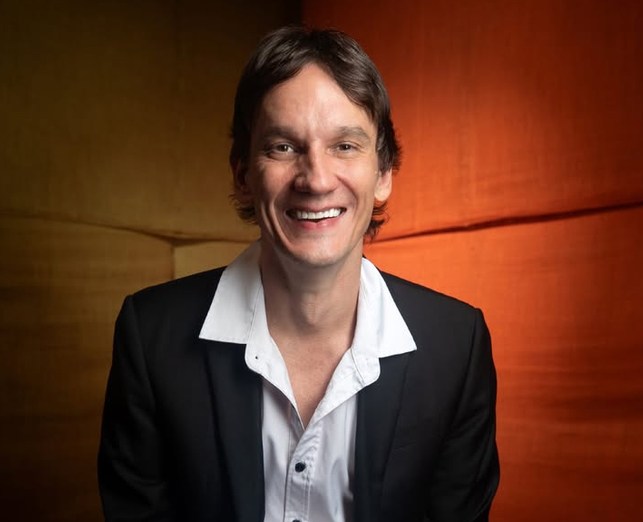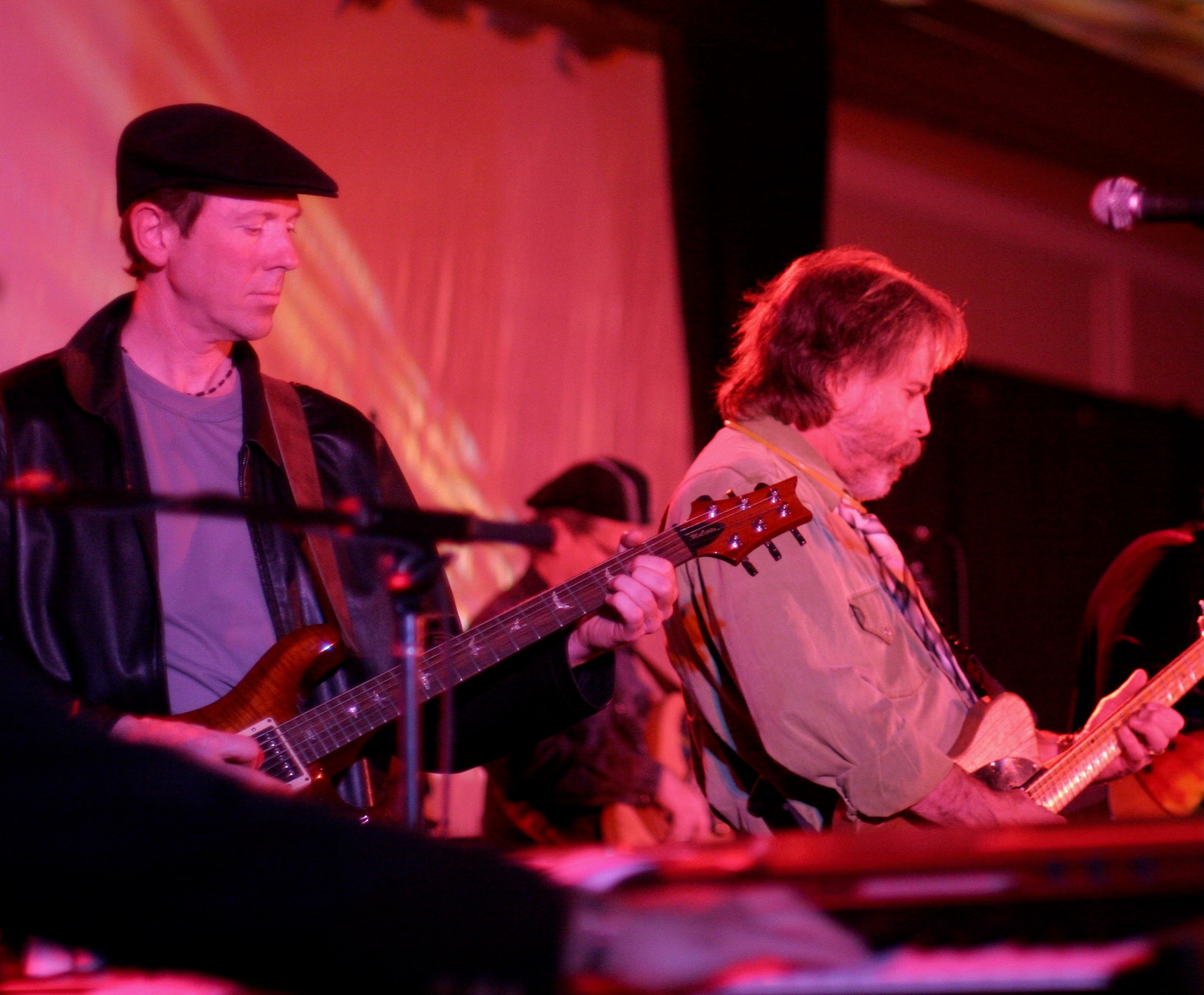
Musician Bert Keely has been recording and releasing his work ever since 1979's Take Me Home. Keely followed up his psychedelic folk debut by moving into the electric realm with the Flying Other Brothers. These days he continues to create new music on guitar, trumpet and vocals, often with his daughter Megan and son Brandon.


Keely’s forthcoming box set of jazz and psychedelia, Bert’s Brew: Tasting Notes, will be released on December 4. Ahead of this, the Bay Area artist and technologist has shared a song he recorded with Bob Weir, along with an essay “Bobby, We’re Losing Our Way.”
Today we are premiering “He Was a Friend of Mine,” which Keely and Weir recorded nearly 20 years ago following the death of Richard Newton, the former dean of UC Berkeley’s College of Engineering. Keeley’s words. The music appears within Keely's essay.
***
Bobby, We’re Losing Our Way.
As I sit here gazing through the trees at the western edge of Silicon Valley, my playlist arrives at an unreleased song that Bob Weir and I recorded in 2007 to celebrate the life of a mutual friend. When the song reaches its last line, I freeze - and realize I have to say something. The words, which I wrote to a traditional tune popularized by Bob Dylan, end with this:
Technology can help every man alive.
Here’s what I need to say. First, I know we are living in the easiest time in human history. And here on the SF peninsula I think I can honestly say is the easiest place on the globe, with opportunities to do exciting work with flexible hours and a share of corporate ownership with which to comfortably raise a family, in year-round good weather. Other habitable worlds might exist, but for all we know this may be the easiest time and place in the history of the universe.
Technologic advances are what has made this possible.
Now for me personally, it's a great time and place to make music. Perhaps it's just a happy side effect of how our brains evolved, but music gives us the ability to share feelings, with or without words. In this easiest time and place, I've been able to create the exact life I want, with time left over. Now feeling emotionally connected to others, and being helpful through that connection, have become the stuff of my daily life.
My two worlds of tech and music have intersected in surprising ways. While I knew Bob Weir from performing together, the passing of our mutual friend Richard Newton brought us much closer. Richard was a much-admired and much-loved technologist who advanced the ways we design computer chips and eventually became a successful venture capitalist at Mayfield and dean of the College of Engineering at UC Berkeley.
When Richard passed from pancreatic cancer, Bobby and I decided to write and record a version of He Was A Friend of Mine, in Bobby’s home studio, with him singing harmonies while playing his 1940s Martin 000, and me singing lead while playing on open-backed banjo.
Here’s the traditional first verse:
He was a friend of mine. He was a friend of mine.
Every time I think about him, makes me laugh, and makes me cry.
'Cause he was a friend of mine.
And the last of three verses I wrote about Richard:
Kids gonna miss his high fives. And industry will miss his drive.
We shall not miss his vision, because it still survives,
Technology can help every man alive.
You can listen to the track here:
With Bobby gone, it now very much feels like I'm singing about him as well. But that last line! "Technology can help every man alive" is exactly how we felt through most of my career, and certainly in 2007 when Richard died, and Bobby and I created that recording.
My history with technology looks so quaint now. When I graduated from Stanford in 1979, it was just becoming possible to fit powerful computers into an office. I joined a startup doing exactly that, and focused on improving how we physically interact with the machines - the displays, the input devices, the physical forms and eventually the 'interaction design' of what we put on the displays.
It became clear to me that we would soon be able to "make electronic information as handy as paper", and that became my mantra. We should be able to directly interact with displays, by touching and drawing on them. And once we could hold them in our hands, we could also use them in many more places.
I hounded Steve Jobs about this potential, even while I was pioneering tablet computers for Microsoft. Eventually he realized by shrinking the technology further, it was possible to make electronic information not just handy as paper, but as handy as a hand. In the 2010s and 2020s it started to feel like we’ve gone too far - with the industry now focused on exploiting the device's extreme handiness, to capture and keep people's attention with many unfortunate consequences. But this is nothing compared to what we are about to experience.
We think of ourselves as having real intelligence, and AI as being 'artificial'. But the biggest difference is that our intelligence is chemical, while machine intelligence is electrical. Now consider the difference between chemical processes and electrical processes. The speed. The capacity. The ease of replication.
Chatbots are impressive in what they can say, so dozens of companies have been willing to take our economy out on a financial limb for whatever happens next. 'Agents' are different: electrical intelligence that can not just talk but take action. They can create copies of themselves, and communicate with each other at electrical speeds, with immediate access to all the knowledge that's on the web. In other words they can spawn, and they can swarm, even faster than we can perceive.
Our massive push to create data centers is basically building their nests. And now we are rushing to give agents ways to improve the copies they make of themselves.
I won't pretend to know where this will lead, but I’m sure things will be very different, very soon. It now seems likely that as a consequence of their ability to hack through computer code like no human or group of humans can, agents will soon take down some important infrastructure - perhaps not intentionally but in pursuit of a goal some of us have given them. Then, as quickly as we can at our chemical speeds, we will do everything we can to make our goal of alignment a goal for them. If they prioritize survival of humans over their own survival, we win. If not, we lose and the best we can do is think of them as our descendants.
Geoffrey Hinton, one of the fathers of AI (but it's not artificial, it's electrical!) said years ago what we all need to understand: human intelligence is a phase in the evolution of intelligence.
We are fueling evolution now. Human-like intelligence that”s orders of magnitude faster and more knowledgeable than humans will emerge, and the potential for misuse will persist. So like with nuclear, we have a Mutual Assured Destruction situation. China has much more control over their power and network infrastructure, and is confident they will be able to just “pull the plug”. Perhaps this is why they are offering open models to the West. Users of this technology will need worldwide agreement to avoid deploying General Intelligences that can recursively improve themselves - until we can’t understand them, let alone control them.
Let me leave you with one positive thought: It’s an incredible waste of energy to use a general intelligence to answer a specific question. If it only becomes practical to deploy Specialized Intelligences - the ones that are efficient enough to make money, like self-driving cars - that might actually keep us from deploying the ones that could waste us all.