

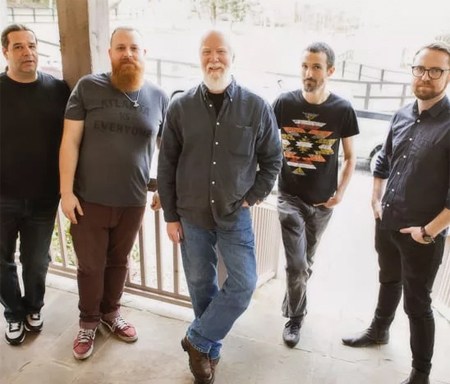
Jimmy Herring is widely considered to be among the elite of today’s guitar players. His fluid phrasing, rapid-fire dexterity, and meticulous consideration for harmonic and melodic nuances have resulted in a plethora of memorable tenures with such iconic improvisational outfits as Col. Bruce Hampton and the Aquarium Rescue Unit, Jazz is Dead, The Allman Brothers Band, Phil Lesh, The Dead, and, currently, Widespread Panic. Last year the guitarist and his band, The Invisible Whip, joined the legendary John McLaughlin for a fall tour, and a resulting live album, that dazzled audiences and critics equally, bringing together two masters of the instrument. This year, Herring will again fill his time away from Widespread with a solo endeavor, assembling a new group, 5 of 7, and scheduling a fall tour that wraps with several November dates in Japan. In between rehearsals with his new ensemble- keyboardist Matt Slocum, bassist Kevin Scott, guitarist/vocalist Rick Lollar, and drummer Darren Stanley- Herring spoke of the enduring influence of the late Bruce Hampton, the energy and talent of this young quartet of Atlanta players supporting him, and the value of a master always remaining a student.
Ifirst met you almost 30 years ago after a Col. Bruce Hampton and the AquariumRescue Unit show in Ithaca, New York. Afterseeing you guys that night I thought, this band is going to be around for along time. The musicianship, the songs,Bruce’s voice and his unique presence; everything that band had was at a reallyhigh level. Given the choice between ARUlasting 30 years or having your career become as varied as it has, are youhappy with how it all turned out?
Bruce used to say, “Everything’s always perfect.” What he meant by that is, whatever happens issupposed to happen. Me, personally, whatI wanted more than anything was to be in a band for 40 years; a band; one band. I’m a child of the ‘70s. I grew up idolizing these epic bands like TheAllman Brothers Band and the Grateful Dead. Or Led Zeppelin. Or, of course,The Beatles. Some of those bands didexactly what I wanted to do; they stayed together for 30, 40 years. As far as I was concerned, (ARU) was it forthe rest of my life, if it could stay together. But, it didn’t. And, that’s okay,too. What ended up happening was Ididn’t get to be in a band for 40 years, but I did play in a couple of bandsthat were together for 40 years. Ididn’t see it coming, but you never see stuff coming. I wouldn’t change anything.
Ithought the ARU, had Bruce stayed, would’ve been as big a success as Phish orBlues Traveler were in the ‘90s.
It was starting to take off. We were never going to be home. Bruce didn’t want to tour all over the placeall of the time, working 200 shows a year. He just wanted to work enough to get by. He saw himself as a kind of minor league coach. He would help these musicians get ready forthe rest of their journey. They would goon to do other things and he would start over again with new guys. As much as he loved us and we loved him, itwas time for that thing to be done. Some things are meant to burn really hardand then flame out. I guess ARU was oneof those things. We tried to keep itgoing. I loved what we did when Kofi(Burbridge) and Paul Henson joined the band after Bruce left. I loved what we were doing but it was not thesame thing. We should’ve been calledsomething different because it was a different band altogether. Once Bruce left, the true ARU was done.
Whenit ended, what were you thinking was your next move?
I didn’t know what I was going to do afterthat. I was just the guy in ARU. Then I got involved with Jazz is Dead. That’s what rescued me. I was unemployed for a while. I was looking for a job as a (guitar) tech,if I could get one. I was calling upfriends (asking them for tech work) and they would cuss at me, telling me I wasinsane- “You’re not doing that. Don’t dothat.” But, I had two children. I had to feed them somehow. And then I got the Jazz is Dead call and Igot to work with some of my freakin’ heroes: Billy Cobham; T Lavitz; AlphonsoJohnson.
Eventhough I think of you as an exceptionally talented, prolific player, I havealso always seen you as a consummate student of music. Every conversation we’ve had included youtelling me something new you’d picked up from your latest experience. Do you see yourself still as a student?
Absolutely. It’s unthinkable to me that one is ever not a student. Especially with all of the wonderful music tolearn from. I’ll be a student forever,as long as I live. Bruce used to talkabout musical liars. His point was, whensomeone plays, if you can’t hear where they’re from then they’re lying. That’s always stuck with me. We all have our favorite musicians that wetry to emulate. For me it’s always beenJohn McLaughlin, or Steve Morse, or Allan Holdsworth, or John Scofield, or JohnColtrane, or Charlie Parker, or McCoy Tyner, or Oscar Peterson, and the listgoes on and on.
Inoticed a few names in that list who are not guitar players.
With guitar players there is a tendency to listen toonly other guitar players. I wentthrough a period where I had to stop listening to guitar players altogetherbecause I loved them so much. I startedlistening to horn players or keyboard players. If you listen to enough stuff it all comes through your filter. Your filter should reflect where you arefrom.
Doyou think what comes through your filter reflects you accurately?
I’m from Fayetteville, North Carolina. My parents were the coolest people in theuniverse. I had a great childhood. I can’t try to act like I lived on the streetin New York City with no parents. Orthat I was beaten as a child. That’s notgoing to come through the music because that’s not who I was. That’s what Bruce was saying: Play your goodchildhood. Play Fayetteville, NorthCarolina. And, (if you do), one day yourvoice pops out and you think, okay, maybe I’m on the right path. I’m 57. If I haven’t found my voice yet I’m in trouble. (Laughs)
Inputting together this band, 5 of 7, did you look for players that had thatbalance of being students but also having their own distinct voice?
I wanted to play with younger guys. When I went to Atlanta in 1986 I met up withsome guys that I would call some of the greatest living musicians on theplanet: Jeff Sipe; Oteil Burbridge; Kofi Burbridge. I was lucky enough to have a long time towork with those guys. Everytime I’vedone something on the side when I wasn’t working with someone else, those(three) guys were the ones I wanted to call. I still feel that way. They’re mybros. We shared something togetherplaying all those years you can’t get anywhere else. But, when I began to think about that small,underground musical renaissance going on when I came to Atlanta, I would thenthink, what’s happening now? Who’s gottheir finger on the pulse of what’s happening now?
Andyou found someone who does?
My son-in-law, (Widespread Panic drummer) DuaneTrucks, he’s really connected to all this young, new music. He introduced me to (bassist) KevinScott. Kevin (then) played in my band,The Invisible Whip, that I had when I toured with John McLaughlin. Kevin told me about Rick Lollar and DarrenStanley. I saw Darren a little bit withBruce and I was like, who is that guy? And Matt (Slocum) is a guy I’ve played with alot. I love his vibe. He plays with a lot of excitement. Youthful exuberance is like food for me. It’s fun. It’s exciting. It’s newagain. The youngest one (in 5 of 7) is32. I remember 32. It was awesome. (Laughs)
Onething that jumps out immediately is that some of the music you’ll be performinghas vocals.
Rick is a great singer, and I wanted to play somevocal music. And we can have someinstrumentals. That was where my headwas at when I called Kevin and said let’s try and put something together withsome local cats. These are the guys heturned me onto. I listened to theirstuff and I was knocked out. We gottogether last November, almost a year ago. There were no gigs booked. Nobodygot paid. We got together for fun. Then a month later we did it again. And two weeks after that we did it again. Next thing you know we were like, let’s dosome gigs.
Youhave played with Matt quite a bit over your career. And Kevin, as you said, was with you on thelast tour. Now you bring two new guysinto that dynamic. How does it feel tomix new players into something that you have established with Matt and Kevin?
It’s amazing. It’s not by design, but it does make a difference. That wasn’t my intention- to balance it outthat way- but it does have benefits. Matt was the first name that came up (when I was considering a keyboardplayer). There’s nobody like him. He is just the guy. So, I know Matt andKevin really well. Rick and Darren- I’mjust getting to know them. Still, it’salmost instantaneous that you feel like brothers. And we’ve all worked with Bruce Hampton, inone way or another. In different eras,yes, but that fact gives us something in common. We have the same stupid sense of humor. There’s no shortage of laughter. To laugh during the hardest parts of being onthe road is everything.
Thistour will include a trip in November to Japan. In a recent video you discussed one of those hard parts of the road thathas previously discouraged you from performing internationally: being able toget the sound you want when you can’t travel with your preferred gear.
I can’t play if I don’t like the sound. If I play a phrase and take a breath, it’sgoing to affect the next phrase I play if I hate the sound. If I love the sound, that affects the nextphrase, too, except in a good way. I’vebecome incredibly funny and specific in what I like to use.
Asa bandleader are you also particular when it comes to how your bandmates sound,as in the tone of their instrument?
I leave it to them. This is their sound. It’s up tothem. But, I’ve collected a lot ofequipment over the years. So, (I maysay), “Hey, man, check out these speakers. Plug your amp into these speakers. Do you like them?” And if theylike the way the speakers sound, then they can use them for the tour; I’ll loanthem out.
Whatabout the overall sound or style of this band? Because you are known for playing with a variety of groups- many with faithfuland attentive fanbases- do you have to take that into account when you areworking on a repertoire?
You can’t avoid certain aspects of your past. It’s who you are. It’s your style. This group of people- and every group I’veever been in, really- doesn’t look at music in terms of genre. If the people that saw me with McLaughlincome to see me expecting every song to be fusion, it won’t be. But, there will be some, if you want to calla certain type of music fusion. To me, fusion is nothing more than elementsof different types of music that are brought together in a way that soundsorganic and natural, not forced. Itcould be folk music blended with Indian music; any hybrid of styles and genresbrought together in a way that doesn’t sound unnatural.
Howwill you draw up a setlist?
We haven’t had time to have enough material to makeit totally different every night. Wedon’t have 150 songs (to draw from). What we are thinking is we don’t want songs back-to-back to be in thesame tempo, or same tonality, or same chord changes.
Areyou thinking about how this band, if it goes well, fits into your life andother responsibilities like Widespread Panic?
I just really want to go play. I think that’s what it comes down to. I’m not like most people. Most people can multitask. I’m not good at that. Whenever I have to I start to getstressed. That’s why I’ve only made twosolo albums in a 30-something-year career. (Laughs) I need a big chunk oftime when I’m not distracted by some other project to be able to do that. It seems like every two years or so I’ll getthat chunk of free time to make a commitment to doing something. So, we’re going to do this. And I’m extremely happy with this group ofpeople. I’m so excited. It’s going to be fun. It’s going to be tough, too, because I’molder and the tour schedule is grinding. But, we come to play. That’s whatwe come to do. And, if it’s somethingwe’re all over the moon about when we finish the tour, we’ll do it again.





