

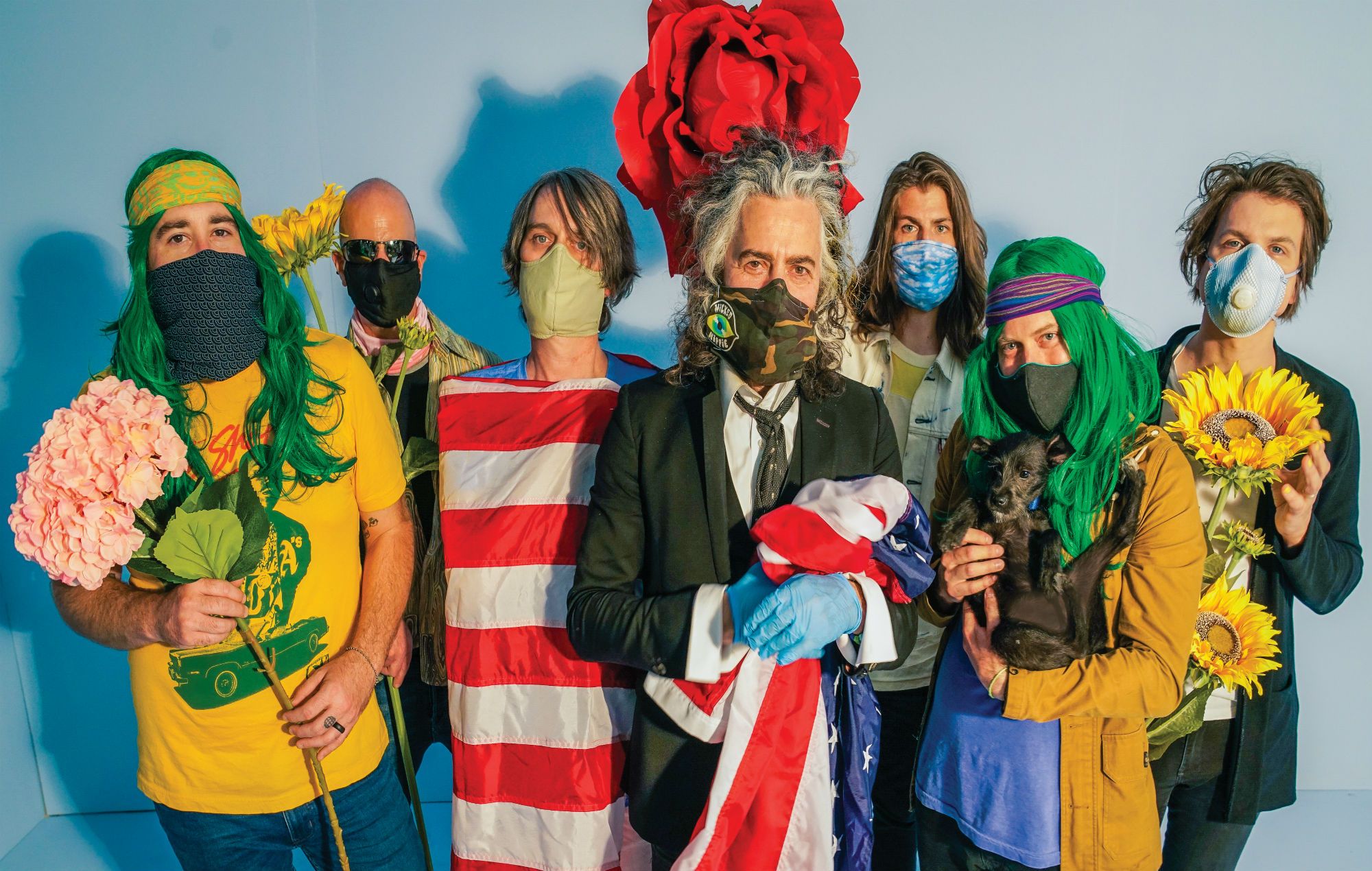
With a seemingly endless ability to make lemonade when life gives them lemons, The Flaming Lips rose to the challenge of a year that featured a pandemic, murder hornets, bushfires, forest fires, a record-breaking hurricane season and a worldwide concert industry placed on pause.
After its spring and summer tour plans were scrapped, the Lips finally released its 21st studio album -- three months from its original date. Titled American Head, the album presented a conceptual theme of sorts that revisits Wayne Coyne’s formative years.
In the press release for the album, Wayne Coyne described his fantasy idea of Tom Petty, while in Mudcrutch, performing in Oklahoma City and never leaving town. Petty would not only never move on to front the Heartbreakers but he’d get involved with Coyne’s brother's druggie friends and bike buddies.
Through that vision, Coyne moved on to memories of his teen years – drugs (“Mother I’ve Taken L.S.D.," "At the Movies on Qualudes"), mortality (“Mother Please Don’t Be Sad”), personal spirituality (“My Religion Is You”) and local dealers ("You N Me Sellin’ Weed," "God and the Policeman"). The result, which includes guest appearances from Kacey Musgraves and Micah Nelson, becomes some of the Lips saddest yet satisfying material.
“The music and songs that make up the American Head album are based in a feeling," Coyne said. “A feeling that, I think, can only be expressed through music and songs. We were, while creating it, trying to NOT hear it as sounds… but to feel it. Mother’s sacrifice, Father’s intensity, Brother’s insanity, Sister’s rebellion…I can’t quite put it into words.
“Something switches and others (your brothers and sisters and mother and father…your pets) start to become more important to you…in the beginning there is only you…and your desires are all that you can care about…but…something switches…I think all of these songs are about this little switch.”
With the extra time allotted by the band's unplanned summer vacation and release delay, the Flaming Lips created six music videos to accompany American Head.
Following years of Coyne crowd-surfing in his Space Bubble, the COVID-19 virus caused the other six members of the band to perform in their own enclosures on “Late Show with Stephen Colbert” and NPR’s "Tiny Desk (Home) Concert." Once they became comfortable in them the next step brought audiences into their individual bubbles for a socially-distanced event. That happened last month when the Lips played a concert that included the filming of the album’s seventh and eighth videos, “Assassins of Youth” and "Brother Eye." The successful experiment led to announced concerts on Dec. 10 and 11 in the band's Oklahoma City hometown with the possibility of a tour of other cities. (This interview took place prior to the Bubble video shoot and scheduled performances.)
My conversation with Coyne, discusses the themes of sadness and death in the Lips’ music but overwhelming joy in the live performances, Musgraves’ contributions to the album, the role of instrumentals on the band’s albums and more.
We talk on a beautiful autumn day in his Oklahoma City hometown. “We've got a nice cool Fall day going here. The leaves are turning yellow and it's not a hundred degrees. So, I'm doing great.
“I never realized how long and hot the summers in Oklahoma are because since 1998, I've never really been here all summer. I've been in and out but I wouldn't have been here the whole summer. Man, it's hot here."
JPG: In all my recent interviews I check on how each person is dealing with the changes that have happened since March due to the pandemic. How has the experience of being home been for you?
WC: For us, if you do a week's worth of traveling, it feels like you've been traveling for a year. That’s just the way it is. But when you're sitting at home, you can sit at home for three weeks and it only feels like a day. It all gets flip-flopped. In the very beginning, we didn't know how long it was going to go. I remember talking to people at the beginning of March saying that we would still be playing shows at the end of May and June. So, in the very beginning, it was like, “Oh, okay, we can't do anything even if we wanted to.” It's a forced vacation, which in the very beginning was fine.
But then we did worry that everybody's going to be dead in the streets and what are we going to do? Once that didn't happen...it was happening in New York and was happening in some parts of the world but it wasn't happening here. It didn’t seem like everybody was gonna die immediately. It felt like a little bit of relief. “Well, there's nothing we can do about it, and maybe this is a month. Maybe this is two months.” I would not have believed you if you said nothing is going to be going on ‘til the next year. I would have said, “There's no way.”
We're very lucky that we can go a year or two and not have to make money. We are alright in that way. I don't want to say anything that says it's good because my situation is really great and a lot of people's situations are really bad but we also have a new baby and he's just a year and a couple months old. Being able to be with him, have your routines that you do every day in your own house and his own bed…and airports are great. I love airports and I love airplanes and hotels and all that, but nothing is as wonderful as being in your house doing your thing.
JPG: Various artists do things in different ways. I think of The Flaming Lips like Andy Warhol’s Factory, where something creative is going on almost every day. Besides family time, are you and the band working on stuff?
WC: That's the part of it that I've probably enjoyed the most. I hesitate to say “enjoy” because for me so many things I do is a collaboration. I’m very lucky to have so many guys around me and we’re always doing stuff.
But, for the first three months of this we couldn't even go to each other's houses. So, I'm painting in my front room. I’m making up songs in the studio but I'm just there by myself, which I would do here and there, but I wouldn't do it day after day after day like I've been able to do in this. So, you're exactly right. And it's given me more time, which I didn't realize I didn't have before. In this way, I hope that I'm forever changed by this.
I keep in mind that to really enjoy anything in life you do have to spend some time with it. You can't just glimpse at it and say, "Okay, on to the next thing,” which we've been doing the best that we can. We've been given this wonderful, wonderful life and a lot of exciting, great things but one of the things that is sacrificed is your time. You spend a lot of time in airports and soundchecks and things.
I try to make every situation wonderful and love it all but not having any time to do anything whereas this has opened all that up and I'm like, “Oh my gosh! I've been a fool. I didn't realize it.”
JPG: The band has either been on the road or recording. You’ve been quite prolific with recordings coming out on a consistent basis. So, at least you still have the ability to record for what could be a next Flaming Lips album or some future collaboration…
WC: And ‘cause people don't realize that when you travel so much even though you may just play a couple of shows, it takes you two weeks to do anything. Then, to get back home. It sounds dorky to say that but I love creating stuff. It doesn't mean everybody has to see it or hear it or any of that but even just time to contemplate ideas, to go over things and to change things and all that. Less, less tired, less stress but very lucky that our family hasn't gotten sick and that we can go awhile without making money. So, in that way, probably different from a lot of the world.
JPG: You were talking about the time at home and thinking about things has changed you. Connecting that to reading your introduction to American Head in the press release and listening to the new album, its lyrics, stories and themes have a fantasized version of your past reality, past memories. I don't recall you being that personal with your work. What brought that up?
WC: I agree. Once you delve into your own world but you're still mythologizing your own reality, some of the things that we're singing about are so long ago. All you have is a faint feeling about it and the rest of it is quite blurry. But music and melodies, they do have a way of evoking mysterious things in you that there's no way you could ever even talk about it but, sometimes, you hear certain phrases or you hear certain tones and something in you is brought back to life. That was starting to become something that we felt like we could do, the more of the songs that we would get. We started off with just a couple. These songs would be two or three years old now.
With the song “Dinosaurs on the Mountain,” that one started to really evoke or encourage us to go deeper. Be more fragile. Be more broken. That one and “Mother I've Taken L.S.D.,” that was about three years old. That really began with me singing, “Mother, I've taken L.S.D.” and trying to evoke this horrible sadness in the song. And it’s not like a joke about acid. Once Steven [Drozd] and I pushed a little further into that, we felt like, “Well, maybe, we could do a whole album like this.”
Our model would have probably been something like the Beatles' "Strawberry Fields Forever" where he's singing about a real place and the things that he's singing about are real things in his life but yet when I was eight years old and I heard it I wouldn't have cared what Strawberry Fields really was. To me it was such a cool thing. It evoked plenty of things to me even without me knowing what the real thing was. So, we felt like, maybe, our songs can have that happen, too. We could be singing about something that's real to us but to the listener it could just be another thing that there is they're connecting to their life.
JPG: Musically, for a good portion of it there's a sense of melancholy, a dreamy lullaby, lush feel to it. Was that where the music was going and then the themes and lyrical ideas reflected that or vice versa? How did it end up where it did?
WC: Well, those things are always touchy ‘cause you don't really know until you hear it. Steven and I will sit there and, sometimes, we'll be working on what we think is a string arrangement, something that's going to push the emotional story, make it a little bit more easy to feel the story. Sometimes, you can do 10 takes and it just feels sappy and then suddenly you've done this thing that changes it into being…We always say it turns it from being music into something that you're feeling. Up until then, it's like, “Yeah, it's music. I can tell what it's doing, but I'm not feeling it.” With Steven's ability, he really is such a master musician, I feel like we can keep trying and something is going to give.
Sometimes, we're working with Steven and [producer] Dave Fridmann at the same time. So, I've got two people that are willing to hone in on something that can really nail it and you just get lucky. I always say, “I don't know what it is that we're going for but I know what it's not." Then, if you're able to do that two or three times then you think maybe you can do it for four or five times. Once you've done it six or seven times, that's when I feel like we have to make an album! This is going to be an album. We have to make it this way. You seize the moment, but a lot of it is very much happening and you don't really know where it's going to go.
That's kind of what music wants you to do. It doesn't want you to force it to be anything. If you could do everything while you're sleepwalking and while you're hypnotized, you probably would go to things that are emotional and are easy to navigate but once you get your fucking mind in there, it all gets complicated. You try to be clever. You try to be smart. You try to be all these things, and music, it doesn't really work that way. It can pierce those true emotional things but you have to get yourself out of the way. That’s where having an ego and all those things just...it's a motherfucker.
To me, the best Flaming Lips music, there is no ego. We stand there saying, “Well, if you don't like this then you don't like us because there's nothing we can do. We've told you exactly the way we feel" but the other side of that is if you relate to it and you like it, it's like we've really communicated something to each other.
JPG: It’s been brought up previously but Flaming Lips songs deal a lot with death and sadness while the music and especially the concert experience maintains a joyfulness and is and life-affirming. I reviewed your Cleveland show and I thought I'd bring up this line to get your comment –“…the prevailing themes of the night surfaced enough times to lodge in most concertgoers’ subconscious — embrace your inner child and don’t forget to LOVE because our time together is precious and it’s interrupted when we least expect it.”
WC: (pauses) Oh, man! I think I saw that. Man! I don't think you could say something about a concert that would be better than that. That would make me want to go. (laughs) But you know, that it is true. A lot of things can be fun and a lot of things can be exciting but to really connect...I don't think Flaming Lips music connects to everybody but it connects to people that have had experiences and it's challenged their optimism and they want to know like we want to know. "Are we idiots for still believing that we want to be happy? Are we idiots for thinking this world is beautiful even though it really is horrible?” When we all get together and we sing these songs, I think we overcome that. We say the world is full of hate and it’s full of pain and it's full of unjust…it’s not fair but it is to us still absolutely beautiful, that you can love and you can give into this thing that's great about it.
Once we've sung about that, I don't think we'd want to sing about the world being any other way. And so I would totally agree with your assessment that when you stood there long enough it has gotten into you. It's like you've been infected. You didn't know it but you allowed this stuff to get in there. That kind of experience it's for us, too. We're not just standing there singing the song saying, “Oh, this could be over.” It’s affecting us, too. That's part of what's happening at our shows. We're going to present this thing but it’s designed in a way that you're going to react and we're going to react to you and it's gonna go back and forth. That's a fucking cool feeling.
There's probably something in the way that my singing voice that allows…I really cannot sing very good at all but I can sing Flaming Lips songs. (slight laugh) That's what I say. That little bit of uncertainty and that little bit of warbling is not musical. There's bits of it that really hint at this other way of communicating. I think if it's too technically good or too pure or too smooth or whatever, it takes you in another way. So, I'm just very lucky that I get to play with the Flaming Lips, especially with Steven who is such a master of that kind of emotional music and that I'm not really a singer. I'm trying to sing the height of these emotional things and hoping that it works. And that's probably the best feeling is that you're really trying. It's not through ego and confidence. You're really just trying to communicate this thing. With the right audiences, we all get there together.
JPG: Going back to the new album, in the press release for it you mentioned about recognizing yourself as an “American band.” I found it interesting and surprising because of all the times you've played overseas and you live in Oklahoma, in the middle of the country. Is it a matter that you never really thought of yourself in that way because the Flaming Lips were and are its own musical category, more psychedelic than traditional rock? You mentioned bands like the Grateful Dead and Parliament Funkadelic that consist of more than a core four number of members and you're not exactly doing traditional American music where it’s recognizable as being based on blues or country or soul.
WC: Yeah. I know exactly what you mean. We are always an American band only we wouldn't really know what that meant. We probably listen to more British music than we purposely listened to American music but little by little we could hone in on…We've made 30 records ourselves. So, it's like little by little we're picking and choosing what we think is the type of stories and the type of storytelling sounds that would work with the things that we're trying to sing about. So, for us, the difference would be, we would say, "Let's do these harmony vocals. Let's make them like the Carpenters as opposed to it being like the Rolling Stones” Taking something that we know is like, “That sounds like the Beach Boys would do that and the Beatles would do it differently;" dorky musician talk that really is not apparent to anybody that's just a listener.
We would purposely go to these types of chord changes that you would hear in songs like The Eagles and bands like Chicago and stuff. “Okay, this could go any way that we want it to but let's try to hone in on that.” And I think that set us up to have these types of songs and for them to be simple but also for them to be intense and sad. I think that's an American trait. When I'm in Europe and we're in Barcelona and I’m thinking that this is an amazing place and I love it and I'm so glad that it's peaceful and it's welcoming and all that but, sometimes, I would say, “What I miss about America is its intensity and its pride and all that,” which I'm not really proud of.
So, that would be a little bit of what we would say, "We're going to put that in the music as opposed to not putting that in there," which we've probably done. We've probably done it on purpose and didn't know it and probably left it out on purpose and didn't know it. By the time we got to one of the songs that we did later on the album, like “Mother Please Don't Be Sad,” that's a typical, not gospel, but you could hear an American band doing that more than you could, for me anyway, would hear a British band doing something like that with those types of chords, those horns playing those very sad things behind the guitar.
I think every song has a fingerpicked guitar solo in it. This is one of our rules that we kind of have. “It's got to have a guitar solo. Otherwise, it's not like the Eagles or it's not like the Grateful Dead.” So, we would say that to ourselves and we were glad ‘cause it'd be like, “Okay, let's see if we can make that work.” Anything that would say this could be anything but we want it to be rich in this way and not rich in another way.
We knew that we were going to call the album American Head. That helped us, too. About halfway through the record, I had this picture of my brother…in the beginning we called it “American Dead.” Even though for me that's not that brutal or that harsh of a title when I sent it to people, they were like, “Oh my God, man! This record is so gentle and so loving. Why do you want to call it “American Dead?”” And I was like, “Well, let’s just call it American Head. (laughs) It's almost the same thing. It's just changing one letter.” So, part of it's that, too. It's storytelling and storytelling has a certain thing about it. Some of these songs within the first 30 seconds, you kinda know, “Alright. I know where he's going with this.” Not all Flaming Lips music are we trying to do it that way. A lot of our music you wouldn't know where it's going. We wouldn't know where it's going after five minutes.
JPG: I could see “American Dead” as the title, too, because the themes and lyrics of the album deal with death and sadness. But, I guess as a marketing thing, better that you changed it.
WC: To some people, they're not hearing that word and having the same connotation as you and I. I understand that. Head is a great word, too. We probably have a couple of records with that already.
JPG: We've been talking about the lyrics and themes and nothing against those but my favorite tracks are the instrumentals. Why did you leave them as instrumentals? Also, bringing in Kacey Musgraves with her no-word vocal on “Watching the Lightbugs Glow” reminded me of Pink Floyd's “Great Gig in the Sky.” Why bring her on that?
WC: For us, the instrumental is always a little bit of…I just get sick of hearing myself sing and there are some times we're coming up with music and we think, “What are we going to do with this ‘cause it's not really a song and are we gonna sing on it?” After a little bit, we'll just say, “It doesn’t matter Let's just make it music for now and see if something hits."
With the music that follows “When We Die When We're High," we wanted there to be a little bit of something with some momentum and some atmosphere without it having to be melodic. That's one of the dilemmas with these types of melodies that we are working with. It's like having a piece of birthday cake or something. You can love one, you might love two, but man, if I give you 10, you're going to throw up. It’s too much. For every two or three pieces of birthday cake that you love we want to give you some potato chips. (laughs) It's like we gotta get out of this thing. Otherwise it sort of halts you from wanting to hear this as one album.
So, part of us knows it doesn't really matter what it sounds like ‘cause you can really just go to song-to-song if you want. But if you want to hear this as a whole album, if we're really gonna go and pummel you with this emotional stuff, you have to have a little bit of room just to have fun and relax and not every minute be crying. Sometimes, the instrumentals are something that we just think sounds cool and we're sick of singing melodies and singing words, too. We know that we're jamming on this thing for a couple of minutes and if it doesn't go good, we won't put it on the record but if it goes good, we're gonna keep working on it, see if we can make it thematically help.
And I think all of our records the instrumentals have helped in that way. It's to say, “You're listening to the Flaming Lips but you don't have to listen to Wayne sing all the time. The music really is what we're about. I just happen to be the singer.” We’ve made some albums that were almost instrumental, “Christmas on Mars” soundtrack. It's just weird instrumental shit. Almost every record has some instrumental stuff on it.
JPG: I didn't know if lyrically you felt like there's nothing I have to add to this but what you said explained it.
WC: That's where we start to pick and choose. Part of it is that you just want to relax for a little bit. Your comparison to Pink Floyd is exactly right. There's certain tempos and there's certain things but it just wears you out to have to pay attention all the time. There's certain beats and certain tempos that just pull you along. Some things you can listen to it for 10 minutes and it only feels like you’re listening for one minute but, sometimes, our music is the opposite. You've only been listening for a minute, you feel like you've been here your whole life.
We're just trying to give you the ability to relax and not have to have your mind…words are always exploding in your mind. To get words and music that go together that's a thing and, sometimes, we don't want to deal with the words firing in your mind. We want that just to swim along, and mostly for us. I am saying we don't want it to do to you but it's mostly for us. We like that's just going. It's telling us a lot. It's just not singing to us.
JPG: Going with Kacey Musgraves on the album reminds me of how the more interesting mainstream Nashville country artists are women, the ones who are pushing the envelope more so than the majority of male artists. Her inclusion on American Head is another example of that.
WC: I don't know that much about current country music. Sometimes, I hear something and I'm like, "I like that. What is that?” Kacey is definitely one of those that we would hear, “Who is that? That's cool.” Then, you hear another thing. “Who’s that? That’s cool.” “That’s Musgraves.” So, over the past couple of years she keeps popping up. We really are drawn to the way that she thinks and the things that she's singing about. In the end we didn't really know her. We don't really know her that much now and we've done this music.
We were trying to get her to do music. So, little by little, we got ahold of the bass player in her group and we sent him a song and then he got the song to her. We knew she was a fan but that doesn't always mean that people want to be on your music. It was cool. The things that she did were just amazing. We made some pretty good -- we call them demos – but they were reference tracks. Steven was able to sing almost exactly like her just to say, “Here's the bits that you would do” so she knew that she didn't have to make up lyrics, she didn’t have to make up melodies. She was free to do what she wanted but it wasn't required. That really lets people be a lot more relaxed and say, “Oh, it's already good and if I add something to it that makes it more special."
That's the way it worked with her. She was very encouraging. We’d send her stuff. We knew that she liked some of the stuff that she was already committed to, “Yeah, I'll do this song and that song.” When we stumbled upon “God and the Policemen,” that being a duet, she responded to that one. "Let's do that one. That's the one I love the most.” We set up a time to do them in the time that we had. She is so great. She really could do almost everything in one take but we would do a couple of takes. It took us two or three hours to do the whole thing.
Then, we got the three tracks and we still had a little bit of messing round to do. In the end she ended up liking all of them and we were able to use all three. She's like the one that we were really trying to get. Of all the people in the world the one that we wanted, we were able to get her. I think it makes the album that much more special and of this time. It's like, “Man, I still can't quite believe it.” When you started talking about it I was like, “We got fucking Kacey Musgraves on our record!” (laughs) What the fuck? Who organized that? Well, we did. But, it doesn't ever seem true. It seems like you're still trying to make it happen and it's already happened.
JPG: I watched your NPR Tiny Desk (Home) Concert. You're used to being in the Bubble, how has it been for the other members of the band? Are you still planning on doing a socially-distanced concert either with or without bubbles for the audience?
WC: We are. The more that we started to do these videos, of all the things that we're doing to promote this record, the guys have gotten in them more and more. Now, the guys just get in them and we figured out all the ways to keep them inflated. There really is a lot of air in there. People think that you can only be in there for five minutes but I know that you could be in there for a couple of hours because I've done it. We've done it for two or three people.
In the beginning, we wanted to get into the Space Bubbles because we were all scared of infecting each other. The main dilemma is you get around music and music is loud. Suddenly, you're screaming loudly at each other because you can't hear. You're putting your face right next to someone else's face. Music and concerts, it's the birth of COVID. One of the worst infections that happened here in Oklahoma City was caused by somebody who went to see the Eagles in Dallas. Sat there and got drunk and screamed at people for two hours. Brought it back to Oklahoma City. So, a lot of it in the beginning was us just protecting ourselves saying, “We know we're going to get excited. We know this is going to get loud. Let's not fall into this trap.”
I've, unfortunately, been to a couple of weddings where people get drunk and then the DJ starts playing and before you know it, drunk dudes are screaming at each other. And so in that way it was to secure ourselves and then the more we've done it, we think, “This could really work.” We're organizing a video shoot on Monday night with a hundred people in Space Bubbles and us playing. We think that we could do three people in each Space Bubble. So, you're not just stuck in there by yourself. You can be in there and you could be drinking and doing whatever and you're in there with your friends. We're thinking that we'd be able to do a show maybe by the beginning of December and feel like we have worked out all the safety measures and all that.





