

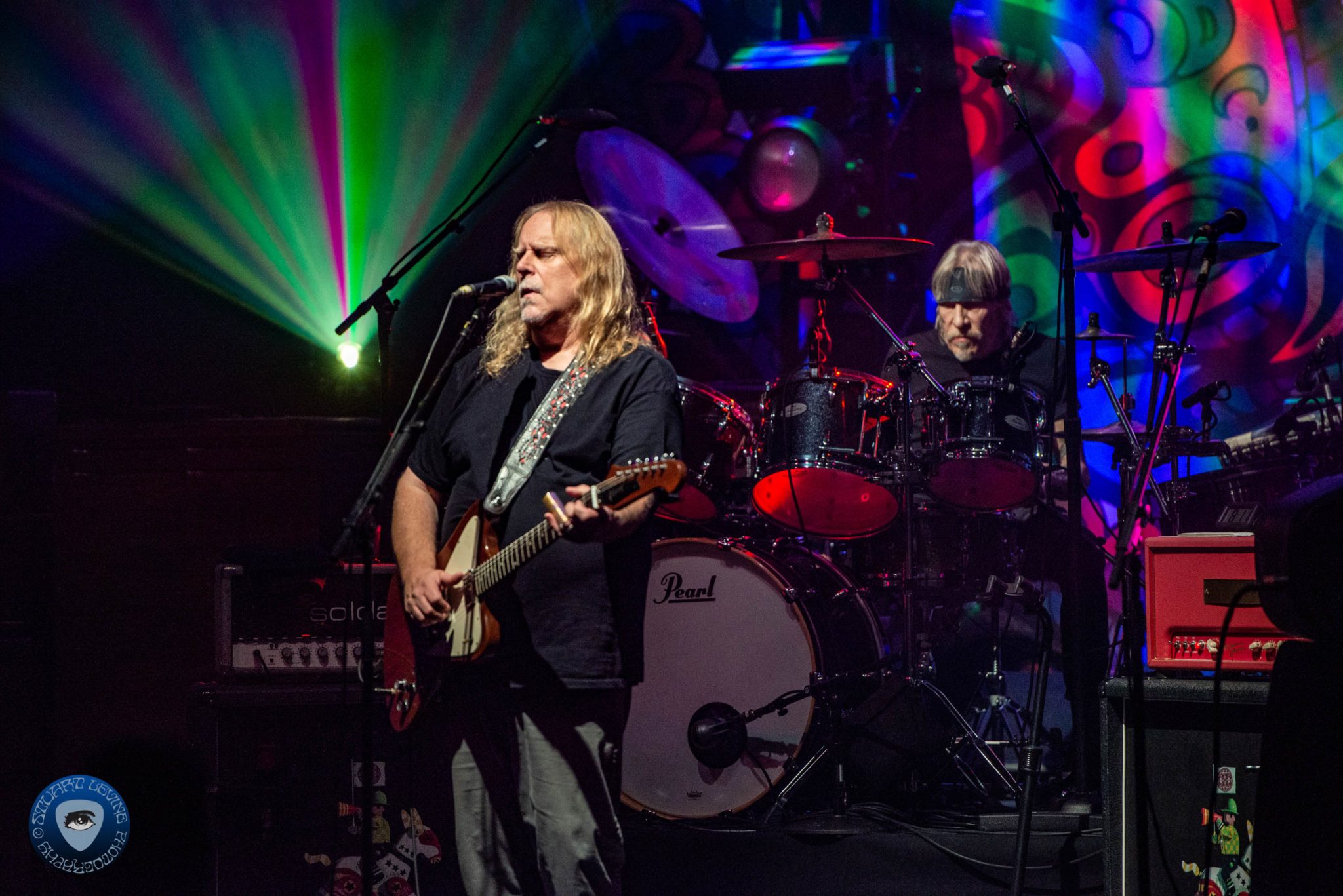
“The last few years I’ve been at home a lot more than normal. So, it was strange to be back to work in the beginning, but it’s starting to feel normal again,” said Warren Haynes as he reflected on returning to a full tour schedule after the COVID break kept him and Gov’t Mule off the road.
His answer comes during an interview that takes place in the midst of a family vacation. A few days prior, Haynes finished his summer tour; a combination of headlining shows, festival dates, interpretations of Pink Floyd’s catalog on the Dark Side of the Mule tour plus appearances on Willie Nelson’s Outlaw Music Festival.
A couple weeks after our conversation and he’s back to his “normal” work life – fall concert dates that include the United States, Canada and Europe. By the end of the year, they will total a Mule-standard of 60 concerts.
The quartet continues to reap what the members sowed two years ago during the worldwide pandemic. Haynes, drummer Matt Abts, keyboardist Danny Louis and bassist Jorgen Carlsson (replaced last June by Kevin Scott) recorded in two separate studios with completely different instrumental setups to create a pair of very different releases.
The Grammy-nominated 2021 release, Heavy Load Blues featured a selection of originals and covers that included legendary artists -- Howlin’ Wolf, Elmore James, Junior Wells, Sonny Boy Williamson, Muddy Waters, and Otis Rush, Ann Peebles and Bobby “Blue” Bland – plus outside-the-box choices—Tom Waits, the Animals and Savoy Brown—for a long-discussed but perpetually-shelved blues-focussed album.
Out earlier this year, Peace…Like a River expands on the band’s classic heavy rock sound and jamming ways with orchestrations and horn arrangements in what may be Mule’s best album in its nearly 30-year career.
During our conversation we discussed the new album, touring, the positive side of the pandemic break, European audiences, Island Exodus 14 and what’s ahead for the hard-working act.
JPG: Let's start with the Dark Side of the Mule dates. You recently finished that tour. The 50th anniversary of the Dark Side album. Was the timing too good to resist not touring behind that?
WH: That was a good reason to do it one more time. We thought we had retired it but it was brought up to do it one more time. And then, with the 50th anniversary of Dark Side of the Moon it made sense to coincide those things.
JPG: When you're playing as Gov’t Mule the four of you can switch things up because you’ve played together long enough that I’m sure there’s a high degree of musical telepathy. Did having additional players for the Dark Side set require you to be a little more rigid or were you able to move around that?
WH: What we were doing on this tour was when Jason Bonham’s Led Zeppelin Evening was opening, they would do an hour and then we would do one long set, which consisted of an hour of Mule and 90 minutes of Floyd. We would do the hour of Mule just as a four-piece, and then when we started doing what we call the Dark Side stuff, the size of the band would double.
The setlist for the Mule songs was different every night, but the setlist for the Floyd songs only varied by five or six numbers. So, that part of the show was more regimented than normal, but we would do an hour of full-on crazy Mule prior.
There were three where Jason Bonham was not on the shows, and so we would do two long sets, which was really fun. But, it was still doing both things but, as you mentioned, it is a little more regimented when it's when we're just doing the Dark Side.
JPG: Some of the people that that were with you, like Ron Holloway, you've worked with before. So, I'm sure, if you veer left, he'd veer left along with you and he won't need to that far ahead of time.
WH: And Jackie Greene as well.
JPG: Oh, yes!
WH: And we actually loosened up the approach to the Dark Side stuff a little more for this tour and made it a little more flexible and a little more improv-oriented, but we still want to honor the original versions. So, it was kind of a song-by-song decision.
JPG: What draws you to Pink Floyd? Is it just the music or is it David Gilmour as a guitarist or something else?
WH: The whole thing came about by accident. We never went into it thinking we were gonna do this more than once. In 2008 we did what we always do for Halloween, which is do one set of Gov’t Mule and one set of something else, and the something else for the 2008 show was Pink Floyd, the same way that we had done Led Zeppelin and Hendrix and Neil Young, and we did Who's Next one year. Recently, we did Black Sabbath. We always do a thematic show on Halloween. We've done a ton of different ones, and any of those could have caught fire. It wasn't like we planned on doing anything past the normal Halloween show.
The only difference was for the 2008 show, we brought in a laser show. We brought in surround sound, and we brought in additional musicians and background singers. So it turned into more of a production. The audience really picked up on it and connected with it and started demanding in their own encouraging way that we do it again. So, it was never something we intended to do it; just came about organically.
I love that music in the same way that I love all the other things that I mentioned. I could give you 20 other bands that I connected with in a similar way. This one just happened to, organically, turn into us doing it more than once, which was bizarre and different for me and for the band as well. It’s not something we ever thought we would do.
JPG: For me my music lessons in life came about from what I heard on the radio from grade school onwards and just spread out from there to what I read about in magazines or watched on TV. In your case was it older siblings? Specific radio stations? Friends? It seems like our musical backgrounds are similar as far as listening to wide range that includes classic rock, Soul, Blues, reggae, punk, alternative...
WH: I had two older brothers that both, still, are big music fans and have great taste in music. When I was growing up, they force-fed me tons of great music to listen to, and they were also record collectors. One of my brothers, in particular, went on to open a record store and still does that to this day. So, my house, growing up, there were thousands of albums available for me to check out and every genre of music. That was something that really helped shape my open-mindedness as a musician from the very beginning.
JPG: What's the record store your brother owns?
WH: For decades, it was called Almost Blue in Asheville. Then, they shut it down and retired it for a long time. Now, they've reopened and it's called Records in the Rad, which is the River Arts District in Asheville.
JPG: Because your latest album, Peace…Like a River is connected to the past including the COVID times, how did you deal with the break? I could see you diving deep into your record collection for a while or did you immediately start writing material for the next album?
WH: A little of both. When it sunk in that were all going to be stuck at home for a while I immediately dove into writing -- listening to a lot of music as well -- but writing more than I have in ages. And that was kind of my saving grace.
JPG: So, was it a difficult adjustment or because you quickly dove into writing you were able to keep your mind busy?
WH: It was difficult in the beginning. Everyone was facing that same challenge. But once I realized that writing is going to be my way of dealing with it, I was able to use that as a way of focusing and utilizing my attention and making the best of a bad situation.
JPG: Did the experience of the break change you in some way?
WH: It changed everybody; a lot of reflecting, a lot of self-examination, a lot of having to let go and surrender to reality and not try to fight to maintain what used to be but confront what's coming.
JPG: Do you feel because of being off the road proved to be fruitful for you as a songwriter do you see taking time off again as a voluntary thing in the future where rather than Gov’t Mule doing 80, 90 dates a year, you’re going to tour less and just hit places in the summertime because before that you’ll be writing during the winter and spring?
WH: I definitely feel like it was nice, on the positive side, to have more time with family and more time to write but I’ve always felt like the slowing down process will kind of happen automatically when the time comes. Right now, we feel good about being on the road again, which is great.
I feel good about continuing a pretty rigid work schedule. It's Impossible to predict how similar it will be to past work schedules but I’m really enjoying touring again and just doing what I do, in general. Most of us realize that we can't take it for granted.
We're lucky to do what we love for a living and that's a rare thing, and we have to treat that with the respect that it deserves. That includes writing and being home and all the things that are dear to my heart. Just take it a year at a time.
JPG: Since you mentioned slowing down, at one point you were playing with Gov’t Mule, Allman Brothers Band, dates with Phil Lesh, dates with The Dead plus solo shows and guest appearances. Did it all become too much? Did it start to become a blur or do you miss that much activity?
WH: Oh, I think at the time all of that was going on it was such a fertile time for me. There was so many wonderful opportunities, and in some cases, it would seem a little daunting on paper. I remember one year when there was so many things happening and I wasn't sure that I could pull it all off. And I remember my wife saying, “Do you want to look back in the future and say, ‘Well, I had this opportunity but I chose not to do it,’” because we're talking about really great musical situations and opportunities that existed in the past that are hard to turn down.
JPG: I’d rather be stressed out that I’m too busy than stressed that I don’t have work.
WH: Yeah, I hear you. Make hay when the sun’s shining, right?
JPG: Yes. As far as touring, in 2023 you’re promoting Peace…Like a River and last year’s Heavy Load Blues, too. This fall, you’ll be on your third leg of touring that included the Dark Side performances as well as Outlaw Music Festival appearances. That’s the traveling fest with Willie Nelson as the headliner. What have you learned from him over the years as far as dealing with music or the music business or even dealing with life and people?
WH: Willie is a great example to any artist and any musician. The fact that he's still out there doing it at 90 and having fun and being inspired and inspiring other people—myself included—is miraculous. I’ve known Willie since 1981. I’ve been a fan most of my entire life. He's a national treasure, and it's always a blast to be able to be part of that scene. I think more artists and musicians and bands should take a cue from that and music lovers, and people, in general, could learn a lot from the example he's been. It's an extremely positive message, a very open-minded, compassionate message as well.
JPG: Speaking of national treasures, you worked with Dolly Parton on a track on her new album.
WH: That was a fantastic opportunity. I'm really honored to be working with her. When you add in all the wonderful people that are part of that project it’s just a huge honor.
JPG: You just got off a tour and you'll be starting another leg in mid-September. Like many artists, touring is your bread and butter in order to make a living, but at the same time you still have that desire to create and put out new material. What has it been like now that you don’t have to rely on terrestrial radio stations to play a track off the new album with satellite radio, the internet, podcasts and streaming?
WH: We get a lot of airplay on satellite radio and streaming and those things. We also have muletracks.com, which is our site where you can purchase high quality recordings of every show that we've done since 2004. That works for us because we do a different show every night. It wouldn't work for a band or an artist who plays the same set list every night. It's been a good business opportunity for us and a way of sharing the music, which is really what it's all about.
The music business has changed drastically over the past 20 years, but it's forced a lot of people to become touring artists or touring bands whereas that's what we've always done. So, in some ways, it’s not as different for us as it is for some people.
JPG: I’m glad that you’ve found a way to make things work for you but having listened to you for years it still makes me angry not to hear your music on an AOR station or a Classic Rock station because it fits so well next to the five millionth time the same Beatles or Black Sabbath or Led Zeppelin tune is played.
WH: We fall between the cracks a little bit. We're not Classic Rock in the way that we weren't around when most of those songs were created, but our music stands up just fine alongside most of that music. There's not really a genuine outlet for what we're doing. We get some play on the Americana and Triple A [radio] and stuff like that but, all in all, we're more of a rock band and there's not a huge straight up rock market these days in the same way that a lot of other genres get represented.
JPG: Speaking of markets, you're going to play Europe and Canada this fall. That’s really great because it’s hit-and-miss with American acts playing those territories. You’ve been cultivating that audience for years, is it a matter of the opportunity comes up every so often to go there so you take it?
WH: We've definitely had to work hard to cultivate the European Market. Our audiences over there have grown and grown and grown, which is great.
It's odd that they don't have a jamband scene over there so Gov’t Mule was looked at like a rock and roll band over there. Now, we've been able to carve out our own audience and build up a following that understands the jamband part of what we do, but it's taken a while. That scene, in general, doesn't really exist over there, and so in some ways it worked out for us better than some of the jambands because they look at us as a rock and roll band. I'm hoping the jamband scene will flourish over there a little bit more than it has in the past but I’m not sure what the future holds for that.
JPG: It's nice that you're bringing the music around the world.
WH: We've been working hard to develop that following for quite a while now, and it's paying off. I think this is going to be without question the best European tour we've ever done. The fans are very appreciative and respectful and very knowledgeable of everything we've done and everything I've done. It's gratifying to have the face-to-face experience; the fact that our music has made an impact over there.
JPG: On the subject of playing outside the United States, Island Exodus in Jamaica has been announced. It will be your 14th event. Wow, that's a lot. What does it mean to you?
WH: It’s an opportunity to bring a bunch of hardcore Mule fans together in one location and play a different show every night. It's very relaxed, and every year it gets better and better and every year we get more comfortable with every aspect of the event.
JPG: Island Exodus 14 takes place in January. Speaking of next year, do you have any news about what's happening with you or Mule beyond those dates?
WH: Well, we'll be going into early next year, sometime, and then it probably will be time to take a break. I'm working on some new material. So, it's a little premature to say what the latter part of next year is going to bring but I think by the time we get on the other side of Island Exodus we’ll have been going for quite a while and it'd be nice to step back and reassess a little bit.





